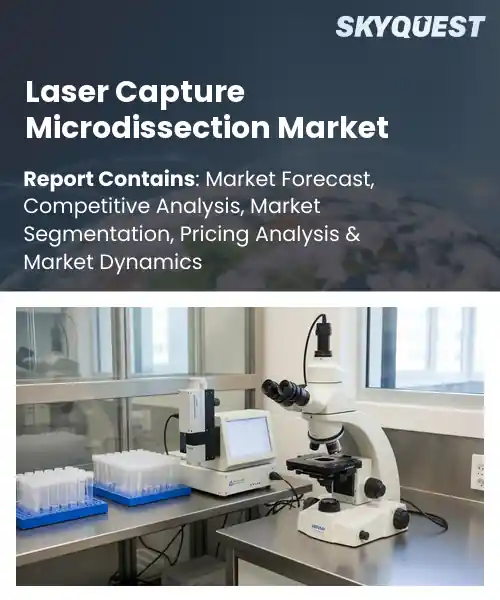
Laser Capture Microdissection Market
Report ID: SQMIG35J2576
Report ID: SQMIG35J2576
[email protected]
USA +1 351-333-4748
Report ID:
SQMIG35J2576 |
Region:
Global |
Published Date: July, 2026
Pages:
157
|Tables:
123
|Figures:
77


Global Laser Capture Microdissection Market size was valued at USD 223.17 Million in 2024 and is poised to grow from USD 245.35 Million in 2025 to USD 523.65 Million by 2033, growing at a CAGR of 9.94% during the forecast period (2026-2033).
The global laser capture microdissection (LCM) market supplies precision tools that isolate specific cells from tissue, a capability essential for genomics, proteomics and pathology research. Its importance stems from the need to obtain pure cellular populations without contamination, which improves data reliability for drug discovery and diagnostic biomarker validation. Historically, the market emerged in the early 1990s when academic labs adopted manual microdissection, then shifted to automated laser platforms as laser technology matured and costs fell. Companies such as Arcturus, Leica and Thermo Fisher accelerated adoption by integrating LCM with downstream sequencing workflows, demonstrating value in oncology and neuroscience studies.
The accelerating demand for single cell analysis constitutes as key trend driving the global laser capture microdissection sector, because researchers require uncontaminated specimens to generate molecular signatures that inform therapeutic decisions. As precision medicine expands, pharmaceutical firms and clinical labs increasingly invest in LCM systems to isolate circulating tumor cells, enabling cancer detection and monitoring of treatment resistance. This investment drives manufacturers to develop faster instruments equipped with AI targeting, which reduces operator time and improves reproducibility. Consequently, market attracts funding for innovation, fosters collaborations with genomics providers, and opens opportunities in emerging regions where biobanking initiatives create sources of tissue clinical specimens.
How is AI-Driven Automation Reshaping the Laser Capture Microdissection Market?
AI-driven automation is streamlining laser capture microdissection by integrating intelligent image analysis, precise targeting algorithms, and real‑time workflow optimization. These technologies reduce manual handling, improve cell selection accuracy, and accelerate sample preparation, making the process more reproducible and scalable. The market is responding to these advances with heightened interest from research labs seeking faster, higher‑quality results, and the technology is being embedded into existing LCM platforms to enhance productivity while lowering operational costs.
In September 2025, Molecular Machines & Industries (MMI GmbH) introduced enhanced AI-assisted cell recognition capabilities for its CellCut Plus laser microdissection platform. The software uses artificial intelligence to automatically identify target cells and streamline laser isolation, improving accuracy, reducing manual intervention, and accelerating spatial biology, genomics, and precision oncology research workflows.
Market snapshot - (2026-2033)
Global Market Size
USD 223.17 Million
Largest Segment
Systems
Fastest Growth
Software
Growth Rate
9.94% CAGR
To get more insights on this market click here to Request a Free Sample Report
Global laser capture microdissection market is segmented by component, laser modality type, application, end user and region. Based on component, the market is segmented into systems, consumables, software and services. Based on laser modality type, the market is segmented into ultraviolet lasers, infrared lasers and combined lasers. Based on application, the market is segmented into molecular biology, cancer research, neuroscience, forensic science, plant biology and clinical diagnostics. Based on end user, the market is segmented into academic research institutes, pharmaceutical companies, biotechnology companies, diagnostic laboratories and forensic laboratories. Based on region, the market is segmented into North America, Europe, Asia Pacific, Latin America and Middle East & Africa.
Based on the global laser capture microdissection market growth, systems segment dominates because integrated platforms provide researchers with precise cell isolation, seamless workflow automation, and reproducible results. The ability to combine optics, stage control, and data capture within a single unit reduces complexity and training requirements, making the technology more accessible. This comprehensive solution addresses core user concerns around reliability and throughput, encouraging broader adoption across laboratories and reinforcing its central position in market development for future growth globally.
However, consumables segment emerges as the key high growth area because disposable caps, specialized membranes, and advanced staining kits are being upgraded to support higher precision and throughput. Continuous innovation and expanding protocol libraries drive laboratories to replace older supplies, fueling demand and creating new revenue streams that accelerate overall market expansion.
Cancer research segment dominates because the technology enables isolation of heterogeneous tumor cells, facilitating genomic and proteomic profiling critical for personalized therapies. Researchers value the precision of laser capture microdissection to separate malignant from surrounding stromal cells, which directly impacts drug target validation and biomarker discovery. This clinical relevance fuels sustained investment and drives the adoption of advanced platforms across oncology labs worldwide and collaborative networks to accelerate translational research.
Meanwhile, neuroscience segment is witnessing the strongest growth momentum because investigators are applying laser capture microdissection to dissect specific neuronal populations and synaptic regions for high resolution molecular studies. Emerging interest in brain wide atlases and neurodegenerative disease mechanisms pushes demand for refined sampling techniques, propelling market expansion and opening new application frontiers.
To get detailed segments analysis, Request a Free Sample Report
As per the global laser capture microdissection market share, North America leads the market through a convergence of deep scientific expertise, robust funding mechanisms, and a mature ecosystem of biotech and pharmaceutical firms that prioritize precision cell isolation techniques. The region benefits from extensive collaboration between elite research universities and industry innovators, fostering rapid translation of laser capture microdissection into therapeutic development and diagnostic workflows. A supportive regulatory framework and early adoption of advanced automation further reinforce the competitive edge, while a culture of continuous innovation sustains high demand for sophisticated instrumentation and consumables across academic and commercial laboratories.
United States Laser Capture Microdissection Market
Laser capture microdissection market in the United States thrives on a strong network of premier research institutions and a vibrant biotech corridor that drives demand for high‑resolution cellular analysis. Collaborative programs between government agencies and private sector accelerate technology adoption, while a pervasive focus on personalized medicine fuels the integration of laser capture techniques into both drug discovery and clinical diagnostics. The market benefits from a culture of innovation that encourages the development of next‑generation platforms, reinforcing the United States as a pivotal hub for advanced cellular research.
Canada Laser Capture Microdissection Market
Laser capture microdissection market in Canada is propelled by a burgeoning life‑science community that leverages government‑backed research initiatives and a collaborative academic environment. Institutional emphasis on genomics and proteomics creates a steady appetite for precise cell isolation solutions, while partnerships with multinational biotech firms enhance technology transfer. The market’s growth is further supported by a commitment to training and expertise development, positioning Canada as an emerging center for high‑quality microdissection research and application.
Based on global laser capture microdissection regional forecast, Europe’s expansion is fueled by a strong emphasis on translational research, strategic public‑private partnerships, and a deep reservoir of specialized expertise across academic and clinical settings. The region’s regulatory landscape encourages innovation while ensuring rigorous validation, prompting widespread adoption of laser capture microdissection in disease modeling and biomarker discovery. Collaborative networks spanning universities, hospitals, and biotech clusters nurture the exchange of best practices, accelerating technology refinement. Moreover, a commitment to sustainable research funding and cross‑border initiatives amplifies market momentum, reinforcing Europe’s position as a dynamic hub for precision cell analysis.
Germany Laser Capture Microdissection Market
Laser capture microdissection market in Germany benefits from a dense concentration of research universities and a prolific pharmaceutical sector that prioritize high‑precision cellular techniques. Strong governmental research programs and industry consortia encourage the integration of laser capture technologies into both basic and applied studies, while a tradition of engineering excellence drives continual platform enhancements. The market’s vitality is anchored in collaborative efforts that bridge academia and industry, establishing Germany as a dominant force in advanced cell isolation.
United Kingdom Laser Capture Microdissection Market
Laser capture microdissection market in the United Kingdom experiences rapid growth through vigorous academic research programs and a thriving biotech ecosystem that embraces innovative diagnostic tools. Strategic investment in life‑science infrastructure and interdisciplinary collaborations accelerate the deployment of laser capture methods across oncology, neuroscience, and personalized medicine initiatives. The market is further energized by an active community of researchers and startups that champion technology adoption, positioning the United Kingdom as a leading driver of market expansion.
France Laser Capture Microdissection Market
Laser capture microdissection market in France is emerging as a focal point for collaborative research endeavors and specialized biotech ventures. National investment in scientific excellence and a growing emphasis on translational medicine stimulate demand for precise cell isolation capabilities. Partnerships between research institutes and emerging companies foster a supportive environment for technology refinement, while academic programs nurture skilled practitioners. This combination of strategic focus and collaborative momentum underpins France’s rising prominence in the European market.
As per global laser capture microdissection regional outlook, Asia Pacific advances its market presence through a blend of strategic research initiatives, expanding biotech manufacturing capacities, and proactive adoption of cutting‑edge analytical tools. Regional emphasis on genomics, oncology, and regenerative medicine drives heightened interest in laser capture microdissection for detailed cellular investigations. Collaborative networks linking universities, government laboratories, and industry players facilitate technology transfer and capacity building. Additionally, a growing culture of innovation and investment in advanced instrumentation supports the region’s trajectory toward becoming a pivotal arena for precision cell analysis.
Japan Laser Capture Microdissection Market
Laser capture microdissection market in Japan is reinforced by a longstanding tradition of scientific rigor and a robust network of research hospitals and universities. National emphasis on precision medicine and advanced diagnostics encourages the integration of laser capture techniques into clinical and translational studies. Collaborative frameworks between academic institutions and leading biotech firms accelerate technology adoption, while continuous investment in equipment innovation sustains market vitality. This environment positions Japan as a key contributor to regional advancement.
South Korea Laser Capture Microdissection Market
Laser capture microdissection market in South Korea benefits from dynamic biotech growth and a strong focus on cellular research within academic and industrial sectors. Government‑supported research programs and strategic partnerships promote the utilization of laser capture methods for cancer research, stem cell exploration, and drug development. The market’s expansion is propelled by a culture of rapid technology adoption and a commitment to developing high‑performance instrumentation, establishing South Korea as an emerging hub for precision cell isolation in the Asia Pacific region.
To know more about the market opportunities by region and country, click here to
Buy The Complete Report
Adopting Advanced Laser Technologies
Growing Need for Precision Oncology
High Cost of Equipment
Regulatory Validation Challenges
Request Free Customization of this report to help us to meet your business objectives.
The global laser capture microdissection market outlook is shaped by intense competition among instrument manufacturers and technology providers, driving rapid innovation in precision cell isolation. Companies are pursuing strategic M&A to integrate advanced imaging capabilities, forming partnerships with academic institutions to co‑develop next‑generation microdissection platforms, and investing in AI‑enabled software to enhance workflow efficiency and data analytics. These moves aim to secure market share by delivering higher throughput, improved accuracy, and broader application support.
Top Player’s Company Profile
Recent Developments
SkyQuest’s ABIRAW (Advanced Business Intelligence, Research & Analysis Wing) is our Business Information Services team that Collects, Collates, Correlates, and Analyses the Data collected by means of Primary Exploratory Research backed by robust Secondary Desk research.
As per SkyQuest analysis, the global laser capture microdissection industry is being propelled primarily by the adoption of advanced laser technologies that enable precise cell isolation for genomics and proteomics, while a second key driver is the rising demand for precision oncology which requires detailed tumor profiling. The primary restraint remains the high cost of equipment, limiting uptake in smaller labs and emerging markets. North America continues to dominate the market thanks to its strong research ecosystem and substantial biotech investment, and the systems segment leads adoption because integrated platforms simplify workflows and improve reproducibility. Together these forces shape market growth.
| Report Metric | Details |
|---|---|
| Market size value in 2024 | USD 223.17 Million |
| Market size value in 2033 | USD 523.65 Million |
| Growth Rate | 9.94% |
| Base year | 2024 |
| Forecast period | (2026-2033) |
| Forecast Unit (Value) | USD Million |
| Segments covered |
|
| Regions covered | North America (US, Canada), Europe (Germany, France, United Kingdom, Italy, Spain, Rest of Europe), Asia Pacific (China, India, Japan, Rest of Asia-Pacific), Latin America (Brazil, Rest of Latin America), Middle East & Africa (South Africa, GCC Countries, Rest of MEA) |
| Companies covered |
|
| Customization scope | Free report customization with purchase. Customization includes:-
|
To get a free trial access to our platform which is a one stop solution for all your data requirements for quicker decision making. This platform allows you to compare markets, competitors who are prominent in the market, and mega trends that are influencing the dynamics in the market. Also, get access to detailed SkyQuest exclusive matrix.
Table Of Content
Executive Summary
Market overview
Parent Market Analysis
Market overview
Market size
KEY MARKET INSIGHTS
COVID IMPACT
MARKET DYNAMICS & OUTLOOK
Market Size by Region
KEY COMPANY PROFILES
Methodology
For the Laser Capture Microdissection Market, our research methodology involved a mixture of primary and secondary data sources. Key steps involved in the research process are listed below:
1. Information Procurement: This stage involved the procurement of Market data or related information via primary and secondary sources. The various secondary sources used included various company websites, annual reports, trade databases, and paid databases such as Hoover's, Bloomberg Business, Factiva, and Avention. Our team did 45 primary interactions Globally which included several stakeholders such as manufacturers, customers, key opinion leaders, etc. Overall, information procurement was one of the most extensive stages in our research process.
2. Information Analysis: This step involved triangulation of data through bottom-up and top-down approaches to estimate and validate the total size and future estimate of the Laser Capture Microdissection Market.
3. Report Formulation: The final step entailed the placement of data points in appropriate Market spaces in an attempt to deduce viable conclusions.
4. Validation & Publishing: Validation is the most important step in the process. Validation & re-validation via an intricately designed process helped us finalize data points to be used for final calculations. The final Market estimates and forecasts were then aligned and sent to our panel of industry experts for validation of data. Once the validation was done the report was sent to our Quality Assurance team to ensure adherence to style guides, consistency & design.
Analyst Support
Customization Options
With the given market data, our dedicated team of analysts can offer you the following customization options are available for the Laser Capture Microdissection Market:
Product Analysis: Product matrix, which offers a detailed comparison of the product portfolio of companies.
Regional Analysis: Further analysis of the Laser Capture Microdissection Market for additional countries.
Competitive Analysis: Detailed analysis and profiling of additional Market players & comparative analysis of competitive products.
Go to Market Strategy: Find the high-growth channels to invest your marketing efforts and increase your customer base.
Innovation Mapping: Identify racial solutions and innovation, connected to deep ecosystems of innovators, start-ups, academics, and strategic partners.
Category Intelligence: Customized intelligence that is relevant to their supply Markets will enable them to make smarter sourcing decisions and improve their category management.
Public Company Transcript Analysis: To improve the investment performance by generating new alpha and making better-informed decisions.
Social Media Listening: To analyze the conversations and trends happening not just around your brand, but around your industry as a whole, and use those insights to make better Marketing decisions.
REQUEST FOR SAMPLE
 REQUEST FREE CUSTOMIZATION
Global Laser Capture Microdissection Market size was valued at USD 223.17 Million in 2024 and is poised to grow from USD 245.35 Million in 2025 to USD 523.65 Million by 2033, growing at a CAGR of 9.94% during the forecast period (2026-2033).
The global laser capture microdissection market is shaped by intense competition among instrument manufacturers and technology providers, driving rapid innovation in precision cell isolation. Companies are pursuing strategic M&A to integrate advanced imaging capabilities, forming partnerships with academic institutions to co‑develop next‑generation microdissection platforms, and investing in AI‑enabled software to enhance workflow efficiency and data analytics. These moves aim to secure market share by delivering higher throughput, improved accuracy, and broader application support. 'Danaher Corporation', 'Thermo Fisher Scientific Inc.', 'Carl Zeiss Meditec AG', 'Nikon Corporation', 'Evident Corporation', 'Molecular Machines & Industries GmbH', 'Avanos Medical, Inc.', 'Keyence Corporation', 'Bruker Corporation', 'Illumina, Inc.', 'Agilent Technologies, Inc.', 'Bio-Rad Laboratories, Inc.', 'QIAGEN N.V.', 'F. Hoffmann-La Roche Ltd', 'Permagen Labware, Ltd.', 'Indivumed GmbH', 'CrestOptics S.r.l.', 'Cellix Ltd.', 'ALS Automated Lab Solutions GmbH', 'Menarini Silicon Biosystems'
Adopting advanced laser technologies enables researchers to isolate cellular structures with unprecedented precision, reducing sample contamination and preserving molecular integrity. This capability enhances the reliability of downstream genomic and proteomic analyses, encouraging broader acceptance across biomedical laboratories. As protocols become more streamlined, scientists experience shorter preparation times and improved reproducibility, which fosters confidence in experimental outcomes. Consequently, academic institutions and commercial research facilities increasingly incorporate laser capture microdissection into their workflows, driving sustained demand for sophisticated instrumentation and related consumables.
Ai-Driven Image Analysis Integration: The convergence of artificial intelligence with laser capture microdissection is reshaping workflow efficiency. Machine‑learning algorithms now assist in real‑time tissue recognition, automating region selection and reducing operator fatigue. This capability accelerates sample preparation, improves reproducibility, and enables researchers to tackle more complex heterogeneous specimens. As AI models become more refined, laboratories are adopting smart LCM systems that seamlessly integrate with downstream omics platforms, fostering faster discovery cycles and broader adoption across academic and clinical settings and industry collaborations globally today.
Why does North America Dominate the Global Laser Capture Microdissection Market? |@12


Want to customize this report? This report can be personalized according to your needs. Our analysts and industry experts will work directly with you to understand your requirements and provide you with customized data in a short amount of time. We offer $1000 worth of FREE customization at the time of purchase.
Feedback From Our Clients


 USA (+1) 351-333-4748

