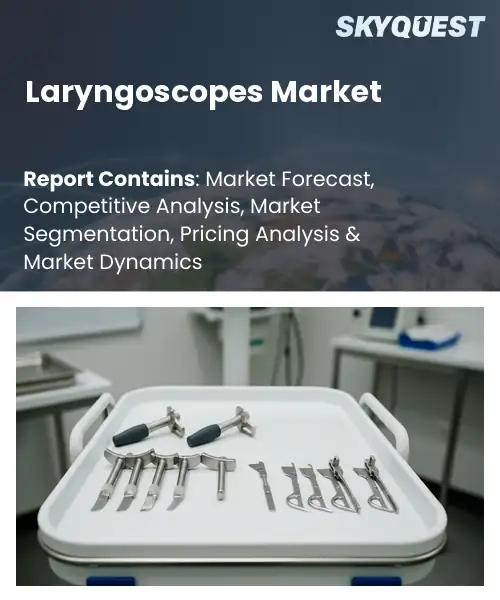
Laryngoscopes Market
Report ID: SQMIG35A3768
Report ID: SQMIG35A3768
[email protected]
USA +1 351-333-4748
Report ID:
SQMIG35A3768 |
Region:
Global |
Published Date: June, 2026
Pages:
157
|Tables:
145
|Figures:
78


Global Laryngoscopes Market size was valued at USD 284.5 Million in 2024 and is poised to grow from USD 301.91 Million in 2025 to USD 485.4 Million by 2033, growing at a CAGR of 6.12% during the forecast period (2026-2033).
Technological innovation in airway visualization, the primary driver that keeps shaping the laryngoscopes market. Laryngoscopes themselves are instruments used to view the larynx, and in practice, they help facilitate tracheal intubation in operating rooms, intensive care units, and emergencies, while the big reason they matter is their effect on patient safety during airway management.
Then, building on that overall shift toward video enabled devices, the key accelerant for the global laryngoscopes market penetration is not only clinical performance, but also infection control economics, meaning the financial side of reducing risk. When video laryngoscopes improve first-pass success, clinicians generally prefer them because fewer attempts can mean less hypoxia and fewer downstream complication costs , which pushes hospital procurement forward and helps justify higher prices. Moreover, concerns about pathogen transmission really sped up demand for disposable blades and integrated sheathing, so suppliers of sterile single-use systems saw more room to grow. As a result, emergency medical services, intensive care units and teaching hospitals increased purchases, while simulation based training programs further reinforce adoption, and that supports aftermarket and service revenues , as outcomes keep improving.
AI improves diagnostic accuracy in the laryngoscopes industry by making the images clearer and by giving real time guidance during airway assessment. Some of the main factors are image enhancement, automated landmark detection, and decision support that points out the glottic opening and, in effect, suggests an optimal tube trajectory. Right now, many vendors are building AI directly into video laryngoscopes, and recent studies show AI-assisted models can recognize laryngeal structures in infants and help with intubation, which can lower operator variability and raise clinician confidence. The market trend also leans toward solutions that bundle AI with simpler workflows, so even less experienced clinicians can make quicker more dependable diagnostic and procedural decisions.
Market snapshot - (2026-2033)
Global Market Size
USD 284.5 Million
Largest Segment
Direct Laryngoscopes
Fastest Growth
Video Laryngoscopes
Growth Rate
6.12% CAGR
To get more insights on this market click here to Request a Free Sample Report
The global laryngoscopes market is segmented by type, product, application, end-user, distribution and region. Based on type, the market is segmented into Direct Laryngoscopes, Video Laryngoscopes and Fiberoptic Laryngoscopes. Based on product, the market is segmented into Blades, Handles and Disposable vs Reusable. Based on application, the market is segmented into Tracheal Intubation, Airway Assessment and Foreign Body Removal. Based on end-user, the market is segmented into Hospitals (ICU, OR, ED), Ambulatory Care and EMS. Based on distribution, the market is segmented into Direct Sales and Distributors. Based on region, the market is segmented into North America, Europe, Asia Pacific, Latin America and Middle East & Africa.
As per the laryngoscopes market analysis, the Video laryngoscopes segment take the lead here, mostly because the indirect look gets better and better, so laryngoscopy performance “levels up” enabling cleaner glottic visualization and easier tube maneuvers even when the anatomy is complex. With better imaging plus ergonomic touches, there’s less procedural insult and the whole learning curve gets shorter… so anesthesiologists and emergency clinicians start choosing them more and more. Also when they integrate with recording and teaching tools, and the vendor support shows up for training programs, procurement folks feel more confident, which then pushes video units into the default role across a lot of care environments.
However, fiberoptic laryngoscopes are showing up as the fastest-growing pocket, mainly because they give more flexible access for awake intubations and for complicated airway checks. Improvements in fiber construction, plus thinner overall builds, make patient tolerance more comfortable and open up extra uses for difficult scenarios. On top of that, clinicians are getting more used to them, and cross-specialty training spreads know how quickly, creating real momentum toward broader adoption and, later, more market room.
According to the laryngoscopes market forecast, the disposable segment is dominating because single-use tools line up with infection control goals, and they also make peri procedure work feel simpler. That removes the reprocessing burden that can really tax hospital capacity. Clinicians, plus procurement officers, tend to lean toward disposables for “known” sterility, faster turnaround, and better fit with point-of-care workflows. In busy high throughput settings, operational efficiency counts a lot, and litigation risk management also shapes what gets purchased—so the disposables keep winning routine uptake. Plus, steady manufacturer supply chains and the availability of validated disposable blade systems add to clinical confidence and help procurement stay consistent.
Whereas reusable devices are still growing strongly, though. This push is tied to the renewed focus on sustainability and total cost of ownership, so hospitals are investing in sturdier materials and in sterilization methods that are validated. Improved durability and more streamlined reprocessing workflows make reusables appealing to institutions trying to balance environmental concerns with longer-term budget optimization. In other words, many procurement strategies are shifting toward lifecycle value, and reusables end up fitting that angle well.
To get detailed segments analysis, Request a Free Sample Report
As per the laryngoscopes market regional forecast, North America is leading because of this mix of structural strengths that pushes fast uptake and ongoing refinement in airway management. The region has advanced hospital infrastructure plus concentrated hubs of clinical skill, so clinicians can evaluate early and then weave new laryngoscope technologies into regular use without too much delay. On top of that there is a solid medtech industry, with a lot of R&D horsepower and global commercial access, which keeps feeding new device ideas and the whole user training side. Reimbursement rules and institutional purchasing habits also back spending on higher value devices, those that help procedural speed while also improving patient safety. And then, strong professional societies, plus simulation training web networks, make sure clinicians get comfortable faster and stay aligned with the relevant guidance. Put together, it feels like an ecosystem where clinical need, market muscle, and regulatory clarity lock in long term market dominance.
United States Laryngoscopes Market
In the United States, the laryngoscopes industry is shaped by early adoption, largely from big tertiary hospital systems, active clinical research, and close collaboration between manufacturers and academic centers. Buying choices tend to weigh device performance first, then training support, and how well it fits into existing clinical routines. Professional societies and simulation centers help nudge standardization of airway management approaches. With major medical device companies present, plus an innovation ecosystem, the flow of new product introductions and clinician education initiatives remains fairly steady.
Canada Laryngoscopes Market
The Canadian laryngoscopes sector shows a more measured, but quality minded adoption environment within a publicly funded healthcare model. Procurement is often centralized, with a focus on patient safety, cost effectiveness, and long term device reliability. Teaching hospitals and regional centers generally drive adoption of advanced laryngoscopes, and they’re supported by training programs that involve multiple stakeholders, plus partnerships with suppliers. Clinical guideline alignment and standardized airway management expectations guide purchasing priorities, encouraging uptake particularly in referral centers and specialty clinics.
Europe is seeing faster market growth due to coordinated movement across clinical practice, procurement know how, and manufacturing capacity. Clinical guidelines and national initiatives that emphasize patient safety are increasing demand for devices that sharpen visualization and also lower airway complications. As a result, hospitals start modernizing their equipment. Collaboration is also expanding between domestic medtech players and multinational suppliers, which improves product availability and helps aftersales support across different healthcare systems. Centralized and regional procurement arrangements make it easier to roll out upgraded devices more widely. Meanwhile, academic centers and professional groups promote training and standardization, which ties the whole thing together. Regulatory alignment, plus targeted investment in surgical capability, keeps stimulating uptake especially where hospital buying power is strong and clinical research is active, with industry partnerships in the mix.
Germany Laryngoscopes Market
The German laryngoscopes market is supported by a strong hospital base and a domestic medical technology foundation that highlights engineering quality and regulatory compliance. Hospitals often prefer devices that slot into known clinical pathways, and still deliver steady reproducible performance, even in high volume settings. Industry cooperation with leading clinical institutions helps generate evidence while also supporting clinician training. In procurement terms, decision making typically balances innovation with long term reliability and technical support, which helps Germany keep a notable position in the regional market.
United Kingdom Laryngoscopes Market
In the United Kingdom, the laryngoscopes market shows up as dynamic adoption, influenced by centralized procurement pilots and patient safety initiatives. National health service structures, along with professional guidance, steer purchasing strategies, encouraging trials for advanced visualization technologies that could improve clinical outcomes. Academic hospitals and simulation centers serve like practical test grounds for new devices and training programs, and collaborative evaluation efforts across hospital trusts support wider adoption. The overall environment tends to favor scalable solutions that match standardized care pathways.
France Laryngoscopes Market
France’s laryngoscopes market is still developing as hospitals modernize their fleets and emphasize clinician training plus standardization. Interest in video and advanced visualization technologies is rising, and that momentum is supported by regional centers of excellence and distributor networks that make access easier. When clinical guidelines are adopted, and hospitals partner with suppliers, it becomes easier to implement new devices in stages. Overall, the market reflects a fairly measured approach where procurement focuses on demonstrating clinical benefit, keeping the user experience manageable, and ensuring smooth integration with existing workflows.
Asia Pacific is trying to push its market standing with a mixed approach, mixing infrastructure spend, boosting local manufacturing, and keeping international collaboration in the picture. Across the region, healthcare systems are quietly upgrading surgical plus critical care strength, so it makes sense that there’s more need for contemporary airway management tools. Local medtech firms are working on sharper products, plus they team up with global players , to speed up know how exchange and also broaden service coverage. In a number of markets the regulatory side is getting more streamlined , which helps new products land sooner and move through clinical evaluation faster. There are also training pushes, academic tie ins, and pilot work inside tertiary hospitals, all of that is helping clinicians get comfortable with advanced laryngoscopes. Overall it turns into a more mature market setting where better access, localized assistance, and rising clinical capability keep feeding the regional momentum.
Japan Laryngoscopes Market
In Japan, the Laryngoscopes Market is basically shaped by a clear need for very high precision and dependability, with hospitals leaning toward devices that hit strict technical plus regulatory thresholds. Domestic manufacturers matter a lot, and they often concentrate on fitting into the already used clinical systems, plus incremental improvements rather than sudden leaps. Medical institutions tend to focus on training routines and tight procedural standardization, and purchasing choices usually reflect long term upkeep, serviceability, and how well the devices match hospital workflows. The market mindset really prizes detailed clinical evidence, and quality assurance when deciding what to buy.
South Korea Laryngoscopes Market
For South Korea, the Laryngoscopes Market has momentum from a lively domestic medtech landscape, along with a healthcare setup that seems open to new technology. Private hospital networks and specialized clinics frequently run early pilots for updated visualization devices, and they do this alongside close clinician—manufacturer collaboration. There’s also a strong push tied to less invasive practices and process efficiency, so new laryngoscope platforms attract attention. Meanwhile export minded companies keep strengthening the innovation ecosystem, and they add clinical support infrastructure across the wider market.
To know more about the market opportunities by region and country, click here to
Buy The Complete Report
Rising Surgical Procedure Volumes
Advances In Visualization Technology
High Acquisition And Maintenance Costs
Limited Reimbursement Policies
Request Free Customization of this report to help us to meet your business objectives.
Competitive dynamics in the global laryngoscopes market hinge on distribution partnerships , a few targeted takeovers , and fast product iteration, as companies try to stay on top of hospital procurement lists. Lately, there have been some notable steps like Teleflex’s exclusive U.S. distribution arrangement for the Insighters video laryngoscope, and Verathon’s GlideScope Go 2 launch too, which really shows how partnership led entry and device refreshes can speed adoption of portable, single use video systems.
Top Player’s Company Profile
Recent Developments in the Laryngoscopes Market
SkyQuest’s ABIRAW (Advanced Business Intelligence, Research & Analysis Wing) is our Business Information Services team that Collects, Collates, Correlates, and Analyses the Data collected by means of Primary Exploratory Research backed by robust Secondary Desk research.
As per SkyQuest analysis, the global laryngoscopes market is mostly powered by airway visualization technology improvements, which boost intubation success and training outcomes. Video laryngoscopes keep showing up as the dominant segment, and North America leads regional adoption. Another strong driver is infection control economics, plus the demand for disposable blade systems that streamline workflows and lower the risk of cross contamination. Adoption is helped along by ai enabled imaging, and by hospitals spending more because patient safety matters. Still, uptake is slowed by high purchase costs and ongoing maintenance costs, so cost sensitive facilities and smaller clinics hesitate. That’s why total cost of ownership and reimbursement alignment are becoming the make-or-break factors for wider penetration.
| Report Metric | Details |
|---|---|
| Market size value in 2024 | USD 284.5 Million |
| Market size value in 2033 | USD 485.4 Million |
| Growth Rate | 6.12% |
| Base year | 2024 |
| Forecast period | (2026-2033) |
| Forecast Unit (Value) | USD Million |
| Segments covered |
|
| Regions covered | North America (US, Canada), Europe (Germany, France, United Kingdom, Italy, Spain, Rest of Europe), Asia Pacific (China, India, Japan, Rest of Asia-Pacific), Latin America (Brazil, Rest of Latin America), Middle East & Africa (South Africa, GCC Countries, Rest of MEA) |
| Companies covered |
|
| Customization scope | Free report customization with purchase. Customization includes:-
|
To get a free trial access to our platform which is a one stop solution for all your data requirements for quicker decision making. This platform allows you to compare markets, competitors who are prominent in the market, and mega trends that are influencing the dynamics in the market. Also, get access to detailed SkyQuest exclusive matrix.
Table Of Content
Executive Summary
Market overview
Parent Market Analysis
Market overview
Market size
KEY MARKET INSIGHTS
COVID IMPACT
MARKET DYNAMICS & OUTLOOK
Market Size by Region
KEY COMPANY PROFILES
Methodology
For the Laryngoscopes Market, our research methodology involved a mixture of primary and secondary data sources. Key steps involved in the research process are listed below:
1. Information Procurement: This stage involved the procurement of Market data or related information via primary and secondary sources. The various secondary sources used included various company websites, annual reports, trade databases, and paid databases such as Hoover's, Bloomberg Business, Factiva, and Avention. Our team did 45 primary interactions Globally which included several stakeholders such as manufacturers, customers, key opinion leaders, etc. Overall, information procurement was one of the most extensive stages in our research process.
2. Information Analysis: This step involved triangulation of data through bottom-up and top-down approaches to estimate and validate the total size and future estimate of the Laryngoscopes Market.
3. Report Formulation: The final step entailed the placement of data points in appropriate Market spaces in an attempt to deduce viable conclusions.
4. Validation & Publishing: Validation is the most important step in the process. Validation & re-validation via an intricately designed process helped us finalize data points to be used for final calculations. The final Market estimates and forecasts were then aligned and sent to our panel of industry experts for validation of data. Once the validation was done the report was sent to our Quality Assurance team to ensure adherence to style guides, consistency & design.
Analyst Support
Customization Options
With the given market data, our dedicated team of analysts can offer you the following customization options are available for the Laryngoscopes Market:
Product Analysis: Product matrix, which offers a detailed comparison of the product portfolio of companies.
Regional Analysis: Further analysis of the Laryngoscopes Market for additional countries.
Competitive Analysis: Detailed analysis and profiling of additional Market players & comparative analysis of competitive products.
Go to Market Strategy: Find the high-growth channels to invest your marketing efforts and increase your customer base.
Innovation Mapping: Identify racial solutions and innovation, connected to deep ecosystems of innovators, start-ups, academics, and strategic partners.
Category Intelligence: Customized intelligence that is relevant to their supply Markets will enable them to make smarter sourcing decisions and improve their category management.
Public Company Transcript Analysis: To improve the investment performance by generating new alpha and making better-informed decisions.
Social Media Listening: To analyze the conversations and trends happening not just around your brand, but around your industry as a whole, and use those insights to make better Marketing decisions.
REQUEST FOR SAMPLE
 REQUEST FREE CUSTOMIZATION
Global Laryngoscopes Market size was valued at USD 284.5 Million in 2024 and is poised to grow from USD 301.91 Million in 2025 to USD 485.4 Million by 2033, growing at a CAGR of 6.12% during the forecast period (2026-2033).
Competitive dynamics in the global laryngoscopes market center on distribution partnerships, targeted acquisitions, and rapid product innovation as firms compete for hospital procurement lists. Recent moves include Teleflex’s exclusive U.S. distribution deal for Insighters video laryngoscope and Verathon’s GlideScope Go 2 launch, concrete examples of partnership-led market entry and device refreshes that accelerate adoption of portable and single use video systems. 'Medtronic plc (McGrath)', 'Verathon (Glidescope)', 'Karl Storz SE', 'Richard Wolf GmbH', 'Heine Optotechnik', 'Welch Allyn (Hill-Rom)', 'Aircraft Medical', 'Proact Medical', 'Pentax Medical (HOYA)', 'Olympus Corporation', 'Flexicare Medical', 'UpsherSmith Laboratories', 'SunMed Group', 'Teleflex Inc.', 'Ambu A/S', 'King Systems (Ambu)', 'KPI Healthcare', 'Intersurgical Ltd.', 'Mercury Medical', 'Midmark Corporation'
Increasing numbers of ENT and general surgical procedures worldwide are driving demand for laryngoscopy equipment because higher procedure volumes create consistent clinical need and inventory replacement cycles. Hospitals and surgical centers prioritize reliable airway management tools to support routine and complex interventions, prompting procurement of both conventional and advanced laryngoscopes. This steady procedural demand encourages manufacturers to expand production, invest in distribution, and develop tailored instruments, which collectively reinforces market growth through greater adoption across inpatient and outpatient care settings.
Ai-Enabled Device Intelligence: Providers increasingly prioritize laryngoscopes that integrate artificial intelligence and software-driven guidance to improve visualization, automate image enhancement, and assist with intubation decision support. These features enhance clinician confidence during difficult airways, enable standardized documentation, and facilitate remote mentoring. Vendors emphasizing interoperable platforms, secure data management, and intuitive interfaces gain differentiation. Regulatory attention on software quality and clinical validation is shaping development priorities, encouraging partnerships among device manufacturers, health IT firms, and academic centers to accelerate meaningful, user-centered innovations.
Why does North America Dominate the Global Laryngoscopes Market? |@12


Want to customize this report? This report can be personalized according to your needs. Our analysts and industry experts will work directly with you to understand your requirements and provide you with customized data in a short amount of time. We offer $1000 worth of FREE customization at the time of purchase.
Feedback From Our Clients


 USA (+1) 351-333-4748

