
Lager Market
Report ID: SQMIG30E2067
Report ID: SQMIG30E2067
[email protected]
USA +1 351-333-4748
Report ID:
SQMIG30E2067 |
Region:
Global |
Published Date: May, 2025
Pages:
196
|Tables:
115
|Figures:
71


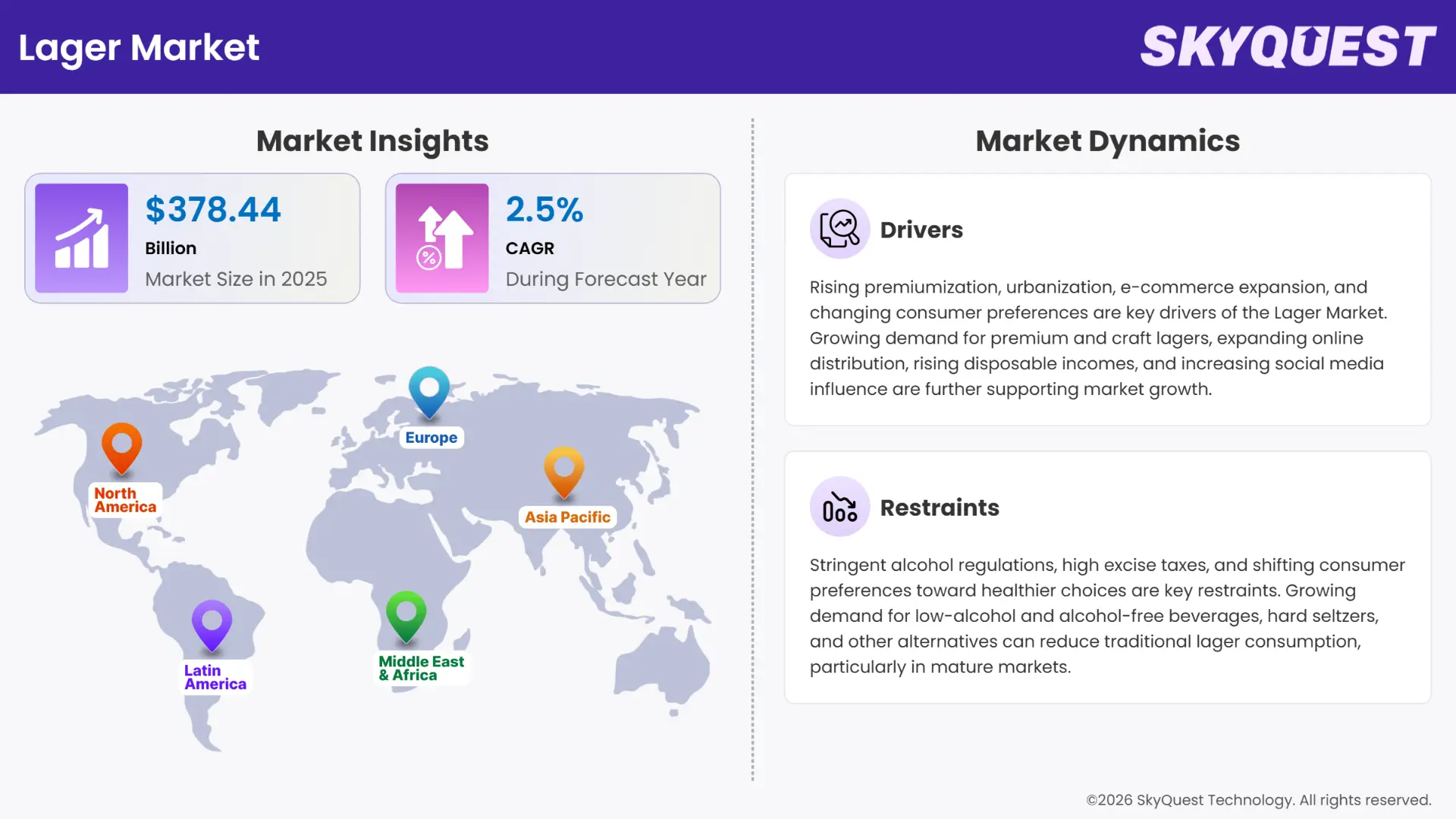
Global Lager Market size was valued at USD 369.21 Billion in 2024 and is poised to grow from USD 378.44 Billion in 2025 to USD 461.09 Billion by 2033, growing at a CAGR of 2.5% during the forecast period (2026–2033).
Key Takeaways: Market Trends & Insights
The huge growth in online and e-commerce and retail channels, increasing social media influence, and increasing beer tourism and brewery visit popularity are some of the major drivers of the global lager market growth. The growth of the global lager market is driven by the inclusion of consumer preference for light, refreshing beers, disposable inflows growth, and strong brand promotion. Lager, with its clean-tasting character and lower alcohol content compared to other beers, is a favorite among a wide base of consumers from social drinkers to beer enthusiasts. The heightened trendiness of social drinking culture, especially across the youth population, has further increased lager sales worldwide.
Apart from this, the increase in demand for craft and premium lagers has aided in increasing demand as consumers are seeking premium quality, tasty alternatives to industrial beers. Breweries are embracing new flavors, packaging sizes, and sustainable brewing practices to entice sustainability-concerned customers.
To get more insights on this market click here to Request a Free Sample Report
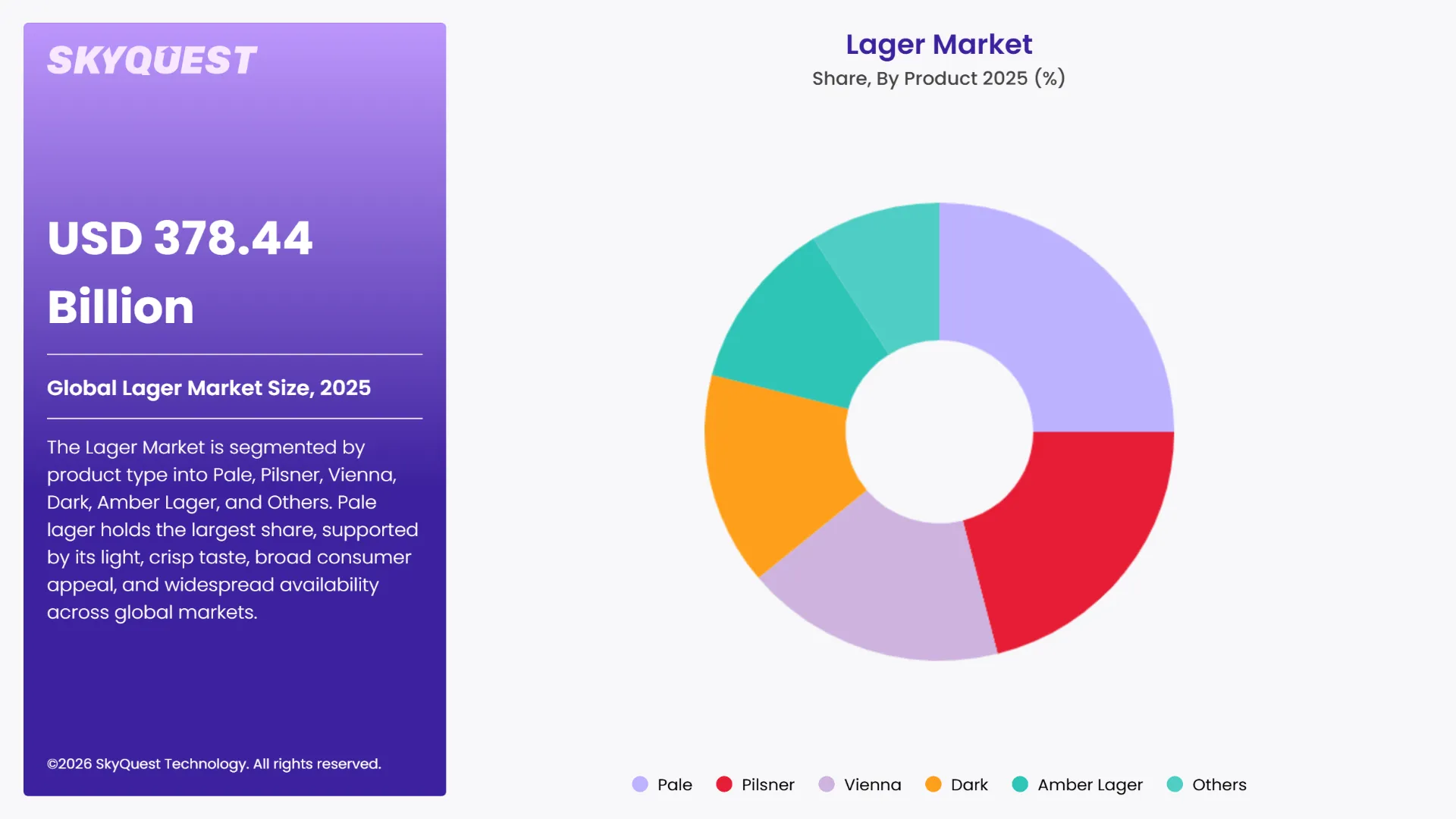
Global Lager Market is segmented by Product Type, Price Point, Packaging Type, Alcohol Content, Gender, Age Group, End User, Sales Channel and region. Based on Product Type, the market is segmented into Pale, Pilsner, Vienna, Dark, Amber Lager and Others. Based on Price Point, the market is segmented into Economic, Premium and Luxury. Based on Packaging Type, the market is segmented into Glass, Metal Can, PET Bottles and Others. Based on Alcohol Content, the market is segmented into Low Alcohol, Standard Alcohol and High Alcohol.
Based on Gender, the market is segmented into Male and Female. Based on Age Group, the market is segmented into 18–30, 31–44 and 45+. Based on End User, the market is segmented into Individual Consumers and Commercial Establishments. Based on Sales Channel, the market is segmented into On-Trade and Off-Trade. Based on region, the market is segmented into North America, Europe, Asia Pacific, Latin America and Middle East & Africa.
As per the 2024 global lager market analysis, the premium lagers have the largest market share because they are characterized by their superior ingredients, meticulous brewing processes, and occasionally, traditional brewing methods. These characteristics yield a refined and classy taste that sets them apart from economy or standard products. The emphasis on superior ingredients and craftsmanship appeals to customers who care about taste and are willing to pay extra for a better beer experience.
Besides, the premium segment provides innovation in different flavor profiles, including variations like craft lagers, specialty lagers, and international premium lagers. Additionally, breweries try to innovate using different ingredients, such as different hops, malts, and adjuncts, to achieve different and unique flavor profiles that cater to evolving consumer trends, thus propelling the growth of the lager market.
However, the standard segment will dominate the market in terms of its value, ubiquity, and popularity among mass buyers. Standard lagers strike a balance between price and quality and are a first preference in various demographics. Leading brands like Budweiser, Heineken, and Carlsberg keep driving their standard lager volumes to maintain market leadership. The segment is also backed by strong distribution networks, offering reach in mature and emerging markets.
Based on the 2024 global lager market forecast, the on-trade segment is the market leader with 73.0% market share, because the venues provide consumers with an environment where they can indulge in lagers in a social setting, and the potential of being accompanied by food and entertainment. The ambiance and setting of these venues are crucial in making the experience of drinking lagers so appealing to turn it into the first choice for social outings, celebrations, and day-outs. Moreover, the on-trade channel also offers a place where customers can test different kinds of products from many different breweries, regions, and styles that allow customers to cure their curiosity and discover new favorite brands, supporting the market's expansion.
Due to wide product portfolios, low prices, and excellent distribution networks, supermarkets & hypermarkets will lead with the highest growth rate in the lager market. These shops are preferred by consumers due to their convenience, bulk purchase option, and promotions provided by established brewing companies. The industry is also backed by the arrival of big retail chains in emerging nations such as Walmart, Tesco, and Carrefour. Its growth is also fueled by evolving consumer behavior towards organized shopping and growing urbanization.
To get detailed segments analysis, Request a Free Sample Report
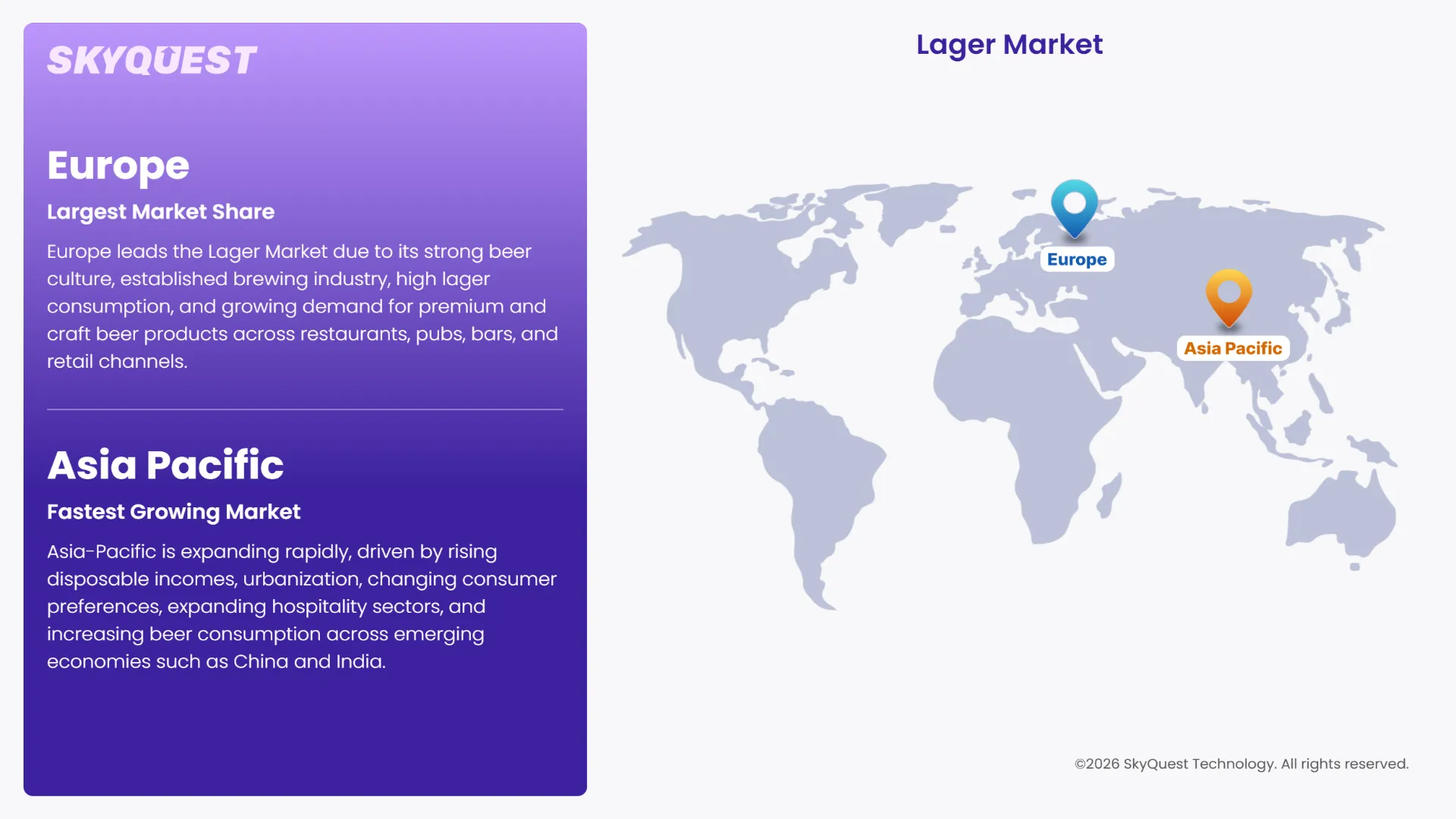
Europe had the largest market share of over 43.6% in 2024. Europe is spearheaded by centuries of brewing history with conventional lagers forming a part of culture in most nations. Additionally, age-old methods of brewing handed down through generations, are supporting the authenticity and diversity of choices. This prolonged beer culture resonates well among Europeans, and lagers turn into a fundamental element of social gatherings, events, and day-to-day lives. Also, the European lager types are a big draw for the different tastes covering the old traditional Czech pilsners, helles in German, British pale, Europe creates a mosaic of flavors suitable to individuals making things relevant and enticing to many consumer groups.
The lager market in France will grow steadily, and revenue generated by beer consumption at home is estimated to reach US$7.6 billion in 2025. This represents the increased popularity of beer at-home consumption through affordability and availability. Premium lagers and specialty lagers are leading market expansion, coupled with rising beer tourism. French consumers are also getting a taste for locally brewed and organic lagers, and this is prompting the big players to innovate using sustainable brewing methods and unique flavor profiles. Market growth is also being spurred by increased craft beer brewing and investments in brewing technology.
The UK lager market is a significant segment of the UK beer market with an estimated 2025 market volume of 3.8 billion liters. Of this, 2.2 billion liters will be consumed at home and 1.6 billion liters will be consumed in on-trade settings such as pubs and bars. The UK's vibrant pub culture is a major driver of lager sales, though economic pressures and consumer preference shift towards premium and craft lagers are influencing market dynamics. Brewers are focusing on innovation and sustainability, introducing low-alcohol and eco-friendly packaging options to appeal to new consumers.
The Asia-Pacific (APAC) lager market is witnessing robust growth, driven by urbanization, evolving consumer preferences, and increasing disposable income. APAC, with a market value of approximately USD 70.0 billion, remains a key region for lager consumption. China, Japan, India, and Australia are witnessing robust demand for premium and craft lagers, driven by young consumers and changing lifestyles. Along with this, e-commerce websites and expanding retailing chains are opening availability of local and international lager brands. Low-ABV and health-conscious beer variants are also being targeted by breweries, in line with consumer health and moderate consumption trends.
Increasingly expanding supermarket of India, having 66,225 stores as of January 2025 (up by 3.88% from 2023), has significantly contributed to the availability of the lager market. Rise in the population of young adults and a premiumization trend toward premium beers are fueling demand. Major companies such as United Breweries (Kingfisher), AB InBev, and Carlsberg are opening local manufacturing sites and green-brewing efforts. Local craft breweries are emerging as well, offering distinctive flavor profiles and ingredients tailored to Indian palates.
Japan's lager segment is still robust with the support of an entrenched culture of beer and demand for quality and innovative beers. The market is controlled by Japan's emphasis on quality, sophisticated taste, and premium and craft lagers gaining strength. Japan's beer market also is shifting towards low-malt and zero-alcohol lagers as health-conscious consumers call for more. Market giants such as Asahi, Kirin, and Suntory are investing in green brewing technology and AI-managed flavor development to take advantage of shifting consumer behaviors. Availability is also fueling sales since more supermarkets and convenience stores stock a range of lager products.
The North American lager market reached value of approximate 75.0 Billion in 2024 driven by expanding beer consumption trends in Canada and US. It benefits from tourist-driven beer sales, with resort and hospitality channels driving demand for international and domestic lagers. Additionally, increased investment in green brewing and brewery extensions is strengthening the region in lager's market.
In the US, increased popularity of lager can be largely attributed to the growing use of social media platforms. As an example, influencer spending in the US is expected to reach USD 7.14 billion by the year 2024, depicting a growth rate of 15.9% year over year. Social media has transformed the lives of consumers in terms of interacting with beverages, with brands, communities, and influencers supporting various lager trends and styles. When products are available online, it greatly increases awareness of the wide variety of options in the market. This has transformed consumer behavior, especially among young people, who now appreciate unique and craft lager varieties.
Seasonal trends, shifting consumer preferences, and the rise in craft breweries influence the Canada’s beer consumption. As of 2025, Canada boasts over 1,200 craft breweries, which have contributed to flavor diversification and brewing style diversity. Shops like supermarkets and liquor stores continue to expand, making more lager available. Major breweries, including Molson Coors and Labatt Brewing Company, are expanding into sustainable brewing practices and local supply, attracting green shoppers.
To know more about the market opportunities by region and country, click here to
Buy The Complete Report
Significant Growth on the E-commerce and Online Shopping Platforms
Rising Social Media Influence
Regulatory Issues Hinder Market Expansion
Shift in Consumer Preferences to Healthier Choices
Request Free Customization of this report to help us to meet your business objectives.
Major breweries like Budweiser, Coors, and Miller are introducing new lager variants, including low-calorie, non-alcoholic, and flavored lagers, to reach health-conscious and young consumers. Craft breweries are also introducing premium lagers with unique ingredients and brewing techniques to differentiate themselves. Corporate players are leveraging digital marketing, influencer partnerships, and sports sponsorship to increase brand visibility. Social media engagement and limited release ensure customer retention and win new customers.
What Role Does AI Play in Brewing and Quality Control?
How Will DeVANS’ Six Fields Expansion Influence the Lager Market?
How is Lager Industry Evolving Over Time?
SkyQuest’s ABIRAW (Advanced Business Intelligence, Research & Analysis Wing) is our Business Information Services team that Collects, Collates, Correlates, and Analyses the Data collected using Primary Exploratory Research backed by robust Secondary Desk research.
As per SkyQuest analysis, increased urbanization, changing consumer tastes, and premiumization are all driving factors for the global lager market's sustained growth. Although North America and Europe continue to dominate, the Asia-Pacific market is growing rapidly with increasing disposable incomes and the development of modern retailing models. The growth of the market is hindered by stringent controls and changing customer tastes towards healthier offerings. Breweries are turning their attention to innovation, sustainable brewing, and a variety of taste profiles to remain competitive. The industry is set to shift as premium and craft beer demand increases, blending innovation and heritage to meet evolving market demands.
| Report Metric | Details |
|---|---|
| Market size value in 2024 | USD 369.21 Billion |
| Market size value in 2033 | USD 461.09 Billion |
| Growth Rate | 2.5% |
| Base year | 2024 |
| Forecast period | 2026–2033 |
| Forecast Unit (Value) | USD Billion |
| Segments covered |
|
| Regions covered | North America (US, Canada), Europe (Germany, France, United Kingdom, Italy, Spain, Rest of Europe), Asia Pacific (China, India, Japan, Rest of Asia-Pacific), Latin America (Brazil, Rest of Latin America), Middle East & Africa (South Africa, GCC Countries, Rest of MEA) |
| Companies covered |
|
| Customization scope | Free report customization with purchase. Customization includes:-
|
To get a free trial access to our platform which is a one stop solution for all your data requirements for quicker decision making. This platform allows you to compare markets, competitors who are prominent in the market, and mega trends that are influencing the dynamics in the market. Also, get access to detailed SkyQuest exclusive matrix.
Table Of Content
Executive Summary
Market overview
Parent Market Analysis
Market overview
Market size
KEY MARKET INSIGHTS
COVID IMPACT
MARKET DYNAMICS & OUTLOOK
Market Size by Region
KEY COMPANY PROFILES
Methodology
For the Lager Market, our research methodology involved a mixture of primary and secondary data sources. Key steps involved in the research process are listed below:
1. Information Procurement: This stage involved the procurement of Market data or related information via primary and secondary sources. The various secondary sources used included various company websites, annual reports, trade databases, and paid databases such as Hoover's, Bloomberg Business, Factiva, and Avention. Our team did 45 primary interactions Globally which included several stakeholders such as manufacturers, customers, key opinion leaders, etc. Overall, information procurement was one of the most extensive stages in our research process.
2. Information Analysis: This step involved triangulation of data through bottom-up and top-down approaches to estimate and validate the total size and future estimate of the Lager Market.
3. Report Formulation: The final step entailed the placement of data points in appropriate Market spaces in an attempt to deduce viable conclusions.
4. Validation & Publishing: Validation is the most important step in the process. Validation & re-validation via an intricately designed process helped us finalize data points to be used for final calculations. The final Market estimates and forecasts were then aligned and sent to our panel of industry experts for validation of data. Once the validation was done the report was sent to our Quality Assurance team to ensure adherence to style guides, consistency & design.
Analyst Support
Customization Options
With the given market data, our dedicated team of analysts can offer you the following customization options are available for the Lager Market:
Product Analysis: Product matrix, which offers a detailed comparison of the product portfolio of companies.
Regional Analysis: Further analysis of the Lager Market for additional countries.
Competitive Analysis: Detailed analysis and profiling of additional Market players & comparative analysis of competitive products.
Go to Market Strategy: Find the high-growth channels to invest your marketing efforts and increase your customer base.
Innovation Mapping: Identify racial solutions and innovation, connected to deep ecosystems of innovators, start-ups, academics, and strategic partners.
Category Intelligence: Customized intelligence that is relevant to their supply Markets will enable them to make smarter sourcing decisions and improve their category management.
Public Company Transcript Analysis: To improve the investment performance by generating new alpha and making better-informed decisions.
Social Media Listening: To analyze the conversations and trends happening not just around your brand, but around your industry as a whole, and use those insights to make better Marketing decisions.
REQUEST FOR SAMPLE
 REQUEST FREE CUSTOMIZATION
Global Lager Market size was valued at USD 369.21 Billion in 2024 and is poised to grow from USD 378.44 Billion in 2025 to USD 461.09 Billion by 2033, growing at a CAGR of 2.5% during the forecast period (2026–2033).
Key vendors in the Lager Market include Heineken N.V., AB InBev, Carlsberg Group, Molson Coors Beverage Company, Asahi Group Holdings, Kirin Holdings Company, Anadolu Efes, Thai Beverage Public Company Limited, San Miguel Corporation, China Resources Snow Breweries, Tsingtao Brewery Group, Diageo, Sapporo Holdings, United Breweries Group, Constellation Brands, Grupo Mahou–San Miguel, Compañía Cervecerías Unidas, Pearl River Beer Group, and Singha Corporation.
The key driver of the Lager Market is the rising demand for premium and craft beer beverages. Increasing consumer interest in high-quality, innovative, and differentiated lagers, along with urbanization, rising disposable incomes, social drinking occasions, and expanding hospitality sectors, is supporting market growth.
The key market trend in the Lager Market is the increasing shift toward premium, craft, low-alcohol, and alcohol-free lagers. Brewers are also introducing flavored and locally inspired variants, sustainable packaging, and innovative brewing methods to meet growing demand for healthier, differentiated, and premium drinking experiences.
Europe accounted for the largest share in the Lager Market, with over 43.6% market share in 2024. Its long-established brewing culture, strong beer consumption, traditional lager varieties, and prominent brewing heritage across countries such as Germany and the Czech Republic support the region’s market leadership.


Want to customize this report? This report can be personalized according to your needs. Our analysts and industry experts will work directly with you to understand your requirements and provide you with customized data in a short amount of time. We offer $1000 worth of FREE customization at the time of purchase.
Feedback From Our Clients


 USA (+1) 351-333-4748

