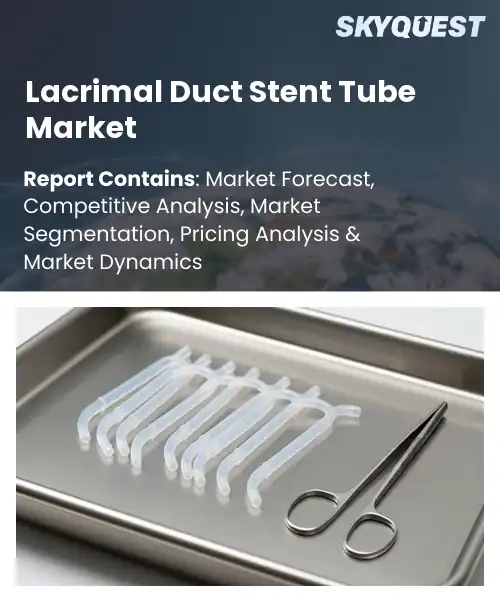
Lacrimal Duct Stent Tube Market
Report ID: SQMIG35A4090
Report ID: SQMIG35A4090
[email protected]
USA +1 351-333-4748
Report ID:
SQMIG35A4090 |
Region:
Global |
Published Date: July, 2026
Pages:
157
|Tables:
116
|Figures:
77


Global Lacrimal Duct Stent Tube Market size was valued at USD 121.3 Million in 2024 and is poised to grow from USD 127.85 Million in 2025 to USD 194.73 Million by 2033, growing at a CAGR of 5.4% during the forecast period (2026-2033).
The global lacrimal duct stent tube market comprises devices used to maintain patency of the nasolacrimal drainage system after procedures such as dacryocystorhinostomy. Its relevance stems from the rising prevalence of chronic epiphora, an eye condition that impairs quality of life and drives demand for reliable minimally invasive solutions. Historically, surgeons relied on silicone probes that required frequent replacement; the introduction of self‑retaining silicone stents in the early 2000s reduced postoperative obstruction and shortened recovery time. This evolution accelerated adoption across North America and Europe, where aging populations and expanding ophthalmic clinics have created a fertile environment for market growth. The next decisive factor shaping the market is the integration of advanced biocompatible polymers that extend stent dwell time while minimizing inflammatory response. This technological improvement directly fuels physician confidence, leading to broader procedural adoption in outpatient settings and lowering overall treatment cost. Real‑world examples illustrate how hospitals in India have replaced traditional silicone probes with drug‑eluting polyurethanes, achieving a 30 % reduction in revision surgeries within a year. Consequently, manufacturers are channeling R&D investments toward customizable designs that address diverse canaliculi anatomies, unlocking new revenue streams across economies and reinforcing the market’s upward trajectory as demand intensifies over the decade
How is AI-driven automation influencing growth in the lacrimal duct stent tube market?
AI‑driven automation is reshaping the lacrimal duct stent tube sector by streamlining design cycles and accelerating prototype testing. Machine‑learning algorithms analyze anatomical data to suggest optimal tube geometries, reducing manual iteration and shortening time‑to‑market. Automation also enhances manufacturing precision, ensuring consistent lumen diameter and surface finish, which improves patient outcomes and lowers rejection rates. With R&D teams adopting these tools, product pipelines become more resilient, allowing firms to respond quickly to emerging clinical needs. The technology further supports regulatory documentation by auto‑generating validated reports, freeing engineers to focus on innovation rather than repetitive tasks. Together, these factors create a more efficient ecosystem that fuels market expansion.OpenPR March 2026, introduced an AI‑powered design platform that automates stent modeling, cutting development lead times and supporting faster product launches, thereby reinforcing growth in the lacrimal duct stent tube market.
Market snapshot - (2026-2033)
Global Market Size
USD 121.3 Million
Largest Segment
Monocanalicular Lacrimal Duct Stent Tubes
Fastest Growth
Monocanalicular Lacrimal Duct Stent Tubes
Growth Rate
5.4% CAGR
To get more insights on this market click here to Request a Free Sample Report
Global lacrimal duct stent tube market is segmented by product type, material type, patient age cohort, end user and region. Based on product type, the market is segmented into Monocanalicular Lacrimal Duct Stent Tubes and Bicanalicular Lacrimal Duct Stent Tubes. Based on material type, the market is segmented into Silicone Materials, Polyethylene Materials and Biodegradable Materials. Based on patient age cohort, the market is segmented into Adult Patients, Pediatric Patients and Neonatal Patients. Based on end user, the market is segmented into Hospitals, Ophthalmic Clinics and Ambulatory Surgical Centers. Based on region, the market is segmented into North America, Europe, Asia Pacific, Latin America and Middle East & Africa.
Monocanalicular Lacrimal Duct Stent Tubes segment dominates because surgeons favor its simplified insertion technique, which reduces operative time and minimizes patient discomfort. The single canal design aligns with prevalent dacryocystorhinostomy procedures, allowing seamless integration into existing clinical workflows. Its proven reliability and ease of removal foster clinician confidence, encouraging widespread adoption across diverse ophthalmic practices and sustaining its leading position in the market and long term outcomes that enhance satisfaction.
However, Bicanalicular Lacrimal Duct Stent Tubes are witnessing the strongest growth momentum as they address complex obstruction cases that require bilateral canal support. Innovative designs improve stability and reduce migration risk, attracting clinicians seeking broader solutions. This evidence base fuels adoption, positioning the technology as a catalyst for market expansion.
Silicone Materials segment dominates because its exceptional biocompatibility and flexibility align perfectly with the delicate ocular environment, minimizing tissue irritation and fostering patient comfort. The material’s proven durability ensures long term patency of stent tubes, reducing the need for frequent replacements. Manufacturers benefit from established production processes and regulatory familiarity, enabling cost effective scaling. These combined clinical and operational advantages reinforce silicone’s preferential status across ophthalmic providers and maintain its market preeminence.
Meanwhile, Biodegradable Materials are emerging as an area because they eliminate removal procedures, appealing to clinicians and patients seeking minimally invasive care. Advances in polymer science provide dissolution rates that align with healing timelines, expanding possibilities. This innovation drives product launches and attracts investment, accelerating market expansion and creating opportunities.
To get detailed segments analysis, Request a Free Sample Report
North America leads the global lacrimal duct stent tube market because it combines a mature healthcare ecosystem with widespread adoption of advanced ophthalmic technologies. Hospitals and specialty eye centers benefit from high levels of clinical expertise and strong integration of minimally invasive procedures. Reimbursement frameworks provide reliable coverage for innovative devices, encouraging physicians to incorporate stent tubes into standard treatment pathways. The region hosts several multinational manufacturers that invest heavily in research and development, fostering a pipeline of next‑generation products. Collaborative networks between academic institutions and industry accelerate clinical trials, reinforcing confidence in safety and efficacy. Together these factors create a virtuous cycle that sustains market leadership and attracts ongoing investment.
Lacrimal Duct Stent Tube Market in United States thrives on extensive specialist networks and a proactive regulatory environment that streamlines device approvals. Leading academic eye hospitals drive early adoption while insurance frameworks ensure consistent reimbursement. Domestic manufacturers benefit from robust supply chains and continuous innovation pipelines, reinforcing the market’s depth. Patient awareness and preference for minimally invasive solutions further cement the United States as a pivotal hub for technology diffusion.
Lacrimal Duct Stent Tube Market in Canada benefits from a publicly funded health system that emphasizes equitable access to cutting‑edge ophthalmic care. Provincial health authorities support the integration of stent tubes through clear reimbursement pathways, while collaborative research institutions advance clinical evidence. Domestic producers leverage strong ties with North American distribution networks, ensuring timely availability. Growing clinician familiarity and patient demand for less invasive options sustain steady expansion within the Canadian landscape.
Europe experiences rapid expansion of the lacrimal duct stent tube market driven by a confluence of regulatory harmonization, strong clinical research traditions, and increasing focus on patient‑centred care. The European Union framework facilitates cross‑border device approvals, enabling manufacturers to reach multiple markets efficiently. National health systems provide structured reimbursement that encourages adoption of minimally invasive solutions. Investment in ophthalmic research clusters, particularly in Germany and the United Kingdom, generates robust clinical data supporting product credibility. Collaborative initiatives among hospitals, universities, and industry accelerate innovation cycles. Additionally, heightened awareness of dry eye and obstruction conditions among aging populations fuels demand, positioning Europe as a dynamic arena for market growth.
Lacrimal Duct Stent Tube Market in Germany is anchored by world‑class medical research institutions that generate high‑quality clinical evidence. Reimbursement policies under statutory health insurance promote widespread adoption across tertiary eye centres. Domestic manufacturers benefit from proximity to leading component suppliers, fostering rapid product iteration. Collaborative programmes between universities and industry accelerate the introduction of next‑generation stent designs, reinforcing Germany’s status as a dominant market within Europe.
Lacrimal Duct Stent Tube Market in United Kingdom accelerates through strong NHS support for innovative ophthalmic technologies and active engagement of specialist eye clinics. The regulatory pathway encourages swift market entry, while research collaborations within leading universities drive evidence generation. Private‑public partnerships fund pilot programmes that showcase clinical benefits, prompting rapid uptake. Growing clinician confidence and patient preference for minimally invasive interventions further propel expansion, establishing United Kingdom as a fastest growing market in the region.
Lacrimal Duct Stent Tube Market in France is emerging as healthcare providers integrate advanced therapies into ophthalmic practice. Reimbursement reforms gradually incorporate minimally invasive devices, creating new avenues for adoption. French research centres contribute to growing clinical literature, supporting physician confidence. Partnerships with international manufacturers bring diversified product portfolios to the market. Increased awareness of lacrimal drainage disorders among an aging demographic fuels a measured yet promising rise in market activity.
Asia Pacific is strengthening its position in the lacrimal duct stent tube market by leveraging rapid economic development, expanding healthcare infrastructure, and a growing emphasis on minimally invasive ophthalmic procedures. Governments in key economies prioritize universal health coverage, enhancing patient access to advanced treatments. Local manufacturers invest heavily in research and development, often collaborating with global partners to accelerate technology transfer. Rising consumer awareness of eye health drives demand for solutions that reduce recovery time. These dynamics collectively elevate the region’s relevance and competitiveness on the global stage.
Lacrimal Duct Stent Tube Market in Japan benefits from a sophisticated medical ecosystem and strong emphasis on precision medicine. National health insurance provides comprehensive coverage for approved devices, encouraging clinician adoption. Leading academic eye hospitals conduct extensive clinical evaluations, establishing robust evidence bases. Domestic firms collaborate closely with multinational partners, integrating cutting‑edge materials and designs. Patient preference for low‑trauma procedures further amplifies market momentum within Japan.
Lacrimal Duct Stent Tube Market in South Korea advances through aggressive investment in ophthalmic research and supportive government incentives for medical device innovation. Reimbursement schemes under national health insurance facilitate patient access to new technologies. Strong ties between university research centres and industry accelerate product development cycles. Growing awareness of lacrimal system disorders among a tech‑savvy population fuels demand for efficient, minimally invasive options, positioning South Korea as a rising contributor to the regional market landscape.
To know more about the market opportunities by region and country, click here to
Buy The Complete Report
Increasing Prevalence of Ocular Disorders
Advancements in Biocompatible Materials
High Cost of Specialized Devices
Limited Clinical Familiarity Among Surgeons
Request Free Customization of this report to help us to meet your business objectives.
The competitive landscape is shaped by several established manufacturers accelerating product differentiation through bio‑resorbable polymer technologies and expanding distribution via licensing agreements with ophthalmic networks across Europe and Asia, while strategic acquisitions of niche device firms aim to consolidate market share and broaden global reach.
Top Player’s Company Profile
Recent Developments
SkyQuest’s ABIRAW (Advanced Business Intelligence, Research & Analysis Wing) is our Business Information Services team that Collects, Collates, Correlates, and Analyses the Data collected by means of Primary Exploratory Research backed by robust Secondary Desk research. As per SkyQuest analysis, the global lacrimal duct stent tube market is propelled primarily by the rising prevalence of ocular disorders such as chronic epiphora, which pushes hospitals and eye clinics to adopt reliable drainage solutions; a second driver is the rapid advancement of biocompatible materials that improve safety and extend dwell time, boosting surgeon confidence. The market is held back by the high cost of specialized devices, limiting uptake in budget‑constrained settings, while limited clinical familiarity further tempers growth. North America dominates due to its mature healthcare ecosystem and strong reimbursement support, and the monocanalicular stent tube segment leads the market thanks to its simpler insertion technique and proven clinical outcomes.
| Report Metric | Details |
|---|---|
| Market size value in 2024 | USD 121.3 Million |
| Market size value in 2033 | USD 194.73 Million |
| Growth Rate | 5.4% |
| Base year | 2024 |
| Forecast period | (2026-2033) |
| Forecast Unit (Value) | USD Million |
| Segments covered |
|
| Regions covered | North America (US, Canada), Europe (Germany, France, United Kingdom, Italy, Spain, Rest of Europe), Asia Pacific (China, India, Japan, Rest of Asia-Pacific), Latin America (Brazil, Rest of Latin America), Middle East & Africa (South Africa, GCC Countries, Rest of MEA) |
| Companies covered |
|
| Customization scope | Free report customization with purchase. Customization includes:-
|
To get a free trial access to our platform which is a one stop solution for all your data requirements for quicker decision making. This platform allows you to compare markets, competitors who are prominent in the market, and mega trends that are influencing the dynamics in the market. Also, get access to detailed SkyQuest exclusive matrix.
Table Of Content
Executive Summary
Market overview
Parent Market Analysis
Market overview
Market size
KEY MARKET INSIGHTS
COVID IMPACT
MARKET DYNAMICS & OUTLOOK
Market Size by Region
KEY COMPANY PROFILES
Methodology
For the Lacrimal Duct Stent Tube Market, our research methodology involved a mixture of primary and secondary data sources. Key steps involved in the research process are listed below:
1. Information Procurement: This stage involved the procurement of Market data or related information via primary and secondary sources. The various secondary sources used included various company websites, annual reports, trade databases, and paid databases such as Hoover's, Bloomberg Business, Factiva, and Avention. Our team did 45 primary interactions Globally which included several stakeholders such as manufacturers, customers, key opinion leaders, etc. Overall, information procurement was one of the most extensive stages in our research process.
2. Information Analysis: This step involved triangulation of data through bottom-up and top-down approaches to estimate and validate the total size and future estimate of the Lacrimal Duct Stent Tube Market.
3. Report Formulation: The final step entailed the placement of data points in appropriate Market spaces in an attempt to deduce viable conclusions.
4. Validation & Publishing: Validation is the most important step in the process. Validation & re-validation via an intricately designed process helped us finalize data points to be used for final calculations. The final Market estimates and forecasts were then aligned and sent to our panel of industry experts for validation of data. Once the validation was done the report was sent to our Quality Assurance team to ensure adherence to style guides, consistency & design.
Analyst Support
Customization Options
With the given market data, our dedicated team of analysts can offer you the following customization options are available for the Lacrimal Duct Stent Tube Market:
Product Analysis: Product matrix, which offers a detailed comparison of the product portfolio of companies.
Regional Analysis: Further analysis of the Lacrimal Duct Stent Tube Market for additional countries.
Competitive Analysis: Detailed analysis and profiling of additional Market players & comparative analysis of competitive products.
Go to Market Strategy: Find the high-growth channels to invest your marketing efforts and increase your customer base.
Innovation Mapping: Identify racial solutions and innovation, connected to deep ecosystems of innovators, start-ups, academics, and strategic partners.
Category Intelligence: Customized intelligence that is relevant to their supply Markets will enable them to make smarter sourcing decisions and improve their category management.
Public Company Transcript Analysis: To improve the investment performance by generating new alpha and making better-informed decisions.
Social Media Listening: To analyze the conversations and trends happening not just around your brand, but around your industry as a whole, and use those insights to make better Marketing decisions.
REQUEST FOR SAMPLE
 REQUEST FREE CUSTOMIZATION


Want to customize this report? This report can be personalized according to your needs. Our analysts and industry experts will work directly with you to understand your requirements and provide you with customized data in a short amount of time. We offer $1000 worth of FREE customization at the time of purchase.
Feedback From Our Clients


 USA (+1) 351-333-4748

