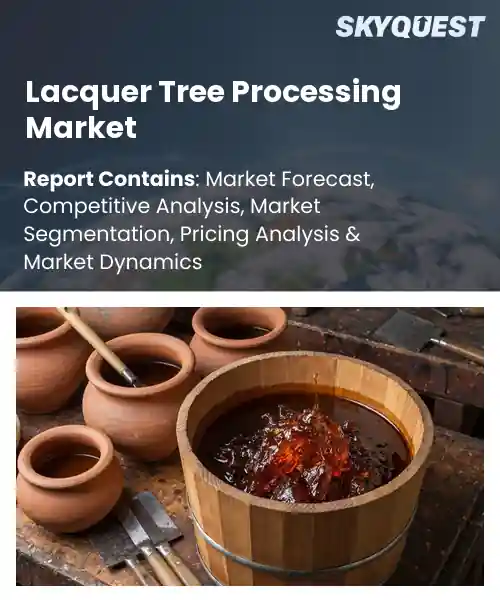
Lacquer Tree Processing Market
Report ID: SQMIG15P2054
Report ID: SQMIG15P2054
[email protected]
USA +1 351-333-4748
Report ID:
SQMIG15P2054 |
Region:
Global |
Published Date: July, 2026
Pages:
157
|Tables:
117
|Figures:
77


Global Lacquer Tree Processing Market size was valued at USD 174.8 Million in 2024 and is poised to grow from USD 184.59 Million in 2025 to USD 285.44 Million by 2033, growing at a CAGR of 5.6% during the forecast period (2026-2033).
The global lacquer tree processing market encompasses extraction, refinement, and commercialization of sap from Toxicodendron vernicifluum, known as the lacquer tree, into raw lacquer, varnish, and specialty coatings. Its primary driver is rising demand for eco‑friendly, high‑performance finishes in automotive, furniture, and electronics, where solvent‑based paints are being replaced due to stricter VOC regulations. Historically, the market emerged in East Asia, where artisans used natural lacquer for centuries, but since the 1990s multinational firms have scaled production to meet Western sustainability goals. This evolution transformed a niche craft into a multibillion‑dollar supply chain that supports rural economies and industries alike. The second pivotal factor driving market growth is the use of lacquer derivatives in products such as electric‑vehicle battery casings and sustainable packaging, where natural hardness and chemical resistance replace petrochemical polymers. Manufacturers aiming to cut carbon footprints now favor bio‑based lacquer coatings over epoxy resins, a switch that shortens cure times and boosts recyclability, creating cost efficiencies across supply chains. A Japanese electronics company recently applied lacquer‑infused film to display substrates, gaining a 15 % weight reduction and superior moisture barrier. This case encourages R&D funding, attracting venture capital that accelerates processing innovations and expands market reach in emerging economies.
How is AI-driven automation reshaping the lacquer tree processing market?
AI-driven automation is streamlining every stage of lacquer tree processing, from raw sap extraction to resin refinement. Sensors monitor tree health and predict optimal tapping times, reducing waste and improving yield. Machine‑learning models analyze moisture content and adjust drying cycles, ensuring consistent quality. Robotics handle the delicate handling of lacquer blocks, cutting labor costs and minimizing human error. Integrated data platforms connect farms with manufacturers, enabling real‑time inventory tracking and faster response to market demand. These technologies collectively boost efficiency, lower production costs, and support sustainable harvesting practices, positioning the sector for steady growth.In September 2025, a leading lacquer processor introduced an AI‑controlled extraction system, accelerating sap collection while preserving tree vitality, thereby enhancing overall market efficiency.
Market snapshot - (2026-2033)
Global Market Size
USD 174.8 Million
Largest Segment
Refined Lacquer
Fastest Growth
Lacquer Derivatives
Growth Rate
5.6% CAGR
To get more insights on this market click here to Request a Free Sample Report
Global lacquer tree processing market is segmented by product type, processing method, application, end user and region. Based on product type, the market is segmented into Raw Lacquer, Refined Lacquer and Lacquer Derivatives. Based on processing method, the market is segmented into Manual Processing and Mechanical Processing. Based on application, the market is segmented into Furniture Coatings, Decorative Crafts, Industrial Coatings and Musical Instruments. Based on end user, the market is segmented into Furniture Manufacturers, Artisans and Industrial Coating Producers. Based on region, the market is segmented into North America, Europe, Asia Pacific, Latin America and Middle East & Africa.
Raw lacquer segment dominates because it provides the foundational natural resin that supplies the core chemical building blocks for all downstream products. Its intrinsic adhesive properties and aesthetic appeal make it the preferred raw material for traditional crafts and emerging eco friendly coatings. Producers prioritize it due to minimal processing requirements, abundant tree cultivation, and strong cultural heritage, ensuring steady demand throughout the supply chain and within diversified product lines.
Meanwhile, refined lacquer emerges as the most rapidly expanding area because its enhanced purity and consistent viscosity meet the stringent performance standards of high end furniture finishes. Ongoing research into sustainable extraction techniques and growing consumer preference for low VOC finishes accelerate its adoption, opening new avenues for premium coating innovations.
Mechanical processing segment leads because it introduces precision engineering that standardizes extraction yields and reduces labor variability. Automated systems synchronize temperature control and solvent recovery, delivering higher purity outputs while lowering operational costs. Manufacturers favor this approach to meet increasing volume requirements and to comply with quality certifications, creating a reliable supply chain that supports broader market applications and fostering confidence among industrial buyers throughout the production lifecycle and across multiple customer segments.
Conversely, manual processing is witnessing the strongest growth momentum because it preserves artisanal qualities prized by niche craft markets and heritage furniture makers. The tactile control enables pigment blending and texture creation that machines cannot replicate, driving renewed interest in bespoke finishes and cultural authenticity. This surge fuels demand for labor and sustains an ecosystem of small scale producers.
To get detailed segments analysis, Request a Free Sample Report
The Asia Pacific region leverages a deep cultural heritage of lacquer art combined with advanced manufacturing capabilities that support high‑quality processing. Strong demand from traditional crafts and modern high‑end furniture sectors fuels sustained activity. Established supply chains for raw lacquer material, supported by proximity to prolific tree‑growing areas, reduce logistical complexity. Technical expertise cultivated through long‑standing artisanship merges with innovative processing techniques, creating a competitive edge that attracts both domestic and international customers. Collaborative research initiatives between industry and academia further enhance process efficiency and product diversification, reinforcing the region’s leadership position.
Lacquer Tree Processing Market in Japan benefits from a heritage of meticulous craftsmanship that emphasizes precision and surface perfection. Continuous refinement of extraction methods aligns with consumer expectations for premium finishes, while close integration with design studios promotes rapid adoption of new applications. Strong domestic demand for traditional lacquerware and high‑end interior solutions sustains a robust pipeline of projects, encouraging investment in advanced processing equipment.
Lacquer Tree Processing Market in South Korea thrives on a blend of traditional expertise and cutting‑edge technology. Emphasis on research and development fosters innovative processing techniques that expand product functionality. Close collaboration between manufacturers and design firms accelerates the introduction of lacquer‑based solutions across furniture and automotive interiors. The supportive regulatory environment and active participation in regional trade networks further bolster market resilience and growth.
Europe’s expansion is propelled by a growing appreciation for sustainable, natural finishes that align with stringent environmental standards. Consumer preference for eco‑friendly luxury drives demand across high‑end furniture, automotive interiors, and heritage restoration projects. Strong design cultures in key markets champion the use of lacquer for its durability and aesthetic versatility, encouraging broader adoption. Collaborative innovation across research institutions and manufacturers accelerates the development of novel processing methods, enhancing product performance while meeting regulatory expectations. The region’s well‑established distribution networks and emphasis on quality assurance reinforce confidence among end users, fostering a dynamic environment for market expansion.
Lacquer Tree Processing Market in Germany is characterized by a focus on precision engineering and high‑quality output. Integration with advanced manufacturing sectors ensures that lacquer processing meets exacting performance criteria, supporting applications in premium automotive and furniture segments. Strong collaboration between research institutes and industry champions the development of refined extraction and curing techniques, reinforcing Germany’s position as a dominant player in the European landscape.
Lacquer Tree Processing Market in the United Kingdom experiences rapid growth driven by a vibrant design community that embraces natural finishes. Emerging trends in bespoke interiors and heritage restoration amplify demand for high‑end lacquer products. Close ties between academic research centers and processing firms foster innovation, enabling the swift introduction of new formulations that address both aesthetic and functional requirements. The market benefits from a supportive regulatory framework that encourages sustainable material adoption, positioning the United Kingdom as a leading growth engine in Europe.
Lacquer Tree Processing Market in France is emerging with strong momentum as designers turn to natural lacquer for refined surface treatments. Emphasis on artisanal craftsmanship combined with modern processing technologies creates a niche appeal for luxury interiors and fine art applications. Collaborative projects between cultural institutions and manufacturers nurture expertise in handling delicate lacquer substrates, enhancing the market’s reputation for quality. The supportive policy environment promotes eco‑conscious material usage, further encouraging market development.
North America is advancing its role through strategic investments in advanced processing technologies and a growing appetite for premium natural finishes. The market benefits from a robust supply chain that links raw material sources with sophisticated manufacturing hubs, enabling efficient production of high‑performance lacquer products. Consumer trends favoring sustainable luxury drive demand across upscale furniture, automotive interiors, and specialty coatings. Strong collaboration between research laboratories and industry players accelerates innovation, resulting in improved extraction efficiency and product consistency. Regulatory support for environmentally responsible materials enhances market attractiveness, while established distribution channels facilitate rapid market penetration across diverse sectors.
Lacquer Tree Processing Market in the United States is bolstered by a convergence of high consumer expectations for refined finishes and a dynamic manufacturing landscape. Integration of cutting‑edge processing equipment with established woodworking and automotive sectors ensures consistent delivery of premium lacquer products. Partnerships between research institutions and industry leaders promote continuous improvement in extraction and application methods, supporting the market’s capacity to meet evolving design trends. A strong emphasis on sustainability and compliance further solidifies the United States position within the global market.
Lacquer Tree Processing Market in Canada benefits from a balanced blend of natural resource availability and technical expertise. Regional processing facilities capitalize on proximity to raw lacquer sources, reducing transport complexities and supporting efficient operation. Collaborative initiatives between academic centers and manufacturers stimulate advancements in processing techniques that enhance product quality. The market’s alignment with eco‑focused consumer preferences and adherence to rigorous environmental standards positions Canada as a reliable contributor to the broader North American market.
To know more about the market opportunities by region and country, click here to
Buy The Complete Report
Rising Demand For Eco Friendly Finishes
Expansion Of Craft Beverage Industry
Limited Supply Of Mature Trees
Stringent Environmental Extraction Regulations
Request Free Customization of this report to help us to meet your business objectives.
The competitive landscape of the global lacquer tree processing market is shaped by firms pursuing strategic M&A to acquire specialized extraction technologies, forming partnerships with sustainable‑product manufacturers, and investing in bio‑based coating innovations to meet rising demand for natural finishes. Recent collaborations between processing specialists and eco‑friendly packaging companies illustrate how alliances are driving product differentiation and market entry barriers.
Top Player’s Company Profile
Recent Developments
SkyQuest’s ABIRAW (Advanced Business Intelligence, Research & Analysis Wing) is our Business Information Services team that Collects, Collates, Correlates, and Analyses the Data collected by means of Primary Exploratory Research backed by robust Secondary Desk research. As per SkyQuest analysis, the global lacquer tree processing market is expanding at a 5.6 % CAGR driven primarily by the rising demand for eco‑friendly finishes, while the growing craft‑beverage sector adds a second boost by seeking natural, high‑gloss lacquer for barrels and packaging. The market’s growth is tempered by a restraint in the limited supply of mature lacquer trees, which curtails raw material availability and raises production costs. Asia Pacific dominates the landscape, leveraging its cultural heritage and proximity to tree‑growing areas, and the raw lacquer segment leads the product mix by supplying the core resin for downstream applications. Together these forces shape a steady upward trajectory.
| Report Metric | Details |
|---|---|
| Market size value in 2024 | USD 174.8 Million |
| Market size value in 2033 | USD 285.44 Million |
| Growth Rate | 5.6% |
| Base year | 2024 |
| Forecast period | (2026-2033) |
| Forecast Unit (Value) | USD Million |
| Segments covered |
|
| Regions covered | North America (US, Canada), Europe (Germany, France, United Kingdom, Italy, Spain, Rest of Europe), Asia Pacific (China, India, Japan, Rest of Asia-Pacific), Latin America (Brazil, Rest of Latin America), Middle East & Africa (South Africa, GCC Countries, Rest of MEA) |
| Companies covered |
|
| Customization scope | Free report customization with purchase. Customization includes:-
|
To get a free trial access to our platform which is a one stop solution for all your data requirements for quicker decision making. This platform allows you to compare markets, competitors who are prominent in the market, and mega trends that are influencing the dynamics in the market. Also, get access to detailed SkyQuest exclusive matrix.
Table Of Content
Executive Summary
Market overview
Parent Market Analysis
Market overview
Market size
KEY MARKET INSIGHTS
COVID IMPACT
MARKET DYNAMICS & OUTLOOK
Market Size by Region
KEY COMPANY PROFILES
Methodology
For the Lacquer Tree Processing Market, our research methodology involved a mixture of primary and secondary data sources. Key steps involved in the research process are listed below:
1. Information Procurement: This stage involved the procurement of Market data or related information via primary and secondary sources. The various secondary sources used included various company websites, annual reports, trade databases, and paid databases such as Hoover's, Bloomberg Business, Factiva, and Avention. Our team did 45 primary interactions Globally which included several stakeholders such as manufacturers, customers, key opinion leaders, etc. Overall, information procurement was one of the most extensive stages in our research process.
2. Information Analysis: This step involved triangulation of data through bottom-up and top-down approaches to estimate and validate the total size and future estimate of the Lacquer Tree Processing Market.
3. Report Formulation: The final step entailed the placement of data points in appropriate Market spaces in an attempt to deduce viable conclusions.
4. Validation & Publishing: Validation is the most important step in the process. Validation & re-validation via an intricately designed process helped us finalize data points to be used for final calculations. The final Market estimates and forecasts were then aligned and sent to our panel of industry experts for validation of data. Once the validation was done the report was sent to our Quality Assurance team to ensure adherence to style guides, consistency & design.
Analyst Support
Customization Options
With the given market data, our dedicated team of analysts can offer you the following customization options are available for the Lacquer Tree Processing Market:
Product Analysis: Product matrix, which offers a detailed comparison of the product portfolio of companies.
Regional Analysis: Further analysis of the Lacquer Tree Processing Market for additional countries.
Competitive Analysis: Detailed analysis and profiling of additional Market players & comparative analysis of competitive products.
Go to Market Strategy: Find the high-growth channels to invest your marketing efforts and increase your customer base.
Innovation Mapping: Identify racial solutions and innovation, connected to deep ecosystems of innovators, start-ups, academics, and strategic partners.
Category Intelligence: Customized intelligence that is relevant to their supply Markets will enable them to make smarter sourcing decisions and improve their category management.
Public Company Transcript Analysis: To improve the investment performance by generating new alpha and making better-informed decisions.
Social Media Listening: To analyze the conversations and trends happening not just around your brand, but around your industry as a whole, and use those insights to make better Marketing decisions.
REQUEST FOR SAMPLE
 REQUEST FREE CUSTOMIZATION


Want to customize this report? This report can be personalized according to your needs. Our analysts and industry experts will work directly with you to understand your requirements and provide you with customized data in a short amount of time. We offer $1000 worth of FREE customization at the time of purchase.
Feedback From Our Clients


 USA (+1) 351-333-4748

