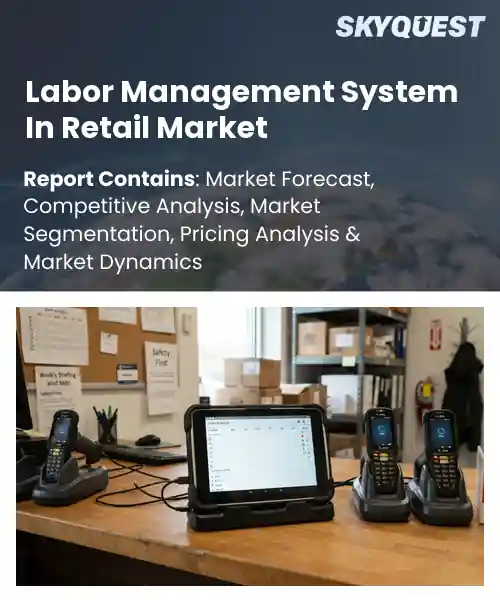
Labor Management System In Retail Market
Report ID: SQMIG45E3240
Report ID: SQMIG45E3240
[email protected]
USA +1 351-333-4748
Report ID:
SQMIG45E3240 |
Region:
Global |
Published Date: September, 2026
Pages:
157
|Tables:
143
|Figures:
78


Global Labor Management System In Retail Market size was valued at USD 5.53 Billion in 2024 and is poised to grow from USD 5.79 Billion in 2025 to USD 8.37 Billion by 2033, growing at a CAGR of 4.7% during the forecast period (2026-2033).
Retail labor management systems (LMS) have become a cornerstone of operations, driven primarily by the need to synchronize workforce scheduling with fluctuating consumer demand. The market includes software platforms that automate shift planning, time‑tracking, compliance monitoring, and performance analytics for brick‑and‑mortar and omni‑channel retailers. Its significance stems from tight profit margins, where labor costs often represent the largest expense; optimizing schedules directly influences profitability and customer service quality. Over the past decade, the sector evolved from punch‑card solutions to suites that integrate with e‑commerce data, exemplified by Walmart’s rollout of a scheduling tool in 2021 that cut overtime by 12 %.AI‑driven analytics is the pivotal factor driving the global retail labor management system market because it converts attendance data into predictive staffing models that match labor supply with sales velocity. When retailers face omnichannel demands and high turnover, accurate forecasts prevent understaffing losses and curb excess wage spend, directly lifting same‑store sales. Target’s real‑time scheduling algorithm, for example, raised checkout speed by 4 % and cut scheduling errors by 6 %, illustrating tangible ROI. Such outcomes encourage midsize chains to adopt scalable cloud LMS platforms, while emerging markets view these systems as essential for meeting stricter labor regulations, expanding vendor significant opportunities.
How is AI-driven automation improving labor management in the retail sector?
AI driven automation is reshaping labor management in retail by linking forecasting, scheduling, and real time task allocation. Predictive analytics anticipate foot traffic and align staffing levels, while computer vision monitors store zones to assign associates where they are needed most. Natural language chatbots handle shift swaps and answer employee queries, freeing managers to focus on coaching. Integrated platforms also capture performance signals, enabling continuous improvement and reducing turnover. As retailers seek to balance cost pressures with service expectations, these technologies provide a scalable way to match workforce supply with demand, creating smoother operations and better customer experiences.Walmart, June 2023, introduced an AI powered scheduling platform that automatically aligns employee shifts with predicted store traffic, reducing manual planning time and improving coverage during peak periods. This rollout demonstrates how AI automation drives efficiency and supports the expanding labor management market in retail.
Market snapshot - (2026-2033)
Global Market Size
USD 5.53 Billion
Largest Segment
Software
Fastest Growth
Services
Growth Rate
4.7% CAGR
To get more insights on this market click here to Request a Free Sample Report
Global labor management system in retail market is segmented by component, deployment, function, store type, enterprise size and region. Based on component, the market is segmented into Software and Services. Based on deployment, the market is segmented into Cloud-Based and On-Premises. Based on function, the market is segmented into Workforce Scheduling, Time & Attendance, Labor Forecasting and Performance Management. Based on store type, the market is segmented into Supermarkets & Hypermarkets, Specialty Stores, Convenience Stores and Department Stores. Based on enterprise size, the market is segmented into Small & Medium Retailers and Large Retailers. Based on region, the market is segmented into North America, Europe, Asia Pacific, Latin America and Middle East & Africa.
Software segment dominates because it provides the core intelligence that integrates scheduling, attendance, and performance data into a unified platform, enabling retailers to automate complex labor rules and respond swiftly to fluctuating demand. Its flexibility to customize workflows, embed analytics, and support mobile interfaces drives widespread adoption, while continuous innovation in AI driven optimization reinforces its central role in retail labor management solutions and improves overall operational efficiency for store managers.
However, Services segment emerges as the most rapidly expanding area because retailers increasingly seek expert implementation, change management, and ongoing support to maximize system value. The rise of subscription based consulting and managed services lowers entry barriers, accelerates deployment, and creates recurring revenue streams, fueling heightened demand and broader market penetration.
Workforce scheduling segment dominates because it directly aligns employee shifts with real time store traffic patterns, ensuring optimal staffing levels that balance labor cost and service quality. Its ability to incorporate rule based constraints, predictive demand inputs, and mobile shift swapping enhances operational agility, while seamless integration with payroll and compliance modules drives retailer confidence in its strategic importance and supports long term workforce planning across multiple locations, sustaining growth.
Meanwhile, Labor forecasting segment is witnessing the strongest growth momentum because analytics and AI enable retailers to anticipate staffing needs days in advance, reducing reliance on manual adjustments. The integration of point of sale data, seasonal trends, and external variables drives more accurate predictions, unlocking efficiencies and encouraging adoption across the retail sector.
To get detailed segments analysis, Request a Free Sample Report
North America’s dominance stems from a confluence of mature retail ecosystems, deep capital investment, and a relentless focus on operational efficiency. Leading retailers have embraced sophisticated workforce analytics, cloud‑based scheduling, and AI‑driven demand forecasting to optimize labor deployment. The region benefits from a highly skilled technology workforce and a regulatory environment that encourages innovation while ensuring compliance. Strong consumer expectations for seamless omni‑channel experiences further compel retailers to adopt advanced labor management solutions, reinforcing a cycle of continuous improvement and market leadership.
United States Labor Management System In Retail Market
Labor Management System In Retail Market in the United States is propelled by a vast network of large‑scale retailers that prioritize real‑time scheduling and performance analytics. Integration with advanced point‑of‑sale platforms enables precise alignment of staff levels with fluctuating foot traffic. Emphasis on compliance with labor standards drives the adoption of automated time‑keeping and reporting tools, while competitive pressures push firms toward predictive staffing models that enhance productivity and customer service.
Canada Labor Management System In Retail Market
Labor Management System In Retail Market in Canada reflects a strong commitment to workforce optimization within a landscape of both national chains and regional players. Retailers leverage cloud‑based solutions to synchronize staffing across dispersed locations, ensuring consistency in service delivery. The focus on regulatory adherence, particularly around overtime and shift regulations, encourages the use of automated compliance modules. Additionally, a collaborative culture between technology providers and retailers fosters rapid implementation of innovative scheduling and analytics capabilities.
Europe’s rapid expansion is driven by harmonized regulatory frameworks, heightened emphasis on sustainability, and a collective push toward digital transformation across retail sectors. Retailers are adopting labor management platforms to meet stringent labor law requirements while simultaneously improving efficiency and reducing waste. The region’s strong engineering heritage supports the integration of advanced analytics and AI, enabling precise workforce planning. Cross‑border trade and unified standards further encourage the deployment of scalable solutions that can be adapted across diverse market contexts, accelerating growth throughout the continent.
Germany Labor Management System In Retail Market
Labor Management System In Retail Market in Germany benefits from a robust engineering culture that emphasizes precision and reliability. Retailers integrate sophisticated scheduling algorithms with real‑time sales data to fine‑tune staffing levels, reducing idle time and enhancing customer interaction. Strong data protection standards drive the adoption of secure, compliant platforms, while a focus on productivity encourages continuous refinement of workforce analytics. Collaborative partnerships between technology firms and retail operators accelerate the rollout of innovative labor solutions across the market.
United Kingdom Labor Management System In Retail Market
Labor Management System In Retail Market in the United Kingdom is characterized by swift adoption of cloud‑based tools that support flexible staffing models. Retailers respond to dynamic consumer behavior by leveraging predictive analytics to align labor supply with peak shopping periods. Regulatory compliance, particularly around working time directives, is managed through automated tracking and reporting features. The competitive retail landscape fuels investment in real‑time dashboards that empower managers to make data‑driven decisions, driving efficiency and service quality.
France Labor Management System In Retail Market
Labor Management System In Retail Market in France is emerging as retailers seek to modernize workforce management amid evolving labor regulations. Adoption of intuitive scheduling interfaces helps align staff availability with fluctuating demand, while compliance modules simplify adherence to complex labor codes. Retail chains are increasingly integrating labor platforms with customer relationship systems to enhance service personalization. Growing awareness of the benefits of data‑driven staffing decisions is encouraging broader implementation across both urban and regional retail environments.
Asia Pacific is strengthening its position through rapid digital adoption, high mobile penetration, and a strategic focus on cost‑effective labor solutions. Retailers are embracing AI‑enabled scheduling and real‑time analytics to address labor shortages and meet rising consumer expectations for seamless service. Government initiatives supporting technology innovation and smart retail infrastructure create an enabling environment for advanced labor management platforms. The region’s blend of large, tech‑savvy consumer bases and competitive retail landscapes drives continuous investment in sophisticated workforce optimization tools.
Japan Labor Management System In Retail Market
Labor Management System In Retail Market in Japan is shaped by an aging workforce and a cultural emphasis on precision and service excellence. Retailers deploy advanced scheduling systems that balance limited labor availability with high customer service standards. Integration with IoT devices and AI forecasting helps predict foot traffic, allowing for optimal staff allocation. Compliance with stringent labor regulations is facilitated through automated time‑tracking solutions, supporting both efficiency and employee well‑being.
South Korea Labor Management System In Retail Market
Labor Management System In Retail Market in South Korea reflects a high degree of digital maturity and a fast‑moving consumer market. Retailers leverage cloud‑based platforms that provide real‑time visibility into staffing needs, enabling rapid adjustments during promotional events. AI‑driven demand forecasting aligns labor supply with dynamic sales patterns, reducing overstaffing and underutilization. Strong government support for smart retail initiatives encourages the integration of labor management tools with broader omnichannel strategies, enhancing overall operational agility.
To know more about the market opportunities by region and country, click here to
Buy The Complete Report
Digital Transformation Accelerates Adoption
Enhanced Employee Experience Improves Retention
Data Privacy Regulations Increase Complexity
High Implementation Costs Limit Adoption
Request Free Customization of this report to help us to meet your business objectives.
The retail labor management arena is intensifying as incumbents and new entrants vie for store‑level efficiency, with competition driving rapid adoption of AI‑based scheduling, real‑time analytics, and integrated payroll. Notable moves include the 2020 merger forming UKG, SAP’s partnership with RetailPro to embed workforce modules, and Amazon’s rollout of AI‑enhanced staffing tools across its physical stores, underscoring a shift toward data‑driven operational agility.
Top Player’s Company Profile
Recent Developments
SkyQuest’s ABIRAW (Advanced Business Intelligence, Research & Analysis Wing) is our Business Information Services team that Collects, Collates, Correlates, and Analyses the Data collected by means of Primary Exploratory Research backed by robust Secondary Desk research. As per SkyQuest analysis the global retail labor management market is being propelled primarily by digital transformation, which pushes retailers to integrate scheduling, time‑tracking and analytics across omni‑channel operations, while a second driver of improved employee experience through mobile self‑service tools is boosting retention and reducing turnover. The software component remains the dominant segment because it delivers the core intelligence for AI‑driven scheduling and forecasting. North America leads the market thanks to mature retail chains, strong tech talent and a regulatory climate that encourages innovation. However, stringent data‑privacy regulations such as GDPR and CCPA add complexity and can slow deployments, acting as a key restraint on growth.
| Report Metric | Details |
|---|---|
| Market size value in 2024 | USD 5.53 Billion |
| Market size value in 2033 | USD 8.37 Billion |
| Growth Rate | 4.7% |
| Base year | 2024 |
| Forecast period | (2026-2033) |
| Forecast Unit (Value) | USD Billion |
| Segments covered |
|
| Regions covered | North America (US, Canada), Europe (Germany, France, United Kingdom, Italy, Spain, Rest of Europe), Asia Pacific (China, India, Japan, Rest of Asia-Pacific), Latin America (Brazil, Rest of Latin America), Middle East & Africa (South Africa, GCC Countries, Rest of MEA) |
| Companies covered |
|
| Customization scope | Free report customization with purchase. Customization includes:-
|
To get a free trial access to our platform which is a one stop solution for all your data requirements for quicker decision making. This platform allows you to compare markets, competitors who are prominent in the market, and mega trends that are influencing the dynamics in the market. Also, get access to detailed SkyQuest exclusive matrix.
Table Of Content
Executive Summary
Market overview
Parent Market Analysis
Market overview
Market size
KEY MARKET INSIGHTS
COVID IMPACT
MARKET DYNAMICS & OUTLOOK
Market Size by Region
KEY COMPANY PROFILES
Methodology
For the Labor Management System In Retail Market, our research methodology involved a mixture of primary and secondary data sources. Key steps involved in the research process are listed below:
1. Information Procurement: This stage involved the procurement of Market data or related information via primary and secondary sources. The various secondary sources used included various company websites, annual reports, trade databases, and paid databases such as Hoover's, Bloomberg Business, Factiva, and Avention. Our team did 45 primary interactions Globally which included several stakeholders such as manufacturers, customers, key opinion leaders, etc. Overall, information procurement was one of the most extensive stages in our research process.
2. Information Analysis: This step involved triangulation of data through bottom-up and top-down approaches to estimate and validate the total size and future estimate of the Labor Management System In Retail Market.
3. Report Formulation: The final step entailed the placement of data points in appropriate Market spaces in an attempt to deduce viable conclusions.
4. Validation & Publishing: Validation is the most important step in the process. Validation & re-validation via an intricately designed process helped us finalize data points to be used for final calculations. The final Market estimates and forecasts were then aligned and sent to our panel of industry experts for validation of data. Once the validation was done the report was sent to our Quality Assurance team to ensure adherence to style guides, consistency & design.
Analyst Support
Customization Options
With the given market data, our dedicated team of analysts can offer you the following customization options are available for the Labor Management System In Retail Market:
Product Analysis: Product matrix, which offers a detailed comparison of the product portfolio of companies.
Regional Analysis: Further analysis of the Labor Management System In Retail Market for additional countries.
Competitive Analysis: Detailed analysis and profiling of additional Market players & comparative analysis of competitive products.
Go to Market Strategy: Find the high-growth channels to invest your marketing efforts and increase your customer base.
Innovation Mapping: Identify racial solutions and innovation, connected to deep ecosystems of innovators, start-ups, academics, and strategic partners.
Category Intelligence: Customized intelligence that is relevant to their supply Markets will enable them to make smarter sourcing decisions and improve their category management.
Public Company Transcript Analysis: To improve the investment performance by generating new alpha and making better-informed decisions.
Social Media Listening: To analyze the conversations and trends happening not just around your brand, but around your industry as a whole, and use those insights to make better Marketing decisions.
REQUEST FOR SAMPLE
 REQUEST FREE CUSTOMIZATION


Want to customize this report? This report can be personalized according to your needs. Our analysts and industry experts will work directly with you to understand your requirements and provide you with customized data in a short amount of time. We offer $1000 worth of FREE customization at the time of purchase.
Feedback From Our Clients


 USA (+1) 351-333-4748

