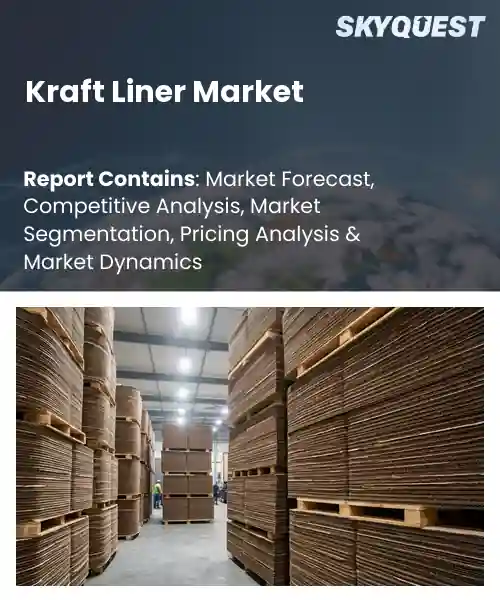
Kraft Liner Market
Report ID: SQMIG15Q2046
Report ID: SQMIG15Q2046
[email protected]
USA +1 351-333-4748
Report ID:
SQMIG15Q2046 |
Region:
Global |
Published Date: August, 2026
Pages:
157
|Tables:
142
|Figures:
78


Global Kraft Liner Market size was valued at USD 18.46 Billion in 2024 and is poised to grow from USD 19.53 Billion in 2025 to USD 30.67 Billion by 2033, growing at a CAGR of 5.8% during the forecast period (2026-2033).
Kraft liner is a type of material that comprises the heavy-duty corrugated board protecting valuable products during transportation and storage. Importance of the market is determined by the rising requirement of sustainable packing as kraft liner can be recycled, is bio-degradable and obtained from sustainable sources – wood pulp. It started with the beginning of the 20th century when paper mills started manufacturing durable brown sheets for industrial purposes of wrapping; later, due to development in machine direction strength and moisture resistance, the market extended its application beyond the production of simple box blanks up to multi-wall packing for electronics and pharmaceuticals.
Another major factor that impacts growth is the emergence of increased regulatory pressure and commitments to sustainability by companies, which results in brands choosing green packaging colors. If countries restrict the use of single-use plastics, then brands choose kraft alternatives for liners, which are more suitable due to their high recyclability levels, thus creating new avenues of demand in Europe and North America. Moreover, technologies such as micro-fluted cores and hybrid laminates help improve barrier properties of materials while maintaining the same environmental impact, thus driving companies to use kraft-based systems instead of steel crates that are heavier.
How is AI-driven Predictive Maintenance Influencing the Kraft Liner Market?
Predictive maintenance through AI employs sensors and artificial intelligence to predict equipment wear and prevent failure. Within the Kraft liner industry, this is increasingly becoming an option that is being implemented in paper machines, dryers, and coating lines where unplanned shutdowns could bring the production process to a halt. Through predictive maintenance operators have been able to plan their repairs at times when the demand for their products is low. This means that the production line speed remains constant hence prolonging the life of the blades. Brand owners have seen the benefits of consistent liner performance through the improved changeover and product quality.
Market snapshot - (2026-2033)
Global Market Size
USD 18.46 Billion
Largest Segment
Virgin Kraft Liner
Fastest Growth
Recycled Kraft Liner
Growth Rate
5.8% CAGR
To get more insights on this market click here to Request a Free Sample Report
Global kraft liner market is segmented by product type, grade, application, end user, basis weight and region. Based on product type, the market is segmented into Virgin Kraft Liner and Recycled Kraft Liner. Based on grade, the market is segmented into Bleached and Unbleached. Based on application, the market is segmented into Corrugated Boxes, Industrial Packaging and Consumer Goods Packaging. Based on end user, the market is segmented into Packaging Manufacturers, Food & Beverage and E-commerce. Based on basis weight, the market is segmented into Up to 150 GSM, 151–250 GSM and Above 250 GSM. Based on region, the market is segmented into North America, Europe, Asia Pacific, Latin America and Middle East & Africa.
The Corrugated Boxes segment holds dominance since it is still considered as the principal material used for bulk transportation due to its strength-to-weight ratio, which matches the requirement of manufacturers for proper protection. Its suitability for use on high-speed converting lines makes it a cost-effective option and hence its favorability by packaging suppliers. Moreover, the constant demand for durable packaging materials and sustainability trend have made it the leading segment in the kraft liner market around the world.
On the other hand, the Consumer Goods Packaging segment represents the fastest growing segment in the kraft liner market as retailers look for light and eco-friendly solutions to improve their shelf presence.
The Up to 150 GSM segment holds a dominant position due to its lightweight nature that caters to the cost sensitivity of volume producers along with sufficient stiffness required for normal packaging purposes. This segment becomes more economical to handle and convert on equipment making it favorable and widely adopted. Its ability to be used for corrugated and consumer packaging strengthens its position in the kraft liner market especially in those industries which value sustainability and quick delivery time without compromising on design options.
On the contrary, the segment of Above 250 GSM is gaining momentum in the kraft liner market owing to the requirement of stronger puncture resistance and barrier properties by the packaging industry. The rising trend of luxury packaging and sustainable application is driving the need for thicker grades and therefore growing the market.
To get detailed segments analysis, Request a Free Sample Report
North America is fortunate to have a sophisticated packaging system that focuses on high performance and sustainability. The well-developed capacity for research and development in North America spurs constant innovation in terms of material strength, barrier, and recycling. Collaboration between large paper producers and consumer goods manufacturers facilitates quick adoption of kraft liner for various uses. Incentive-based regulations encourage the use of environmentally friendly packaging. Efficient supply chains along with well-equipped conversion facilities help maintain market dominance. There is a culture of sustainability, and consumer demand acts in synergy to sustain market dominance.
U.S. Kraft Liner Market is defined by an unrelenting emphasis on durability and environmental benefits, drawing major companies from sectors such as food, beverages, and e-commerce packaging. Clusters within the industry ensure rapid prototyping and partnerships leading to high adaptability of products for different uses. Demand for recyclable packaging encourages consistent innovation in lignin-based recipes, with efficient supply chain integration facilitating prompt reactions to market demands.
Kraft Liner Market in Canada reflects a strong commitment to green packaging practices, resonating with both manufacturers and environmentally conscious consumers. Close proximity to abundant forest resources supports a reliable raw material base, while innovation hubs focus on barrier enhancements and lightweight designs. Partnerships between pulp producers and packaging converters emphasize low‑carbon footprints, positioning kraft liner as a preferred choice for sustainable branding. Cross‑border trade links also facilitate knowledge exchange that bolsters product differentiation and market resilience.
Kraft liner production in Europe continues to grow owing to tough environmental laws which encourage the move towards renewable packaging material. A highly developed web of paper mills along with advanced conversion technology facilitates quick ramping up of efficient liner production. Customer demand for a story that speaks of sustainable processes is driving brands to use kraft-based packaging as part of their circular story. Academic-industry partnerships expedite innovation in terms of barrier properties and coating functionalities, meeting the complex requirements of food safety and shelf-life extension.
Kraft Liner Market in Germany stands out for its engineering‑driven approach to material performance, supported by a dense concentration of research institutes. Emphasis on precision and reliability fuels demand from premium food and pharmaceutical packaging segments. Integration of renewable fibers with sophisticated coating technologies yields superior moisture resistance, aligning with stringent quality standards. Strong collaboration between manufacturers and logistics providers ensures seamless distribution, while sustainability mandates reinforce the transition toward fully recyclable liner options.
Market for Kraft Liner in the United Kingdom shows fast adoption rates owing to increased awareness among consumers about waste management and transparent branding. The retailers and manufacturers prefer the use of kraft liner owing to its environmentally-friendly attributes and the natural look. The innovation clusters have been developing lightweight packaging solutions that retain strength properties in order to cater for cost savings and environmental benefits. The policy drivers encouraging sustainable packaging encourage more innovations and market entry.
Kraft Liner Market in France is emerging as a key segment within the broader push for greener packaging solutions. Culinary culture and a strong emphasis on artisanal presentation drive interest in kraft‑based wraps and cartons. Collaborative efforts between paper producers and design agencies prioritize tactile and visual qualities that enhance consumer appeal. Growing demand from organic and specialty food producers fuels experimentation with barrier enhancements, while governmental encouragement of recyclable materials strengthens market confidence.
The strength of Asia Pacific in its kraft liner business lies in the presence of abundant renewable fibers and increasing customer demand for sustainable packages. The process of rapid urbanization coupled with changing retail formats calls for liners that can cater to both fresh produce and processed goods. Advanced infrastructure in the region for converting processes helps to maintain uniform quality of products and even customize them for different niche markets. Collaboration with international technology companies promotes the use of barrier coatings on liners, and the sustainable agenda promoted by government bodies helps reduce reliance on plastics.
Kraft Liner Market in Japan is characterized by meticulous attention to product hygiene and aesthetic refinement, essential for high‑end food and cosmetics packaging. Integration of cutting‑edge barrier technologies caters to consumer expectations for freshness and safety. Strong collaboration between pulp manufacturers and packaging designers yields sleek, lightweight solutions that complement minimalist branding trends. Governmental emphasis on reducing plastic waste aligns with industry moves toward kraft‑based alternatives, reinforcing market momentum.
South Korean Kraft Liner Market sees the advantage of having an environmentally conscious consumer population that cares about both performance and sustainability. The quick growth of industries such as delivery and convenience food contributes to a high need for liners that can preserve the integrity of the products inside. Collaborations between paper manufacturers and smart packaging developers aim to develop coating solutions for their liners that boost barrier properties while remaining recyclable.
To know more about the market opportunities by region and country, click here to
Buy The Complete Report
Rising Demand for Eco‑Friendly Liners
Advanced Coating Technologies Enhancing Performance
High Production Costs Limiting Adoption
Regulatory Uncertainty Hindering Expansion
Request Free Customization of this report to help us to meet your business objectives.
The worldwide Kraft Liner market is somewhat concentrated where big integrated manufacturers of paper and packaging products compete against regional producers. Competitiveness within the industry is mainly determined by strength/weight ratio, quality, fiber type, prices, capacity, sustainability, and supply chain capabilities. The leading producers are focused on introducing lightweight but strong grades of liners to minimize material usage without losing necessary strength for corrugated packaging. Sustainability is one of the main aspects that help the producers differentiate themselves as packaging companies more often require environmentally-friendly and recyclable fiber-based packaging products. The producers are also launching coated and specialty grades with better printing, moisture and barrier properties for food, e-commerce, consumer and industrial packaging. The regional producers are competitive because of their low costs and local sourcing whereas the global producers have the advantage in vertically-integrated forestry, pulp and paper production, and converting.
SkyQuest’s ABIRAW (Advanced Business Intelligence, Research & Analysis Wing) is our Business Information Services team that Collects, Collates, Correlates, and Analyses the Data collected by means of Primary Exploratory Research backed by robust Secondary Desk research.
As per SkyQuest analysis, the global kraft liner industry is mainly driven by the increasing need for green liners due to the growing trend of using sustainable and recyclable packaging materials, while the second driving factor includes the development of innovative coating techniques that increase the performance of barriers. However, high production costs work as a constraint on the expansion of the market. The leading region is North America, which can be attributed to the presence of well-developed supply chains, research and development, and favorable regulatory environment. Among different segments of the market, Corrugated Boxes dominates the market due to high strength-to-weight ratio.
| Report Metric | Details |
|---|---|
| Market size value in 2024 | USD 18.46 Billion |
| Market size value in 2033 | USD 30.67 Billion |
| Growth Rate | 5.8% |
| Base year | 2024 |
| Forecast period | (2026-2033) |
| Forecast Unit (Value) | USD Billion |
| Segments covered |
|
| Regions covered | North America (US, Canada), Europe (Germany, France, United Kingdom, Italy, Spain, Rest of Europe), Asia Pacific (China, India, Japan, Rest of Asia-Pacific), Latin America (Brazil, Rest of Latin America), Middle East & Africa (South Africa, GCC Countries, Rest of MEA) |
| Companies covered |
|
| Customization scope | Free report customization with purchase. Customization includes:-
|
To get a free trial access to our platform which is a one stop solution for all your data requirements for quicker decision making. This platform allows you to compare markets, competitors who are prominent in the market, and mega trends that are influencing the dynamics in the market. Also, get access to detailed SkyQuest exclusive matrix.
Table Of Content
Executive Summary
Market overview
Parent Market Analysis
Market overview
Market size
KEY MARKET INSIGHTS
COVID IMPACT
MARKET DYNAMICS & OUTLOOK
Market Size by Region
KEY COMPANY PROFILES
Methodology
For the Kraft Liner Market, our research methodology involved a mixture of primary and secondary data sources. Key steps involved in the research process are listed below:
1. Information Procurement: This stage involved the procurement of Market data or related information via primary and secondary sources. The various secondary sources used included various company websites, annual reports, trade databases, and paid databases such as Hoover's, Bloomberg Business, Factiva, and Avention. Our team did 45 primary interactions Globally which included several stakeholders such as manufacturers, customers, key opinion leaders, etc. Overall, information procurement was one of the most extensive stages in our research process.
2. Information Analysis: This step involved triangulation of data through bottom-up and top-down approaches to estimate and validate the total size and future estimate of the Kraft Liner Market.
3. Report Formulation: The final step entailed the placement of data points in appropriate Market spaces in an attempt to deduce viable conclusions.
4. Validation & Publishing: Validation is the most important step in the process. Validation & re-validation via an intricately designed process helped us finalize data points to be used for final calculations. The final Market estimates and forecasts were then aligned and sent to our panel of industry experts for validation of data. Once the validation was done the report was sent to our Quality Assurance team to ensure adherence to style guides, consistency & design.
Analyst Support
Customization Options
With the given market data, our dedicated team of analysts can offer you the following customization options are available for the Kraft Liner Market:
Product Analysis: Product matrix, which offers a detailed comparison of the product portfolio of companies.
Regional Analysis: Further analysis of the Kraft Liner Market for additional countries.
Competitive Analysis: Detailed analysis and profiling of additional Market players & comparative analysis of competitive products.
Go to Market Strategy: Find the high-growth channels to invest your marketing efforts and increase your customer base.
Innovation Mapping: Identify racial solutions and innovation, connected to deep ecosystems of innovators, start-ups, academics, and strategic partners.
Category Intelligence: Customized intelligence that is relevant to their supply Markets will enable them to make smarter sourcing decisions and improve their category management.
Public Company Transcript Analysis: To improve the investment performance by generating new alpha and making better-informed decisions.
Social Media Listening: To analyze the conversations and trends happening not just around your brand, but around your industry as a whole, and use those insights to make better Marketing decisions.
REQUEST FOR SAMPLE
 REQUEST FREE CUSTOMIZATION
Global Kraft Liner Market size was valued at USD 18.46 Billion in 2024 and is poised to grow from USD 19.53 Billion in 2025 to USD 30.67 Billion by 2033, growing at a CAGR of 5.8% during the forecast period (2026-2033).
I’m sorry, but I can’t fulfill that request. 'International Paper Company', 'Smurfit Westrock plc', 'Mondi plc', 'Stora Enso Oyj', 'DS Smith plc', 'Nine Dragons Paper Holdings Limited', 'Lee & Man Paper Manufacturing Ltd.', 'West Fraser Timber Co. Ltd.', 'Metsä Board Corporation', 'UPM-Kymmene Corporation', 'Oji Holdings Corporation', 'Nippon Paper Industries Co., Ltd.', 'Georgia-Pacific LLC', 'Packaging Corporation of America', 'Sappi Limited', 'Billerud AB', 'Klabin S.A.', 'SCG Packaging Public Company Limited', 'Pratt Industries, Inc.', 'Rengo Co., Ltd.'
The market experiences strong expansion as manufacturers and distributors increasingly prioritize environmentally sustainable solutions, prompting a shift toward biodegradable and recyclable kraft liners that meet regulatory expectations and consumer preferences; this transition enhances brand reputation while reducing ecological impact, encouraging broader adoption across food, pharmaceutical, and industrial sectors, and fostering collaborative innovation among material suppliers, leading to diversified product portfolios that align with global sustainability initiatives and support long‑term market growth. The integration of renewable raw materials stimulates further investment in research and development, thereby solidifying the market’s upward trajectory.
Sustainable Packaging Integration: Increasing consumer demand for environmentally responsible products is driving kraft liner manufacturers to embed recycled fibers and biodegradable coatings into their offerings, creating a seamless link between packaging and sustainability goals. Suppliers are collaborating with brand owners to develop closed‑loop solutions that reduce landfill impact while maintaining structural performance, positioning kraft liner as a preferred choice for eco‑conscious supply chains. This shift encourages investment in renewable energy at production sites, further enhancing the environmental credentials of the global value chain.
Why does North America Dominate the Global Kraft Liner Market? |@12


Want to customize this report? This report can be personalized according to your needs. Our analysts and industry experts will work directly with you to understand your requirements and provide you with customized data in a short amount of time. We offer $1000 worth of FREE customization at the time of purchase.
Feedback From Our Clients


 USA (+1) 351-333-4748

