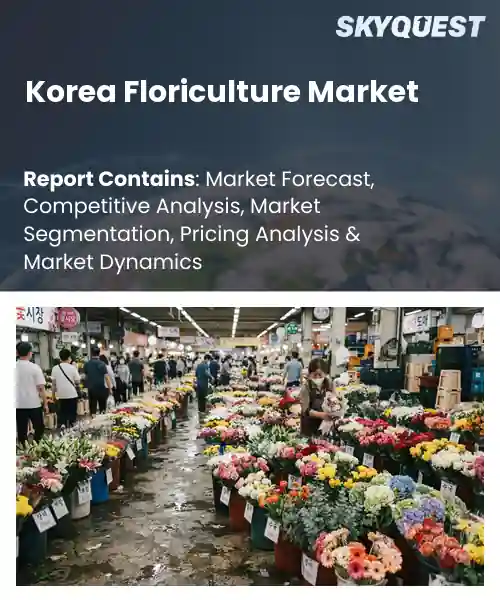
Korea Floriculture Market
Report ID: SQMIG30H2563
Report ID: SQMIG30H2563
[email protected]
USA +1 351-333-4748
Report ID:
SQMIG30H2563 |
Region:
Global |
Published Date: August, 2026
Pages:
157
|Tables:
93
|Figures:
76


Global Korea Floriculture Market size was valued at USD 2.43 Billion in 2024 and is poised to grow from USD 2.56 Billion in 2025 to USD 3.91 Billion by 2033, growing at a CAGR of 5.4% during the forecast period (2026-2033).
The Korean floriculture market, covering production and distribution of ornamental plants, cut flowers, and potted greens, is a pivotal segment of the horticultural economy. Its primary driver is rising domestic demand for aesthetically pleasing indoor and outdoor spaces, fueled by urbanization and a cultural emphasis on seasonal décor. Over the past decade, spending on floral arrangements for weddings, corporate events, and everyday gifting has risen by more than 15 percent annually, prompting growers to adopt greenhouse systems. For example, the Suwon region now supplies 40 percent of national cut‑flower output, showing how infrastructure and consumer preferences have reshaped the market. Export expansion acts as the catalyst that lifts the Korean floriculture market onto the stage, because producers use advanced breeding to create varieties meeting standards for longevity and aesthetics. This capability opened channels in China, Japan, and the United Arab Emirates, where cut‑flower demand exceeds local supply, prompting Korean firms to secure long‑term contracts that stabilize revenues. Government incentives for cultivation lower costs by encouraging LED lighting and water‑recycling systems. A notable example is a Seoul greenhouse supplying seasonal bouquets to a Dubai hotel chain, showcasing horticulture and demonstrating how technology and export focus drive market growth and brand recognition.
How is AI-driven automation influencing the Korea floriculture market?
AI-driven automation is reshaping Korea’s floriculture sector by integrating smart sensors, predictive analytics, and robotic handling into greenhouse operations. Growers now use AI to monitor temperature, humidity, and light levels in real time, allowing precise adjustments that boost flower quality and reduce waste. Data‑driven pest detection helps limit chemical use, while automated pruning and harvesting machines free labor for higher‑value tasks. These technologies create more consistent yields and enable smaller farms to compete with larger producers, fostering a more resilient and innovative market environment.In March 2026, a leading Korean greenhouse operator introduced an AI‑powered climate control system, streamlining energy use and enhancing bloom consistency, which underscores how automation is driving efficiency and growth in the sector.
Market snapshot - (2026-2033)
Global Market Size
USD 2.43 Billion
Largest Segment
Cut Flowers
Fastest Growth
Potted Plants
Growth Rate
5.4% CAGR
To get more insights on this market click here to Request a Free Sample Report
Global korea floriculture market is segmented by product type, application, distribution channel and region. Based on product type, the market is segmented into Cut Flowers, Potted Plants, Bedding Plants and Nursery Stock. Based on application, the market is segmented into Ornamental, Landscaping, Gifting and Events & Decorations. Based on distribution channel, the market is segmented into Wholesale Markets, Florists, Garden Centers and Online Retail. Based on region, the market is segmented into North America, Europe, Asia Pacific, Latin America and Middle East & Africa.
Cut Flowers segment dominates because they are the primary revenue driver for Korean florists, offering high aesthetic value and quick turnover. Their popularity is reinforced by cultural traditions that prioritize fresh bouquets for celebrations, and by a supply chain that ensures consistent availability. Additionally, the visual impact of cut flowers aligns with Korean interior design trends, encouraging frequent purchases for personal and corporate settings and seasonal gifting occasions throughout the year.
However, Potted Plants segment is witnessing the strongest growth momentum because urban dwellers are increasingly adopting indoor greenery for wellness and space efficiency. Innovative container designs and low maintenance varieties are expanding consumer appeal, while retail outlets promote them as lifestyle accessories, accelerating market expansion and creating new revenue streams.
Gifting segment leads because flowers are embedded in Korean social customs, symbolizing respect, gratitude and celebration. The emotional resonance of gifting drives repeat purchases across birthdays, anniversaries and corporate milestones, while retailers tailor packaging to enhance perceived value. This cultural alignment fuels consistent demand, making gifting the cornerstone of sales strategies and reinforcing its market leadership. Additionally, the rise of e commerce platforms enables convenient ordering and same day delivery, further embedding flower gifting into everyday life.
Meanwhile, Events and Decorations segment emerges as the key high growth area because corporate functions, festivals and pop culture gatherings increasingly rely on elaborate floral displays to create immersive experiences. Creative collaborations with designers and the adoption of sustainable materials boost appeal, driving rapid market expansion and opening new channels for specialized services.
To get detailed segments analysis, Request a Free Sample Report
Asia Pacific leverages a deep cultural affinity for ornamental horticulture, robust distribution networks, and advanced greenhouse technologies that together create a fertile environment for Korea floriculture products. Consumer preferences in the region emphasize premium quality and seasonal variety, encouraging retailers to source from Korea for its reputation of meticulous cultivation. Strategic trade agreements facilitate smooth logistics, while proximity reduces lead times and transportation costs, reinforcing supply chain resilience. Collaborative research initiatives between regional growers and Korean innovators drive continuous improvement in breeding and post‑harvest handling, further cementing the region’s leadership position in the market.
Japan Korea Floriculture Market
Korea Floriculture Market benefits from Japan’s sophisticated retail landscape, where high consumer expectations for aesthetic excellence drive demand for premium Korean blooms. Strong partnerships with Japanese distributors enable seamless market entry, while shared expertise in greenhouse management enhances product consistency. Cultural events and seasonal festivals in Japan create recurring peaks in demand, encouraging Korean growers to align production cycles with local celebrations. The emphasis on quality and design in Japanese floral arrangements reinforces the reputation of Korean varieties as desirable choices for both private and commercial settings.
South Korea Korea Floriculture Market
Korea Floriculture Market thrives within its home country, where a vibrant domestic culture celebrates flowers in everyday life and special occasions. Extensive retail channels, from traditional markets to modern e‑commerce platforms, provide diverse avenues for Korean growers to reach consumers. Government support for horticultural research and sustainable practices fuels innovation, resulting in a broad portfolio of cultivars that meet evolving aesthetic trends. Strong consumer loyalty to locally produced flowers reinforces market stability, while export‑oriented producers leverage domestic expertise to meet international standards.
Europe’s growing appreciation for exotic and high‑quality ornamental plants aligns closely with the strengths of Korean floriculture, propelling rapid market expansion. Consumers across the continent seek distinctive varieties that combine visual appeal with durability, positioning Korean offerings as attractive alternatives to traditional European stock. Collaborative marketing initiatives and participation in prominent horticultural exhibitions raise brand visibility, while the region’s well‑established logistics infrastructure supports efficient distribution. Environmental awareness drives demand for sustainably cultivated blooms, a niche where Korean growers excel through eco‑friendly practices. These converging factors create a fertile ground for continued growth and deeper market penetration.
Germany Korea Floriculture Market
Korea Floriculture Market finds a receptive audience in Germany, where a strong tradition of garden design and indoor decoration fuels demand for diverse floral options. German retailers value the reliability and consistency of Korean cultivars, integrating them into seasonal assortments that cater to both private consumers and professional florists. Collaborative research projects between German horticultural institutes and Korean growers enhance breeding programs, ensuring that new varieties meet local climate and aesthetic preferences. The emphasis on sustainability in German supply chains aligns with Korean eco‑friendly production methods, reinforcing market confidence.
United Kingdom Korea Floriculture Market
Korea Floriculture Market experiences accelerated uptake in the United Kingdom, where a dynamic retail environment and a penchant for innovative floral designs drive interest in Korean products. British consumers prioritize freshness and visual impact, attributes that Korean growers consistently deliver through advanced post‑harvest techniques. Partnerships with leading UK wholesalers facilitate rapid market entry, while participation in high‑profile garden shows amplifies brand exposure. The United Kingdom’s focus on sustainable sourcing resonates with Korean growers’ commitment to environmentally responsible cultivation, fostering strong buyer confidence.
France Korea Floriculture Market
Korea Floriculture Market is emerging in France, where a sophisticated appreciation for artistic floral arrangements creates opportunities for Korean varieties. French boutique florists seek unique blooms that complement classic design sensibilities, and Korean cultivars offer distinctive color palettes and forms. Collaborative exchanges with French horticultural schools encourage knowledge sharing, enhancing adaptation of Korean plants to local growing conditions. Growing consumer interest in ethically produced flowers aligns with Korean sustainable practices, supporting gradual market acceptance and expansion.
North America’s expansive retail landscape and evolving consumer tastes provide a robust platform for Korean floriculture to deepen its market presence. The region’s emphasis on convenience, coupled with a rising demand for premium, long‑lasting blooms, aligns with Korean expertise in high‑quality production and innovative packaging. Strategic alliances with major garden centers and online platforms enable broader distribution, while participation in industry trade shows raises brand awareness among professional growers and retailers. Environmental consciousness among North American buyers further amplifies interest in Korean sustainable cultivation methods, reinforcing the region’s role as a key growth engine for Korean floral exports.
United States Korea Floriculture Market
Korea Floriculture Market benefits from the United States’ diverse consumer base, where demand for fresh, vibrant flowers spans both residential and commercial sectors. Large‑scale retailers and specialty boutiques alike value the consistency and aesthetic appeal of Korean cultivars, integrating them into year‑round assortments. Collaborative initiatives with American horticultural research institutions drive the development of varieties suited to varied climatic zones, enhancing market relevance. The United States’ focus on sustainable sourcing dovetails with Korean eco‑friendly production, strengthening buyer confidence and fostering long‑term partnerships.
Canada Korea Floriculture Market
Korea Floriculture Market engages Canada’s market through a focus on quality and adaptability to cooler growing conditions. Canadian florists and garden centers appreciate the resilience of Korean varieties, which maintain visual appeal even in shorter daylight periods. Partnerships with Canadian distributors facilitate efficient logistics across vast geographic areas, ensuring timely delivery of fresh blooms. The country’s growing emphasis on environmentally responsible products aligns with Korean sustainable cultivation practices, supporting a mutually beneficial market relationship.
To know more about the market opportunities by region and country, click here to
Buy The Complete Report
Rising Demand For Ornamental Flowers
Growth Of Eco‑Friendly Gardening
High Production Cost Pressures
Regulatory Constraints on Pesticide Use
Request Free Customization of this report to help us to meet your business objectives.
The competitive landscape in the Korean floriculture sector is shaped by aggressive M&A activity, strategic partnerships with logistics providers, and rapid adoption of digital supply‑chain platforms, as exemplified by Dümmen Orange’s recent acquisition of a regional seed distributor and Ares3’s collaboration with a major e‑commerce retailer to streamline online flower sales. These moves intensify rivalry and drive innovation in breeding, distribution efficiency, and sustainability practices.
Top Player’s Company Profile
Recent Developments
SkyQuest’s ABIRAW (Advanced Business Intelligence, Research & Analysis Wing) is our Business Information Services team that Collects, Collates, Correlates, and Analyses the Data collected by means of Primary Exploratory Research backed by robust Secondary Desk research. As per SkyQuest analysis, the Korean floriculture market is being propelled primarily by rising demand for ornamental flowers, especially for gifting and events, while a secondary growth engine stems from the rapid adoption of eco‑friendly cultivation practices that command premium pricing and open export doors. The cut‑flower segment remains the market’s dominant revenue generator, supported by strong cultural preferences and efficient supply chains. Asia‑Pacific emerges as the leading region, capitalising on proximity, trade agreements and a deep appreciation for high‑quality blooms. However, high production costs, driven by labour, land and advanced greenhouse requirements, pose a notable restraint that could temper expansion unless mitigated through automation or scale efficiencies.
| Report Metric | Details |
|---|---|
| Market size value in 2024 | USD 2.43 Billion |
| Market size value in 2033 | USD 3.91 Billion |
| Growth Rate | 5.4% |
| Base year | 2024 |
| Forecast period | (2026-2033) |
| Forecast Unit (Value) | USD Billion |
| Segments covered |
|
| Regions covered | North America (US, Canada), Europe (Germany, France, United Kingdom, Italy, Spain, Rest of Europe), Asia Pacific (China, India, Japan, Rest of Asia-Pacific), Latin America (Brazil, Rest of Latin America), Middle East & Africa (South Africa, GCC Countries, Rest of MEA) |
| Companies covered |
|
| Customization scope | Free report customization with purchase. Customization includes:-
|
To get a free trial access to our platform which is a one stop solution for all your data requirements for quicker decision making. This platform allows you to compare markets, competitors who are prominent in the market, and mega trends that are influencing the dynamics in the market. Also, get access to detailed SkyQuest exclusive matrix.
Table Of Content
Executive Summary
Market overview
Parent Market Analysis
Market overview
Market size
KEY MARKET INSIGHTS
COVID IMPACT
MARKET DYNAMICS & OUTLOOK
Market Size by Region
KEY COMPANY PROFILES
Methodology
For the Korea Floriculture Market, our research methodology involved a mixture of primary and secondary data sources. Key steps involved in the research process are listed below:
1. Information Procurement: This stage involved the procurement of Market data or related information via primary and secondary sources. The various secondary sources used included various company websites, annual reports, trade databases, and paid databases such as Hoover's, Bloomberg Business, Factiva, and Avention. Our team did 45 primary interactions Globally which included several stakeholders such as manufacturers, customers, key opinion leaders, etc. Overall, information procurement was one of the most extensive stages in our research process.
2. Information Analysis: This step involved triangulation of data through bottom-up and top-down approaches to estimate and validate the total size and future estimate of the Korea Floriculture Market.
3. Report Formulation: The final step entailed the placement of data points in appropriate Market spaces in an attempt to deduce viable conclusions.
4. Validation & Publishing: Validation is the most important step in the process. Validation & re-validation via an intricately designed process helped us finalize data points to be used for final calculations. The final Market estimates and forecasts were then aligned and sent to our panel of industry experts for validation of data. Once the validation was done the report was sent to our Quality Assurance team to ensure adherence to style guides, consistency & design.
Analyst Support
Customization Options
With the given market data, our dedicated team of analysts can offer you the following customization options are available for the Korea Floriculture Market:
Product Analysis: Product matrix, which offers a detailed comparison of the product portfolio of companies.
Regional Analysis: Further analysis of the Korea Floriculture Market for additional countries.
Competitive Analysis: Detailed analysis and profiling of additional Market players & comparative analysis of competitive products.
Go to Market Strategy: Find the high-growth channels to invest your marketing efforts and increase your customer base.
Innovation Mapping: Identify racial solutions and innovation, connected to deep ecosystems of innovators, start-ups, academics, and strategic partners.
Category Intelligence: Customized intelligence that is relevant to their supply Markets will enable them to make smarter sourcing decisions and improve their category management.
Public Company Transcript Analysis: To improve the investment performance by generating new alpha and making better-informed decisions.
Social Media Listening: To analyze the conversations and trends happening not just around your brand, but around your industry as a whole, and use those insights to make better Marketing decisions.
REQUEST FOR SAMPLE
 REQUEST FREE CUSTOMIZATION


Want to customize this report? This report can be personalized according to your needs. Our analysts and industry experts will work directly with you to understand your requirements and provide you with customized data in a short amount of time. We offer $1000 worth of FREE customization at the time of purchase.
Feedback From Our Clients


 USA (+1) 351-333-4748

