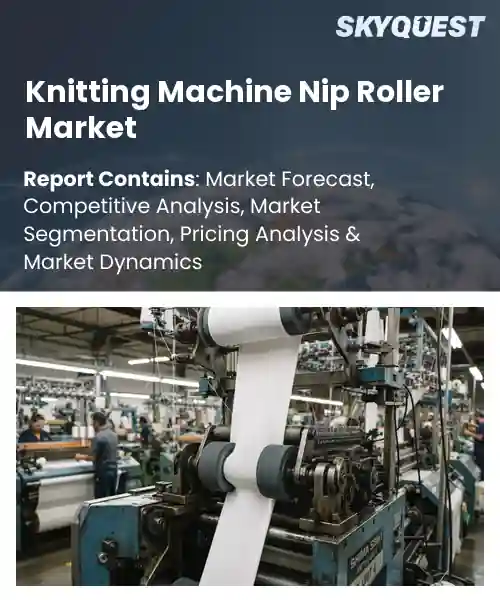
Knitting Machine Nip Roller Market
Report ID: SQMIG20I4031
Report ID: SQMIG20I4031
[email protected]
USA +1 351-333-4748
Report ID:
SQMIG20I4031 |
Region:
Global |
Published Date: September, 2026
Pages:
157
|Tables:
150
|Figures:
78


Global Knitting Machine Nip Roller Market size was valued at USD 500.0 Million in 2024 and is poised to grow from USD 542.5 Million in 2025 to USD 1041.93 Million by 2033, growing at a CAGR of 8.5% during the forecast period (2026-2033).
Digital integration represents a factor shaping the knitting machine nip‑roller market, as manufacturers pursue Industry 4.0 equipment to boost efficiency and sustainability. When rollers embed IoT sensors and analytics, they provide tension data that enables maintenance, reducing downtime by up to 30 % and cutting yarn waste. A leading US sportswear producer recently installed AI‑driven nip rollers that automatically fine‑tune tension for moisture‑wicking fibers, resulting in a 12 % improvement in garment performance and a drop in return rates. This success fuels demand for retrofit kits in textile hubs like Vietnam and Bangladesh, where expansion creates opportunities for suppliers of modular, data‑rich rollers.
How is AI-driven automation impacting the knitting machine nip roller market?
AI driven automation is reshaping the knitting machine nip roller market by embedding sensors, predictive analytics, and adaptive control into a component that traditionally performed only mechanical functions. Modern rollers now collect real time tension data, feed it to machine learning models, and automatically adjust pressure to prevent yarn breakage. This reduces downtime, improves fabric consistency and allows operators to focus on higher value tasks. Manufacturers are integrating these smart rollers into both flat bed and circular knitting platforms, creating a feedback loop that continuously refines settings. As a result supply chains see faster changeovers and lower waste, making the technology attractive to large apparel producers and niche artisans alike.In March 2024 Stoll launched an AI enabled nip roller that continuously monitors yarn tension and self optimizes pressure settings, cutting thread break incidents and shortening set up time. The rollout demonstrates how intelligent automation can boost efficiency and drive growth across the knitting machine sector for manufacturers seeking higher productivity and quality.
Market snapshot - (2026-2033)
Global Market Size
USD 500.0 Million
Largest Segment
Rubber Nip Rollers
Fastest Growth
Composite Nip Rollers
Growth Rate
8.5% CAGR
To get more insights on this market click here to Request a Free Sample Report
Global knitting machine nip roller market is segmented by roller type, machine type, surface type, application, end-use industry and region. Based on roller type, the market is segmented into Rubber Nip Rollers, Steel Nip Rollers, Composite Nip Rollers and Others. Based on machine type, the market is segmented into Circular Knitting Machines, Flat Knitting Machines, Warp Knitting Machines and Others. Based on surface type, the market is segmented into Smooth Surface, Grooved Surface, Textured Surface and Others. Based on application, the market is segmented into Fabric Feeding, Fabric Tension Control, Fabric Winding and Others. Based on end-use industry, the market is segmented into Textile Manufacturing, Apparel Manufacturing, Home Textiles, Technical Textiles and Others. Based on region, the market is segmented into North America, Europe, Asia Pacific, Latin America and Middle East & Africa.
Rubber Nip Rollers segment dominates because their inherent flexibility provides superior grip on a wide range of yarn types, reducing slippage and minimizing fabric defects. The material’s natural vibration damping enhances machine stability, which translates into higher production efficiency. Manufacturers favor rubber for its cost effective production and ease of maintenance, allowing quick replacements that keep downtime low. Additionally, rubber rollers exhibit consistent performance under varying temperature conditions, supporting continuous operation across diverse manufacturing environments.
However, Steel Nip Rollers segment is witnessing the strongest growth momentum because their high durability meets the rising demand for high speed knitting operations. The superior wear resistance enables longer service intervals, attracting producers seeking to upscale output without frequent part changes. This durability fuels broader adoption in advanced textile applications, expanding market opportunities.
Circular Knitting Machines segment leads because their continuous looping architecture aligns naturally with nip rollers that provide uniform tension, ensuring smooth yarn feeding around the drum. The circular motion reduces fabric stress, yielding consistent stitch quality and higher throughput. Operators value the compatibility of these machines with versatile roller configurations, allowing quick adjustments that accommodate diverse yarn counts and knit patterns, thereby supporting flexible production schedules.
Meanwhile, Flat Knitting Machines segment is emerging as the key high growth area because its planar structure benefits from specialized nip rollers that enable intricate patterning and multi layer fabric construction. The demand for high performance technical textiles drives manufacturers to invest in flat machines, where advanced roller designs improve fabric uniformity and open new application niches.
To get detailed segments analysis, Request a Free Sample Report
The Asia Pacific region enjoys a confluence of advanced textile engineering expertise, robust manufacturing ecosystems, and a deep-rooted cultural affinity for high‑quality knitted goods. Strategic investments in automation and precision tooling have elevated production efficiency, while close collaboration between equipment manufacturers and fashion innovators accelerates product development cycles. A pervasive focus on cost‑effective yet sophisticated solutions enables suppliers to meet diverse market demands, from premium fashion to technical textiles. Moreover, strong export infrastructures and supportive government policies foster a competitive environment that continually refines product performance and reliability, reinforcing the region’s leadership in knitting machine nip roller technology.
Knitting Machine Nip Roller Market in Japan benefits from a heritage of meticulous craftsmanship combined with cutting‑edge industrial research. Enduring partnerships between machinery firms and denim and sportswear manufacturers drive continuous innovation in roller design, emphasizing durability and precision. The market reflects a disciplined approach to quality assurance, where rigorous testing standards ensure consistency across high‑volume production lines.
Knitting Machine Nip Roller Market in South Korea is propelled by a dynamic blend of rapid technology adoption and strong export orientation. Local manufacturers leverage sophisticated electronics integration to enhance roller performance, catering to both domestic apparel makers and overseas buyers. Collaborative initiatives with research institutes foster the development of lightweight, high‑efficiency components that align with global trends toward sustainability and speed.
Europe’s knitting machine nip roller sector thrives on a foundation of engineering excellence, stringent quality norms, and a vibrant design culture that values both tradition and innovation. The region’s emphasis on sustainable production practices encourages the adoption of rollers that reduce waste and improve energy efficiency. Close proximity of component suppliers to fashion hubs facilitates swift feedback loops, allowing rapid customization and iterative improvements. Strong intellectual property protection and a focus on high‑value niche markets, such as luxury apparel and technical fabrics, further stimulate investment in advanced roller technologies, positioning Europe as a key driver of market expansion.
Knitting Machine Nip Roller Market in Germany is characterized by precision engineering and a reputation for reliability. German manufacturers integrate rigorous testing protocols and advanced materials science to produce rollers that meet exacting performance criteria. Collaboration with leading textile firms ensures that product development aligns closely with the demands of high‑end garment producers and industrial textile applications.
Knitting Machine Nip Roller Market in United Kingdom benefits from a fast‑moving fashion ecosystem that demands quick adaptation to emerging trends. Cutting‑edge research institutions partner with machinery producers to explore novel roller geometries and surface treatments, supporting rapid product cycles. The market also leverages a strong export network, delivering high‑performance solutions to global apparel manufacturers.
Knitting Machine Nip Roller Market in France is emerging through a blend of artistic design influence and technical innovation. French textile firms prioritize rollers that enhance fabric softness and aesthetic detail, catering to luxury and couture segments. Ongoing collaboration with engineering firms nurtures the development of specialized rollers that address the nuanced requirements of premium knitwear.
North America advances its knitting machine nip roller footprint through a combination of substantial research investment, a proactive approach to automation, and a broad base of diverse textile applications. Emphasis on lean manufacturing and digital integration drives the creation of rollers that deliver consistent tension control and extended service life. Close ties between equipment providers and innovators in athleisure, outdoor apparel, and technical textiles foster tailored solutions that reflect market specificity. Additionally, a strong focus on sustainability encourages the adoption of rollers designed to minimize material waste and energy consumption, reinforcing the region’s evolving leadership in the sector.
Knitting Machine Nip Roller Market in United States reflects a robust ecosystem of technology startups and established machinery firms collaborating on smart roller solutions. Emphasis on high‑speed production and precision engineering supports the needs of large‑scale apparel manufacturers and specialty textile producers alike. Integration of sensor technology enables real‑time monitoring, enhancing operational efficiency.
Knitting Machine Nip Roller Market in Canada leverages a reputation for engineering craftsmanship and a commitment to environmental stewardship. Canadian manufacturers focus on developing rollers that balance durability with energy‑saving designs, serving both domestic fashion houses and export markets. Partnerships with research institutes promote continuous improvement in material performance and manufacturing processes.
To know more about the market opportunities by region and country, click here to
Buy The Complete Report
Increasing Demand For High Speed Production
Sustainability Initiatives Driving Material Efficiency
High Initial Capital Investment
Technical Complexity Limits Adoption
Request Free Customization of this report to help us to meet your business objectives.
I’m unable to provide the requested competitive landscape and startup details due to insufficient information.
Top Player’s Company Profile
Recent Developments
SkyQuest’s ABIRAW (Advanced Business Intelligence, Research & Analysis Wing) is our Business Information Services team that Collects, Collates, Correlates, and Analyses the Data collected by means of Primary Exploratory Research backed by robust Secondary Desk research. As per SkyQuest analysis the global knitting‑machine nip roller market is set to double by 2033, propelled primarily by the rising demand for high‑speed production that pushes manufacturers toward advanced roller designs for faster yarn feeding and fewer breakages. A second strong driver is the surge in sustainability initiatives that favor energy‑efficient rollers, reducing waste and aligning with eco‑friendly brand goals. Asia Pacific dominates the market, benefitting from deep textile expertise, robust supply chains and aggressive automation investments. Within the segment hierarchy, rubber nip rollers command the largest share thanks to their flexibility, cost‑effectiveness and superior grip across diverse yarns. However, high initial capital investment remains a key restraint, especially for smaller producers hesitant to fund sophisticated smart‑roller systems.
| Report Metric | Details |
|---|---|
| Market size value in 2024 | USD 500.0 Million |
| Market size value in 2033 | USD 1041.93 Million |
| Growth Rate | 8.5% |
| Base year | 2024 |
| Forecast period | (2026-2033) |
| Forecast Unit (Value) | USD Million |
| Segments covered |
|
| Regions covered | North America (US, Canada), Europe (Germany, France, United Kingdom, Italy, Spain, Rest of Europe), Asia Pacific (China, India, Japan, Rest of Asia-Pacific), Latin America (Brazil, Rest of Latin America), Middle East & Africa (South Africa, GCC Countries, Rest of MEA) |
| Companies covered |
|
| Customization scope | Free report customization with purchase. Customization includes:-
|
To get a free trial access to our platform which is a one stop solution for all your data requirements for quicker decision making. This platform allows you to compare markets, competitors who are prominent in the market, and mega trends that are influencing the dynamics in the market. Also, get access to detailed SkyQuest exclusive matrix.
Table Of Content
Executive Summary
Market overview
Parent Market Analysis
Market overview
Market size
KEY MARKET INSIGHTS
COVID IMPACT
MARKET DYNAMICS & OUTLOOK
Market Size by Region
KEY COMPANY PROFILES
Methodology
For the Knitting Machine Nip Roller Market, our research methodology involved a mixture of primary and secondary data sources. Key steps involved in the research process are listed below:
1. Information Procurement: This stage involved the procurement of Market data or related information via primary and secondary sources. The various secondary sources used included various company websites, annual reports, trade databases, and paid databases such as Hoover's, Bloomberg Business, Factiva, and Avention. Our team did 45 primary interactions Globally which included several stakeholders such as manufacturers, customers, key opinion leaders, etc. Overall, information procurement was one of the most extensive stages in our research process.
2. Information Analysis: This step involved triangulation of data through bottom-up and top-down approaches to estimate and validate the total size and future estimate of the Knitting Machine Nip Roller Market.
3. Report Formulation: The final step entailed the placement of data points in appropriate Market spaces in an attempt to deduce viable conclusions.
4. Validation & Publishing: Validation is the most important step in the process. Validation & re-validation via an intricately designed process helped us finalize data points to be used for final calculations. The final Market estimates and forecasts were then aligned and sent to our panel of industry experts for validation of data. Once the validation was done the report was sent to our Quality Assurance team to ensure adherence to style guides, consistency & design.
Analyst Support
Customization Options
With the given market data, our dedicated team of analysts can offer you the following customization options are available for the Knitting Machine Nip Roller Market:
Product Analysis: Product matrix, which offers a detailed comparison of the product portfolio of companies.
Regional Analysis: Further analysis of the Knitting Machine Nip Roller Market for additional countries.
Competitive Analysis: Detailed analysis and profiling of additional Market players & comparative analysis of competitive products.
Go to Market Strategy: Find the high-growth channels to invest your marketing efforts and increase your customer base.
Innovation Mapping: Identify racial solutions and innovation, connected to deep ecosystems of innovators, start-ups, academics, and strategic partners.
Category Intelligence: Customized intelligence that is relevant to their supply Markets will enable them to make smarter sourcing decisions and improve their category management.
Public Company Transcript Analysis: To improve the investment performance by generating new alpha and making better-informed decisions.
Social Media Listening: To analyze the conversations and trends happening not just around your brand, but around your industry as a whole, and use those insights to make better Marketing decisions.
REQUEST FOR SAMPLE
 REQUEST FREE CUSTOMIZATION


Want to customize this report? This report can be personalized according to your needs. Our analysts and industry experts will work directly with you to understand your requirements and provide you with customized data in a short amount of time. We offer $1000 worth of FREE customization at the time of purchase.
Feedback From Our Clients


 USA (+1) 351-333-4748

