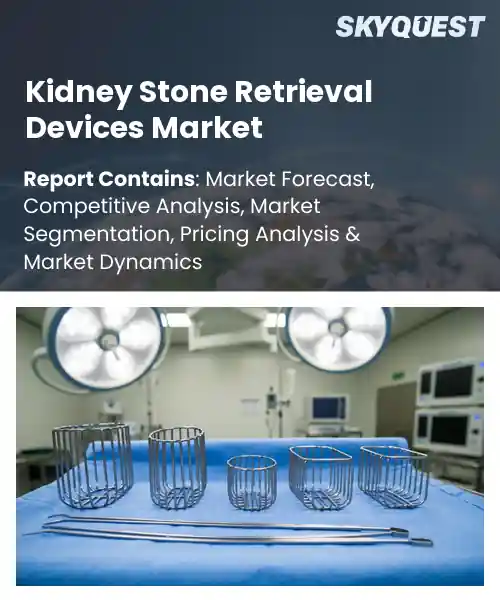
Kidney Stone Retrieval Devices Market
Report ID: SQMIG35A3680
Report ID: SQMIG35A3680
[email protected]
USA +1 351-333-4748
Report ID:
SQMIG35A3680 |
Region:
Global |
Published Date: June, 2026
Pages:
157
|Tables:
118
|Figures:
77


Global Kidney Stone Retrieval Devices Market size was valued at USD 1082.5 Million in 2024 and is poised to grow from USD 1158.49 Million in 2025 to USD 1985.4 Million by 2033, growing at a CAGR of 7.02% during the forecast period (2026-2033).
The primary driver of the kidney stone retrieval devices industry is the rising burden of urolithiasis coupled with technological innovation that converts clinical need into commercial demand. This market comprises instruments used to locate, fragment and extract renal and ureteral calculi, and it matters because improved devices reduce morbidity and healthcare costs while enabling outpatient care.
Consequently, the pivotal factor shaping market trajectories is the accelerated shift toward minimally invasive and single-use retrieval technologies, which changes procurement, clinical workflow and economics. Hospitals and ambulatory surgery centers adopting disposable flexible ureteroscopes and single-use baskets reduce infection risk and costly repairs, so procedural volumes rise and capital expenditures decline. For example, outpatient clinics performing laser lithotripsy with disposable scopes can schedule more cases without sterilization delays, creating demand for consumables. This cause-and-effect dynamic attracts manufacturers to scale production, spurs value-based procurement negotiations and opens opportunities in emerging markets where sterilization infrastructure is limited, thereby amplifying global market growth.
How is AI enhancing procedural efficiency in the kidney stone retrieval devices market?
AI is progressively optimizing the workflow of extracting kidney stones through image interpretation, identifying stone fragments and controlling instruments and through improving the overall flow of operations. This involves providing real time image segmentation to display the stones during ureteroscopy, utilizing computational decision support to assist the operator in targeting the laser for the fragmentation of the stones and automating the process of manipulating and controlling the scope during the procedure. The kidney stone retrieval devices market trend within the kidney stone retrieval market is toward combined systems that offer aspiration ureteroscopes with both AI-based detection capabilities and training tools to reduce the duration of the procedure and enable more consistent outcomes. There is evidence in the clinical literature that the automated feature may improve the ability to detect stones during the performance of ureteroscopy. Data from previous studies presented at major cardiology congresses have indicated significant improvements with respect to stone clearance and a more efficient flow through the procedure with the utilization of aspiration-enabled systems.
One of the most important indicators of progress within the surgical market is the completion of Korea’s first AI-assisted kidney stone retrieval surgical robot which was performed using the “Zamenix” platform in April 2026. The clinical trial demonstrated the capability of real-time tracking and replaying of stone retrieval operations while reducing staff exposure to injury due to repetitive movement and providing greater operator comfort and convenience to perform the surgery in a more reproducible, efficient manner. The results of the study demonstrate the potential of AI-based kidney stone retrieval platforms for future widespread utilization.
Market snapshot - (2026-2033)
Global Market Size
USD 1082.5 Million
Largest Segment
Ureteral Stents
Fastest Growth
Stone Baskets & Graspers
Growth Rate
7.02% CAGR
To get more insights on this market click here to Request a Free Sample Report
Global kidney stone retrieval devices market is segmented by device type, procedure, end-user, distribution and region. Based on device type, the market is segmented into Ureteral Stents, Stone Baskets & Graspers, Balloon Dilators, Guidewires and Ureteral Access Sheaths. Based on procedure, the market is segmented into Ureteroscopy, Percutaneous Nephrolithotomy (PCNL) and Extracorporeal Shock Wave Lithotripsy (ESWL). Based on end-user, the market is segmented into Hospitals, Urology Clinics and ASCs. Based on distribution, the market is segmented into Direct and Distributors. Based on region, the market is segmented into North America, Europe, Asia Pacific, Latin America and Middle East & Africa.
Ureteral stents segment dominates with large kidney stone retrieval devices market share because they are foundational in perioperative management and long term drainage for stone patients, creating consistent demand across treatment settings. Their broad clinical acceptance, predictable safety profile, and compatibility with other retrieval technologies drive procurement preferences and recurring purchases. Providers favor stents to prevent obstruction and facilitate staged procedures, which sustains manufacturer investment in design improvements and supply chain prioritization, reinforcing their leading market role.
As per global kidney stone retrieval devices market outlook, stone baskets and graspers are emerging as the most rapidly expanding device class due to innovation in single use designs and improved retrieval efficiency, prompting wider adoption in minimally invasive procedures. Enhanced maneuverability and compatibility with smaller endoscopes broaden clinical applications and create new procurement opportunities for manufacturers and distributors, accelerating market growth.
As per global kidney stone retrieval devices market forecast, ureteroscopy segment dominates because it enables direct visualization and instrument based stone removal across a wide range of stone sizes and locations, making it the procedural backbone for device utilization. Its compatibility with flexible scopes and adjunctive tools drives routine procurement of retrieval baskets, guidewires, and access sheaths, while clinician preference for minimally invasive, scope based interventions fuels sustained innovation and training investments that reinforce its market primacy.
As per global kidney stone retrieval devices market analysis, percutaneous nephrolithotomy (PCNL) is emerging as the fastest growing procedure due to miniaturization trends, improved access systems, and demand for effective management of complex stones. Advances in dedicated instruments and perioperative devices expand procedural eligibility and create high value procurement needs, drawing manufacturer R&D and opening new opportunities for specialized device categories that will broaden market scope.
To get detailed segments analysis, Request a Free Sample Report
As per kidney stone retrieval devices market regional outlook, dominance of North America can be attributed to the presence of high-end clinical infrastructure, concentration of endourology expertise, and a supportive innovation ecosystem. Minimally invasive retrieval methods and integrated imaging are early-adopted by hospitals and specialized centers, and collaborative networks speed clinical evaluation and protocol development. The mature reimbursement system and available financial markets allow manufacturers to engage in iterative device enhancements and market education. Regulatory paths that balance safety with predictable timelines further incentivize commercialization. Professional development courses and patient education programs extensively maintain clinical competence and openness to innovative approaches. Robust after sales support and specific distribution channels allow for reliable device adoption throughout care settings.
As per kidney stone retrieval devices industry analysis, United States is characterized by concentration of leading device manufacturers, widespread specialist centers, and rapid clinical acceptance of minimally invasive procedures. Existing reimbursement structures and dense networks for clinical training enable ongoing refining of procedural procedures. Innovation and penetration Strong industry investment in product development and cooperation with academic hospitals foster innovation and penetration.
As per kidney stone retrieval devices market regional forecast, Canada kidney stone retrieval devices market operates within a healthcare system that emphasizes equal access and institutional purchasing. Urban hospital urology units with specialized staff have clinical demand for reliable, cost effective retrieval instruments. Clinical facilities with vendors from different countries help to test devices and teach clinicians. Value based selection and coordinated purchasing processes impact procurement decisions and ongoing device utilization across care settings and post market monitoring activities.
Europe is growing fast driven by a combination of clinical demand, regulatory harmonization and a varied industrial base that encourages both established and new device providers. Strong public and private hospital networks drive the implementation of minimally invasive retrieval technology. Clinical guidelines and collaborative registries across the continent facilitate the standardization of care and evidence gathering. Germany adds manufacturing depth and clinical leadership UK demonstrates acceleration with targeted investments and pathway modernization. France is developing capacity with targeted clinical programs Cross border information exchange, streamlined procurement efforts and a focus on cost effective, outcome focused gadgets further drive market adoption across a range of care settings.
Germany is anchored by a strong manufacturing ecosystem and clinical expertise. Medtech firms and specialized hospital networks collaborate on device refinement and evaluation, supporting high standards for performance and safety. Institutional procurement and a focus on engineering excellence encourage development of advanced retrieval instruments. Training programs and close ties between research institutions and industry sustain innovation and leadership in device design and clinical practice.
United Kingdom benefits from targeted healthcare modernization and investment in specialist centers. Regional initiatives have accelerated clinical adoption of innovative retrieval technologies. Collaboration between public providers and industry supports pragmatic device assessment and clinician training. Procurement frameworks that reward value driven outcomes encourage suppliers to demonstrate procedural efficiency, while clinician networks enable dissemination of best practice across hospitals and support scaling of effective devices.
France is evolving as clinical programs and specialty centers expand procedural capacity. Hospitals and academic clinics emphasize robust clinical evidence and device reliability in selection. Local manufacturers and multinational suppliers engage in clinician training to demonstrate value in practice. Centralized purchasing and emphasis on cost effective clinical pathways influence adoption patterns, while growing attention to minimally invasive treatments supports integration of advanced retrieval technologies.
Asia Pacific is strengthening its position through a combination of domestic innovation, strategic partnerships, and expanding clinical capability in specialized centers. Japan and South Korea offer technical expertise and quality of manufacturing, which enable the localized production of retrieval equipment. Joint partnership with foreign suppliers hastens the transfer of knowledge. Clinical training programs, procedural competence building and targeted regulatory engagement help integrate sophisticated devices into practice. Distribution networks and specific market strategies increase accessibility in large urban hospitals and a focus on cost effective, high performance solutions making the region an increasingly important source of both demand and device development. Incentives from both the public and private sectors are driving research and clinical studies to validate the benefits of devices for local patient populations. Adoption by clinicians is further facilitated by after sales support networks and regional device modification, allowing for continuous market expansion throughout the area.
Japan market is distinguished by precision engineering and stringent clinical assessment. Domestic producers design high quality instruments that focus on incremental improvements and reliability. Tertiary hospital networks and urology units have developed retrieval technology and generate evidence. Collaboration with industry and academic centers promotes clinician training and iterative design and complete after sales support and supplier ties ensures device availability throughout care settings .
South Korea is driven by strong industrial capability and medical innovation. Manufacturers leverage expertise in precision components to develop competitive retrieval systems. Modern hospital facilities and specialized clinical teams adopt advanced techniques supported by training programs. Government initiatives and industry academic partnerships facilitate regulatory engagement and product refinement. Efficient distribution channels and focus on cost performance support adoption across public and private care providers.
To know more about the market opportunities by region and country, click here to
Buy The Complete Report
Rising Prevalence Of Kidney Stones
Technological Advancements In Devices
High Procedure Costs And Reimbursement
Shortage Of Skilled Urologists
Request Free Customization of this report to help us to meet your business objectives.
Competitive landscape in the global kidney stone retrieval devices industry is shifting as incumbents execute acquisitions and startups push device innovation. Recent strategic moves include Farco Pharma’s acquisition of a hydrogel fragment solution and startup accelerator partnerships that helped Maguro Surgical progress.
SkyQuest’s ABIRAW (Advanced Business Intelligence, Research & Analysis Wing) is our Business Information Services team that Collects, Collates, Correlates, and Analyses the Data collected by means of Primary Exploratory Research backed by robust Secondary Desk research.
As per SkyQuest analysis, the global kidney stone retrieval devices market growth is being driven primarily by the rising prevalence of kidney stones, which increases procedural demand and recurring device use, but growth is constrained by high procedure costs and inconsistent reimbursement that slow adoption in cost-sensitive settings. North America currently dominates the market due to advanced clinical infrastructure and early adoption of minimally invasive technologies, and ureteral stents remain the dominating segment because of their routine perioperative and drainage role. Technological advancements, including miniaturization, integrated imaging, AI-assisted workflows and single-use platforms, act as a second major driver by improving efficiency and expanding outpatient care. The market trend is witnessing significant growth driven by the increasing prevalence of kidney stones, rising adoption of minimally invasive urological procedures, and growing demand for advanced stone retrieval technologies.
| Report Metric | Details |
|---|---|
| Market size value in 2024 | USD 1082.5 Million |
| Market size value in 2033 | USD 1985.4 Million |
| Growth Rate | 7.02% |
| Base year | 2024 |
| Forecast period | (2026-2033) |
| Forecast Unit (Value) | USD Million |
| Segments covered |
|
| Regions covered | North America (US, Canada), Europe (Germany, France, United Kingdom, Italy, Spain, Rest of Europe), Asia Pacific (China, India, Japan, Rest of Asia-Pacific), Latin America (Brazil, Rest of Latin America), Middle East & Africa (South Africa, GCC Countries, Rest of MEA) |
| Companies covered |
|
| Customization scope | Free report customization with purchase. Customization includes:-
|
To get a free trial access to our platform which is a one stop solution for all your data requirements for quicker decision making. This platform allows you to compare markets, competitors who are prominent in the market, and mega trends that are influencing the dynamics in the market. Also, get access to detailed SkyQuest exclusive matrix.
Table Of Content
Executive Summary
Market overview
Parent Market Analysis
Market overview
Market size
KEY MARKET INSIGHTS
COVID IMPACT
MARKET DYNAMICS & OUTLOOK
Market Size by Region
KEY COMPANY PROFILES
Methodology
For the Kidney Stone Retrieval Devices Market, our research methodology involved a mixture of primary and secondary data sources. Key steps involved in the research process are listed below:
1. Information Procurement: This stage involved the procurement of Market data or related information via primary and secondary sources. The various secondary sources used included various company websites, annual reports, trade databases, and paid databases such as Hoover's, Bloomberg Business, Factiva, and Avention. Our team did 45 primary interactions Globally which included several stakeholders such as manufacturers, customers, key opinion leaders, etc. Overall, information procurement was one of the most extensive stages in our research process.
2. Information Analysis: This step involved triangulation of data through bottom-up and top-down approaches to estimate and validate the total size and future estimate of the Kidney Stone Retrieval Devices Market.
3. Report Formulation: The final step entailed the placement of data points in appropriate Market spaces in an attempt to deduce viable conclusions.
4. Validation & Publishing: Validation is the most important step in the process. Validation & re-validation via an intricately designed process helped us finalize data points to be used for final calculations. The final Market estimates and forecasts were then aligned and sent to our panel of industry experts for validation of data. Once the validation was done the report was sent to our Quality Assurance team to ensure adherence to style guides, consistency & design.
Analyst Support
Customization Options
With the given market data, our dedicated team of analysts can offer you the following customization options are available for the Kidney Stone Retrieval Devices Market:
Product Analysis: Product matrix, which offers a detailed comparison of the product portfolio of companies.
Regional Analysis: Further analysis of the Kidney Stone Retrieval Devices Market for additional countries.
Competitive Analysis: Detailed analysis and profiling of additional Market players & comparative analysis of competitive products.
Go to Market Strategy: Find the high-growth channels to invest your marketing efforts and increase your customer base.
Innovation Mapping: Identify racial solutions and innovation, connected to deep ecosystems of innovators, start-ups, academics, and strategic partners.
Category Intelligence: Customized intelligence that is relevant to their supply Markets will enable them to make smarter sourcing decisions and improve their category management.
Public Company Transcript Analysis: To improve the investment performance by generating new alpha and making better-informed decisions.
Social Media Listening: To analyze the conversations and trends happening not just around your brand, but around your industry as a whole, and use those insights to make better Marketing decisions.
REQUEST FOR SAMPLE
 REQUEST FREE CUSTOMIZATION
Global Kidney Stone Retrieval Devices Market size was valued at USD 1082.5 Million in 2024 and is poised to grow from USD 1158.49 Million in 2025 to USD 1985.4 Million by 2033, growing at a CAGR of 7.02% during the forecast period (2026-2033).
Competitive landscape in the global kidney stone retrieval devices market is shifting as incumbents execute acquisitions and startups push device innovation. Recent strategic moves include Farco Pharma’s acquisition of a hydrogel fragment solution and startup accelerator partnerships that helped Maguro Surgical progress. Regulatory milestones and product clearances for noninvasive and vacuum aspiration systems are accelerating consolidation and selective partnerships between large medtech firms and specialist innovators. 'Boston Scientific', 'Olympus Corporation', 'Cook Medical', 'Karl Storz SE', 'Coloplast A/S', 'BD (Becton Dickinson)', 'NN Inc.', 'Cogentix Medical', 'Urotech', 'Bard Medical (BD)', 'Teleflex Inc.', 'Applied Medical', 'Medi-Globe GmbH', 'Gemini Medical Technologies', 'Advin Health Care', 'Endo-Flex GmbH', 'Carag AG', 'Micro-Tech (Nanjing)', 'Sumitomo Bakelite', 'Richard Wolf GmbH'
The increasing number of individuals affected by kidney stone conditions is elevating clinical demand for effective retrieval solutions, prompting healthcare providers to adopt a broader range of minimally invasive instruments. This persistent clinical need encourages manufacturers to expand product portfolios and enhance accessibility across care settings, driving innovation in device design and procedural compatibility. As clinicians seek reliable, patient centered options that reduce recovery time and complications, procurement decisions and treatment pathways increasingly prioritize availability of advanced retrieval technologies and outcomes.
𝗠𝗶𝗻𝗶𝗺𝗮𝗹𝗹𝘆 𝗜𝗻𝘃𝗮𝘀𝗶𝘃𝗲 𝗗𝗲𝘃𝗶𝗰𝗲 𝗜𝗻𝗻𝗼𝘃𝗮𝘁𝗶𝗼𝗻: The market is shifting toward increasingly miniaturized, ergonomically refined retrieval systems that emphasize precision and patient comfort. Manufacturers are focusing on novel materials, single-use platforms, and integrated laser and grasping technologies to simplify stone capture while reducing tissue trauma. Design efforts prioritize device flexibility, maneuverability in complex anatomies, and streamlining of procedures for broader clinical adoption. Collaboration with clinicians is accelerating iterative improvements and encouraging differentiated product portfolios that address diverse clinical needs across inpatient and outpatient settings.
Why does North America Dominate the Global Kidney Stone Retrieval Devices Market? |@12


Want to customize this report? This report can be personalized according to your needs. Our analysts and industry experts will work directly with you to understand your requirements and provide you with customized data in a short amount of time. We offer $1000 worth of FREE customization at the time of purchase.
Feedback From Our Clients


 USA (+1) 351-333-4748

