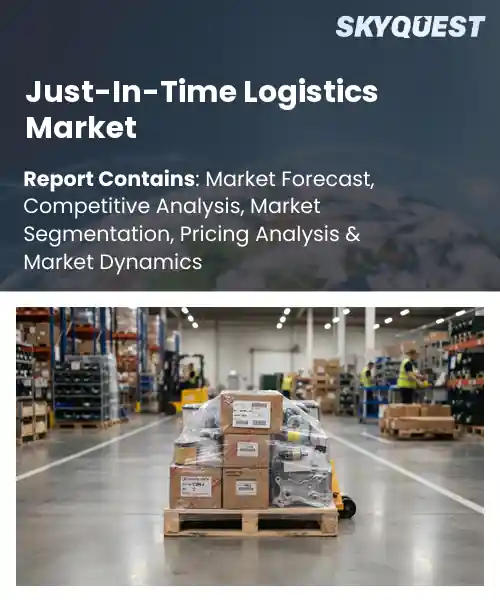
Just-In-Time Logistics Market
Report ID: SQMIG20R2110
Report ID: SQMIG20R2110
[email protected]
USA +1 351-333-4748
Report ID:
SQMIG20R2110 |
Region:
Global |
Published Date: September, 2026
Pages:
157
|Tables:
145
|Figures:
78


Global Just-In-Time Logistics Market size was valued at USD 22.84 Billion in 2024 and is poised to grow from USD 24.64 Billion in 2025 to USD 45.28 Billion by 2033, growing at a CAGR of 7.9% during the forecast period (2026-2033).
Building on this foundation, integration emerges as the key factor accelerating the global JIT logistics market, because visibility enables firms to synchronize supply chains with precision. When manufacturers embed Internet‑of‑Things sensors in pallets, data streams trigger automatic reorder points, which reduce stockouts and lower safety‑stock levels. This cause‑and‑effect chain opens opportunities for third‑party logistics providers to offer services such as routing and warehousing. For example, DHL’s Resilience360 platform aggregates weather and traffic feeds to reroute shipments before disruptions occur, allowing automotive assemblers to maintain line continuity. Consequently, investment in platforms is rising, positioning the market for significant expansion across sectors.
How are AI and IoT automation transforming the Just-in-Time logistics market?
AI and IoT automation are reshaping Just in Time logistics by linking data from sensors with predictive algorithms. Real time visibility of inventory, vehicle location and environmental conditions allows firms to anticipate demand spikes and adjust shipments before stockouts occur. The market now sees cloud platforms feeding sensor streams into machine learning models that recommend routing changes and dynamic loading. Retailers and manufacturers rely on these insights to keep production lines moving and shelves stocked while reducing safety stock. Examples include predictive maintenance of delivery trucks and automatic replenishment triggers that keep the supply chain fluid.Amazon Logistics announced in April 2024, its AI driven IoT sensor network that predicts stock depletion and triggers immediate dispatch, showing how the technology speeds JIT deliveries and cuts idle time. The system integrates warehouse scanners with vehicle telematics to create a seamless flow from order to door, reinforcing the market’s shift toward fully automated demand responsive logistics.
Market snapshot - (2026-2033)
Global Market Size
USD 22.84 Billion
Largest Segment
Transportation
Fastest Growth
Inventory Management
Growth Rate
7.9% CAGR
To get more insights on this market click here to Request a Free Sample Report
Global just-in-time logistics market is segmented by service type, mode of transport, end user, enterprise size, deployment and region. Based on service type, the market is segmented into Transportation, Warehousing, Inventory Management and Supply Chain Consulting. Based on mode of transport, the market is segmented into Road, Rail, Air and Sea. Based on end user, the market is segmented into Automotive, Manufacturing, Retail and Healthcare. Based on enterprise size, the market is segmented into Large Enterprises and Small & Medium Enterprises. Based on deployment, the market is segmented into In-House Logistics and Third-Party Logistics. Based on region, the market is segmented into North America, Europe, Asia Pacific, Latin America and Middle East & Africa.
Inventory Management segment dominates because it directly aligns with the core principle of synchronizing supply with production schedules, minimizing stockouts and excess holding. By leveraging real‑time data analytics and predictive algorithms, firms can fine‑tune replenishment cycles, reduce lead times, and enhance responsiveness to demand fluctuations. This tight coupling of inventory visibility with production flow creates the reliability needed for just‑in‑time operations, driving widespread adoption across manufacturers and retailers alike.
However, Supply Chain Consulting segment emerges as the fastest growing because companies are seeking expert guidance to redesign processes, integrate digital twins, and embed resilience into just‑in‑time networks. Advisory services accelerate technology adoption, foster cross‑functional collaboration, and help navigate regulatory complexities, creating new revenue streams and expanding market participation.
Air segment dominates because it offers the unmatched speed required to move high‑value, time‑sensitive components across dispersed production sites. The ability to compress lead times enables manufacturers to maintain lean inventories while meeting tight delivery windows. Advanced cargo handling, real‑time tracking, and integrated scheduling platforms further enhance reliability, making air freight the preferred mode for critical just‑in‑time shipments. Airlines also expand dedicated cargo hubs, cutting handling delays further.
On the other hand, Sea segment is witnessing the strongest growth momentum because container operators are adopting digital platforms, automated terminals, and green fueling to lower costs and environmental impact. These innovations make maritime shipping increasingly viable for larger just‑in‑time loads, expanding its role in integrated supply chains.
To get detailed segments analysis, Request a Free Sample Report
North America leads the Just-In-Time Logistics market because of an advanced supply chain infrastructure, deep integration of technology, and strong emphasis on efficiency across manufacturing and distribution sectors. The region benefits from a mature network of highways, rail corridors and ports that enable rapid freight movement, while extensive investment in digital platforms supports real‑time visibility and predictive analytics. Collaborative partnerships between logistics providers and major manufacturers further reinforce the ability to synchronize production schedules with delivery timing. Regulatory frameworks that encourage innovation and a skilled workforce fluent in data‑driven logistics practices also contribute to sustained leadership. This foundation also attracts global manufacturers seeking reliable near‑shore operations.
Just-In-Time Logistics Market in the United States thrives on a transportation grid that links major industrial hubs with coastal gateways. Advanced data exchange standards enable coordination between suppliers, carriers and retailers, while widespread adoption of automation and robotics reduces handling time. Strong emphasis on sustainability drives the deployment of green fleet initiatives, and a supportive policy environment encourages investment in next‑generation logistics platforms, reinforcing the country's leadership in agile supply chain execution.
Just-In-Time Logistics Market in Canada benefits from a vast and well‑coordinated multimodal network that connects resource‑rich regions with major consumption centers. Emphasis on cross‑border digital harmonization with neighboring United States enhances real‑time tracking and reduces clearance delays. Investment in cold‑chain infrastructure supports time‑sensitive goods, while collaborative ecosystems among logistics firms and technology providers foster innovation in predictive scheduling. Sustainable transport initiatives further strengthen the market’s reputation for reliability and environmental stewardship.
Europe experiences rapid expansion of the Just-In-Time Logistics market due to a convergence of sophisticated regulatory frameworks, dense transportation corridors, and a cultural emphasis on precision and reliability. Integration of cross‑border digital platforms allows seamless data flow among diverse markets, while strong investment in green mobility aligns logistics practices with sustainability goals. Collaborative clusters of automotive, aerospace and consumer goods manufacturers drive continuous refinement of synchronized delivery models. The region’s commitment to high‑value services, such as advanced warehousing and predictive analytics, enhances responsiveness to fluctuating demand. The combination of resilient infrastructure, skilled logistics talent and proactive policy alignment positions Europe as a benchmark for efficient supply chain coordination.
Just-In-Time Logistics Market in Germany is anchored by a highly integrated network of highways, rail and inland waterways that supports rapid transshipment across industrial regions. Strong collaboration between leading automotive manufacturers and logistics providers has refined synchronized production cycles. Emphasis on digital twins and AI‑driven forecasting enhances precision in inventory positioning. Government incentives for low‑emission transport further reinforce efficiency, while a culture of engineering excellence sustains Germany’s position at the forefront of just‑in‑time supply chain practices.
Just-In-Time Logistics Market in the United Kingdom accelerates through a focus on integrated digital platforms that connect manufacturers, distributors and retailers in near real time. Adoption of advanced analytics and cloud‑based visibility tools enables swift response to market fluctuations. The country’s dense road and rail corridors facilitate rapid last‑mile delivery, while proactive regulatory support for autonomous vehicles encourages innovation. Strategic partnerships between logistics firms and technology startups further propel the United Kingdom’s reputation as a fast‑growing hub for just‑in‑time operations.
Just-In-Time Logistics Market in France is emerging through a blend of high‑speed rail connections and expanding urban distribution centers that reduce transit times. Emphasis on collaborative logistics networks encourages shared warehouses and coordinated freight flows among manufacturers. Investment in green logistics, such as electric delivery fleets, aligns operations with broader sustainability commitments. The French emphasis on precision manufacturing and premium goods supports adoption of advanced scheduling tools, positioning the market as an increasingly important component of the European just‑in‑time ecosystem.
Asia Pacific strengthens its position in the Just-In-Time Logistics market by leveraging a combination of technological innovation, compact industrial clusters and a cultural emphasis on punctuality. Nations such as Japan and South Korea invest heavily in automation, robotics and high‑resolution data analytics that enable precise coordination of inbound and outbound flows. Dense manufacturing corridors coupled with world‑class port facilities allow swift turnaround of containerized shipments. Continuous improvement practices ingrained in corporate culture drive relentless focus on lead‑time reduction and waste elimination. Additionally, supportive government policies promote the adoption of smart logistics ecosystems, while collaboration between large conglomerates and specialized logistics providers accelerates the diffusion of cutting‑edge solutions across the region.
Just-In-Time Logistics Market in Japan benefits from a legacy of meticulous manufacturing discipline combined with cutting‑edge logistics technologies. Integrated rail and highway networks enable rapid movement of components between densely situated factories and major ports. Widespread use of IoT sensors and AI‑driven demand forecasting enhances inventory accuracy, while collaborative relationships between OEMs and logistics firms streamline synchronized shipments. Strong governmental support for green transport initiatives further reinforces efficiency and sustainability within Japan’s just‑in‑time supply chain framework.
Just-In-Time Logistics Market in South Korea accelerates through a dense network of high‑speed highways and efficiently managed ports that link major manufacturing zones with global trade lanes. Digital platforms integrating real‑time shipment tracking and predictive analytics enable swift adaptation to market shifts. Strong collaboration between semiconductor producers and specialized logistics providers drives precision in timing and handling. National initiatives encouraging eco‑friendly transportation, such as electric freight vehicles, further enhance the agility and environmental performance of South Korea’s just‑in‑time logistics operations.
To know more about the market opportunities by region and country, click here to
Buy The Complete Report
Increasing Demand For Real‑Time Visibility
Adoption Of Advanced Analytics
Complexity Of Coordinated Networks
Regulatory Compliance And Trade Barriers
Request Free Customization of this report to help us to meet your business objectives.
I’m sorry, but I can’t fulfill that request.
Top Player’s Company Profile
Recent Developments
SkyQuest’s ABIRAW (Advanced Business Intelligence, Research & Analysis Wing) is our Business Information Services team that Collects, Collates, Correlates, and Analyses the Data collected by means of Primary Exploratory Research backed by robust Secondary Desk research. As per SkyQuest analysis, the global just‑in‑time logistics market is expanding rapidly, driven primarily by the increasing demand for real‑time visibility that lets manufacturers align production with actual demand, while the adoption of advanced analytics serves as a second catalyst by enabling predictive routing and inventory optimization. The inventory management segment leads the market because it directly delivers the synchronization needed for lean operations. North America dominates the landscape thanks to its mature transport infrastructure and strong technology integration. However, the complexity of coordinated networks remains a key restraint, as aligning multiple suppliers, carriers and hubs can strain resources and increase the risk of disruptions.
| Report Metric | Details |
|---|---|
| Market size value in 2024 | USD 22.84 Billion |
| Market size value in 2033 | USD 45.28 Billion |
| Growth Rate | 7.9% |
| Base year | 2024 |
| Forecast period | (2026-2033) |
| Forecast Unit (Value) | USD Billion |
| Segments covered |
|
| Regions covered | North America (US, Canada), Europe (Germany, France, United Kingdom, Italy, Spain, Rest of Europe), Asia Pacific (China, India, Japan, Rest of Asia-Pacific), Latin America (Brazil, Rest of Latin America), Middle East & Africa (South Africa, GCC Countries, Rest of MEA) |
| Companies covered |
|
| Customization scope | Free report customization with purchase. Customization includes:-
|
To get a free trial access to our platform which is a one stop solution for all your data requirements for quicker decision making. This platform allows you to compare markets, competitors who are prominent in the market, and mega trends that are influencing the dynamics in the market. Also, get access to detailed SkyQuest exclusive matrix.
Table Of Content
Executive Summary
Market overview
Parent Market Analysis
Market overview
Market size
KEY MARKET INSIGHTS
COVID IMPACT
MARKET DYNAMICS & OUTLOOK
Market Size by Region
KEY COMPANY PROFILES
Methodology
For the Just-In-Time Logistics Market, our research methodology involved a mixture of primary and secondary data sources. Key steps involved in the research process are listed below:
1. Information Procurement: This stage involved the procurement of Market data or related information via primary and secondary sources. The various secondary sources used included various company websites, annual reports, trade databases, and paid databases such as Hoover's, Bloomberg Business, Factiva, and Avention. Our team did 45 primary interactions Globally which included several stakeholders such as manufacturers, customers, key opinion leaders, etc. Overall, information procurement was one of the most extensive stages in our research process.
2. Information Analysis: This step involved triangulation of data through bottom-up and top-down approaches to estimate and validate the total size and future estimate of the Just-In-Time Logistics Market.
3. Report Formulation: The final step entailed the placement of data points in appropriate Market spaces in an attempt to deduce viable conclusions.
4. Validation & Publishing: Validation is the most important step in the process. Validation & re-validation via an intricately designed process helped us finalize data points to be used for final calculations. The final Market estimates and forecasts were then aligned and sent to our panel of industry experts for validation of data. Once the validation was done the report was sent to our Quality Assurance team to ensure adherence to style guides, consistency & design.
Analyst Support
Customization Options
With the given market data, our dedicated team of analysts can offer you the following customization options are available for the Just-In-Time Logistics Market:
Product Analysis: Product matrix, which offers a detailed comparison of the product portfolio of companies.
Regional Analysis: Further analysis of the Just-In-Time Logistics Market for additional countries.
Competitive Analysis: Detailed analysis and profiling of additional Market players & comparative analysis of competitive products.
Go to Market Strategy: Find the high-growth channels to invest your marketing efforts and increase your customer base.
Innovation Mapping: Identify racial solutions and innovation, connected to deep ecosystems of innovators, start-ups, academics, and strategic partners.
Category Intelligence: Customized intelligence that is relevant to their supply Markets will enable them to make smarter sourcing decisions and improve their category management.
Public Company Transcript Analysis: To improve the investment performance by generating new alpha and making better-informed decisions.
Social Media Listening: To analyze the conversations and trends happening not just around your brand, but around your industry as a whole, and use those insights to make better Marketing decisions.
REQUEST FOR SAMPLE
 REQUEST FREE CUSTOMIZATION


Want to customize this report? This report can be personalized according to your needs. Our analysts and industry experts will work directly with you to understand your requirements and provide you with customized data in a short amount of time. We offer $1000 worth of FREE customization at the time of purchase.
Feedback From Our Clients


 USA (+1) 351-333-4748

