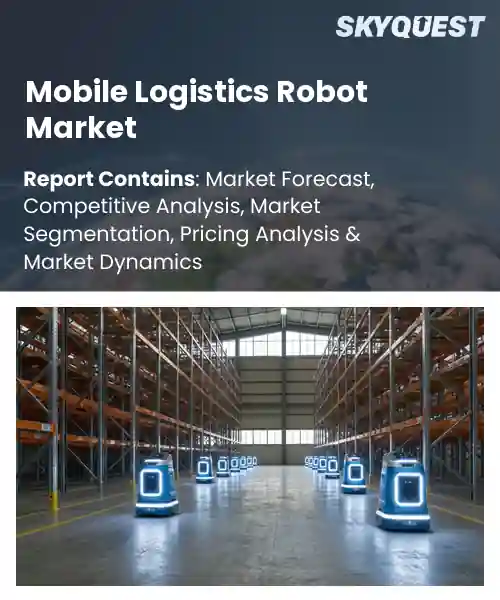
Mobile Logistics Robot Market
Report ID: SQMIG45I2368
Report ID: SQMIG45I2368
[email protected]
USA +1 351-333-4748
Report ID:
SQMIG45I2368 |
Region:
Global |
Published Date: May, 2026
Pages:
157
|Tables:
184
|Figures:
79


Global Mobile Logistics Robot Market size was valued at USD 7.2 Billion in 2024 and is poised to grow from USD 7.87 Billion in 2025 to USD 16.03 Billion by 2033, growing at a CAGR of 9.3% during the forecast period (2026-2033).
The global mobile logistics robot market growth is driven due to the steady rise of e-commerce and this long term labor crunch that makes companies want to automate. This market really matters because it tightens cycle times, lowers mistakes, and chops operating costs, while still letting firms scale fulfillment when demand suddenly spikes. Before this, the whole market moved from fixed path automated guided vehicles to sensor rich autonomous mobile robots and then up to fleet orchestration software, which is shown in Amazon’s move toward AMRs and DHL’s pilot programs , and both of those highlight cost and productivity jumps. As fulfillment gets complicated fast, and those unpredictable peaks force people to be nimble and efficient, the major factor enhancing the global mobile logistics robot market penetration is intelligent fleet orchestration and systems integration, it turns separate robots into one coordinated fleet with better utilization and that also helps with returns handling.
When companies roll out real-time tasking, cloud analytics, and API based warehouse management hookups, throughput climbs, and human staff move toward supervision, exception work, and other higher-level tasks, so labor expenses shrink and lead times get faster. In real-world deployments like dark stores, automated parcel hubs, and hospitals, software meshes tightly with hardware, operators can unlock new service patterns, grow revenue, and even retrofit older setups can be seen.
AI along with IoT is pushing the mobile logistics robot market, toward perception driven autonomy, better fleet orchestration, and constant sensing that gives the operators a real operational view. There are a few big parts here, like intelligent route planning, adaptive tasking, and sensor based health monitoring, all together. Right now, it’s seeing broad adoption in warehouses and distribution centers, where robots and people work close side by side, so delays get reduced and the order flow stays smoother. In general demand seems to be leaning toward flexible automation and modular systems, which can scale up and down as volumes rise or fall. For instance, machine vision-aided picking and IoT-connected zones can reveal bottlenecks immediately, which makes the whole operation more resilient and responsive.
Locus Robotics, in April 2026, rolled out Locus Array, a fully autonomous robot plus robotic arm configuration, and it’s basically built to show embedded AI perception along with connected sensors so it can handle end-to-end execution without awkward human handoffs, and that supports market growth by boosting throughput, cutting down manual touches, and enabling predictive maintenance for higher uptime.
Market snapshot - (2026-2033)
Global Market Size
USD 7.2 Billion
Largest Segment
Autonomous Mobile Robots (AMRs)
Fastest Growth
Autonomous Mobile Robots (AMRs)
Growth Rate
9.3% CAGR
To get more insights on this market click here to Request a Free Sample Report
Global mobile logistics robot market is segmented by type, payload capacity, battery type, application, end-use industry, deployment mode and region. Based on type, the market is segmented into Automated Guided Vehicles (AGVs), Autonomous Mobile Robots (AMRs), Autonomous Forklift Robots, Goods-to-Person Picking Robots, Towing & Tugger Robots, Unit Load Carriers, Inventory Scanning Robots and Others. Based on payload capacity, the market is segmented into Light Duty (Up to 100 Kg), Medium Duty (100–500 Kg) and Heavy Duty (Above 500 Kg). Based on battery type, the market is segmented into Lithium-Ion Batteries, Lead-Acid Batteries, Nickel-Based Batteries and Others. Based on application, the market is segmented into Material Transportation, Pallet Handling, Order Picking & Fulfillment, Sorting & Packaging, Inventory Management, Line Feeding, Trailer Loading & Unloading and Others. Based on end-use industry, the market is segmented into Manufacturing, Food & Beverage, Healthcare & Pharmaceuticals, Airports & Ports and Others. Based on deployment mode, the market is segmented into Indoor Logistics Robots, Outdoor Logistics Robots and Hybrid Indoor-Outdoor Robots. Based on region, the market is segmented into North America, Europe, Asia Pacific, Latin America and Middle East & Africa.
As per the global mobile logistics robot market analysis, the Autonomous Mobile Robots segment tends to dominate, mostly because their flexible navigation , perception, and fleet orchestration let them handle dynamic task allocation across different warehouse layouts, which directly reduces idle time and process variation. Their software driven upgrades and compatibility with warehouse control systems also give operators a clearer upgrade path, and the collaborative behaviors along with modular payloads reduce deployment friction. Put together, these points make logistics managers prefer them when the goal is continuous throughput gains and stronger operational resilience.
However, the Automated Guided Vehicles segment is showing up as the fastest expanding segment, because they’re proven in repetitive, high-throughput workflows, and they’re easier to plug into older fixed path operations. There’s also this established vendor ecosystem, predictable performance, and they handle continuous heavy transport well, so operators often retrofit them into legacy facilities. That tends to speed up deployments where fixed routes and process stability create immediate efficiency improvements and more scalable retrofit chances.
According to the global mobile logistics robot market forecast, Order Picking & Fulfillment is the one that dominates because it targets the main value drivers in fulfillment, meaning speed and accuracy. It combines robotic picking, better item localization, and fleet coordination, so pick times drop sharply and human travel decreases. These solutions align really well with e commerce service expectations , since they reduce order cycle time and errors, and that’s why operators prioritize robotic spending when they expect measurable throughput improvements and better customer satisfaction.
Whereas the Inventory Management category is predicted to achieve the largest mobile logistics robot market share because continuous visibility and automated cycle counting basically becomes mandatory for omnichannel distribution. New autonomous scanning robots, AI reconciliation methods, and smooth integration with inventory platforms are pushing fast adoption among operators who care most about stock accuracy and predictive replenishment, and that builds new operational models along with repeat value streams around real time inventory assurance.
To get detailed segments analysis, Request a Free Sample Report
As per the mobile logistics robot market regional forecast, Asia Pacific dominated the market and shows a mixing of industrial strength , technological leadership, and straight up demand. There are established manufacturing hubs, and huge electronics supply chains, which helps companies develop and scale robotic platforms quickly. There’s also strong adoption across automotive consumer electronics, and e commerce logistics so that pushes continuous upgrades in navigation and fleet orchestration. A lot of regional players blend hardware know how with software services, so they can deliver a more combined solution, tuned for crowded warehouses and factory floors. On top of that, supportive industrial policy and partnerships between research institutions and private industry speed up the move from prototype to actual deployment. Dense urban areas and fairly well developed service networks also make after-sales support easier, plus it helps with continuous optimization.
Japan Mobile Logistics Robot Market
The Mobile Logistics Robot sector in Japan benefits from a solid robotics heritage, a precision engineering mindset, and close collaboration between makers and research groups. The local approach leans hard on reliability, safety protocols, and smooth integration with factory automation. Because of that, local solutions feel especially appealing for tricky production lines and warehouse situations. With strong service networks and system integration expertise, deployments can be customized to handle labor constraints and optimize logistics where space is limited, especially in urban and industrial zones.
South Korea Mobile Logistics Robot Market
The Mobile Logistics Robot industry in South Korea leans on strong electronics and semiconductor manufacturing ecosystems, plus a lively scene of robotics startups, and tight connections between major industrial conglomerates and technology suppliers. Local firms often aim for intelligent navigation and compact designs for packed facilities. They also focus on integration with warehouse management platforms, which helps with control and workflow. The emphasis on quick deployment and on being able to service robots without too much hassle supports both e-commerce needs and high-mix production settings. When industry players team up with research centers, it tends to speed up new ideas for domestic logistics needs, and even for regional challenges.
North America rapid expansion in the mobile logistics robot market comes from an operational emphasis on productivity, the stress of omnichannel fulfillment, and a active ecosystem of systems integrators plus solution providers. Retailers and third party logistics firms push automation to cut manual bottlenecks and boost throughput inside complicated distribution networks. A more mature technology services market also helps with integration, including fleet orchestration, cloud based monitoring, and data driven optimization. Collaboration between OEMs, integrators, and end users supports tailored implementations across different kinds of facilities. Safety standards matter a lot, and the flexibility in deployment models and dependable service and maintenance infrastructure helps organizations adopt automation with less disruption day to day. That then backs continued investment and scaling.
United States Mobile Logistics Robot Market
The Mobile Logistics Robot Market in the United States shows broad retailer and third-party logistics adoption, and many different facility layouts, along with a mature ecosystem of integrators and technology vendors. A big focus on fleet orchestration, cloud connectivity, and retrofit solutions helps support deployments across mixed environments. Pilot initiatives act like practical reference points, which makes it easier to expand rollouts across distribution and fulfillment centers. Strong service coverage, together with data-driven operations, helps keep improvements coming and supports long-term operational resilience.
Canada Mobile Logistics Robot Market
In Canada, the Mobile Logistics Robot Market is shaped a lot by cross-border logistics complexity, and also by that need to adapt to varied facility sizes, like distribution hubs that are not all the same. Also, partnerships between integrators and end users they matter more than people think. Most firms seem to lean toward flexible platforms that can manage cold chain conditions, and still function well in regional distribution setups. What stays most important is serviceability, and interoperability with existing warehouse systems. In practice, deployments are encouraging adoption across multiple sectors, because the workflow is similar yet not the same. And when industry players collaborate with technology providers, it becomes easier to build customized solutions for urban fulfillment centers, while keeping day to day warehouse operations running efficiently, without too many surprises.
Europe is strengthening its position in the mobile logistics robot market, mostly via coordinated industry efforts, strong engineering skills, and also an emphasis on interoperable solutions that fit the different national supply chains. Automotive, industrial machinery, and consumer goods keep pulling demand for automated material handling, and that has to match strict safety and quality expectations, pretty much every time. Collaborative initiatives among manufacturers, research institutions, and systems integrators keep circling the same goals, like common communication standards, modular hardware, and scalable software stacks. And then there’s the sustainability angle , plus energy efficient operations, which nudges designers toward setups that link into broader warehouse modernization programs. Mature service ecosystems, and a lot of cross border logistics experience, help support deployments across multiple countries, while attention to retrofit strategies also lets adoption happen in older facilities, so European firms can compete on reliability, compliance, and system integration know-how.
Germany Mobile Logistics Robot Market
The Mobile Logistics Robot Market in Germany is anchored in advanced industrial automation know-how, with deep ties to automotive and manufacturing supply chains. Local integrators tend to highlight robust engineering, safety compliance, and tailored system integration for those complex production environments. The demand leans toward dependable performance in heavy-duty throughput logistics scenarios, and retrofit solutions are treated as a major lever for modernization in legacy facilities. Collaboration between OEMs and research centers keeps producing innovations that prioritize reliability and efficient, effective maintenance practices, even under real-world constraints.
United Kingdom Mobile Logistics Robot Market
The Mobile Logistics Robot Market in the United Kingdom is characterized by strong demand from e-commerce retail and logistics, where flexible automation matters a lot. Local integrators and startups emphasize modular, software-centric solutions that can adapt to varied warehouse footprints, rather than forcing a one-size plan. The focus stays on safety, interoperability, and retrofit options, which help the systems blend with existing setups. There is also an emphasis on service contracts and operator training, so operations remain reliable over time, not just in the beginning. Collaboration between industry and universities also pushes applied research, and deployment pathways that actually get used.
France Mobile Logistics Robot Market
The Mobile Logistics Robot Market in France combines solid industrial engineering capability with growing adoption across domestic retail and manufacturing logistics segments. Local vendors and integrators emphasize adaptable systems that cover both urban handling and more industrial needs in one framework. Focus on safety compliance, energy-efficient operation, and modular designs that support retrofit and new builds, depending on what each site requires. Collaboration among technology providers, logistics operators, and research organizations sparks pilots, and those pilots often turn into broader operational adoption with stronger maintenance frameworks, which is important in practice.
To know more about the market opportunities by region and country, click here to
Buy The Complete Report
Expansion Of E-Commerce Fulfillment
Advances In Sensing and Navigation
High Initial Capital Requirements
Regulatory and Safety Standards
Request Free Customization of this report to help us to meet your business objectives.
Competition inside the global mobile logistics robot market is getting more intense, as established players chase acquisitions and strategic partnerships while newer entrants push ahead with mobile manipulator work and AI navigation improvements. For example, Zebra Technologies picking up Fetch Robotics, and the big pilot programs between parcel operators and autonomous unloader suppliers, those efforts are really nudging consolidation along and making tech integration feel more inevitable, and then everyone is trying to sharpen their differentiated go-to-market approach, mainly around vision, software orchestration, and the trailer-unloading feature set.
Top Player’s Company Profile
Recent Developments
SkyQuest’s ABIRAW (Advanced Business Intelligence, Research & Analysis Wing) is our Business Information Services team that Collects, Collates, Correlates, and Analyses the Data collected by means of Primary Exploratory Research backed by robust Secondary Desk research.
As per SkyQuest analysis, the global mobile logistics robot market is largely being propelled by the rapid expansion of e-commerce fulfillment, but the high up-front capital requirements still act as a major restraint for many operators. Autonomous Mobile Robots, or AMRs, dominate the segment because they offer flexible navigation and software-driven upgrades. And Asia Pacific leads the market, mainly due to strong manufacturing hubs, deep supply chains, and supportive policies. A second key driver is intelligent fleet orchestration and systems integration, which unlock higher utilization, real-time tasking, and retrofit opportunities. Taken together, these forces tend to favor modular, software-centric platforms alongside service ecosystems that help accelerate scalable automation adoption across all logistics environments.
| Report Metric | Details |
|---|---|
| Market size value in 2024 | USD 7.2 Billion |
| Market size value in 2033 | USD 16.03 Billion |
| Growth Rate | 9.3% |
| Base year | 2024 |
| Forecast period | (2026-2033) |
| Forecast Unit (Value) | USD Billion |
| Segments covered |
|
| Regions covered | North America (US, Canada), Europe (Germany, France, United Kingdom, Italy, Spain, Rest of Europe), Asia Pacific (China, India, Japan, Rest of Asia-Pacific), Latin America (Brazil, Rest of Latin America), Middle East & Africa (South Africa, GCC Countries, Rest of MEA) |
| Companies covered |
|
| Customization scope | Free report customization with purchase. Customization includes:-
|
To get a free trial access to our platform which is a one stop solution for all your data requirements for quicker decision making. This platform allows you to compare markets, competitors who are prominent in the market, and mega trends that are influencing the dynamics in the market. Also, get access to detailed SkyQuest exclusive matrix.
Table Of Content
Executive Summary
Market overview
Parent Market Analysis
Market overview
Market size
KEY MARKET INSIGHTS
COVID IMPACT
MARKET DYNAMICS & OUTLOOK
Market Size by Region
KEY COMPANY PROFILES
Methodology
For the Mobile Logistics Robot Market, our research methodology involved a mixture of primary and secondary data sources. Key steps involved in the research process are listed below:
1. Information Procurement: This stage involved the procurement of Market data or related information via primary and secondary sources. The various secondary sources used included various company websites, annual reports, trade databases, and paid databases such as Hoover's, Bloomberg Business, Factiva, and Avention. Our team did 45 primary interactions Globally which included several stakeholders such as manufacturers, customers, key opinion leaders, etc. Overall, information procurement was one of the most extensive stages in our research process.
2. Information Analysis: This step involved triangulation of data through bottom-up and top-down approaches to estimate and validate the total size and future estimate of the Mobile Logistics Robot Market.
3. Report Formulation: The final step entailed the placement of data points in appropriate Market spaces in an attempt to deduce viable conclusions.
4. Validation & Publishing: Validation is the most important step in the process. Validation & re-validation via an intricately designed process helped us finalize data points to be used for final calculations. The final Market estimates and forecasts were then aligned and sent to our panel of industry experts for validation of data. Once the validation was done the report was sent to our Quality Assurance team to ensure adherence to style guides, consistency & design.
Analyst Support
Customization Options
With the given market data, our dedicated team of analysts can offer you the following customization options are available for the Mobile Logistics Robot Market:
Product Analysis: Product matrix, which offers a detailed comparison of the product portfolio of companies.
Regional Analysis: Further analysis of the Mobile Logistics Robot Market for additional countries.
Competitive Analysis: Detailed analysis and profiling of additional Market players & comparative analysis of competitive products.
Go to Market Strategy: Find the high-growth channels to invest your marketing efforts and increase your customer base.
Innovation Mapping: Identify racial solutions and innovation, connected to deep ecosystems of innovators, start-ups, academics, and strategic partners.
Category Intelligence: Customized intelligence that is relevant to their supply Markets will enable them to make smarter sourcing decisions and improve their category management.
Public Company Transcript Analysis: To improve the investment performance by generating new alpha and making better-informed decisions.
Social Media Listening: To analyze the conversations and trends happening not just around your brand, but around your industry as a whole, and use those insights to make better Marketing decisions.
REQUEST FOR SAMPLE
 REQUEST FREE CUSTOMIZATION
Global Mobile Logistics Robot Market size was valued at USD 7.2 Billion in 2024 and is poised to grow from USD 7.87 Billion in 2025 to USD 16.03 Billion by 2033, growing at a CAGR of 9.3% during the forecast period (2026-2033).
Competition in the global mobile logistics robot market is intensifying as incumbents pursue acquisitions and strategic partnerships while startups accelerate mobile-manipulator and AI navigation advances. Examples include Zebra Technologies’ acquisition of Fetch Robotics and large-scale pilot partnerships between parcel operators and autonomous unloader vendors, which are driving consolidation, technology integration, and differentiated go-to-market plays focused on vision, software orchestration, and trailer-unloading capabilities. 'Geek+', 'GreyOrange', 'Locus Robotics', 'Fetch Robotics', 'Mobile Industrial Robots (MiR)', 'Seegrid', 'OTTO Motors', 'Vecna Robotics', 'AutoStore', 'Symbotic', 'Dematic', 'Swisslog', 'SSI SCHAEFER', 'KNAPP', 'Daifuku', 'Omron', 'ABB', 'KUKA', 'Quicktron Robotics', 'ForwardX Robotics'
Rapid expansion of e-commerce fulfillment centers has intensified the need for automated intralogistics solutions, prompting warehouses and distribution hubs to integrate mobile logistics robots to handle increased pick, pack, and sort volumes while addressing workforce limitations. The deployment of these robots enables flexible routing, denser storage utilization, and faster order turnaround, which aligns with retailer service commitments and consumer expectations. As businesses prioritize scalability and operational continuity, mobile robots offer a modular automation approach that supports evolving fulfillment strategies without extensive facility redesign.
Ai-Driven Fleet Coordination: Intelligent, onboard perception and centralized orchestration enable fleets of mobile logistics robots to operate collaboratively and adaptively across complex facilities. Machine learning models facilitate handoffs, dynamic task allocation and real-time path negotiation with human workers and equipment. Emphasis on interoperability with enterprise systems and software stacks supports scalable deployment and ongoing improvement. This trend reduces friction between automation and operations, drives standardized communication frameworks and encourages solution providers to offer integrated fleet management across diverse use cases.
Why does Asia Pacific Dominate the Global Mobile Logistics Robot Market? |@12


Want to customize this report? This report can be personalized according to your needs. Our analysts and industry experts will work directly with you to understand your requirements and provide you with customized data in a short amount of time. We offer $1000 worth of FREE customization at the time of purchase.
Feedback From Our Clients


 USA (+1) 351-333-4748

