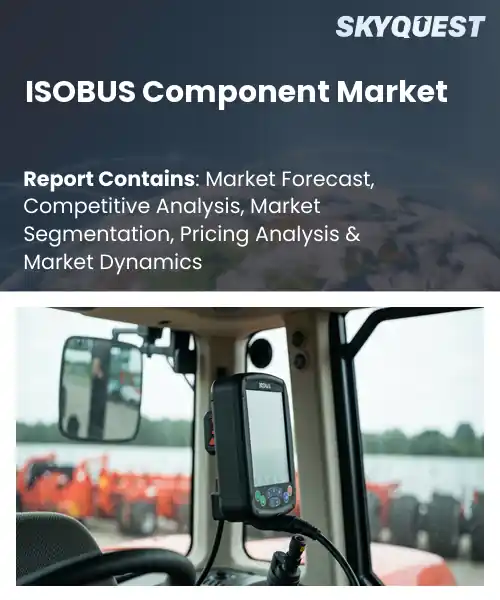
ISOBUS Component Market
Report ID: SQMIG20I2796
Report ID: SQMIG20I2796
[email protected]
USA +1 351-333-4748
Report ID:
SQMIG20I2796 |
Region:
Global |
Published Date: April, 2026
Pages:
157
|Tables:
118
|Figures:
77


Global Isobus Component Market size was valued at USD 842.5 Million in 2024 and is poised to grow from USD 913.27 Million in 2025 to USD 848.8 Million by 2033, growing at a CAGR of 8.4% during the forecast period (2026-2033).
ISOBUS component market centers on standardized electronic communication protocols that allow tractors, implements, and precision agriculture systems to interoperate seamlessly, with interoperability the primary driver reshaping equipment architecture. The market matters because it reduces integration costs, accelerates adoption of precision farming technologies, and improves data consistency across manufacturers, enabling new service models and analytics. Historically, the market evolved from proprietary interfaces to open standards after ISO 11783 adoption, with early adopters like Fendt and John Deere implementing compatible controllers and terminal displays, and more recent entrants focusing on modular sensors, telematics units, and plug-and-play ECU designs that simplify retrofitting globally.Building on widespread standardization, a pivotal growth factor is increasing connectivity and data integration, because farms that adopt telematics and cloud analytics demand ISOBUS components capable of transmitting standardized control and diagnostic messages across mixed fleets. As a result OEMs and aftermarket suppliers invest in smarter ECUs, universal terminals, and secure gateways, enabling use cases such as variable-rate application where implements receive prescription maps from farm management software to reduce inputs and overlap. Consequently service providers monetize fleet data for predictive maintenance while contractors benefit from plug-and-play compatibility, which expands retrofit markets and creates recurring revenue streams for component manufacturers.
How is IoT driving innovation in the Isobus component market?
IoT is reshaping the ISOBUS component market by turning implements into connected nodes that share telemetry, sensor and task data with tractors and cloud platforms. Key aspects include real time telemetry, remote diagnostics and interoperable task controllers that let mixed fleets work together. The current state shows OEMs and aftermarket suppliers adding embedded connectivity and software layers to traditional control units. This shifts the market toward subscription services, remote support and predictive maintenance. Practical instances include remote reading of sensor values for troubleshooting, variable rate application driven by cloud maps and readiness for semi autonomous guidance. These changes improve uptime, ease integration and encourage new service models.Kverneland May 2025, the company began fitting ISOBUS implements with a Sync telemetry box that links machine data to the cloud and enables remote diagnostics and data sharing. This IoT driven innovation speeds troubleshooting, enables data driven maintenance and supports efficient mixed fleet operation which helps market growth and adoption of smarter components.
Market snapshot - (2026-2033)
Global Market Size
USD 842.5 Million
Largest Segment
Electronic Control Units (ECUs)
Fastest Growth
Connectivity Gateways & Bridges
Growth Rate
8.4% CAGR
To get more insights on this market click here to Request a Free Sample Report
Global isobus component market is segmented by hardware component, software & protocol, application vertical, sales channel and region. Based on hardware component, the market is segmented into Electronic Control Units (ECUs), ISOBUS Terminals/Universal Terminals (UT), Connectivity Gateways & Bridges and Wiring Harnesses & Breakout Boxes. Based on software & protocol, the market is segmented into Task Controller (TC) Software, Virtual Terminal (VT) Interface and Section Control & Variable Rate Applications. Based on application vertical, the market is segmented into Tractor-Implement Connectivity, Precision Seeding & Spraying, Harvesting & Yield Monitoring and Fertilizer Application Systems. Based on sales channel, the market is segmented into Original Equipment Manufacturers (OEM) and Aftermarket Retrofit Kits. Based on region, the market is segmented into North America, Europe, Asia Pacific, Latin America and Middle East & Africa.
Electronic Control Units (ECUs) segment dominates because ECUs consolidate control logic, sensor inputs and actuator commands into a single deterministic layer that enables reliable implement coordination across ISOBUS networks. OEMs rely on ECUs for protocol compliance, safety functions and real time processing, which drives deep integration with tractors and implements, encourages standard implementation and reduces system complexity, thereby positioning ECUs as indispensable infrastructure for ISOBUS-enabled equipment.
However, Connectivity Gateways & Bridges are emerging as the fastest growing area, driven by demand for seamless cross-protocol translation and telematics integration that link legacy implements to modern ISOBUS systems. Their role in enabling retrofit connectivity, cloud-based diagnostics and heterogeneous device interoperability accelerates deployment of precision features and creates aftermarket opportunities that expand the ISOBUS ecosystem.
Task Controller (TC) Software segment leads because TC software orchestrates job management, prescription execution and section control functions that translate agronomic decisions into implement actions across ISOBUS networks. Its standardized interfaces enable complex workflows, traceability and compatibility with farm management systems, prompting OEMs and implement makers to embed TC capabilities for operational efficiency and reliable automated application, which strengthens its central role in the ISOBUS component landscape.
Meanwhile, Virtual Terminal (VT) Interface is witnessing the strongest growth as user-centric displays and standardized UI frameworks simplify multi-implement control and reduce operator training burdens. Advances in customizable layouts, touchscreen ergonomics and integration with cloud services boost adoption across OEMs and retrofit providers, creating new pathways for rapid feature rollouts and higher utilization of ISOBUS capabilities.
To get detailed segments analysis, Request a Free Sample Report
Europe dominates the global ISOBUS component market because it combines a concentrated base of advanced agricultural machinery manufacturers with deep integration of precision farming philosophies. The region benefits from a collaborative ecosystem where original equipment manufacturers, component suppliers, and research institutions align around common interoperability standards, enabling rapid product refinement and reliable field performance. Strong aftermarket and retrofit demand among large and mid sized farms sustains component volumes while skilled engineering talent and proximity to leading test environments accelerate innovation. Policy frameworks and industry consortia favor standardized interfaces, which reduces fragmentation and encourages suppliers to invest in compatible, high quality components. This confluence of industrial capability, cooperative standardization, and practical adoption by technologically progressive farms secures a sustained leadership position for Europe in ISOBUS components.
ISOBUS Component Market in Germany is anchored by a robust manufacturing base and a tradition of engineering excellence that prioritize reliability and system integration. OEMs and specialized suppliers work closely with research centers to refine component interoperability and functional safety. German farm operations often demand high durability and serviceability, driving suppliers to focus on quality, modularity, and strong distributor networks. This ecosystem supports continuous improvement and cements Germany as a center for premium ISOBUS component development.
ISOBUS Component Market in United Kingdom reflects a balance between independent implement manufacturers and resilient dealer networks that emphasize compatibility and user experience. Adoption is guided by pragmatic farm management needs and a thriving service sector that supports retrofitting and aftermarket upgrades. Suppliers in the United Kingdom concentrate on intuitive human machine interfaces, local technical support, and adaptable solutions that meet diverse farm sizes. The local market fosters collaboration between technology vendors and operators to ensure practical, field oriented component performance.
ISOBUS Component Market in France is driven by a diverse agricultural landscape and strong ties between equipment makers and cooperative purchasing groups. Manufacturers prioritize system flexibility and ease of integration to serve a wide range of cropping systems and machinery types. French suppliers often emphasize modular components and localized service capabilities, enabling rapid on farm adoption and aftermarket growth. Close collaboration with farm advisors and cooperatives helps tailor component offerings to operational realities and supports steady market uptake.
The rapid expansion of the ISOBUS component market in North America is propelled by increasing demand for operational efficiency and a strong replacement and retrofit culture among large scale commercial farming enterprises. The region features a dynamic landscape of diversified equipment manufacturers and aftermarket specialists that prioritize interoperability and scalable automation. Technological adoption is reinforced by service networks and independent dealers that facilitate integration across legacy fleets, easing barriers to entry for advanced components. Emphasis on precision application, data driven management, and productivity gains encourages suppliers to offer modular, field proven components with robust support. Cross industry partnerships and investment in technical training further enable faster deployment of ISOBUS solutions across a wide range of cropping systems and machine platforms.
ISOBUS Component Market in United States centers on high intensity commercial agriculture and a large aftermarket ecosystem that supports retrofit and upgrade activity. Suppliers focus on ruggedized components, broad compatibility, and comprehensive dealer support to meet the expectations of large operators and custom service providers. Integration with precision agronomy workflows and data management platforms is a priority, so components emphasize connectivity and ease of use. The market benefits from active collaboration between technology developers and field service networks that accelerate practical adoption.
ISOBUS Component Market in Canada is characterized by a focus on durability and adaptability to diverse climatic and operational conditions. Suppliers tailor offerings to support long service intervals and versatile implement combinations, with strong dealer partnerships delivering installation and calibration services. Canadian operators value components that align with precision management goals and that can be integrated across mixed fleets. The market's pragmatic adoption pattern encourages solutions that balance reliability with interoperability and local technical support.
Asia Pacific is strengthening its position in the ISOBUS component market through a combination of strategic manufacturing growth, targeted technology transfer, and rising adoption among higher value cropping systems. Regional suppliers are investing in compatibility and cost efficient production to serve both domestic and export demand, while partnerships with international OEMs enable faster assimilation of established standards. Increasing emphasis on mechanization and precision practices in key agricultural markets stimulates interest in interoperable components that support productivity improvements. Local engineering talent, expanding testing facilities, and a growing service network help reduce adoption friction. Together, these factors cultivate a maturing market where component quality, affordability, and alignment with global interoperability norms are steadily improving.
ISOBUS Component Market in Japan places premium attention on miniaturization, precision, and system reliability suited to intensive, high value farming operations. Manufacturers emphasize compact, technologically advanced components that integrate seamlessly with automated implements and sensing systems. Strong engineering capabilities and close collaboration between equipment makers and research institutions support development of user friendly interfaces and robust connectivity. The market favors high quality components that deliver consistent performance and efficient service support.
ISOBUS Component Market in South Korea is driven by rapid industrialization of agricultural equipment and a focus on smart farming integration. Local suppliers concentrate on connectivity, automation support, and scalable solutions that cater to both commercial farms and precision horticulture. Government and private sector initiatives encourage technology adoption, while partnerships with global component manufacturers facilitate knowledge exchange. The market emphasizes interoperability, compact design, and responsive service offerings to meet evolving operator needs.
To know more about the market opportunities by region and country, click here to
Buy The Complete Report
Precision Agriculture Adoption
Interoperability Standards Maturation
Fragmented Equipment Compatibility
High Integration and Maintenance Costs
Request Free Customization of this report to help us to meet your business objectives.
The competitive landscape of the Global ISOBUS Component Market is shaped by intense interoperability and differentiation plays among OEMs, component specialists and software vendors. Strategic M&A and partnerships accelerate market access, while targeted product launches drive technical parity. Examples include tractor OEM partnerships to embed ISOBUS in platforms and the launch of modular ISOBUS ECUs by system suppliers, all shifting competition toward integrated hardware plus software solutions.
Top Player’s Company Profile
Recent Developments
SkyQuest’s ABIRAW (Advanced Business Intelligence, Research & Analysis Wing) is our Business Information Services team that Collects, Collates, Correlates, and Analyses the Data collected by means of Primary Exploratory Research backed by robust Secondary Desk research. As per SkyQuest analysis, the global ISOBUS component market is being propelled by precision agriculture adoption as a key driver and further accelerated by rising IoT enabled connectivity and data integration as a second driver, which together encourage adoption of smarter ECUs, universal terminals and gateways. Fragmented equipment compatibility remains a primary restraint that slows retrofit uptake and increases integration costs for mixed fleets. Europe continues to dominate the market thanks to its dense machinery manufacturing base and cooperative standardization, while Electronic Control Units lead the product landscape by consolidating control logic and ensuring protocol compliance. Suppliers should prioritize modular, cloud ready solutions to capture retrofit and service revenue.
| Report Metric | Details |
|---|---|
| Market size value in 2024 | USD 842.5 Million |
| Market size value in 2033 | USD 848.8 Million |
| Growth Rate | 8.4% |
| Base year | 2024 |
| Forecast period | (2026-2033) |
| Forecast Unit (Value) | USD Million |
| Segments covered |
|
| Regions covered | North America (US, Canada), Europe (Germany, France, United Kingdom, Italy, Spain, Rest of Europe), Asia Pacific (China, India, Japan, Rest of Asia-Pacific), Latin America (Brazil, Rest of Latin America), Middle East & Africa (South Africa, GCC Countries, Rest of MEA) |
| Companies covered |
|
| Customization scope | Free report customization with purchase. Customization includes:-
|
To get a free trial access to our platform which is a one stop solution for all your data requirements for quicker decision making. This platform allows you to compare markets, competitors who are prominent in the market, and mega trends that are influencing the dynamics in the market. Also, get access to detailed SkyQuest exclusive matrix.
Table Of Content
Executive Summary
Market overview
Parent Market Analysis
Market overview
Market size
KEY MARKET INSIGHTS
COVID IMPACT
MARKET DYNAMICS & OUTLOOK
Market Size by Region
KEY COMPANY PROFILES
Methodology
For the ISOBUS Component Market, our research methodology involved a mixture of primary and secondary data sources. Key steps involved in the research process are listed below:
1. Information Procurement: This stage involved the procurement of Market data or related information via primary and secondary sources. The various secondary sources used included various company websites, annual reports, trade databases, and paid databases such as Hoover's, Bloomberg Business, Factiva, and Avention. Our team did 45 primary interactions Globally which included several stakeholders such as manufacturers, customers, key opinion leaders, etc. Overall, information procurement was one of the most extensive stages in our research process.
2. Information Analysis: This step involved triangulation of data through bottom-up and top-down approaches to estimate and validate the total size and future estimate of the ISOBUS Component Market.
3. Report Formulation: The final step entailed the placement of data points in appropriate Market spaces in an attempt to deduce viable conclusions.
4. Validation & Publishing: Validation is the most important step in the process. Validation & re-validation via an intricately designed process helped us finalize data points to be used for final calculations. The final Market estimates and forecasts were then aligned and sent to our panel of industry experts for validation of data. Once the validation was done the report was sent to our Quality Assurance team to ensure adherence to style guides, consistency & design.
Analyst Support
Customization Options
With the given market data, our dedicated team of analysts can offer you the following customization options are available for the ISOBUS Component Market:
Product Analysis: Product matrix, which offers a detailed comparison of the product portfolio of companies.
Regional Analysis: Further analysis of the ISOBUS Component Market for additional countries.
Competitive Analysis: Detailed analysis and profiling of additional Market players & comparative analysis of competitive products.
Go to Market Strategy: Find the high-growth channels to invest your marketing efforts and increase your customer base.
Innovation Mapping: Identify racial solutions and innovation, connected to deep ecosystems of innovators, start-ups, academics, and strategic partners.
Category Intelligence: Customized intelligence that is relevant to their supply Markets will enable them to make smarter sourcing decisions and improve their category management.
Public Company Transcript Analysis: To improve the investment performance by generating new alpha and making better-informed decisions.
Social Media Listening: To analyze the conversations and trends happening not just around your brand, but around your industry as a whole, and use those insights to make better Marketing decisions.
REQUEST FOR SAMPLE
 REQUEST FREE CUSTOMIZATION


Want to customize this report? This report can be personalized according to your needs. Our analysts and industry experts will work directly with you to understand your requirements and provide you with customized data in a short amount of time. We offer $1000 worth of FREE customization at the time of purchase.
Feedback From Our Clients


 USA (+1) 351-333-4748

