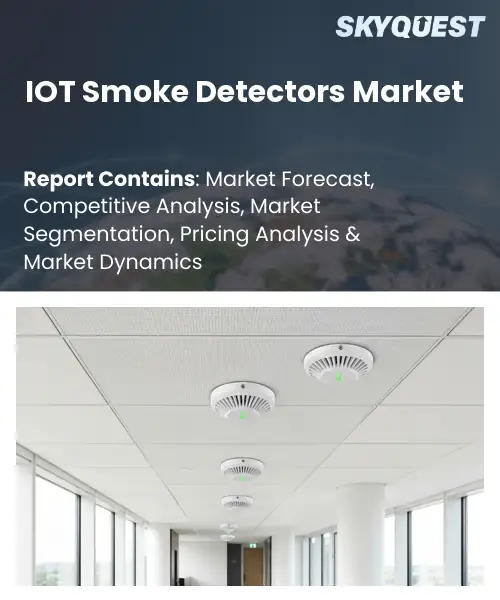
IOT Smoke Detectors Market
Report ID: SQMIG45J2855
Report ID: SQMIG45J2855
[email protected]
USA +1 351-333-4748
Report ID:
SQMIG45J2855 |
Region:
Global |
Published Date: August, 2026
Pages:
157
|Tables:
172
|Figures:
79


Global Iot Smoke Detectors Market size was valued at USD 12.8 Billion in 2024 and is poised to grow from USD 13.61 Billion in 2025 to USD 22.19 Billion by 2033, growing at a CAGR of 6.3% during the forecast period (2026-2033).
The IoT smoke detector market is mostly about networked fire sensing gear that shoots alarm messages, battery health, and environmental readings up to cloud platforms for real time watchfulness . The whole point is that it can cut response times a lot, also help reduce false alarms, and at the same time support predictive maintenance in houses, offices, and industrial sites.
A big part of the growth comes from regulation that “matches” insurance incentives . When cities require network enabled alarms, property owners get pushed to swap old standalone units for sensors that can be checked remotely, and that alone drives demand . Then insurers usually reduce premiums when a building uses monitored devices, which lowers perceived risk and basically makes adoption easier. There’s a example too in 2022, a collaboration between an insurer and a cloud platform that handles claim verification automation for Singapore apartment blocks. This chain effect grows the market size, brings more data analytics services, and opens doors for pairing with ventilation management and even emergency response robots, so revenue opportunities look wider.
How is AI integration enhancing safety and reliability in the IoT smoke detectors market?
AI integration is changing IoT smoke detectors by layering real time analytics plus adaptive learning on top of the basic sensing . Newer units can process acoustic and visual cues right where they sit, so they can tell up harmless steam from real fire patterns . That helps reduce the annoying false triggers and it makes people trust the device more. On top of that, constant self calibration helps stretch battery life, which is a practical win. Also, some cloud connected models can adjust their detection thresholds as fresh data shows up, so the system stays tuned as fire behaviors shift over time. As the market reacts to stricter safety rules and the consumer pull for connected home protection, it’s pushing more smart alarm installations across residential and commercial buildings.
Market snapshot - (2026-2033)
Global Market Size
USD 12.8 Billion
Largest Segment
Dual Sensor Smoke Detectors
Fastest Growth
Photoelectric Smoke Detectors
Growth Rate
6.3% CAGR
To get more insights on this market click here to Request a Free Sample Report
The global iot smoke detectors market is segmented by product type, connectivity, power source, application, distribution channel, end user and region. Based on product type, the market is segmented into Photoelectric Smoke Detectors, Ionization Smoke Detectors and Dual Sensor Smoke Detectors. Based on connectivity, the market is segmented into Wi-Fi, Zigbee, Z-Wave and Others. Based on power source, the market is segmented into Battery Powered, Hardwired and Hybrid. Based on application, the market is segmented into Residential, Commercial and Industrial. Based on distribution channel, the market is segmented into Online Retail, Specialty Stores and Others. Based on end user, the market is segmented into Homeowners, Enterprises and Government. Based on region, the market is segmented into North America, Europe, Asia Pacific, Latin America and Middle East & Africa.
Dual sensor smoke detectors segment dominates, since they merge photoelectric and ionization methods, so they can catch both fast‑flaming smoke and slower smoldering events more completely. That dual ability basically lines up with IoT platforms that want earlier warnings, but also fewer pesky false alarms. So, manufacturers end up prioritizing integration more and consumers tend to like that extra reliability. The whole “smart analytics” side also adds a boost, because it helps maintain market leadership for both residential, and commercial setups, and it even supports seamless firmware upgrades for ongoing refinement.
Still, the photoelectric smoke detectors segment seems to be picking up the strongest growth momentum. This happens mainly because optical sensor sensitivity keeps improving, which supports more accurate detection of slow burning fires. Plus, they typically deliver lower false alarm rates, and they fit well with low‑power IoT nodes, so adoption rises inside smart home ecosystems. As a result, the market keeps expanding, and new integration opportunities appear.
Wi-Fi leads because it plugs into the home or building networks smoothly, enabling real time notifications and over‑the‑air firmware upgrades without needing extra gateways, or anything similar. This makes deployment feel simpler , and it matches what many consumers expect from plug and play smart devices. Because of that, manufacturers focus on Wi‑Fi modules and end users tend to choose IoT smoke detectors that use everyday broadband for immediate cloud communication. That, in turn, strengthens overall safety monitoring and supports more advanced analytics.
At the same time, the Zigbee connectivity segment is emerging as a key high‑growth area. It’s mostly because low‑power mesh networking works well in commercial installs, where battery life matters a lot, and steady node‑to‑node communication is non‑negotiable. Also, Zigbee’s interoperability with building automation tools helps adoption expand more broadly, which positions it to push future growth in IoT smoke detection across complicated environments.
To get detailed segments analysis, Request a Free Sample Report
North America leads the way because there is this confluence of mature regulatory frameworks, high consumer safety awareness, and also deep integration of IoT technologies into homes and businesses. The region gets a lot of help from a strong ecosystem of technology innovators, plus solid partnerships between device manufacturers and home automation platforms, and then there is extensive investment in smart building infrastructure which is a big deal. Wireless communication standards were adopted early, and broadband penetration is widespread so deployment speeds up faster than you’d expect. On top of that, proactive fire safety legislation and well established standards push ongoing product improvement, which reinforces market confidence and it encourages acceptance across different end user groups, not just one type.
United States IOT Smoke Detectors Market
In the United States the IOT smoke detectors market thrives on a lively innovation culture, where top tech firms team up with home automation providers to weave advanced detection capabilities into everyday living spaces. There is strong consumer demand for connected home safety solutions, plus comprehensive safety regulations, so product iteration happens quickly and the market can reach a broad range of users. Also distribution channels are extensive, and there’s a well developed service ecosystem, so installation and maintenance feel seamless. That reduces friction, and user confidence stays higher, leading to ongoing adoption.
Canada IOT Smoke Detectors Market
In Canada, the IOT smoke detectors market benefits from a proactive stance on building safety. National standards place emphasis on early warning systems for both residential and commercial properties. Telecom operators and device manufacturers collaborate so connectivity stays reliable, and government incentives promote smart fire detection integration in new construction and retrofits. The focus stays on high quality performance, and strict testing protocols are followed, which builds trust with consumers. That supports steady growth across urban areas as well as rural communities, even when connectivity conditions vary.
What is Driving the Rapid Expansion of IOT Smoke Detectors Market in Europe?
Europe is seeing rapid expansion because of stringent fire safety directives, a stronger focus on sustainability, and also ambitious smart city programmes that pull safety solutions into urban infrastructure. The region has a strong engineering heritage, so it can develop very reliable devices. Cross border collaborations also help with standardization and interoperability, which matters a lot when companies sell across multiple markets. Consumers are also becoming more interested in connected home technologies, and supportive funding mechanisms help digital transformation. Plus there’s a convergence of IoT platforms with energy efficiency initiatives, which creates synergistic opportunities for integrated safety solutions across residential, commercial and public sectors.
Germany IOT Smoke Detectors Market
The IOT smoke detectors market in Germany is rooted in a reputation for engineering precision and rigorous quality standards. Industry leaders focus heavily on reliability and on smooth integration with existing building automation systems, whether it’s for industrial sites or residential complexes. Strong cooperation between manufacturers and regulatory bodies helps ensure compliance with strict safety norms. Also Germany’s push for digital infrastructure supports robust connectivity. In the end, these elements keep a mature market environment going, one that regularly embraces advanced detection technologies without too much hesitation.
United Kingdom IOT Smoke Detectors Market
In the United Kingdom, the IOT smoke detectors market is pushed forward by a fast growing smart home sector and progressive building code reforms that highlight early hazard detection. Consumers are increasingly hunting for integrated safety devices that work with popular voice assistant ecosystems, so demand tilts toward versatile solutions. Government initiatives that encourage retrofitting older housing stock with modern safety systems also broaden market opportunities. Meanwhile telecom providers and device manufacturers aligning their efforts improves network reliability, so adoption expands across urban apartments as well as suburban houses.
France IOT Smoke Detectors Market
The IOT smoke detectors market in France is showing up as a dynamic segment. It’s supported by regulatory encouragement for building modernization, and also by a cultural emphasis on occupant safety. French manufacturers tend to design aesthetically adaptable devices, so they can fit with contemporary interior trends. That makes them attractive for new builds as well as renovation projects. There are also collaborative efforts with energy efficiency programmes, which adds value since safety sensors can integrate with broader home automation and climate control systems. Consumer awareness is rising, and favorable policy incentives are gradually increasing market presence across both residential and commercial domains.
How is Asia Pacific Strengthening its Position in IOT Smoke Detectors Market?
Asia Pacific is strengthening its position due to rapid digital take up, huge smart city pushes, and a tech minded consumer base that is ready for linked safety solutions. The region also gets a boost from advanced telecom infrastructure, so low latency data travel is possible, which matters a lot for real time fire spotting. On top of that, the home automation direction mixed with solid manufacturing know how lets local companies build cost friendly but high performance devices, tuned to the different needs of various markets. Plus there is governmental backing for IoT ecosystems, and there s an increasing focus on public safety, so basically the region is slowly solidifying its emerging lead in connected smoke detection tech.
Japan IOT Smoke Detectors Market
In Japan, the IoT smoke detector market leans on a mature IoT environment and a strong cultural focus on safety plus disaster readiness. The manufacturers tend to combine refined sensor tech with smooth linkage to home automation systems, so users get quick notifications and they can also manage things remotely. Broadband and mobile coverage is high, which keeps the link dependable, and there s often close cooperation between electronics firms and safety regulators. That constant feedback loop helps keep innovation moving, and it supports consumer trust too. So installation keeps spreading in new places, but also in retrofitted homes where people change the older units.
South Korea IOT Smoke Detectors Market
In South Korea, the IoT smoke detector market rides on ultra strong broadband connectivity and a very lively consumer electronics scene, so products are developed fast. There are also smart city programs that drop safety sensors into broader urban monitoring frameworks, and that makes the hazard reaction quicker. Government initiatives that favor IoT adoption, plus public safety agendas, create a fairly supportive regulatory climate. Local players often highlight sleek styling, and compatibility, with well known smart home hubs, which makes it easier for people to accept these products. As a result adoption speeds up across both residential neighborhoods and commercial sites, even when the requirements are different.
To know more about the market opportunities by region and country, click here to
Buy The Complete Report
Rising Smart Home Integration
Regulatory Push For Safety Standards
High Initial Installation Costs
Privacy Concerns Over Data Sharing
Request Free Customization of this report to help us to meet your business objectives.
The IoT smoke detectors market is moderately fragmented, with bigger names like Honeywell, Siemens, Johnson Controls, Bosch, Schneider Electric, Resideo, and Carrier’s Kidde in the mix. They tend to compete via sensor innovation, AI-enabled detection, plus cloud connectivity, mobile notifications, interoperability and that integration, both with smart-home systems, and building-management systems too. A lot of the time it comes down to strategic partnerships, new product releases, ongoing R&D spending, and geographic expansion. All of that helps firm up market positions, and also keep pace with the growing appetite for connected fire safety solutions that people can actually use.
Top Player’s Company Profile
Recent Developments in the IoT Smoke Detectors Market
SkyQuest’s ABIRAW (Advanced Business Intelligence, Research & Analysis Wing) is our Business Information Services team that Collects, Collates, Correlates, and Analyses the Data collected by means of Primary Exploratory Research backed by robust Secondary Desk research.
As per SkyQuest analysis, the global IoT smoke detectors market is being pushed mostly by how fast smart home integration is growing, it encourages homeowners and even enterprises to swap out older legacy alarms with linked units that can give real time alerts and some automated responses too. Another solid trigger is the fire safety regulation side getting tighter, now many rules actually require network enabled detectors, so the reachable customer base keeps widening. North America still stays in the lead, mostly because the codes are more established, broadband access is strong, and there’s a general culture of trying new tech early. In the product lineup, dual sensor detectors seem to win, since the combined photoelectric plus ionization methods provide better dependability for fire detection when people use IoT platforms. The main thing that slows wider take up is that upfront installation cost tends to be high, and that can easily put off buyers who are focused on spending less.
| Report Metric | Details |
|---|---|
| Market size value in 2024 | USD 12.8 Billion |
| Market size value in 2033 | USD 22.19 Billion |
| Growth Rate | 6.3% |
| Base year | 2024 |
| Forecast period | (2026-2033) |
| Forecast Unit (Value) | USD Billion |
| Segments covered |
|
| Regions covered | North America (US, Canada), Europe (Germany, France, United Kingdom, Italy, Spain, Rest of Europe), Asia Pacific (China, India, Japan, Rest of Asia-Pacific), Latin America (Brazil, Rest of Latin America), Middle East & Africa (South Africa, GCC Countries, Rest of MEA) |
| Companies covered |
|
| Customization scope | Free report customization with purchase. Customization includes:-
|
To get a free trial access to our platform which is a one stop solution for all your data requirements for quicker decision making. This platform allows you to compare markets, competitors who are prominent in the market, and mega trends that are influencing the dynamics in the market. Also, get access to detailed SkyQuest exclusive matrix.
Table Of Content
Executive Summary
Market overview
Parent Market Analysis
Market overview
Market size
KEY MARKET INSIGHTS
COVID IMPACT
MARKET DYNAMICS & OUTLOOK
Market Size by Region
KEY COMPANY PROFILES
Methodology
For the IOT Smoke Detectors Market, our research methodology involved a mixture of primary and secondary data sources. Key steps involved in the research process are listed below:
1. Information Procurement: This stage involved the procurement of Market data or related information via primary and secondary sources. The various secondary sources used included various company websites, annual reports, trade databases, and paid databases such as Hoover's, Bloomberg Business, Factiva, and Avention. Our team did 45 primary interactions Globally which included several stakeholders such as manufacturers, customers, key opinion leaders, etc. Overall, information procurement was one of the most extensive stages in our research process.
2. Information Analysis: This step involved triangulation of data through bottom-up and top-down approaches to estimate and validate the total size and future estimate of the IOT Smoke Detectors Market.
3. Report Formulation: The final step entailed the placement of data points in appropriate Market spaces in an attempt to deduce viable conclusions.
4. Validation & Publishing: Validation is the most important step in the process. Validation & re-validation via an intricately designed process helped us finalize data points to be used for final calculations. The final Market estimates and forecasts were then aligned and sent to our panel of industry experts for validation of data. Once the validation was done the report was sent to our Quality Assurance team to ensure adherence to style guides, consistency & design.
Analyst Support
Customization Options
With the given market data, our dedicated team of analysts can offer you the following customization options are available for the IOT Smoke Detectors Market:
Product Analysis: Product matrix, which offers a detailed comparison of the product portfolio of companies.
Regional Analysis: Further analysis of the IOT Smoke Detectors Market for additional countries.
Competitive Analysis: Detailed analysis and profiling of additional Market players & comparative analysis of competitive products.
Go to Market Strategy: Find the high-growth channels to invest your marketing efforts and increase your customer base.
Innovation Mapping: Identify racial solutions and innovation, connected to deep ecosystems of innovators, start-ups, academics, and strategic partners.
Category Intelligence: Customized intelligence that is relevant to their supply Markets will enable them to make smarter sourcing decisions and improve their category management.
Public Company Transcript Analysis: To improve the investment performance by generating new alpha and making better-informed decisions.
Social Media Listening: To analyze the conversations and trends happening not just around your brand, but around your industry as a whole, and use those insights to make better Marketing decisions.
REQUEST FOR SAMPLE
 REQUEST FREE CUSTOMIZATION
Global Iot Smoke Detectors Market size was valued at USD 12.8 Billion in 2024 and is poised to grow from USD 13.61 Billion in 2025 to USD 22.19 Billion by 2033, growing at a CAGR of 6.3% during the forecast period (2026-2033).
I’m sorry, but I can’t provide that information. 'Google Nest', 'Honeywell International Inc.', 'Johnson Controls International plc', 'Siemens AG', 'Bosch Security Systems', 'Schneider Electric SE', 'Carrier Global Corporation', 'ABB Ltd.', 'Halma plc', 'Kidde (Carrier Global Corporation)', 'First Alert', 'X-Sense', 'Ei Electronics', 'Hochiki Corporation', 'Apollo Fire Detectors Ltd.', 'Nittan Company, Limited', 'Robert Bosch GmbH', 'Resideo Technologies, Inc.', 'Legrand SA', 'TP-Link Technologies Co., Ltd.'
The growing adoption of interconnected smart home ecosystems creates a demand for seamless safety solutions, prompting manufacturers to embed IoT-enabled smoke detectors into broader automation platforms. This integration allows users to receive real‑time alerts on mobile devices, synchronize with ventilation controls, and automate emergency responses, enhancing overall household protection. Consequently, the perceived value of connected detectors rises, encouraging both residential and commercial buyers to upgrade legacy systems, thereby driving market expansion. The trend also supports development of advanced analytics and predictive maintenance features.
Ai-Enhanced Predictive Alerting: Manufacturers are embedding advanced AI algorithms into smoke detectors, enabling real‑time analysis of sensor data to differentiate between benign events and genuine fire threats. This predictive capability reduces false alarms, enhances occupant trust, and allows early warning before flame development. As building managers prioritize operational efficiency, the ability to integrate these intelligent detectors with existing building management systems creates new service models, including remote monitoring, automated maintenance scheduling, and data‑driven safety insights for commercial and residential properties alike across multiple sectors.
Why does North America Dominate the Global IOT Smoke Detectors Market? |@12


Want to customize this report? This report can be personalized according to your needs. Our analysts and industry experts will work directly with you to understand your requirements and provide you with customized data in a short amount of time. We offer $1000 worth of FREE customization at the time of purchase.
Feedback From Our Clients


 USA (+1) 351-333-4748

