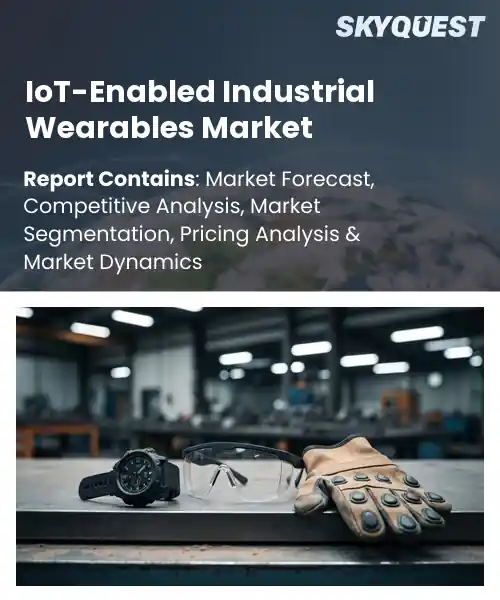
IoT-Enabled Industrial Wearables Market
Report ID: SQMIG45J2484
Report ID: SQMIG45J2484
[email protected]
USA +1 351-333-4748
Report ID:
SQMIG45J2484 |
Region:
Global |
Published Date: June, 2026
Pages:
157
|Tables:
113
|Figures:
77


Global Iot-Enabled Industrial Wearables Market size was valued at USD 68.4 Billion in 2024 and is poised to grow from USD 76.2 Billion in 2025 to USD 180.73 Billion by 2033, growing at a CAGR of 11.4% during the forecast period (2026-2033).
Industrial IoT-enabled wearables encompass devices such as smart helmets, connected exoskeletons, augmented reality glasses and sensor-laden safety vests that stream situational data to enterprise platforms, and the primary driver behind this market is the compelling need to improve worker safety and operational efficiency. This market matters because it reduces accident rates, lowers downtime and provides granular productivity insights that inform strategic decisions, while regulators and insurers increasingly incentivize digital safety solutions. Since early pilot deployments in oil and gas and manufacturing, adoption has expanded into logistics and construction as costs declined and ecosystems matured through standardized communication protocols and analytics.A key factor accelerating the global IoT-enabled industrial wearables market is the maturation of connectivity and analytics that turns sensor streams into actionable intelligence, which causes companies to invest to cut costs and manage risk. For example, connected helmets detecting hazardous gas and sending alerts reduce incident response times, while sensor-enhanced gloves and exoskeletons enable predictive maintenance and lower musculoskeletal injuries, producing measurable productivity gains that justify capital outlays. As 5G and edge computing reduce latency and extend battery life, vendors gain opportunities to offer subscription analytics, tailored vertical solutions and safety-insurance programs, creating scalable revenue and broader enterprise adoption.
How is AI enhancing safety and productivity in the IoT-enabled industrial wearables market?
AI is improving safety and productivity in IoT enabled industrial wearables by turning sensor streams into real time insights that guide workers and managers. Key aspects include on device inference for rapid alerts, contextual augmented reality that keeps hands free, and predictive analytics that flag equipment issues before failures. The current market favors lightweight enterprise grade smart glasses and wearables that integrate edge AI and cloud services for secure data flow. Use cases range from guided maintenance and remote expert support to automated hazard detection, making operations safer and more efficient while lowering downtime and human error.Vuzix January 2026, the company showcased AI powered smart glasses at CES that deliver hands free AR instructions and on device vision analytics to speed inspections and surface hazards enhancing worker safety and operational efficiency. These capabilities help drive wider enterprise adoption and improve return on wearable investments.
Market snapshot - (2026-2033)
Global Market Size
USD 68.4 Billion
Largest Segment
Smart Helmets
Fastest Growth
Smart Gloves
Growth Rate
11.4% CAGR
To get more insights on this market click here to Request a Free Sample Report
Global iot-enabled industrial wearables market is segmented by device type, application sector, end user, technology and region. Based on device type, the market is segmented into Smart Gloves and Smart Helmets. Based on application sector, the market is segmented into Manufacturing and Logistics. Based on end user, the market is segmented into Large Enterprises and Small & Medium Enterprises. Based on technology, the market is segmented into Connectivity and Sensors. Based on region, the market is segmented into North America, Europe, Asia Pacific, Latin America and Middle East & Africa.
Smart Gloves segment dominates because their hands-on interface converts raw tactile and motion inputs into precise operational data that directly improves task accuracy and cycle efficiency on shop floors. Integrated sensors and haptic feedback enable real-time guidance, reducing errors and training time while supporting complex assembly and inspection workflows. Seamless connections to enterprise systems and analytics make gloves a primary tool for productivity gains, safety monitoring, and workflow digitization across industrial operations.
However, Smart Helmets are the most rapidly expanding area, driven by combined head-mounted displays, environmental sensors, and integrated communications that enable remote assistance, situational awareness, and regulatory-compliant safety monitoring. Growing use in hazardous tasks, immersive training, and real-time video streams accelerates demand, opening new service models and platform opportunities for industrial operators.
Connectivity segment dominates because reliable, low-latency networks form the essential backbone that turns discrete wearable devices into coordinated, enterprise-grade systems. Standardized protocols and persistent links enable continuous telemetry, synchronized workflows, and secure edge-cloud data flow, which in turn unlocks centralized monitoring, predictive analytics, and fleet orchestration. Robust connectivity reduces integration friction and operational risk, driving adoption among industrial operators seeking scalable, interoperable wearable deployments.
However, sensors are witnessing the strongest growth momentum as miniaturized, multi-modal sensing modules expand wearable capabilities from motion tracking to physiological and environmental monitoring. Rapid innovation in sensor accuracy and energy efficiency creates new safety, health, and maintenance use cases, prompting vendors and operators to integrate advanced sensing into next-generation products and services.
To get detailed segments analysis, Request a Free Sample Report
North America leads due to a convergence of advanced industrial ecosystems, deep enterprise technology adoption, and strong vendor presence. Established industrial enterprises collaborate with solution providers and system integrators to pilot and scale wearable use cases across safety monitoring, workflow optimization, and asset tracking. A mature connectivity infrastructure and a culture of early adoption reduce deployment friction, while a sophisticated regulatory and compliance environment drives enterprise demand for secure and reliable solutions. Healthy channel ecosystems, access to capital for innovation, and active partnerships between hardware manufacturers, software vendors, and service providers reinforce commercialization pathways. Integration with existing automation and analytics platforms along with skilled workforce support positions the region as a primary source of innovation and market shaping activity and investment momentum.
IoT-Enabled Industrial Wearables Market United States combines robust industrial digitization, prominent technology vendors, and enterprise trials. Adoption is concentrated among sectors with complex safety and productivity requirements where wearables integrate into broader automation and analytics architectures. Strong private sector investment, mature supplier networks, and a collaborative culture among integrators and end users accelerate deployment. Emphasis on interoperability, security, and compliance fosters sophisticated solution design and scaling across industrial environments today.
IoT-Enabled Industrial Wearables Market Canada reflects a pragmatic approach driven by resource intensive sectors and manufacturers seeking operational resilience. Emphasis on worker safety and remote monitoring has motivated pilots that link wearables with centralized analytics platforms. Focus on reliable connectivity in distributed sites and partnerships between domestic firms and international vendors smooth commercialization. Stakeholders emphasize standards alignment and workforce training to ensure scalable, secure deployments that complement industrial automation investments.
Expansion in Asia Pacific is fueled by dynamic industrial modernization efforts, strong electronics and manufacturing supply chains, and active collaboration between local vendors and global technology providers. Rapid adoption of automation and robotics creates complementary demand for wearable solutions that enhance operator safety, task efficiency, and real time data capture on the factory floor. Investment in high quality connectivity and local engineering talent enables customization for domestic requirements, while public policy emphasis on industrial competitiveness supports pilot programs and standards development. Growing awareness of worker safety and productivity benefits drives uptake among heavy industry and discrete manufacturing verticals. Regional supply chain integration and competitive component ecosystems accelerate time to market for both hardware and software offerings. Local pilot successes and cross border partnerships are strengthening commercialization and market confidence.
IoT-Enabled Industrial Wearables Market Japan benefits from deep industrial automation expertise, engineering, and close integration between manufacturers and component suppliers. Strong focus on quality, safety, and efficiency gains encourages deployments in automotive, electronics, and heavy machinery segments. Local firms emphasize rigorous testing, reliability, and seamless integration with existing control systems. Collaborative pilots between system integrators and industrial end users accelerate refinement of design, ergonomics, and interoperability for demanding production environments.
IoT-Enabled Industrial Wearables Market South Korea is characterized by a strong semiconductor and electronics ecosystem that supports prototyping and manufacturing of wearable components. Industrial operators use wearables with robotics and factory digitization to optimize workflows and strengthen safety protocols. Collaboration among conglomerates, startups, and research institutions accelerates solution validation and localization. Focus on connectivity performance, miniaturized sensors, and software integration yields tailored offerings for high mix production environments across sectors.
Europe is reinforcing its position through coordinated efforts among industrial leaders, technology vendors, and policy makers that emphasize interoperability, safety, and data governance. A strong legacy of heavy industry and advanced manufacturing provides fertile ground for wearable applications that improve worker safety, quality assurance, and process efficiency. Cross border collaboration on standards and pilot programs enables scalable solutions that respect stringent regulatory frameworks. Robust research institutions and skilled engineering talent support localized innovation and customization, while a diverse supplier base fosters competitive component sourcing. Emphasis on secure architectures, privacy conscious data handling, and integration with existing automation platforms helps European firms deliver reliable, compliant solutions tailored to complex industrial operations. Strong public private partnerships and accessible innovation networks aid commercialization and facilitate skills development across supply chains.
IoT-Enabled Industrial Wearables Market Germany leverages an established machinery and automotive sector to pilot wearables for safety, maintenance, and quality control. OEMs and system integrators focus on ruggedized designs, deterministic connectivity, and deep integration with manufacturing execution systems. Collaboration among industry clusters and research centers supports standardization activities. Emphasis on industrial grade reliability, long term support, and compatibility with automation ecosystems broadly drive adoption across discrete and process manufacturing environments.
IoT-Enabled Industrial Wearables Market United Kingdom leverages strengths in software development, systems integration, and industrial services that support wearable deployments. End users pair wearable data with cloud analytics to improve safety programs and operational decision making. A vibrant startup community and consulting ecosystem enables prototyping and tailored solutions for mid sized manufacturers. Emphasis on standards compliance, data security, and workforce training ensures reliable operational outcomes and smoother technology adoption pathways.
IoT-Enabled Industrial Wearables Market France draws on a strong engineering base and innovation programs that support wearable uptake in aerospace, automotive, and energy sectors. Enterprises prioritize safety monitoring and maintenance optimization, integrating wearables with national research and industrial clusters. Local suppliers and system integrators collaborate to adapt solutions to regulatory requirements and workforces. Emphasis on user centric design, ergonomics, and reliable connectivity accelerates practical deployments across large industrial sites nationally.
To know more about the market opportunities by region and country, click here to
Buy The Complete Report
Enterprise Efficiency and Productivity Gains
Enhanced Safety Compliance and Monitoring
Interoperability and Integration Challenges
Data Privacy and Security Concerns
Request Free Customization of this report to help us to meet your business objectives.
The competitive landscape in the global IoT enabled industrial wearables market is driven by targeted M&A, platform partnerships, and rapid hardware innovation that reframe vendor positioning. Large vendors consolidate AR and head mounted capabilities through acquisitions such as RealWear's purchase of Almer Technologies. Startups intensify competition via novel sensors and exosuits, exemplified by Somalytics' sensor commercialization and Verve Motion's soft exosuit platform.
Top Player’s Company Profile
Recent Developments
SkyQuest’s ABIRAW (Advanced Business Intelligence, Research & Analysis Wing) is our Business Information Services team that Collects, Collates, Correlates, and Analyses the Data collected by means of Primary Exploratory Research backed by robust Secondary Desk research. As per SkyQuest analysis, the global IoT-enabled industrial wearables market is driven primarily by the urgent need to improve worker safety and operational efficiency, with the Smart Gloves segment dominating thanks to hands-on tactile sensing and workflow digitization. North America remains the leading region, supported by advanced industrial ecosystems and early enterprise adoption. A second important driver is the maturation of connectivity and analytics, including edge AI, which turns sensor streams into actionable intelligence. However, market expansion is restrained by interoperability and integration challenges across legacy systems and diverse protocols, which complicate deployments and slow scaling despite clear productivity and safety benefits.
| Report Metric | Details |
|---|---|
| Market size value in 2024 | USD 68.4 Billion |
| Market size value in 2033 | USD 180.73 Billion |
| Growth Rate | 11.4% |
| Base year | 2024 |
| Forecast period | (2026-2033) |
| Forecast Unit (Value) | USD Billion |
| Segments covered |
|
| Regions covered | North America (US, Canada), Europe (Germany, France, United Kingdom, Italy, Spain, Rest of Europe), Asia Pacific (China, India, Japan, Rest of Asia-Pacific), Latin America (Brazil, Rest of Latin America), Middle East & Africa (South Africa, GCC Countries, Rest of MEA) |
| Companies covered |
|
| Customization scope | Free report customization with purchase. Customization includes:-
|
To get a free trial access to our platform which is a one stop solution for all your data requirements for quicker decision making. This platform allows you to compare markets, competitors who are prominent in the market, and mega trends that are influencing the dynamics in the market. Also, get access to detailed SkyQuest exclusive matrix.
Table Of Content
Executive Summary
Market overview
Parent Market Analysis
Market overview
Market size
KEY MARKET INSIGHTS
COVID IMPACT
MARKET DYNAMICS & OUTLOOK
Market Size by Region
KEY COMPANY PROFILES
Methodology
For the IoT-Enabled Industrial Wearables Market, our research methodology involved a mixture of primary and secondary data sources. Key steps involved in the research process are listed below:
1. Information Procurement: This stage involved the procurement of Market data or related information via primary and secondary sources. The various secondary sources used included various company websites, annual reports, trade databases, and paid databases such as Hoover's, Bloomberg Business, Factiva, and Avention. Our team did 45 primary interactions Globally which included several stakeholders such as manufacturers, customers, key opinion leaders, etc. Overall, information procurement was one of the most extensive stages in our research process.
2. Information Analysis: This step involved triangulation of data through bottom-up and top-down approaches to estimate and validate the total size and future estimate of the IoT-Enabled Industrial Wearables Market.
3. Report Formulation: The final step entailed the placement of data points in appropriate Market spaces in an attempt to deduce viable conclusions.
4. Validation & Publishing: Validation is the most important step in the process. Validation & re-validation via an intricately designed process helped us finalize data points to be used for final calculations. The final Market estimates and forecasts were then aligned and sent to our panel of industry experts for validation of data. Once the validation was done the report was sent to our Quality Assurance team to ensure adherence to style guides, consistency & design.
Analyst Support
Customization Options
With the given market data, our dedicated team of analysts can offer you the following customization options are available for the IoT-Enabled Industrial Wearables Market:
Product Analysis: Product matrix, which offers a detailed comparison of the product portfolio of companies.
Regional Analysis: Further analysis of the IoT-Enabled Industrial Wearables Market for additional countries.
Competitive Analysis: Detailed analysis and profiling of additional Market players & comparative analysis of competitive products.
Go to Market Strategy: Find the high-growth channels to invest your marketing efforts and increase your customer base.
Innovation Mapping: Identify racial solutions and innovation, connected to deep ecosystems of innovators, start-ups, academics, and strategic partners.
Category Intelligence: Customized intelligence that is relevant to their supply Markets will enable them to make smarter sourcing decisions and improve their category management.
Public Company Transcript Analysis: To improve the investment performance by generating new alpha and making better-informed decisions.
Social Media Listening: To analyze the conversations and trends happening not just around your brand, but around your industry as a whole, and use those insights to make better Marketing decisions.
REQUEST FOR SAMPLE
 REQUEST FREE CUSTOMIZATION


Want to customize this report? This report can be personalized according to your needs. Our analysts and industry experts will work directly with you to understand your requirements and provide you with customized data in a short amount of time. We offer $1000 worth of FREE customization at the time of purchase.
Feedback From Our Clients


 USA (+1) 351-333-4748

