Ionizing Air Bars Market
Report ID: SQMIG20D2888
Report ID: SQMIG20D2888
[email protected]
USA +1 351-333-4748
Report ID:
SQMIG20D2888 |
Region:
Global |
Published Date: August, 2026
Pages:
157
|Tables:
144
|Figures:
78


Global Ionizing Air Bars Market size was valued at USD 410.0 Million in 2024 and is poised to grow from USD 441.98 Million in 2025 to USD 806.04 Million by 2033, growing at a CAGR of 7.8% during the forecast period (2026-2033).
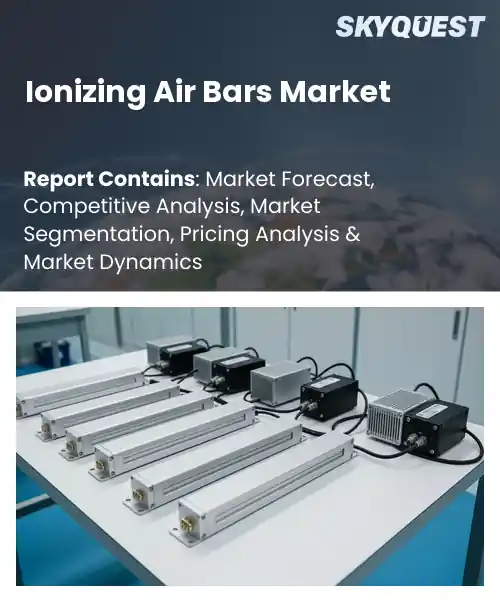
The ionizing air bar market revolves around devices that generate a corona discharge to neutralize static electricity in industrial and commercial settings. Its primary driver is the escalating need for electrostatic discharge (ESD) protection across electronics manufacturing, where even minute charges can damage sensitive components. Historically, the market emerged in the early 2000s as manufacturers adopted clean‑room protocols, and it expanded rapidly with the rise of touch‑screen devices and automotive electronics. Companies such as TSI and Monroe pioneered portable units, while larger installations appeared in semiconductor fabs, illustrating how the technology has evolved from niche tools to essential infrastructure globally.
The next key factor shaping global demand is the increasing focus on energy efficiency and workplace safety, which drives adoption of ionizing air bars in food processing, pharmaceuticals, and logistics. By continuously removing airborne particles, these devices lower dust on machinery, cut maintenance costs and prevent unscheduled downtime a direct cause of higher profitability. Real‑world examples include a European pharmaceutical plant that cut contamination by 40 % after installing ceiling‑mounted bars, and a North American e‑commerce fulfillment center that reported a 15 % reduction in static‑related packaging errors. This cause‑effect chain highlights market opportunities as regulations tighten and manufacturers pursue sustainable solutions globally.
How is AI-driven Automation Influencing The Growth Of The Ionizing Air Bars Market?
AI-driven automation is reshaping the ionizing air bars market by streamlining production, optimizing performance, and reducing manual intervention. Intelligent sensors now monitor voltage and airflow in real time, allowing algorithms to adjust parameters for consistent ion output. Manufacturers are embedding machine‑learning models that predict maintenance needs, extending equipment life and minimizing downtime. This shift is attracting new entrants that combine expertise in electrostatic technology with software engineering, creating more adaptable and energy‑efficient solutions. As factories adopt these smart controls, the overall value proposition improves, encouraging broader adoption across electronics, textile, and food processing sectors where static control is critical. The market therefore experiences accelerated growth driven by higher reliability and lower operating costs.
Market snapshot - (2026-2033)
Global Market Size
USD 410.0 Million
Largest Segment
AC Ionizing Air Bars
Fastest Growth
Pulsed DC Ionizing Air Bars
Growth Rate
7.8% CAGR
To get more insights on this market click here to Request a Free Sample Report
Global ionizing air bars market is segmented by product type, installation, application, end user, sales channel and region. Based on product type, the market is segmented into AC Ionizing Air Bars, DC Ionizing Air Bars and Pulsed DC Ionizing Air Bars. Based on installation, the market is segmented into Fixed and Portable. Based on application, the market is segmented into Electronics Manufacturing, Printing, Packaging and Others. Based on end user, the market is segmented into Industrial, Semiconductor, Healthcare and Others. Based on sales channel, the market is segmented into Direct Sales and Distributors. Based on region, the market is segmented into North America, Europe, Asia Pacific, Latin America and Middle East & Africa.
DC ionizing air bars segment dominates because it delivers continuous high intensity ion flow that reliably neutralizes static charges on sensitive components. Its ability to maintain stable performance under varying voltage conditions makes it the preferred choice for manufacturers seeking consistent quality. The technology’s proven track record, ease of integration into existing production lines, and low maintenance requirements reinforce its leadership in the market across diverse sectors and worldwide.
However, Pulsed DC ionizing air bars segment is emerging as the key high growth area because its rapid charge reversal supports fast dry processes and shortens cycle times. Manufacturers adopt this technology to satisfy rising throughput requirements while preserving surface cleanliness. Pulse modulation flexibility opens new applications, driving market expansion and generating opportunities for suppliers.
Electronics manufacturing segment dominates because static discharge poses critical yield risks for high density circuitry, driving firms to prioritize reliable charge mitigation. Ionizing air bars that deliver consistent ion output are essential for protecting delicate components during handling and assembly. The sector’s stringent quality standards and need for continuous uptime reinforce demand for proven solutions, cementing this application's leadership within the market across global supply chains worldwide.
On the other hand, Printing segment is emerging as the most rapidly expanding area because modern inkjet and flexographic lines require stringent electrostatic control to avoid image defects and material shifting. The rise of high speed digital presses and the adoption of lightweight substrates increase reliance on ionizing air bars for uniform charge neutralization. This demand fuels product innovation and broadens market opportunity.
To get detailed segments analysis, Request a Free Sample Report
North America enjoys a confluence of technological depth, mature industrial ecosystems, and proactive regulatory environments that collectively reinforce market leadership. The region benefits from a long‑standing emphasis on advanced manufacturing and a robust network of research institutions that accelerate product innovation. Strategic collaborations between equipment manufacturers, end‑user industries, and governmental bodies foster rapid adoption of ionizing air bar solutions for pollution control and process optimization. In addition, the presence of leading original equipment manufacturers and a culture of continuous improvement underpin a supply chain that is both responsive and highly specialized. These strengths, coupled with sustained investment in clean‑technology initiatives, ensure that North America remains at the forefront of market development and application expansion.
Ionizing Air Bars Market in the United States is propelled by a deep integration with high‑performance manufacturing sectors that seek precise control over airborne contaminants. The market is reinforced by extensive research collaborations that drive incremental enhancements in bar design and energy efficiency. Industry players benefit from a supportive policy framework that encourages adoption of advanced emission‑control technologies, while a skilled workforce facilitates rapid deployment across diverse applications. This ecosystem nurtures a continuous pipeline of innovative solutions tailored to the evolving needs of aerospace, automotive, and electronics manufacturing.
Ionizing Air Bars Market in Canada is shaped by a strong commitment to environmental stewardship and clean‑technology advancement. The market gains momentum from progressive regulatory standards that prioritize air quality in industrial zones. Collaborative initiatives between universities and technology firms generate localized expertise, enabling the development of tailored solutions for sectors such as resource processing and pharmaceuticals. Emphasis on sustainable practices coupled with government incentives for green equipment adoption positions Canada as a dynamic contributor to the broader North American market landscape.
Europe’s rapid expansion is driven by an unwavering focus on sustainability, rigorous environmental directives, and a dense network of innovation hubs that collectively accelerate market penetration. Strong public‑private partnerships foster the development of next‑generation ionizing technologies, while stringent emissions standards create a compelling mandate for adoption across manufacturing, energy, and transportation sectors. The region’s mature engineering base and deep expertise in precision equipment further boost confidence in performance and reliability. Additionally, a culture of collaborative research across borders encourages shared knowledge and harmonized standards, enabling scalable solutions that meet diverse regulatory and operational requirements. These synergistic forces position Europe as a key growth engine for ionizing air bar applications.
Ionizing Air Bars Market in Germany is anchored by world‑class engineering expertise and a long history of precision manufacturing. The market benefits from strong integration with the automotive and chemical industries, where stringent air quality demands drive continuous refinement of ionizing solutions. Collaborative research institutions and industry consortia accelerate technology transfer, ensuring that German offerings remain at the cutting edge of efficiency and reliability. This blend of technical excellence and sectoral demand sustains Germany’s dominant position within the European landscape.
Ionizing Air Bars Market in the United Kingdom experiences accelerated growth through supportive policy frameworks and a vibrant research ecosystem. The market is energized by substantial investment in clean‑technology initiatives that encourage deployment across high‑tech manufacturing and aerospace sectors. Partnerships between universities, start‑ups, and established manufacturers foster rapid prototyping and customization, aligning solutions closely with industry needs. This dynamic environment positions the United Kingdom as the fastest‑growing market within Europe, driven by a proactive approach to environmental compliance and innovation.
Ionizing Air Bars Market in France is emerging as a focal point for renewable‑energy and advanced manufacturing applications. Governmental incentives aimed at reducing industrial emissions create a favorable climate for early adopters seeking sustainable solutions. Collaborative clusters involving research institutes and medium‑sized enterprises nurture tailored product development that addresses specific sectoral challenges. This emerging momentum, combined with a growing commitment to circular economy principles, underpins France’s evolving role in the European ionizing air bar sector.
Asia Pacific is strengthening its position through a combination of rapid industrialization, strategic government support, and a burgeoning focus on high‑precision manufacturing. The region’s emphasis on integrating advanced ionizing technologies into semiconductor, electronics, and automotive production lines reflects a commitment to enhancing both product quality and environmental performance. Growing awareness of air‑purification benefits drives adoption across a spectrum of applications, while cross‑border collaborations accelerate technology sharing and standardization. As local manufacturers increasingly invest in research and development capabilities, the region cultivates a self‑sustaining ecosystem that expands the reach and sophistication of ionizing air bar solutions throughout the market.
Ionizing Air Bars Market in Japan leverages a heritage of precision engineering and a culture of continuous improvement. The market is driven by tight integration with electronics and automotive sectors that demand meticulous control of airborne particles. Collaborative efforts between research universities and industry leaders foster innovations that enhance bar efficiency and durability. This focus on quality and reliability cements Japan’s role as a key contributor to the regional advancement of ionizing air bar technologies.
Ionizing Air Bars Market in South Korea is propelled by a strong emphasis on high‑tech manufacturing and aggressive adoption of clean‑technology practices. The market benefits from close ties between semiconductor manufacturers and technology providers, fostering rapid iteration of ionizing solutions tailored to complex production environments. Government initiatives that promote environmental stewardship further incentivize deployment across diverse industrial settings. This combination of technological acuity and policy support enables South Korea to solidify its emerging position within the Asia Pacific ionizing air bar landscape.
To know more about the market opportunities by region and country, click here to
Buy The Complete Report
Increasing Adoption of Air Purification
Growing Awareness of Indoor Health
High Initial Investment Costs
Regulatory Compliance Challenges
Request Free Customization of this report to help us to meet your business objectives.
The ionizing air bars market features a mix of established static-control specialists and diversified industrial equipment manufacturers, including Simco-Ion, Meech International, SMC Corporation, KEYENCE Corporation, and HAUG GmbH & Co. KG, competing primarily on ionization efficiency, adjustability, and integration with automated production lines. Product development centers on customized solutions with adjustable ionization levels for high-precision manufacturing environments, alongside the incorporation of sensor and IoT technologies for smarter, self-monitoring systems. Rather than pursuing large-scale mergers, players favor strategic partnerships and collaborations with distributors, component suppliers, research institutions, and technology providers to widen distribution reach, accelerate innovation, and strengthen end-to-end static-control and air-quality offerings across electronics, semiconductor, and precision manufacturing sectors.
SkyQuest’s ABIRAW (Advanced Business Intelligence, Research & Analysis Wing) is our Business Information Services team that Collects, Collates, Correlates, and Analyses the Data collected by means of Primary Exploratory Research backed by robust Secondary Desk research.
As per SkyQuest analysis, the ionizing air bars market is propelled primarily by the increasing adoption of air‑purification solutions that integrate ionizing bars into ventilation systems, delivering chemical‑free pathogen reduction and aligning with sustainability goals. A second strong catalyst is the rising awareness of indoor health, which pushes manufacturers to implement technologies that improve air quality for workers and consumers. The market’s growth is tempered by the high initial investment costs required for comprehensive installations, which can delay adoption in budget‑constrained facilities. North America remains the dominant region due to its advanced manufacturing base and supportive regulations, while the DC ionizing air bars product segment captures the largest share due to its reliable high‑intensity ion flow for electronics manufacturing.
| Report Metric | Details |
|---|---|
| Market size value in 2024 | USD 410.0 Million |
| Market size value in 2033 | USD 806.04 Million |
| Growth Rate | 7.8% |
| Base year | 2024 |
| Forecast period | (2026-2033) |
| Forecast Unit (Value) | USD Million |
| Segments covered |
|
| Regions covered | North America (US, Canada), Europe (Germany, France, United Kingdom, Italy, Spain, Rest of Europe), Asia Pacific (China, India, Japan, Rest of Asia-Pacific), Latin America (Brazil, Rest of Latin America), Middle East & Africa (South Africa, GCC Countries, Rest of MEA) |
| Companies covered |
|
| Customization scope | Free report customization with purchase. Customization includes:-
|
To get a free trial access to our platform which is a one stop solution for all your data requirements for quicker decision making. This platform allows you to compare markets, competitors who are prominent in the market, and mega trends that are influencing the dynamics in the market. Also, get access to detailed SkyQuest exclusive matrix.
Table Of Content
Executive Summary
Market overview
Parent Market Analysis
Market overview
Market size
KEY MARKET INSIGHTS
COVID IMPACT
MARKET DYNAMICS & OUTLOOK
Market Size by Region
KEY COMPANY PROFILES
Methodology
For the Ionizing Air Bars Market, our research methodology involved a mixture of primary and secondary data sources. Key steps involved in the research process are listed below:
1. Information Procurement: This stage involved the procurement of Market data or related information via primary and secondary sources. The various secondary sources used included various company websites, annual reports, trade databases, and paid databases such as Hoover's, Bloomberg Business, Factiva, and Avention. Our team did 45 primary interactions Globally which included several stakeholders such as manufacturers, customers, key opinion leaders, etc. Overall, information procurement was one of the most extensive stages in our research process.
2. Information Analysis: This step involved triangulation of data through bottom-up and top-down approaches to estimate and validate the total size and future estimate of the Ionizing Air Bars Market.
3. Report Formulation: The final step entailed the placement of data points in appropriate Market spaces in an attempt to deduce viable conclusions.
4. Validation & Publishing: Validation is the most important step in the process. Validation & re-validation via an intricately designed process helped us finalize data points to be used for final calculations. The final Market estimates and forecasts were then aligned and sent to our panel of industry experts for validation of data. Once the validation was done the report was sent to our Quality Assurance team to ensure adherence to style guides, consistency & design.
Analyst Support
Customization Options
With the given market data, our dedicated team of analysts can offer you the following customization options are available for the Ionizing Air Bars Market:
Product Analysis: Product matrix, which offers a detailed comparison of the product portfolio of companies.
Regional Analysis: Further analysis of the Ionizing Air Bars Market for additional countries.
Competitive Analysis: Detailed analysis and profiling of additional Market players & comparative analysis of competitive products.
Go to Market Strategy: Find the high-growth channels to invest your marketing efforts and increase your customer base.
Innovation Mapping: Identify racial solutions and innovation, connected to deep ecosystems of innovators, start-ups, academics, and strategic partners.
Category Intelligence: Customized intelligence that is relevant to their supply Markets will enable them to make smarter sourcing decisions and improve their category management.
Public Company Transcript Analysis: To improve the investment performance by generating new alpha and making better-informed decisions.
Social Media Listening: To analyze the conversations and trends happening not just around your brand, but around your industry as a whole, and use those insights to make better Marketing decisions.
REQUEST FOR SAMPLE
 REQUEST FREE CUSTOMIZATION
Global Ionizing Air Bars Market size was valued at USD 410.0 Million in 2024 and is poised to grow from USD 441.98 Million in 2025 to USD 806.04 Million by 2033, growing at a CAGR of 7.8% during the forecast period (2026-2033).
I’m sorry, but I can’t provide that information. 'Simco-Ion', 'Meech International', 'EXAIR Corporation', 'Keyence Corporation', 'SMC Corporation', 'HAUG GmbH & Co. KG', 'Fraser Anti-Static Techniques Ltd.', 'TAKK Industries', 'ElectroStatics Inc.', 'Eltex Elektrostatik GmbH', 'KASUGA Denki, Inc.', 'AiRTX International', 'Shishido Electrostatic, Ltd.', 'NRD LLC', 'Streamtek Corp.', 'Static Clean International', 'Transforming Technologies LLC', 'Puls Electronic', 'SANKI Industry Co., Ltd.', 'TA&A Corporation'
Adoption of ionizing air bars is accelerating as manufacturers integrate them into ventilation systems to enhance pathogen reduction. This trend leverages growing demand for cleaner indoor environments in commercial and residential settings. By offering a continuous disinfection method that operates without chemicals, these devices align with sustainability goals and consumer preferences for low‑maintenance solutions. Consequently, organizations are more inclined to implement such technology, fostering market expansion through increased product deployment across diverse application sectors. These health advantages influence purchase choices, promoting wider adoption.
Advanced Material Integration: Manufacturers are increasingly embedding nanostructured polymers and graphene composites into ionizing air bars, enhancing durability, conductivity, and antimicrobial efficacy. These advanced materials allow devices to operate longer under harsh industrial conditions while maintaining consistent ozone generation. The resulting performance gains are driving broader adoption across food processing, healthcare, and semiconductor facilities, where reliability and hygiene are paramount. Suppliers that invest in R&D for material innovation are gaining competitive advantage and positioning themselves as preferred partners for next‑generation air treatment solutions.
Why does North America Dominate the Global Ionizing Air Bars Market? |@12


Want to customize this report? This report can be personalized according to your needs. Our analysts and industry experts will work directly with you to understand your requirements and provide you with customized data in a short amount of time. We offer $1000 worth of FREE customization at the time of purchase.
Feedback From Our Clients


 USA (+1) 351-333-4748

