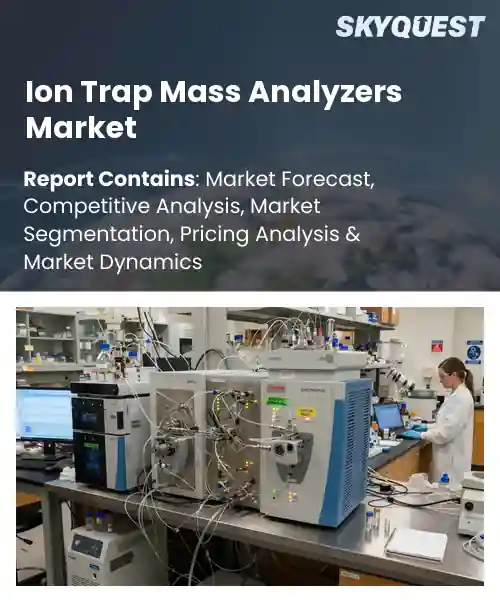
Ion Trap Mass Analyzers Market
Report ID: SQMIG45J2952
Report ID: SQMIG45J2952
[email protected]
USA +1 351-333-4748
Report ID:
SQMIG45J2952 |
Region:
Global |
Published Date: September, 2026
Pages:
157
|Tables:
128
|Figures:
77


Global Ion Trap Mass Analyzers Market size was valued at USD 1.31 Billion in 2024 and is poised to grow from USD 1.43 Billion in 2025 to USD 2.97 Billion by 2033, growing at a CAGR of 9.5% during the forecast period (2026-2033).
Global ion trap mass analyzer market encompasses devices that capture and fragment ions within fields, enabling molecular identification for pharmaceuticals and proteomics. Its importance stems from the ability to deliver sensitivity at cost compared to Orbitrap or FT‑ICR systems, which has accelerated adoption in academic labs and biotech firms. Historically the sector originated in the 1970s with first Paul trap, but commercial viability surged after 2000 when manufacturers introduced miniature models that integrated with liquid chromatography. This evolution, illustrated by Thermo Fisher’s Finnigan LTQ and Bruker’s amaZon, shows how shrinking footprints software have turned routine analysis into a scalable service. Regulatory pressure for contaminant detection drives ion trap growth because limits force labs to adopt affordable tools that enable multi‑residue screening. This stimulus has accelerated development of hybrid linear traps that pair quadrupole selection with trap fragmentation, delivering selectivity needed by food‑safety agencies while remaining cheaper than time‑of‑flight systems. Consequently manufacturers expand production to supply research organizations processing thousands of samples daily; Bruker’s EVOQ, installed at a European pesticide lab, cut analysis time by 30 %. The ensuing demand for faster data handling prompts investment in automated processing software, lowering expertise barriers and opening opportunities in clinical diagnostics and forensic science.
How is AI-driven automation influencing the growth of the ion trap mass analyzers market?
AI driven automation is reshaping the ion trap mass analyzer market by streamlining data acquisition, reducing manual tuning, and accelerating sample throughput. Modern instruments embed machine learning algorithms that predict optimal trapping parameters, allowing users to focus on interpretation rather than hardware adjustments. This shift improves reproducibility and lowers the skill barrier for new laboratories, encouraging broader adoption across pharmaceutical, environmental and food safety sectors. Vendors are integrating cloud based analytics platforms that automatically flag anomalies and suggest corrective actions, turning routine runs into self optimizing processes. As a result, demand for smarter, more efficient ion trap systems is rising, fueling product upgrades and new model introductions.At this time I do not have a specific recent company announcement with month and year to cite. However, the trend of embedding AI driven automation continues to drive efficiency gains and market expansion as manufacturers adopt smarter ion trap solutions.
Market snapshot - (2026-2033)
Global Market Size
USD 1.31 Billion
Largest Segment
Linear Ion Trap Mass Analyzers
Fastest Growth
Orbitrap-Ion Trap Hybrid Analyzers
Growth Rate
9.5% CAGR
To get more insights on this market click here to Request a Free Sample Report
Global ion trap mass analyzers market is segmented by analyzer type, ionization technique, application, end user and region. Based on analyzer type, the market is segmented into 3D Ion Trap Mass Analyzers, Linear Ion Trap Mass Analyzers, Orbitrap-Ion Trap Hybrid Analyzers, Quadrupole-Ion Trap Hybrid Analyzers and Others. Based on ionization technique, the market is segmented into Electrospray Ionization, Electron Ionization, Atmospheric Pressure Chemical Ionization, Matrix-Assisted Laser Desorption/Ionization and Others. Based on application, the market is segmented into Proteomics, Pharmaceutical Analysis, Environmental Analysis, Food and Beverage Testing, Clinical Diagnostics, Forensic Analysis and Others. Based on end user, the market is segmented into Pharmaceutical Companies, Biotechnology Companies, Academic and Research Institutions, Contract Research Organizations, Diagnostic Laboratories and Others. Based on region, the market is segmented into North America, Europe, Asia Pacific, Latin America and Middle East & Africa.
3D ion trap mass analyzers segment dominates because they provide unparalleled trapping efficiency and robust performance across a wide mass range, making them the workhorse for routine analysis. Their mature technology, extensive method libraries, and compatibility with diverse ionization sources foster confidence among users, driving sustained preference and reinforcing market leadership. Their cost‑effective operation and proven reliability reduce downtime, while seamless integration into existing LC‑MS platforms accelerates workflow adoption, further cementing their dominant position.
Meanwhile, linear ion trap mass analyzers are witnessing the strongest growth momentum as their compact form factor and faster scan speeds enable high‑throughput screening in emerging proteomics and metabolomics workflows. The push for miniaturized instrumentation and real‑time data acquisition fuels adoption, positioning this technology as a catalyst for expanding market opportunities.
proteomics segment dominates because ion trap instruments deliver high sensitivity and rapid MS/MS capabilities essential for large‑scale peptide sequencing. Their ability to perform multiple stages of fragmentation within a compact footprint aligns with the intensive throughput demands of discovery‑driven studies. Coupled with extensive software ecosystems and proven quantitative workflows, proteomics users consistently prioritize ion trap platforms, reinforcing their central role in market adoption. Their flexibility to handle diverse sample matrices and compatibility with label‑free quantitation further solidify their appeal across academic and industrial labs.
Conversely, clinical diagnostics is emerging as the key high‑growth area as ion trap mass spectrometers are increasingly deployed for rapid biomarker verification and therapeutic drug monitoring. Stringent regulatory pathways and the need for cost‑effective, multiplexed assays drive adoption, positioning this application to accelerate market expansion and generate new revenue streams.
To get detailed segments analysis, Request a Free Sample Report
North America retains a leading position because it combines world‑class research ecosystems with deep capital resources that accelerate technology development. The region hosts a concentration of pioneering instrument manufacturers that continually push design performance, while major pharmaceutical and environmental laboratories adopt these tools for high‑throughput analysis. Strong collaborations between universities, government labs and industry create a rapid feedback loop that shortens product cycles. An established supply chain ensures ready availability of critical components and service expertise. Favorable regulatory frameworks encourage adoption in clinical and forensic settings, and a highly skilled engineering workforce sustains ongoing innovation. These interlocking strengths reinforce a market environment where new ion trap architectures are rapidly commercialized and broadly implemented.
Ion Trap Mass Analyzers Market in the United States benefits from a dense network of research universities and a thriving pharmaceutical sector that drives demand for high‑resolution analytical tools. Leading manufacturers headquartered in the country leverage extensive R&D budgets to introduce next‑generation designs. Close proximity between instrument developers and end‑users enables rapid customization, while a sophisticated service infrastructure ensures high instrument uptime and customer confidence and long‑term partnership with regulatory agencies.
Ion Trap Mass Analyzers Market in Canada is bolstered by strong governmental research programs and a collaborative biotech ecosystem that emphasizes precision analytics. Canadian laboratories prioritize instrument reliability for environmental monitoring and food safety, encouraging manufacturers to tailor solutions for local standards. Proximity to major North American suppliers ensures easy access to components, while a skilled technical workforce supports advanced method development. These factors collectively foster steady adoption across academic and industrial settings.
Europe’s expansion is propelled by a confluence of rigorous environmental legislation, deep investment in life‑science research and a vibrant network of collaborative research programmes that emphasize analytical excellence. Governments across the region allocate substantial support to academic and industrial projects that require high‑performance mass spectrometry, prompting laboratories to upgrade to advanced ion trap configurations. The pharmaceutical and chemical sectors, seeking precise molecular characterization, generate steady demand for instruments that combine sensitivity with robustness. Moreover, the presence of established precision‑instrument manufacturers in key industrial hubs fosters localised supply chains and swift technical support. A culture of cross‑border scientific cooperation further accelerates knowledge transfer, ensuring that emerging analytical techniques are rapidly adopted throughout the continent.
Ion Trap Mass Analyzers Market in Germany benefits from a highly engineered manufacturing base and a strong emphasis on precision research in academia and industry. German laboratories prioritize reliability and analytical depth for pharmaceutical synthesis and automotive material analysis, encouraging vendors to deliver robust, high‑resolution solutions. Close collaboration between instrument firms and technical institutes accelerates product refinement, while a well‑established service network guarantees rapid maintenance and calibration support across the nation.
Ion Trap Mass Analyzers Market in the United Kingdom is energized by a thriving life‑science sector and leading university research that drives demand for cutting‑edge analytical capability. British drug discovery teams rely on ion trap technology for rapid structure elucidation, while environmental agencies adopt the instruments for trace contaminant monitoring. The presence of several innovative instrument distributors ensures competitive pricing and swift access to upgrades, and a strong regulatory emphasis on analytical quality reinforces ongoing investment in advanced mass spectrometry platforms.
Ion Trap Mass Analyzers Market in France is shaped by a strong emphasis on chemical research and an expanding biotech ecosystem that values high‑precision analytical tools. French academic laboratories and pharmaceutical firms seek ion trap systems for detailed molecular profiling, prompting vendors to adapt interfaces to local workflow standards. Government‑funded initiatives encourage collaborative projects that integrate mass spectrometry into environmental and food safety testing, while a network of specialized service providers ensures reliable instrument performance across the country.
Asia Pacific is enhancing its market stature through a blend of intensified research activity, expanding pharmaceutical manufacturing and strategic government incentives that prioritize advanced analytical capabilities. The region’s emerging biotech hubs and growing chemical production lines demand high‑throughput, compact ion trap systems that can operate under diverse laboratory conditions. Local instrument makers benefit from competitive manufacturing ecosystems, enabling cost‑effective solutions that appeal to both domestic and export markets. Collaborative research consortia across Japan, South Korea and neighboring economies accelerate technology transfer, while educational programs produce a skilled workforce adept at sophisticated mass spectrometric techniques. These dynamics collectively foster broader adoption and position Asia Pacific as a significant contributor to global ion trap advancements.
Ion Trap Mass Analyzers Market in Japan is driven by world‑class research institutions and a mature electronics manufacturing sector that together propel instrument innovation. Japanese pharmaceutical and materials science laboratories favor ion trap technology for its sensitivity and adaptability, prompting domestic vendors to integrate cutting‑edge electronics and miniaturization. Strong collaboration between academic labs and industry accelerates method development, while a robust after‑sales network guarantees prompt maintenance, reinforcing confidence among end‑users across the country.
Ion Trap Mass Analyzers Market in South Korea benefits from a focused national strategy to strengthen high‑tech manufacturing and life‑science research capabilities. Korean research hospitals and chemical firms adopt ion trap instruments for rapid compound identification, encouraging local suppliers to tailor solutions for high‑density laboratory environments. Close ties between university engineering departments and instrument developers accelerate integration of advanced software features, while government‑backed innovation clusters provide funding and shared facilities that enhance overall market uptake across the nation.
To know more about the market opportunities by region and country, click here to
Buy The Complete Report
Rising Need for Molecular Characterization
Advancements in Miniaturized Ion Trap Designs
High Capital Expenditure for Instruments
Limited Skilled Workforce for Operation
Request Free Customization of this report to help us to meet your business objectives.
The ion trap mass analyzer market is shaped by intense rivalry among Thermo Fisher Scientific, Agilent Technologies, Bruker, Shimadzu and Waters, each leveraging product innovation and strategic alliances to capture premium segments. Drivers such as demand for higher resolution, faster analysis and portable solutions intensify competition. Recent moves include Bruker’s launch of the timsTOF Pro with trapped ion mobility, Thermo Fisher’s partnership with Cambridge Nanotech to mini‑fabricate ion traps, and Waters’ 2022 collaboration with Sciex to co‑develop next‑generation ion‑trap modules.
Top Player’s Company Profile
Recent Developments
SkyQuest’s ABIRAW (Advanced Business Intelligence, Research & Analysis Wing) is our Business Information Services team that Collects, Collates, Correlates, and Analyses the Data collected by means of Primary Exploratory Research backed by robust Secondary Desk research. As per SkyQuest analysis, the ion trap mass analyzers market is propelled primarily by the rising need for molecular characterization across pharmaceuticals, environmental and food safety labs, while the parallel advancement of miniaturized ion‑trap designs expands use into portable and field‑deployed settings, providing a second strong growth catalyst. However, the high capital expenditure required for these instruments remains a key restraint that limits adoption, especially among smaller organizations. North America continues to dominate the market, driven by its robust research ecosystem, deep capital resources and leading instrument manufacturers. Within product types, 3D ion traps hold the largest share thanks to their proven reliability, wide mass range and seamless LC‑MS integration.
| Report Metric | Details |
|---|---|
| Market size value in 2024 | USD 1.31 Billion |
| Market size value in 2033 | USD 2.97 Billion |
| Growth Rate | 9.5% |
| Base year | 2024 |
| Forecast period | (2026-2033) |
| Forecast Unit (Value) | USD Billion |
| Segments covered |
|
| Regions covered | North America (US, Canada), Europe (Germany, France, United Kingdom, Italy, Spain, Rest of Europe), Asia Pacific (China, India, Japan, Rest of Asia-Pacific), Latin America (Brazil, Rest of Latin America), Middle East & Africa (South Africa, GCC Countries, Rest of MEA) |
| Companies covered |
|
| Customization scope | Free report customization with purchase. Customization includes:-
|
To get a free trial access to our platform which is a one stop solution for all your data requirements for quicker decision making. This platform allows you to compare markets, competitors who are prominent in the market, and mega trends that are influencing the dynamics in the market. Also, get access to detailed SkyQuest exclusive matrix.
Table Of Content
Executive Summary
Market overview
Parent Market Analysis
Market overview
Market size
KEY MARKET INSIGHTS
COVID IMPACT
MARKET DYNAMICS & OUTLOOK
Market Size by Region
KEY COMPANY PROFILES
Methodology
For the Ion Trap Mass Analyzers Market, our research methodology involved a mixture of primary and secondary data sources. Key steps involved in the research process are listed below:
1. Information Procurement: This stage involved the procurement of Market data or related information via primary and secondary sources. The various secondary sources used included various company websites, annual reports, trade databases, and paid databases such as Hoover's, Bloomberg Business, Factiva, and Avention. Our team did 45 primary interactions Globally which included several stakeholders such as manufacturers, customers, key opinion leaders, etc. Overall, information procurement was one of the most extensive stages in our research process.
2. Information Analysis: This step involved triangulation of data through bottom-up and top-down approaches to estimate and validate the total size and future estimate of the Ion Trap Mass Analyzers Market.
3. Report Formulation: The final step entailed the placement of data points in appropriate Market spaces in an attempt to deduce viable conclusions.
4. Validation & Publishing: Validation is the most important step in the process. Validation & re-validation via an intricately designed process helped us finalize data points to be used for final calculations. The final Market estimates and forecasts were then aligned and sent to our panel of industry experts for validation of data. Once the validation was done the report was sent to our Quality Assurance team to ensure adherence to style guides, consistency & design.
Analyst Support
Customization Options
With the given market data, our dedicated team of analysts can offer you the following customization options are available for the Ion Trap Mass Analyzers Market:
Product Analysis: Product matrix, which offers a detailed comparison of the product portfolio of companies.
Regional Analysis: Further analysis of the Ion Trap Mass Analyzers Market for additional countries.
Competitive Analysis: Detailed analysis and profiling of additional Market players & comparative analysis of competitive products.
Go to Market Strategy: Find the high-growth channels to invest your marketing efforts and increase your customer base.
Innovation Mapping: Identify racial solutions and innovation, connected to deep ecosystems of innovators, start-ups, academics, and strategic partners.
Category Intelligence: Customized intelligence that is relevant to their supply Markets will enable them to make smarter sourcing decisions and improve their category management.
Public Company Transcript Analysis: To improve the investment performance by generating new alpha and making better-informed decisions.
Social Media Listening: To analyze the conversations and trends happening not just around your brand, but around your industry as a whole, and use those insights to make better Marketing decisions.
REQUEST FOR SAMPLE
 REQUEST FREE CUSTOMIZATION


Want to customize this report? This report can be personalized according to your needs. Our analysts and industry experts will work directly with you to understand your requirements and provide you with customized data in a short amount of time. We offer $1000 worth of FREE customization at the time of purchase.
Feedback From Our Clients


 USA (+1) 351-333-4748

