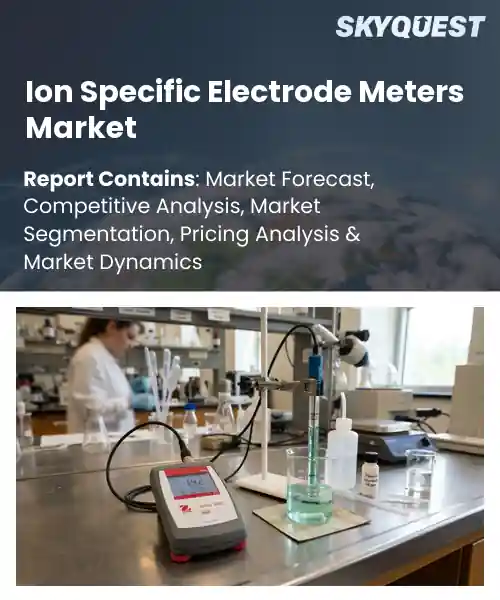
Ion Specific Electrode Meters Market
Report ID: SQMIG45J2828
Report ID: SQMIG45J2828
[email protected]
USA +1 351-333-4748
Report ID:
SQMIG45J2828 |
Region:
Global |
Published Date: August, 2026
Pages:
157
|Tables:
129
|Figures:
77


Global Ion Specific Electrode Meters Market size was valued at USD 486.2 Million in 2024 and is poised to grow from USD 518.78 Million in 2025 to USD 871.56 Million by 2033, growing at a CAGR of 6.7% during the forecast period (2026-2033).
The global ion‑specific electrode (ISE) meter market revolves around handheld and benchtop devices that convert selective ion activity into precise electrical signals for real‑time water‑quality assessment. Its importance stems from escalating regulatory scrutiny on drinking‑water standards and the need for rapid, on‑site analysis in agriculture, pharmaceuticals, and industrial effluents. Historically, the sector emerged in the 1970s with glass‑membrane electrodes, then expanded in the 1990s as solid‑state sensors reduced maintenance costs. Recent adoption of digital communication protocols has further accelerated uptake, exemplified by municipalities deploying networked ISE meters to monitor nitrate spikes during heavy rain events and protect public health globally. The growth catalyst for the ISE meter market is the convergence of farm initiatives with environmental compliance, which compels growers to adopt sensor networks that instantly flag ion imbalances in irrigation water. As a result, manufacturers are integrating Bluetooth Energy and cloud analytics, enabling agronomists to adjust fertilizer regimes before crop stress manifests, thereby boosting yields and reducing runoff. Parallel demand from semiconductor fabs for water monitoring creates lucrative contracts, while emerging applications in home‑testing kits for water‑hardness and pH attract spending. Consequently, investment in miniaturized solid‑state membranes and calibration algorithms is expected to expand the market’s addressable volume significantly.
How are AI and IoT enhancing accuracy in the ion-specific electrode meter market?
AI and IoT are reshaping ion‑specific electrode meters by embedding smart analytics and seamless connectivity into the measurement workflow. Machine‑learning models process raw sensor signals to correct drift, filter noise and predict interference, while IoT links each meter to cloud platforms for continuous monitoring and remote updates. This combination enables users to obtain reliable readings without manual recalibration, reduces downtime, and supports automated process control in water treatment, food safety and pharmaceutical labs. As the market expands, manufacturers are integrating edge computing chips and wireless protocols, turning traditional meters into adaptive, data‑rich instruments that respond instantly to changing sample conditions.In July 2024 a leading ion‑specific electrode meter manufacturer launched an AI‑driven calibration module that streams data via IoT to a cloud analytics hub, allowing real‑time accuracy adjustments and predictive maintenance. This innovation shortens setup time and boosts confidence in critical monitoring applications, reinforcing market momentum.
Market snapshot - (2026-2033)
Global Market Size
USD 486.2 Million
Largest Segment
Benchtop Ion Specific Electrode Meters
Fastest Growth
Online Ion Specific Electrode Meters
Growth Rate
6.7% CAGR
To get more insights on this market click here to Request a Free Sample Report
Global ion specific electrode meters market is segmented by meter type, ion type, application, end user and region. Based on meter type, the market is segmented into Benchtop Ion Specific Electrode Meters, Portable Ion Specific Electrode Meters, Handheld Ion Specific Electrode Meters and Online Ion Specific Electrode Meters. Based on ion type, the market is segmented into Fluoride, Chloride, Nitrate, Ammonium, Calcium and Other Ions. Based on application, the market is segmented into Water & Wastewater Testing, Environmental Testing, Food & Beverage Testing, Pharmaceutical Testing, Chemical Analysis, Research & Laboratory and Others. Based on end user, the market is segmented into Environmental Laboratories, Pharmaceutical Companies, Food & Beverage Companies, Chemical Companies, Water Treatment Facilities, Research & Academic Institutions and Others. Based on region, the market is segmented into North America, Europe, Asia Pacific, Latin America and Middle East & Africa.
Portable Ion Specific Electrode Meters segment dominates because field operators prioritize mobility and rapid result generation, enabling onsite analysis without laboratory delays. The compact design integrates battery power, rugged casings, and intuitive interfaces, aligning with the growing need for real time decision making in water and wastewater networks. This convenience drives procurement preferences, as users can conduct continuous monitoring across dispersed sites, reducing reliance on sample transport and enhancing operational efficiency.
However, Online Ion Specific Electrode Meters segment emerges as the most rapidly expanding because integrated data acquisition systems enable continuous, automated ion monitoring within process control loops. Smart connectivity and cloud based analytics attract utility and industrial customers seeking predictive maintenance, thereby accelerating market penetration and opening new revenue streams.
Fluoride segment dominates because regulatory agencies enforce strict limits on fluoride concentrations in drinking water, prompting widespread deployment of dedicated electrodes for compliance verification. Its chemical selectivity and stability across varying pH levels make it a reliable tool for municipalities and testing laboratories. Consequently, manufacturers prioritize fluoride sensing technology development, and end users adopt these meters to safeguard public health, reinforcing the segment’s central position overall in the market.
On the other hand, Nitrate segment is witnessing the strongest growth momentum because concerns over agricultural runoff and eutrophication drive demand for precise nitrate monitoring. Advances in electrode materials improve selectivity in complex matrices, and expanding environmental regulations compel utilities and farms to adopt testing, propelling market expansion and creating application niches.
To get detailed segments analysis, Request a Free Sample Report
North America benefits from a mature research ecosystem that fuels continuous innovation in ion specific electrode technology. Strong collaboration among leading universities, industry research labs, and government agencies accelerates product development and adoption. The region hosts highly integrated manufacturing networks that ensure rapid prototyping and scalable production, meeting demanding quality standards. End‑user industries such as water treatment, pharmaceutical manufacturing, and environmental monitoring demand precise analytical tools, creating a robust demand base. Well‑established regulatory frameworks promote confidence in measurement accuracy, encouraging broader market penetration. Extensive distribution channels and after‑sales support further reinforce market leadership, positioning North America as a benchmark for performance and reliability in the sector.
Ion Specific Electrode Meters Market in the United States thrives on a combination of cutting‑edge research institutions and a vibrant commercial landscape. Technology firms leverage advanced materials and sensor designs to deliver high‑precision solutions for industrial and laboratory applications. Strategic partnerships with water utilities and environmental agencies drive adoption in critical monitoring projects. A focus on compliance with stringent quality standards reinforces trust among customers, while a well‑developed service infrastructure sustains long‑term product performance.
Ion Specific Electrode Meters Market in Canada is shaped by strong governmental support for environmental monitoring and sustainable water management. Collaboration between research centres and local manufacturers yields innovative sensor platforms tailored to cold‑climate operations. Provincial initiatives promote the deployment of precise measurement tools in municipal and industrial settings. Emphasis on reliability and ease of integration enhances acceptance among end users, while a growing network of technical service providers ensures consistent operational support.
Europe experiences rapid expansion driven by rigorous environmental legislation that mandates precise ion monitoring across water and industrial processes. A network of research excellence spanning universities and specialized institutes fuels continuous refinement of electrode technologies, emphasizing miniaturization and robustness. Strong demand from the chemical, pharmaceutical, and food sectors encourages investment in high‑accuracy analytical equipment. Collaborative innovation clusters bridge gaps between manufacturers and end users, fostering tailored solutions that meet diverse regulatory requirements. Well‑established standards for calibration and quality assurance enhance market confidence, while a fragmented yet cohesive distribution landscape ensures broad accessibility across member states.
Ion Specific Electrode Meters Market in Germany benefits from a deep engineering tradition and a concentration of high‑tech manufacturers. Advanced research facilities focus on sensor precision and durability, supporting industries such as chemical processing and wastewater treatment. Close alignment with stringent national and EU standards drives continuous product enhancement. A strong culture of collaboration between academia and industry accelerates technology transfer, positioning Germany as a leader in reliable measurement solutions.
Ion Specific Electrode Meters Market in the United Kingdom is propelled by vibrant research ecosystems and a proactive regulatory environment. Universities and specialized tech firms develop next‑generation electrode designs that cater to water safety and industrial monitoring needs. Government‑backed initiatives encourage adoption of precise analytical tools across public utilities and private enterprises. An emphasis on rapid deployment and user‑friendly interfaces accelerates market uptake, establishing the United Kingdom as a rapidly growing hub for ion measurement technology.
Ion Specific Electrode Meters Market in France emerges from a strong focus on environmental sustainability and public health monitoring. Collaborative projects between research institutes and manufacturers promote the development of compact, high‑sensitivity electrodes. National programs supporting water quality improvement create a steady demand for accurate analytical instruments. Emphasis on compliance with European standards and the availability of specialized technical support underpin market growth, positioning France as an emerging player in the sector.
Asia Pacific strengthens its position through a blend of rapid industrialization and increasing emphasis on environmental stewardship. Investment in research and development across the region drives innovation in miniaturized, cost‑effective electrode solutions tailored to diverse market needs. Growing awareness of water quality challenges motivates adoption of precise measurement tools in both public utilities and private manufacturing. Strategic partnerships between multinational corporations and local technology firms facilitate technology transfer and capacity building. Robust supply chains and emerging talent pools enable scalable production, while regulatory reforms encouraging accurate monitoring bolster market confidence, positioning Asia Pacific as a dynamic contributor to the global ion specific electrode landscape.
Ion Specific Electrode Meters Market in Japan leverages a legacy of precision engineering and strong collaboration between research universities and sensor manufacturers. Emphasis on high reliability and compact design meets the stringent requirements of semiconductor, chemical, and water treatment industries. Government initiatives supporting environmental monitoring encourage widespread deployment of advanced electrodes. A well‑structured service network ensures consistent calibration and maintenance, reinforcing market credibility.
Ion Specific Electrode Meters Market in South Korea is driven by a focus on high‑tech manufacturing and proactive environmental policies. Domestic firms integrate cutting‑edge materials science to produce robust electrodes suited for electronics, petrochemical, and municipal water sectors. Collaborative innovation programs link academic research with industry application, accelerating product refinement. Growing demand for precise ion monitoring in advanced manufacturing processes sustains market momentum, positioning South Korea as an influential contributor within the Asia Pacific region.
To know more about the market opportunities by region and country, click here to
Buy The Complete Report
Increasing Demand for Water Quality Monitoring
Advancements in Sensor Miniaturization
High Initial Capital Investment
Stringent Calibration and Validation Requirements
Request Free Customization of this report to help us to meet your business objectives.
The ion specific electrode meters market is characterized by fierce competition between long‑standing analytical instrument manufacturers and a wave of newer entrants, prompting accelerated product innovation and strategic collaborations. Companies are pursuing technology‑focused partnerships and selective acquisitions of niche sensor developers to expand their portfolios and capture emerging applications in environmental monitoring and industrial process control.
Top Player’s Company Profile
Recent Developments
SkyQuest’s ABIRAW (Advanced Business Intelligence, Research & Analysis Wing) is our Business Information Services team that Collects, Collates, Correlates, and Analyses the Data collected by means of Primary Exploratory Research backed by robust Secondary Desk research. As per SkyQuest analysis the global ion‑specific electrode meters market is projected to reach $871.6 million by 2033, driven first by the rising demand for water‑quality monitoring as regulators tighten drinking‑water standards, and second by rapid advances in sensor miniaturisation that enable compact, low‑power devices. The portable ion‑specific electrode meter segment leads the market because field users value mobility and instant results, while North America remains the dominant region thanks to its strong research ecosystem and established end‑user base. A notable restraint is the high initial capital outlay and rigorous calibration requirements, which can slow adoption among cash‑constrained operators overall globally.
| Report Metric | Details |
|---|---|
| Market size value in 2024 | USD 486.2 Million |
| Market size value in 2033 | USD 871.56 Million |
| Growth Rate | 6.7% |
| Base year | 2024 |
| Forecast period | (2026-2033) |
| Forecast Unit (Value) | USD Million |
| Segments covered |
|
| Regions covered | North America (US, Canada), Europe (Germany, France, United Kingdom, Italy, Spain, Rest of Europe), Asia Pacific (China, India, Japan, Rest of Asia-Pacific), Latin America (Brazil, Rest of Latin America), Middle East & Africa (South Africa, GCC Countries, Rest of MEA) |
| Companies covered |
|
| Customization scope | Free report customization with purchase. Customization includes:-
|
To get a free trial access to our platform which is a one stop solution for all your data requirements for quicker decision making. This platform allows you to compare markets, competitors who are prominent in the market, and mega trends that are influencing the dynamics in the market. Also, get access to detailed SkyQuest exclusive matrix.
Table Of Content
Executive Summary
Market overview
Parent Market Analysis
Market overview
Market size
KEY MARKET INSIGHTS
COVID IMPACT
MARKET DYNAMICS & OUTLOOK
Market Size by Region
KEY COMPANY PROFILES
Methodology
For the Ion Specific Electrode Meters Market, our research methodology involved a mixture of primary and secondary data sources. Key steps involved in the research process are listed below:
1. Information Procurement: This stage involved the procurement of Market data or related information via primary and secondary sources. The various secondary sources used included various company websites, annual reports, trade databases, and paid databases such as Hoover's, Bloomberg Business, Factiva, and Avention. Our team did 45 primary interactions Globally which included several stakeholders such as manufacturers, customers, key opinion leaders, etc. Overall, information procurement was one of the most extensive stages in our research process.
2. Information Analysis: This step involved triangulation of data through bottom-up and top-down approaches to estimate and validate the total size and future estimate of the Ion Specific Electrode Meters Market.
3. Report Formulation: The final step entailed the placement of data points in appropriate Market spaces in an attempt to deduce viable conclusions.
4. Validation & Publishing: Validation is the most important step in the process. Validation & re-validation via an intricately designed process helped us finalize data points to be used for final calculations. The final Market estimates and forecasts were then aligned and sent to our panel of industry experts for validation of data. Once the validation was done the report was sent to our Quality Assurance team to ensure adherence to style guides, consistency & design.
Analyst Support
Customization Options
With the given market data, our dedicated team of analysts can offer you the following customization options are available for the Ion Specific Electrode Meters Market:
Product Analysis: Product matrix, which offers a detailed comparison of the product portfolio of companies.
Regional Analysis: Further analysis of the Ion Specific Electrode Meters Market for additional countries.
Competitive Analysis: Detailed analysis and profiling of additional Market players & comparative analysis of competitive products.
Go to Market Strategy: Find the high-growth channels to invest your marketing efforts and increase your customer base.
Innovation Mapping: Identify racial solutions and innovation, connected to deep ecosystems of innovators, start-ups, academics, and strategic partners.
Category Intelligence: Customized intelligence that is relevant to their supply Markets will enable them to make smarter sourcing decisions and improve their category management.
Public Company Transcript Analysis: To improve the investment performance by generating new alpha and making better-informed decisions.
Social Media Listening: To analyze the conversations and trends happening not just around your brand, but around your industry as a whole, and use those insights to make better Marketing decisions.
REQUEST FOR SAMPLE
 REQUEST FREE CUSTOMIZATION


Want to customize this report? This report can be personalized according to your needs. Our analysts and industry experts will work directly with you to understand your requirements and provide you with customized data in a short amount of time. We offer $1000 worth of FREE customization at the time of purchase.
Feedback From Our Clients


 USA (+1) 351-333-4748

