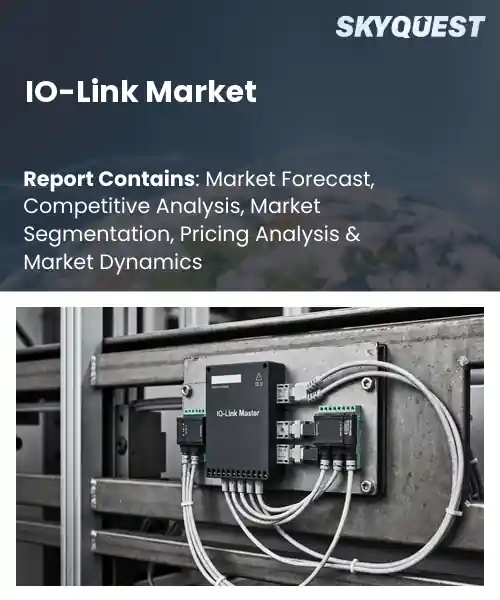
IO-Link Market
Report ID: SQMIG45K2260
Report ID: SQMIG45K2260
[email protected]
USA +1 351-333-4748
Report ID:
SQMIG45K2260 |
Region:
Global |
Published Date: May, 2026
Pages:
157
|Tables:
94
|Figures:
76


Global Io-Link Market size was valued at USD 16.23 Billion in 2024 and is poised to grow from USD 19.35 Billion in 2025 to USD 78.85 Billion by 2033, growing at a CAGR of 19.2% during the forecast period (2026-2033).
The IO-Link industry is revolving around a standard “point-to-point” communication method to connect sensors and actuators to the main automation controller which allows for richer data and better diagnostics on devices. The impact of IO-Link is the increased uptime, ease of changing out devices, and greater flexibility in manufacturing lines resulting in a lower total cost of ownership and quicker adoption of Industry 4.0. Over the years, IO-Link has changed from an auxiliary field bus extension to being a core part of enabling smart devices through the addition of configuration profiles and wireless gateways by OEMs; for example, automotive manufacturers are utilizing IO-Link for quick changeovers on their assembly lines and food manufacturers are utilizing hygennic sensors with parameterized settings for efficient cleaning cycles.
The fundamental acceptance of IO-Link creates a demand for inter-operable ecosystems and is one of the driving factors of the IO-Link market growth as they enable reduced integration costs and encourage multiple vendors to work together. Machine builders can leverage standardized configuration and diagnostics to deliver Modular Cells, which leads to rapid time to market for OEMs. For example, an electronic manufacturer uses IO-Link-enabled sensors to automate product variants, resulting in fewer defects and improved yields. Similarly predictive maintenance programs ingest IO-Link diagnostics into cloud analytics platforms, enabling scheduled interventions that decrease unplanned downtime and open opportunities for managed services and subscription revenue.
How is IoT-enabled Automation Influencing Growth In The Io-link Market?
IoT enabled automation is accelerating adoption of IO-Link by turning simple sensors into information sources that feed control systems and cloud services. IO-Link provides a standardized two way connection for sensors and actuators and supports wired and wireless variants. This enables remote configuration, device health reporting and richer diagnostics. The market is shifting toward easy commissioning and modular IO architectures that make production lines more flexible. Use cases in packaging, robotics and machine building demonstrate faster setup and improved uptime. Suppliers and integrators are expanding IO-Link masters and gateways to bridge plant networks with edge and cloud platforms, making deployments more scalable and more serviceable.
Balluff February 2026, introduced IO-Link Wireless to enable cable free sensor communication in mobile and harsh environments. That innovation supports IoT enabled automation by reducing wiring effort, speeding deployment and enabling continuous device data to flow to control and cloud systems, which strengthens operational efficiency and encourages broader IO-Link adoption.
Market snapshot - (2026-2033)
Global Market Size
USD 16.23 Billion
Largest Segment
IO-Link Devices
Fastest Growth
IO-Link Devices
Growth Rate
19.2% CAGR
To get more insights on this market click here to Request a Free Sample Report
Global io-link market is segmented by component, application, industry vertical and region. Based on component, the market is segmented into IO-Link Masters, IO-Link Devices and Software and Cables. Based on application, the market is segmented into Machine Tooling, Assembly Lines, Intralogistics and Material Handling, Packaging Systems and Others. Based on industry vertical, the market is segmented into Automotive, Food and Beverages, Pharmaceuticals, Semiconductor and Electronics and Others. Based on region, the market is segmented into North America, Europe, Asia Pacific, Latin America and Middle East & Africa.
As per Io-link market analysis, IO-Link Masters dominate the segment as they provide a central communication point, translating IO-Link data from devices to a higher level control system so that all controllers and fieldbuses are uniformly connected. In addition to providing a central point for consolidating device network connections, enforcing protocol compliance and providing centralized diagnostics, they reduce the complexity and engineering work associated with integration making IO-Link Masters the preferred interface by OEMs and system integrators when building scalable, maintainable IO-Link deployments.
As per Io-link market forecast, the fastest growing area is IO-Link Devices as the emergence of smart sensors and actuators with rich diagnostic/system configuration capabilities to support machine intelligence has increased demand for predictive maintenance, compact sensing and flexible automation. The increase in demand will continue to propel the adoption of this technology as application specific opportunities for suppliers in this area expand and broaden the use of IO-Link.
The segment with the greatest percentage of growth is Assembly Lines because they depend on a highly connected, dense, and fast-performing set of points for their repetitive processes. The IO-Link protocol is ideal for this environment because it allows simple, standardized, point-to-point communication between devices, simplifies wiring, and provides a single place for diagnostics. In addition, for OEMs and Integrators, having the capability to easily change tooling, verify product quality and redesign modular production environments contributes to a reduction in engineering and downtime. Therefore, Assembly Line OEMs and Integrators are looking to IO-Link to provide them with the flexibility and resiliency they need to produce an efficient production flow.
As per Io-link market outlook, Intralogistics and Material Handling is experiencing rapid growth as a result of the explosion of warehouse automation and autonomous transport, all of which are dependent upon the use of interoperable and capable sensor networks for tracking assets and conditions. In addition to this trend, there is also an increasing interest in the use of plug and play devices and remote diagnostics that are driving the use of IO-Link technology in conveyors, shuttles, and autonomous vehicles. This trend provides a tremendous opportunity for vendors and integrators to retrofit existing operations and expand into new greenfield projects.
To get detailed segments analysis, Request a Free Sample Report
The Asia Pacific region dominates the IO-Link market as a result of a very dense industrial ecosystem where large-scale factories are combined with a high level of automation. Strong concentrations of automotive, electronics, and consumer goods manufacturing generate ongoing demand for reliable sensor and actuator connectivity. A well-established supplier network composed of component manufacturers, system integrators, and robotics vendors facilitates rapid development and deployment of solutions. Regional manufacturers also place emphasis on interoperability and fieldbus compatibility; in addition, the presence of local engineering talent and testing facilities enhances the ability to customize solutions for intricate production lines. A focus on policies supporting smart factories and digital transformation, as well as extensive after-sales service networks, along with proximity to critical supply chains, facilitates IO-Link implementations to be scalable across both new construction and retrofit projects—further boosting the region’s leadership in terms of technology adoption and solution innovation.
The IO-Link market in Japan expects precision, stability and very tight integration with the robotics and automation systems used in those marketplaces. Both local machine builders and OEMs want components that are standardized and high quality, along with predictable performance when delivered over a long production run. Local system integrators and research facilities validate the use of IO-Link in severe environmental conditions, while currently supplying a well established network of suppliers will help to introduce locally developed customized electrical/electronic assembly system solutions into Japan's automotive manufacturing sector. Continued establishment of long lifecycle support and interoperability will positively enhance continued expansion of IO-Link usage within the two major categories (factory automation and process control) of equipment that utilize IO-Link in their systems.
The IO-Link market in South Korea has benefitted from its very advanced, high tech manufacturing environment and long-standing workflow connections to the semiconductor, electronics and automotive manufacturing sectors. Both early adoption of sensor to sensor communications (due to rapid prototyping and Agile working innovation) provide rapid startup and improved workflow change overs. Also, as the majority of automation suppliers and integration companies in South Korea are also looking to connect their products, systems and services to the IIoT platforms they use or intend on using - this will allow for the development of much more effective business analytics and maintenance solutions for their respective customer bases. Years of establishing high-quality relationships between international suppliers and local South Korean manufacturers have resulted in developing and delivering localized solutions for manufacturers operating in both the manufacturing and high-tech process environments.
The sudden increase in the size of the IO-Link market in Europe is due to a combination of modernization projects, a need for retrofitting old equipment, and a strong emphasis by Industry to develop standards for products. The need for modular production, predictive maintenance, and energy efficiency drives manufacturers' desire for flexible, interoperable sensor connectivity. The presence of a large number of machine builders, automation suppliers, and independent integrators already established in an ecosystem allows for widespread adoption within both discrete and process industries. Cross-border supply chains and export-driven production will provide competitive advantages to manufacturers as it relates to standardized communication protocols, thus leading to easier integration. Initiatives from both public and private sectors promoting digitization of the industrial sector, in conjunction with a strong aftermarket services market, drive increasing levels of adoption by large and mid-sized manufacturers, further establishing Europe as a vibrant growth region with multiple applications and an expansive supplier base.
Germany's IO-Link Market is based on strong automotive & machinery industries that have a history of valuing engineering mastery and interoperability over time. The need for modular production capabilities and international supply chains requires large original equipment manufacturers (OEM) and machine builders to have an ever-increasing demand for robust, standardized sensor connectivity. Local automation suppliers, as well as specialist integrators, will play a key role in providing the necessary domain solutions to facilitate complex retrofitting or greenfield projects by providing localized solutions to businesses that have high levels of facility automation.
The UK is starting to become part of the IO-Link Market due to its increased emphasis on flexible manufacturing, as well as an increased emphasis placed on software-based automation. The UK's strength in industrial software development/production, systems integration and providing services for items such as swappable manufacturing processes (sometimes referred to as servitization) will continue to fuel the use of sensor-based communications technologies for retrofitting devices and producing small product batches. There are also a number of hybrid architectures being developed/tested in the UK that are combining traditional PLC systems with modern IIoT platforms. Consultancies and local integrators are supporting this new movement towards using a hybrid approach. The ability to obtain both the software capabilities needed to enhance manufacturing processes and to meet the needs of practical manufacturing facilities are moving the UK towards becoming a leading adopter of IO-Link solutions.
IO-Link Market in France is demonstrating rapid growth as industrial policy and sectoral modernization efforts encourage adoption in aerospace, automotive, and food processing sectors. Mid-sized manufacturers are increasingly investing in smart sensors and actuator communication to improve traceability and process control. Local engineering firms and global suppliers collaborate on pilot projects that showcase benefits in operational efficiency and quality management. A favorable ecosystem for industrial digitization and focused industry initiatives accelerate deployment across diverse manufacturing contexts.
North America is strengthening its position in the IO-Link market through a combination of technological integration, ecosystem development, and targeted modernization efforts. Adoption is driven by a need to modernize aging infrastructures while enabling advanced analytics and IIoT interoperability. A vibrant supplier community, including established automation vendors and innovative startups, supports solution diversity and integration with cloud and edge platforms. OEMs and large industrial end users are piloting IO-Link to enhance diagnostics and simplify wiring in complex systems, while integrators develop migration strategies for brownfield environments. Cross industry collaboration, standards engagement, and emphasis on training and certification contribute to steadily increasing deployment and improved local capabilities.
IO-Link Market in United States is propelled by advanced manufacturing initiatives and strong demand from aerospace, automotive, and industrial equipment sectors. System integrators and automation vendors focus on integrating sensor level data with enterprise analytics and cloud services, enabling predictive maintenance and process optimization. A market driven by innovation sees rapid prototyping and pilot projects that validate IO-Link benefits in diverse environments, while after-sales and service models support wider adoption across both greenfield and retrofit applications.
IO-Link Market in Canada is gaining traction through adoption in resource based industries, automotive clusters, and food processing facilities that require reliable connectivity in challenging environments. Emphasis on operational efficiency and remote monitoring encourages use of IO-Link for improved diagnostics and maintenance. Local integrators and vendors adapt global solutions to meet needs for resilience and energy optimization, while cross-border collaboration with adjacent markets supports scale up of implementations and knowledge transfer across industrial segments.
To know more about the market opportunities by region and country, click here to
Buy The Complete Report
Growing Adoption In Manufacturing
The integration of IO-Link into manufacturing environments is driving market growth by providing seamless communication between devices at the device level and providing improved interoperability of sensors, actuators, and controllers. This enables simpler designs and less complicated configurations for systems. The standard interface of IO-Link allows for quicker and easier commissioning and scalability, allowing for operators of plants to expand or reconfigure production lines with little or no disruption. Enhanced diagnostic capabilities and transparency provide maintenance personnel with greater access to identifying issues quickly, increasing uptime of equipment and improving operational reliability. The continued expansion of compatible devices and solutions further encourages the adoption of IO-Link by reducing the potential for vendor lock-in and simplifying the integration of systems.
Expansion Of Industrial Automation
Integration Complexity With Legacy Systems
The use of proprietary communication protocols and heterogeneous interfaces in existing legacy control architectures makes integrating IO-Link devices into these systems complicated. The retrofitting process often necessitates additional gateways, custom engineering, and a thorough validation process to prevent any lapse in production, which can disincentivize users from adopting IO-Link if the goal is to not disrupt production. Additionally, some plant managers may hesitate to incorporate IO-Link into their current systems due to perceived complexity or because coordination of multiple projects increases implementation time as well as creates anxiety about risk and resource allocation. As a result of these concerns, many organizations may delay or limit their implementations of IO-Link until modernization initiatives have substantiated the operational disruption associated with the integration effort and subsequent organizational change.
Limited Awareness and Skills Shortage
Request Free Customization of this report to help us to meet your business objectives.
Competition in the global IO-Link market centers on rapid product innovation and ecosystem consolidation, driven by demand for safety certified IO-Link devices and multi protocol masters. Established suppliers pursue targeted acquisitions such as Baumer’s purchase of X-Sensors, product led moves like Pilz’s IO-Link safety system and Turck’s IP69K module expansions, and semiconductor plays such as Renesas’ multi channel master IC.
SkyQuest’s ABIRAW (Advanced Business Intelligence, Research & Analysis Wing) is our Business Information Services team that Collects, Collates, Correlates, and Analyses the Data collected by means of Primary Exploratory Research backed by robust Secondary Desk research.
As per SkyQuest analysis, the global IO-Link market is driven by growing adoption in manufacturing, which accelerates standardized sensor and actuator connectivity, and further propelled by the expansion of industrial automation that demands modular, data rich device networks. One restraint is integration complexity with legacy systems that raises retrofit costs and implementation risk. Asia Pacific remains the dominating region due to dense manufacturing ecosystems and strong automation uptake. IO-Link Masters is the dominating segment as masters consolidate device communications and simplify system integration. These dynamics point to steady market expansion as vendors and integrators focus on interoperability, diagnostics and scalable deployment models.
| Report Metric | Details |
|---|---|
| Market size value in 2024 | USD 16.23 Billion |
| Market size value in 2033 | USD 78.85 Billion |
| Growth Rate | 19.2% |
| Base year | 2024 |
| Forecast period | (2026-2033) |
| Forecast Unit (Value) | USD Billion |
| Segments covered |
|
| Regions covered | North America (US, Canada), Europe (Germany, France, United Kingdom, Italy, Spain, Rest of Europe), Asia Pacific (China, India, Japan, Rest of Asia-Pacific), Latin America (Brazil, Rest of Latin America), Middle East & Africa (South Africa, GCC Countries, Rest of MEA) |
| Companies covered |
|
| Customization scope | Free report customization with purchase. Customization includes:-
|
To get a free trial access to our platform which is a one stop solution for all your data requirements for quicker decision making. This platform allows you to compare markets, competitors who are prominent in the market, and mega trends that are influencing the dynamics in the market. Also, get access to detailed SkyQuest exclusive matrix.
Table Of Content
Executive Summary
Market overview
Parent Market Analysis
Market overview
Market size
KEY MARKET INSIGHTS
COVID IMPACT
MARKET DYNAMICS & OUTLOOK
Market Size by Region
KEY COMPANY PROFILES
Methodology
For the IO-Link Market, our research methodology involved a mixture of primary and secondary data sources. Key steps involved in the research process are listed below:
1. Information Procurement: This stage involved the procurement of Market data or related information via primary and secondary sources. The various secondary sources used included various company websites, annual reports, trade databases, and paid databases such as Hoover's, Bloomberg Business, Factiva, and Avention. Our team did 45 primary interactions Globally which included several stakeholders such as manufacturers, customers, key opinion leaders, etc. Overall, information procurement was one of the most extensive stages in our research process.
2. Information Analysis: This step involved triangulation of data through bottom-up and top-down approaches to estimate and validate the total size and future estimate of the IO-Link Market.
3. Report Formulation: The final step entailed the placement of data points in appropriate Market spaces in an attempt to deduce viable conclusions.
4. Validation & Publishing: Validation is the most important step in the process. Validation & re-validation via an intricately designed process helped us finalize data points to be used for final calculations. The final Market estimates and forecasts were then aligned and sent to our panel of industry experts for validation of data. Once the validation was done the report was sent to our Quality Assurance team to ensure adherence to style guides, consistency & design.
Analyst Support
Customization Options
With the given market data, our dedicated team of analysts can offer you the following customization options are available for the IO-Link Market:
Product Analysis: Product matrix, which offers a detailed comparison of the product portfolio of companies.
Regional Analysis: Further analysis of the IO-Link Market for additional countries.
Competitive Analysis: Detailed analysis and profiling of additional Market players & comparative analysis of competitive products.
Go to Market Strategy: Find the high-growth channels to invest your marketing efforts and increase your customer base.
Innovation Mapping: Identify racial solutions and innovation, connected to deep ecosystems of innovators, start-ups, academics, and strategic partners.
Category Intelligence: Customized intelligence that is relevant to their supply Markets will enable them to make smarter sourcing decisions and improve their category management.
Public Company Transcript Analysis: To improve the investment performance by generating new alpha and making better-informed decisions.
Social Media Listening: To analyze the conversations and trends happening not just around your brand, but around your industry as a whole, and use those insights to make better Marketing decisions.
REQUEST FOR SAMPLE
 REQUEST FREE CUSTOMIZATION
Global Io-Link Market size was valued at USD 16.23 Billion in 2024 and is poised to grow from USD 19.35 Billion in 2025 to USD 78.85 Billion by 2033, growing at a CAGR of 19.2% during the forecast period (2026-2033).
Competition in the global IO-Link market centers on rapid product innovation and ecosystem consolidation, driven by demand for safety certified IO-Link devices and multi protocol masters. Established suppliers pursue targeted acquisitions such as Baumer’s purchase of X-Sensors, product led moves like Pilz’s IO-Link safety system and Turck’s IP69K module expansions, and semiconductor plays such as Renesas’ multi channel master IC. 'Siemens', 'ifm electronic', 'Balluff', 'Turck', 'Sick AG', 'Pepperl+Fuchs', 'Omron Corporation', 'Rockwell Automation', 'Schneider Electric', 'ABB', 'Festo', 'SMC Corporation', 'Banner Engineering', 'Wago', 'Phoenix Contact', 'Beckhoff Automation', 'Murrelektronik', 'Belden', 'Baumer Group', 'Datalogic'
IO-Link integration within manufacturing environments drives market growth by enabling seamless device-level communication and improved interoperability across sensors, actuators, and controllers, which simplifies system design and reduces configuration complexity. Its standardized interface supports easier commissioning and scalability, allowing plant operators to expand or reconfigure production lines with minimal disruption. Enhanced diagnostics and diagnostic transparency empower maintenance teams to identify issues more quickly, improving equipment uptime and operational reliability. The growing ecosystem of compatible devices and solutions further encourages adoption by reducing vendor lock-in and simplifying system integration.
Edge Device Interoperability: Widespread adoption of IO-Link is accelerating interoperability among edge sensors, actuators, and controllers, enabling seamless plug-and-play connectivity across varied vendor ecosystems. Standardized communication reduces custom integration efforts and fosters a modular automation approach, allowing manufacturers to scale flexible production lines and introduce rapid reconfiguration. Enhanced device-level diagnostics and parameter sharing streamline commissioning and maintenance work, improving uptime and simplifying engineering workflows. This trend supports broader Industry adoption by lowering deployment barriers and promoting an ecosystem of compatible devices and software.
Why does Asia Pacific Dominate the Global IO-Link Market? |@12


Want to customize this report? This report can be personalized according to your needs. Our analysts and industry experts will work directly with you to understand your requirements and provide you with customized data in a short amount of time. We offer $1000 worth of FREE customization at the time of purchase.
Feedback From Our Clients


 USA (+1) 351-333-4748

