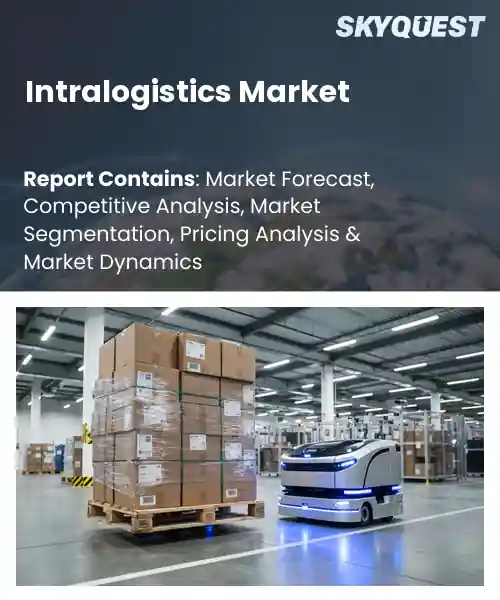
Intralogistics Market
Report ID: SQMIG20I3281
Report ID: SQMIG20I3281
[email protected]
USA +1 351-333-4748
Report ID:
SQMIG20I3281 |
Region:
Global |
Published Date: July, 2026
Pages:
157
|Tables:
156
|Figures:
78


Global Intralogistics Market size was valued at USD 69.84 Billion in 2024 and is poised to grow from USD 77.35 Billion in 2025 to USD 175.21 Billion by 2033, growing at a CAGR of 10.8% during the forecast period (2026-2033).
Automation of material handling plays a key role in the intralogistics market trends, reducing cycle time and labour dependency and improving safety. Robotic palletizers, autonomous mobile robots and pick-by-light stations are increasing throughput by 20-40 percent for companies, shortening order-to-delivery cycles and improving customer satisfaction. One US e-commerce fulfillment center deployed a fleet of AMRs and reduced its labor costs by 15 percent in one year, releasing capital to grow into delivery services. Vendors are stepping up platforms and offering cloud-based fleet management, which opens up opportunities for businesses wanting scalable solutions for warehouses of any size.
How are AI and IoT Automation Transforming the Intralogistics Market?
AI and IoT are changing intralogistics with automation by seamlessly connecting sensors, robots and analytics. Connected devices provide real-time data that enables predictive routing, dynamic inventory placement, and adaptive load balancing. Warehouses with smart conveyors that speed up and slow down based on demand. Autonomous mobile robots that use machine learning to find the best path. The intralogistics market growth has moved from individual pieces of equipment to integrated ecosystems where software orchestrates material handling. Companies are deploying cloud-based dashboards that show performance and automatically trigger corrective actions. The convergence reduces downtime, improves order accuracy and speeds throughput, making facilities more responsive to fluctuating demand.
In March 2024, GreyOrange launched its GreyMatter AI platform that uses a combination of sensor fusion and machine learning to coordinate fleets of picking robots in real time. The solution saves travel distance, speeds up order processing and demonstrates efficiency gains and growth enablement of AI and IoT automation in the intralogistics market.
Market snapshot - (2026-2033)
Global Market Size
USD 69.84 Billion
Largest Segment
Hardware
Fastest Growth
Software
Growth Rate
10.76% CAGR
To get more insights on this market click here to Request a Free Sample Report
Global intralogistics market is segmented by component, solution, deployment mode, warehouse type, end user and region. Based on component, the market is segmented into hardware, software and services. Based on solution, the market is segmented into material handling systems, warehouse management systems (WMS), warehouse control systems (WCS), warehouse execution systems (WES), automated storage & retrieval systems (AS/RS), sortation systems, conveyor systems, automated guided vehicles (AGVs), autonomous mobile robots (AMRs) and others. Based on deployment mode, the market is segmented into on-premises and cloud. Based on warehouse type, the market is segmented into conventional warehouses, automated warehouses and micro fulfillment centers. Based on end user, the market is segmented into retail & e-commerce, manufacturing, food & beverage, healthcare & pharmaceuticals, automotive, logistics & third-party logistics (3PL), consumer goods, airports & postal services and others. Based on region, the market is segmented into North America, Europe, Asia Pacific, Latin America and Middle East & Africa.
The hardware segment is dominant because it provides the physical basis for any intralogistics operation, the physical means of moving, storing and protecting goods. Robust, reliable, and seamlessly integrated into existing infrastructure, it is indispensable for manufacturers who need uninterrupted flow. Additionally, the long life of industrial equipment reinforces its key role, anchoring investment decisions and shaping the overall system structure across multiple industries, ensuring operational resilience and confidence among supply chain partners.
However, software segment is the fastest growing segment as enterprise digitize warehouse processes to get real time visibility and predictive insights. Agile development cycles mean we can upgrade features continuously and connectivity to the cloud reduces barriers to implementation. This momentum helps to drive further adoption and unlock new efficiencies and new revenue streams for solution providers.
The warehouse management systems segment is leading the pack, acting as the central nervous system that orchestrates inventory, orders and labor across complex fulfillment networks. It unifies data from all touch points to provide accurate pick path optimization and real time stock visibility that are critical to reducing errors and increasing throughput. Its flexible configuration allows it to adapt to a variety of operational models and is the go-to choice for businesses looking to streamline processes and improve customer satisfaction.
However, the autonomous mobile robots segment is emerging as the key high growth area as companies look for scalable automation without large infrastructure changes. Improvements in perception algorithms and battery technology mean longer operation cycles and safer navigation through crowded aisles. This capability addresses the spike in e commerce volumes, allowing for quick deployment and driving the next phase of warehouse modernization.
To get detailed segments analysis, Request a Free Sample Report
Europe’s dominance is the result of a combination of mature manufacturing ecosystems, highly integrated transport corridors, and a historical focus on operational efficiency. The site is fitted with the most modern automation technology and is committed to sustainability, facilitating sophisticated warehouse designs and world-class material flows. Strong regulatory frameworks promote investment in digital twins, AI-driven inventory management and collaborative robotics. This speeds innovation , with a strong research base and skilled labor pool . And cross-border logistics hubs can speed distribution across the continent . These strengths create an environment in which high-value intralogistics solutions are required and can easily be implemented, reinforcing Europe’s leading position.
Intralogistics market outlook in Germany thrives on a legacy of engineering excellence and a dense network of automotive and industrial suppliers. Companies prioritize precision automation and modular storage systems to accommodate complex production lines. Collaboration between technology firms and logistics providers accelerates the rollout of AI‑enabled forecasting tools. The market also benefits from a proactive approach to energy efficiency, encouraging the integration of renewable power sources within warehouse operations.
Intralogistics market forecast in the United Kingdom is shaped by a vibrant e‑commerce sector and a strategic focus on supply‑chain resilience. Businesses adopt flexible fulfillment centers equipped with autonomous guided vehicles and advanced picking technologies. Strong collaboration between academia and industry drives research into digital twins and real‑time analytics. Regulatory incentives support investments in low‑emission material handling equipment, reinforcing the market’s move toward greener operations.
Intralogistics market analysis in France is propelled by a robust retail landscape and a commitment to smart logistics. French firms embrace integrated warehouse management platforms that synchronize inventory across multiple distribution nodes. Emphasis on collaborative robotics enhances labor productivity while maintaining high safety standards. Government initiatives encouraging circular economy practices spur the adoption of reverse‑logistics solutions, reinforcing France’s position as a forward‑looking intralogistics hub.
In the Asia Pacific region, demand is driven by the exponential growth in manufacturing output, booming e-commerce demand and an appetite for technology-enabled efficiency. Nations looking to escape labor problems and rising cost pressures are pouring money into warehouse automation. Strategic port locations and increasingly sophisticated digital infrastructure provide the region’s supply chains with real-time visibility and predictive analytics. Companies are concentrating on modular and scalable solutions for fast market swings while sustainability goals are encouraging the adoption of energy-efficient equipment. This mix of economic vibrancy, technological readiness and policy support is driving rapid growth across the region.
Intralogistics market regional outlook in Japan is characterized by a precision‑driven manufacturing culture that values compact, high‑density storage solutions. Japanese firms lead in the deployment of collaborative robots and AI‑based inventory optimization to manage limited space efficiently. Continuous improvement philosophies drive integration of advanced sensors and IoT platforms, enhancing real‑time monitoring. A focus on sustainable practices encourages the use of energy‑saving conveyors and low‑emission handling equipment, reinforcing Japan’s reputation for innovative logistics.
Intralogistics market regional forecast in South Korea benefits from a tech‑focused economy and a strong emphasis on smart factory initiatives. Companies adopt high‑speed automated guided vehicles and sophisticated warehouse management systems to support fast‑moving consumer electronics supply chains. Government support for Industry 4.0 accelerates the rollout of AI‑enabled demand forecasting tools. Integration of renewable energy sources within logistics facilities reflects South Korea’s commitment to greener operations, positioning the market for continued advancement.
North America solidifies its position by aggressively deploying state-of-the-art automation, vast e-commerce networks and a proactive approach to supply-chain digitalization. Large distribution centers use advanced robotics, autonomous mobile platforms, and sophisticated warehouse orchestration software to increase throughput. Technology providers and logistics companies are teaming up to accelerate the rollout of decision support systems powered by AI. Electric material-handling fleet investment and energy-efficient infrastructure driven by sustainability focus. Strong capital markets and a skilled workforce in the region enable the rapid scaling of innovative intralogistics solutions and ensure the region’s continued strategic importance.
Intralogistics market penetration in the United States is driven by expansive fulfillment networks that serve a diverse consumer base. Adoption of high‑capacity robotic picking systems and cloud‑based warehouse execution platforms enhances operational agility. Companies focus on integrating AI for demand sensing and dynamic slotting, reducing dwell times. Sustainability initiatives promote the transition to electric forklifts and solar‑powered facilities, reflecting a growing emphasis on environmental responsibility within U.S. logistics.
Intralogistics industry in Canada capitalizes on its vast geography and a strong focus on efficient long‑haul distribution. Canadian firms emphasize modular warehouse designs equipped with autonomous guided vehicles to navigate large floor spaces. Investment in digital twin technology enables precise capacity planning and risk mitigation. Energy‑conscious strategies encourage the deployment of low‑emission handling equipment, aligning Canada’s intralogistics landscape with broader sustainability goals.
To know more about the market opportunities by region and country, click here to
Buy The Complete Report
Increasing Automation Adoption
Growth Fueled By E‑Commerce Expansion
High Initial Capital Investment
Complex Integration And Interoperability Issues
Request Free Customization of this report to help us to meet your business objectives.
The intralogistics market is highly competitive, with leading automation providers expanding their capabilities through acquisitions, strategic partnerships, and investments in artificial intelligence, robotics, and warehouse software. Companies are increasingly integrating autonomous mobile robots (AMRs), automated storage and retrieval systems (AS/RS), warehouse execution software, and AI-driven analytics to improve operational efficiency and address labor shortages. Strategic collaborations between logistics providers, robotics developers, and software companies continue to accelerate warehouse automation while enabling customers to build more flexible, scalable, and data-driven supply chain operations.
Top Player’s Company Profile
Recent Developments in the Intralogistics Market
SkyQuest’s ABIRAW (Advanced Business Intelligence, Research & Analysis Wing) is our Business Information Services team that Collects, Collates, Correlates, and Analyses the Data collected by means of Primary Exploratory Research backed by robust Secondary Desk research. As per SkyQuest analysis the global intralogistics market is being propelled primarily by the surge in automation adoption that enables higher throughput while cutting labor dependence, and a secondary boost from rapid e‑commerce growth demanding faster order fulfillment. Europe emerges as the dominant region, benefiting from mature manufacturing ecosystems and strong regulatory support, while the hardware segment remains the core driver of operational capability. However, high initial capital investment acts as a notable restraint, limiting uptake among smaller players and slowing broader market penetration. Together these forces shape a landscape where advanced equipment and digital solutions are expanding, yet financial barriers temper the pace of adoption.
| Report Metric | Details |
|---|---|
| Market size value in 2024 | USD 69.84 Billion |
| Market size value in 2033 | USD 175.21 Billion |
| Growth Rate | 10.76% |
| Base year | 2024 |
| Forecast period | (2026-2033) |
| Forecast Unit (Value) | USD Billion |
| Segments covered |
|
| Regions covered | North America (US, Canada), Europe (Germany, France, United Kingdom, Italy, Spain, Rest of Europe), Asia Pacific (China, India, Japan, Rest of Asia-Pacific), Latin America (Brazil, Rest of Latin America), Middle East & Africa (South Africa, GCC Countries, Rest of MEA) |
| Companies covered |
|
| Customization scope | Free report customization with purchase. Customization includes:-
|
To get a free trial access to our platform which is a one stop solution for all your data requirements for quicker decision making. This platform allows you to compare markets, competitors who are prominent in the market, and mega trends that are influencing the dynamics in the market. Also, get access to detailed SkyQuest exclusive matrix.
Table Of Content
Executive Summary
Market overview
Parent Market Analysis
Market overview
Market size
KEY MARKET INSIGHTS
COVID IMPACT
MARKET DYNAMICS & OUTLOOK
Market Size by Region
KEY COMPANY PROFILES
Methodology
For the Intralogistics Market, our research methodology involved a mixture of primary and secondary data sources. Key steps involved in the research process are listed below:
1. Information Procurement: This stage involved the procurement of Market data or related information via primary and secondary sources. The various secondary sources used included various company websites, annual reports, trade databases, and paid databases such as Hoover's, Bloomberg Business, Factiva, and Avention. Our team did 45 primary interactions Globally which included several stakeholders such as manufacturers, customers, key opinion leaders, etc. Overall, information procurement was one of the most extensive stages in our research process.
2. Information Analysis: This step involved triangulation of data through bottom-up and top-down approaches to estimate and validate the total size and future estimate of the Intralogistics Market.
3. Report Formulation: The final step entailed the placement of data points in appropriate Market spaces in an attempt to deduce viable conclusions.
4. Validation & Publishing: Validation is the most important step in the process. Validation & re-validation via an intricately designed process helped us finalize data points to be used for final calculations. The final Market estimates and forecasts were then aligned and sent to our panel of industry experts for validation of data. Once the validation was done the report was sent to our Quality Assurance team to ensure adherence to style guides, consistency & design.
Analyst Support
Customization Options
With the given market data, our dedicated team of analysts can offer you the following customization options are available for the Intralogistics Market:
Product Analysis: Product matrix, which offers a detailed comparison of the product portfolio of companies.
Regional Analysis: Further analysis of the Intralogistics Market for additional countries.
Competitive Analysis: Detailed analysis and profiling of additional Market players & comparative analysis of competitive products.
Go to Market Strategy: Find the high-growth channels to invest your marketing efforts and increase your customer base.
Innovation Mapping: Identify racial solutions and innovation, connected to deep ecosystems of innovators, start-ups, academics, and strategic partners.
Category Intelligence: Customized intelligence that is relevant to their supply Markets will enable them to make smarter sourcing decisions and improve their category management.
Public Company Transcript Analysis: To improve the investment performance by generating new alpha and making better-informed decisions.
Social Media Listening: To analyze the conversations and trends happening not just around your brand, but around your industry as a whole, and use those insights to make better Marketing decisions.
REQUEST FOR SAMPLE
 REQUEST FREE CUSTOMIZATION
Global Intralogistics Market size was valued at USD 69.84 Billion in 2024 and is poised to grow from USD 77.35 Billion in 2025 to USD 175.21 Billion by 2033, growing at a CAGR of 10.76% during the forecast period (2026-2033).
The intralogistics arena is shaped by aggressive M&A activity, strategic partnerships and rapid tech roll‑outs, with Amazon’s 2021 acquisition of Canvas Technology and DHL’s 2022 alliance with Locus Robotics accelerating automation adoption, while firms leverage AI‑driven software to differentiate warehouse orchestration and reduce labor costs. 'Daifuku Co. Ltd.', 'Dematic', 'KION Group AG', 'SSI Schaefer Group', 'Murata Machinery Ltd.', 'Vanderlande Industries B.V.', 'Honeywell Intelligrated', 'Knapp AG', 'Toyota Industries Corporation', 'Swisslog Holding AG', 'Kardex Holding AG', 'TGW Logistics Group GmbH', 'Mecalux S.A.', 'Beumer Group GmbH & Co. KG', 'System Logistics S.p.A.', 'Bastian Solutions LLC', 'Muratec', 'Interroll Holding AG', 'Egemin Automation', 'AutoStore Holdings Ltd.'
Increasing automation adoption drives the Global Intralogistics Market by enabling warehouses to handle higher throughput with minimal human intervention. Advanced robotics and integrated software streamline material handling, reduce cycle times, and improve consistency across operations. As companies seek to enhance flexibility and respond swiftly to demand fluctuations, automated systems provide scalable solutions that align with modern supply chain requirements. This shift toward automated processes fosters investment in sophisticated intralogistics infrastructure, thereby expanding market demand and encouraging continuous innovation throughout globally.
Ai‑Driven Warehouse Orchestration: Advanced artificial intelligence is reshaping intralogistics by enabling real‑time decision making across storage, picking, and transport operations. Machine‑learning models predict demand fluctuations, dynamically allocate resources, and synchronize robotic fleets with human workers. Integrated sensor networks feed continuous data, allowing predictive maintenance and adaptive routing that minimizes bottlenecks. The resulting orchestration improves throughput, reduces labor strain, and enhances flexibility in responding to seasonal spikes, positioning AI as a core driver of operational excellence in modern distribution centers throughout global networks today.
Why does Europe Dominate the Global Intralogistics Market? |@12


Want to customize this report? This report can be personalized according to your needs. Our analysts and industry experts will work directly with you to understand your requirements and provide you with customized data in a short amount of time. We offer $1000 worth of FREE customization at the time of purchase.
Feedback From Our Clients


 USA (+1) 351-333-4748

