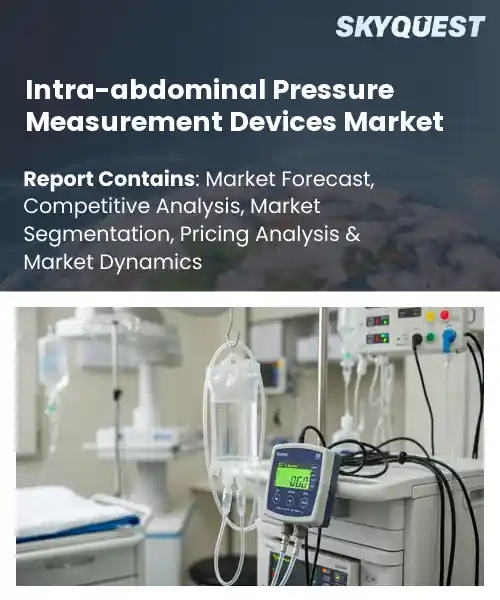
Intra-abdominal Pressure Measurement Devices Market
Report ID: SQMIG35A3733
Report ID: SQMIG35A3733
[email protected]
USA +1 351-333-4748
Report ID:
SQMIG35A3733 |
Region:
Global |
Published Date: June, 2026
Pages:
157
|Tables:
203
|Figures:
80


Global Intra-Abdominal Pressure Measurement Devices Market size was valued at USD 162.4 Million in 2024 and is poised to grow from USD 174.09 Million in 2025 to USD 303.63 Million by 2033, growing at a CAGR of 7.2% during the forecast period (2026-2033).
The primary driver of the intra-abdominal pressure measurement devices market growth is rising clinical demand for timely detection and management of abdominal compartment syndrome and ensuing organ dysfunction. The market includes devices that quantify pressure within the abdominal cavity using bladder based transducers, intragastric probes and non invasive sensors, and it matters because accurate monitoring prevents organ failure and shortens intensive care stays. Historically clinicians relied on intermittent manual bladder pressure readings, but over the last decade innovation produced continuous electronic monitoring and wireless telemetry, exemplified by integrated Foley manometry systems in trauma and burn centers.
This evolving landscape creates a key growth factor: technological maturation of continuous noninvasive platforms which turns clinical need into broader adoption. As accurate real time readings reduce delayed diagnosis of intra abdominal hypertension, clinicians can intervene earlier with decompressive measures or fluid adjustments, producing fewer organ failures and shorter intensive care durations, which persuades hospitals to invest in devices. Adoption is visible in trauma units using bladder based telemetry after polytrauma and in perioperative care during complex abdominal surgery, while analytics enabled platforms create opportunities for remote monitoring, subscription models and deeper penetration into emerging health systems and strengthened partnerships.
How is AI improving accuracy in the intra-abdominal pressure measurement devices market?
Intra abdominal pressure devices measure internal abdominal tension to guide critical care and surgical decisions. Key aspects are sensor fidelity, artifact rejection, patient variability and integration with clinical records. AI is improving the current state by cleaning noisy waveforms, fusing signals from multiple sensors and recommending optimal measurement timing and placement to reduce operator variability. Machine learning models enable continuous calibration and anomaly detection which makes readings more reliable and actionable for clinicians. Market momentum favors AI enabled monitoring because vendors can deliver more consistent bedside data and smoother clinical workflows using on device and cloud analytics.
Bright Uro in May 2026, the company gained regulatory clearance for an abdominal sensor that produces richer pressure signals which can be paired with AI driven signal processing and predictive analytics to enhance measurement accuracy and streamline urodynamic workflows, supporting broader adoption and operational efficiency.
Market snapshot - (2026-2033)
Global Market Size
USD 162.4 Million
Largest Segment
Disposable Intra-abdominal Pressure Measurement Devices
Fastest Growth
Disposable Intra-abdominal Pressure Measurement Devices
Growth Rate
7.2% CAGR
To get more insights on this market click here to Request a Free Sample Report
Global intra-abdominal pressure measurement devices market is segmented by product type, technique, device type, measurement method, patient category, application, end user and region. Based on product type, the market is segmented into Disposable Intra-abdominal Pressure Measurement Devices, Reusable Intra-abdominal Pressure Measurement Devices and Intra-abdominal Pressure Monitoring Kits & Accessories. Based on technique, the market is segmented into Bladder Pressure Measurement, Gastric Pressure Measurement, Rectal Pressure Measurement and Direct Intraperitoneal Measurement. Based on device type, the market is segmented into Pressure Transducers, Monitoring Systems & Modules, Catheter-based Measurement Devices and Integrated ICU Monitoring Devices. Based on measurement method, the market is segmented into Continuous Monitoring and Intermittent Monitoring. Based on patient category, the market is segmented into Adult, Pediatric and Neonatal. Based on application, the market is segmented into Intra-abdominal Hypertension (IAH) Monitoring, Abdominal Compartment Syndrome (ACS) Management, Critical Care Monitoring, Trauma & Emergency Care and Postoperative Monitoring. Based on end user, the market is segmented into Hospitals, Intensive Care Units (ICUs), Ambulatory Surgical Centers (ASCs), Specialty Clinics and Trauma Centers. Based on region, the market is segmented into North America, Europe, Asia Pacific, Latin America and Middle East & Africa.
Disposable intra-abdominal pressure measurement devices segment dominates because hospitals and critical care teams favor single use solutions that simplify workflow, reduce contamination risk, and limit maintenance overhead. Their predictability in performance and vendor-supported supply chains drive procurement preference, while ease of bedside deployment accelerates clinician adoption. These factors collectively make disposable offerings the default choice where infection control, staff time pressure and rapid turnaround influence purchasing and clinical protocols.
As per intra-abdominal pressure measurement devices market outlook, reusable Intra-abdominal Pressure Measurement Devices are accelerating growth driven by sustainability concerns, improving sterilizable designs, and perceived lower lifecycle costs. Enhanced compatibility with hospital monitoring systems and supplier service offerings encourage bulk procurement and long-term use, creating vendor opportunities to support integration, maintenance and training that expand clinical deployment.
As per intra-abdominal pressure measurement devices market forecast, continuous monitoring segment stands out because continuous real-time data enables early detection of intra-abdominal hypertension and timely intervention, directly supporting critical care decision making and patient safety. Seamless integration with ICU telemetry, alarm customization and analytics-driven trend visualization enhance clinician confidence and workflow efficiency, prompting investment from high-acuity units. Technology advances and demand for round-the-clock surveillance make continuous approaches central to evolving clinical protocols and device roadmaps.
As per intra-abdominal pressure measurement devices market analysis, intermittent monitoring is gaining rapid traction because it is cost-effective, simple to deploy in perioperative and ambulatory settings, and familiar to clinicians. Lower training burden and compatibility with point-of-care workflows drive adoption across surgical units and smaller facilities, expanding demand for portable devices and measurement accessory kits.
To get detailed segments analysis, Request a Free Sample Report
As per intra-abdominal pressure measurement devices market regional outlook, the market is expected to be dominated by North America based on the geographical perspective, driven by the strong presence of modern clinical infrastructure, increasing adoption of minimally invasive care procedures and leading medical device manufacturers in the region. Mature hospital systems and integrated care pathways provide routine monitoring and defined processes to facilitate device use. Strong regulatory frameworks and well-established reimbursement procedures are helpful for product development and market launch. Ongoing investment in clinical research and collaborative efforts between academic institutes and industry accelerate validation and acceptance of novel measurement technology. High knowledge among the region’s healthcare professionals about intra-abdominal hypertension management further drives demand for reliable monitoring technologies, enabling a supply chain that fosters innovation and commercialization. Strategic acquisitions and concentrated marketing by major suppliers enhance market leadership and improve clinical access.
As per intra-abdominal pressure measurement devices industry analysis, United States is driven by the concentration of leading device makers, clinical studies, and hospital networks that prioritize patient safety. Clinicians’ knowledge with monitoring techniques and health record systems facilitates device use and data integration. A favorable regulatory framework and payment mechanisms encourage innovation, and strong ties with industry and the academic centers expedite the implementation of measuring technology in critical care and surgical settings in regional networks.
As per intra-abdominal pressure measurement devices market regional forecast, Canada market has a coordinated healthcare system that emphasizes evidence based procedures and interdisciplinary care for abdominal hypertension management. Standardized monitoring methods and procurement frameworks promoted by provincial networks and tertiary centres are driving uptake. Clinicians and suppliers collaborating increases localization of training and service support. The market growth is supported by increased clinician adoption of device technologies and incorporation of monitoring in critical care pathways.
Europe is experiencing rapid expansion in intra-abdominal pressure measurement devices due to harmonized clinical guidelines, emphasis on patient safety, and increasing integration of monitoring into perioperative and intensive care pathways. Strong hospital procurement networks and regional collaborations support wider adoption across public and private providers. A concentration of specialized clinical research centers and cooperative multicenter studies enhances evidence generation and clinical acceptance. Regulatory convergence and focused reimbursement initiatives in several markets reduce barriers to entry and enable manufacturers to scale distribution. Additionally, a growing supplier base with tailored training programs and service models facilitates clinician uptake, while cross border knowledge exchange among professional societies accelerates dissemination of best practices and device standardization. Manufacturers are increasingly aligning product portfolios with clinical workflow needs, improving usability and post market support.
Germany is shaped by a strong network of tertiary care centers and hospitals that drive clinical evaluation and protocol development. Procurement processes in large hospital groups favor validated, interoperable devices and service offerings. Collaboration between device manufacturers and clinical research units fosters local evidence generation, while emphasis on clinical guidelines and training ensures consistent application of monitoring practices across surgical and critical care disciplines.
United Kingdom reflects modernization and active clinician networks that disseminate procedural updates. National health service procurement frameworks favor evaluation of cost effective, user friendly technologies that fit clinical workflows. Manufacturer engagement through localized training and post market support builds clinician confidence. Emphasis on guideline implementation and multicenter clinical collaboration supports faster uptake across acute care and surgical units and across community and tertiary settings.
France is emerging as regional centers and professional societies promote standardized monitoring in surgical and critical care pathways. Public hospital procurement emphasizes clinical interoperability and training commitments, favoring suppliers offering localized support and clinician education. Multidisciplinary coordination and guideline alignment encourage integration of intra-abdominal monitoring into routine perioperative and intensive care practice across tertiary and regional facilities and community hospitals nationwide support broader adoption.
Asia Pacific is strengthening its position in the intra-abdominal pressure measurement devices market through targeted investments in healthcare infrastructure, rising clinical specialization, and closer collaboration between regional hospitals and international manufacturers. Growth is supported by expanding critical care capacity and increasing emphasis on perioperative monitoring standards in advanced centers. Local innovation and adaptation of device designs to meet workflow and cost considerations improve accessibility. Training initiatives and partnerships with academic institutions facilitate clinician competence and protocol adoption. Strategic market entry by global suppliers, combined with growing regional distribution networks and service capabilities, enhances availability and after sales support, enabling more consistent use of monitoring technologies across diverse healthcare settings. Regulatory maturation and regional harmonization efforts are gradually reducing adoption barriers and encouraging broader clinical validation and supplier commitment.
Japan is supported by advanced hospital infrastructure and focus on precision in perioperative and critical care monitoring. Clinical research units and specialty centers drive evidence based adoption, while procurement decisions prioritize device interoperability and long term service relationships. Manufacturers partnering with clinical leaders tailor solutions to workflow needs. Training and structured post market support enhance clinician confidence and integration of monitoring into routine care.
South Korea benefits from advanced hospital systems and rapid clinical uptake in tertiary centers emphasizing perioperative safety. Collaboration between device companies and innovation units supports adaptation of devices to local workflows. Government led quality initiatives and procurement strategies encourage adoption of interoperable monitoring solutions. Focused clinician training and service infrastructures enhance confidence and promote consistent implementation across surgical and intensive care departments at scale.
To know more about the market opportunities by region and country, click here to
Buy The Complete Report
Rising Clinical Awareness and Adoption
Advances In Monitoring Technology
High Procedure Costs and Reimbursement
Limited Standardization and Training
Request Free Customization of this report to help us to meet your business objectives.
Competitive landscape in the global intra-abdominal pressure measurement devices industry is shaped by consolidation among established medtechs, targeted M&A and hospital partnerships, and rapid product differentiation by startups deploying continuous and minimally invasive sensors. Recent strategic moves include Getinge’s acquisition of Pulsion and BD’s purchase of Edwards’ critical care group, while clinical validation efforts from companies such as Sentinel and Potrero drive competitive technology adoption.
SkyQuest’s ABIRAW (Advanced Business Intelligence, Research & Analysis Wing) is our Business Information Services team that Collects, Collates, Correlates, and Analyses the Data collected by means of Primary Exploratory Research backed by robust Secondary Desk research.
As per SkyQuest analysis, rising clinical awareness and demand for timely detection and management of abdominal compartment syndrome is a key driver, supported by technological advances such as continuous noninvasive platforms and AI-enabled signal processing that enhance accuracy and enable broader adoption. High procedure and device costs coupled with inconsistent reimbursement represent a major restraint that can slow hospital procurement. North America remains the dominating region due to advanced clinical infrastructure, strong reimbursement pathways, and concentrated manufacturer presence. Disposable intra-abdominal pressure measurement devices are the dominating segment because single-use solutions simplify workflows, reduce infection risk, and lower maintenance burdens, driving preference across critical care settings. The intra-abdominal pressure measurement devices market trend line is driven by the increasing prevalence of abdominal compartment syndrome, growing adoption of critical care monitoring technologies, and rising demand for accurate pressure assessment in intensive care units and surgical settings.
| Report Metric | Details |
|---|---|
| Market size value in 2024 | USD 162.4 Million |
| Market size value in 2033 | USD 303.63 Million |
| Growth Rate | 7.2% |
| Base year | 2024 |
| Forecast period | (2026-2033) |
| Forecast Unit (Value) | USD Million |
| Segments covered |
|
| Regions covered | North America (US, Canada), Europe (Germany, France, United Kingdom, Italy, Spain, Rest of Europe), Asia Pacific (China, India, Japan, Rest of Asia-Pacific), Latin America (Brazil, Rest of Latin America), Middle East & Africa (South Africa, GCC Countries, Rest of MEA) |
| Companies covered |
|
| Customization scope | Free report customization with purchase. Customization includes:-
|
To get a free trial access to our platform which is a one stop solution for all your data requirements for quicker decision making. This platform allows you to compare markets, competitors who are prominent in the market, and mega trends that are influencing the dynamics in the market. Also, get access to detailed SkyQuest exclusive matrix.
Table Of Content
Executive Summary
Market overview
Parent Market Analysis
Market overview
Market size
KEY MARKET INSIGHTS
COVID IMPACT
MARKET DYNAMICS & OUTLOOK
Market Size by Region
KEY COMPANY PROFILES
Methodology
For the Intra-abdominal Pressure Measurement Devices Market, our research methodology involved a mixture of primary and secondary data sources. Key steps involved in the research process are listed below:
1. Information Procurement: This stage involved the procurement of Market data or related information via primary and secondary sources. The various secondary sources used included various company websites, annual reports, trade databases, and paid databases such as Hoover's, Bloomberg Business, Factiva, and Avention. Our team did 45 primary interactions Globally which included several stakeholders such as manufacturers, customers, key opinion leaders, etc. Overall, information procurement was one of the most extensive stages in our research process.
2. Information Analysis: This step involved triangulation of data through bottom-up and top-down approaches to estimate and validate the total size and future estimate of the Intra-abdominal Pressure Measurement Devices Market.
3. Report Formulation: The final step entailed the placement of data points in appropriate Market spaces in an attempt to deduce viable conclusions.
4. Validation & Publishing: Validation is the most important step in the process. Validation & re-validation via an intricately designed process helped us finalize data points to be used for final calculations. The final Market estimates and forecasts were then aligned and sent to our panel of industry experts for validation of data. Once the validation was done the report was sent to our Quality Assurance team to ensure adherence to style guides, consistency & design.
Analyst Support
Customization Options
With the given market data, our dedicated team of analysts can offer you the following customization options are available for the Intra-abdominal Pressure Measurement Devices Market:
Product Analysis: Product matrix, which offers a detailed comparison of the product portfolio of companies.
Regional Analysis: Further analysis of the Intra-abdominal Pressure Measurement Devices Market for additional countries.
Competitive Analysis: Detailed analysis and profiling of additional Market players & comparative analysis of competitive products.
Go to Market Strategy: Find the high-growth channels to invest your marketing efforts and increase your customer base.
Innovation Mapping: Identify racial solutions and innovation, connected to deep ecosystems of innovators, start-ups, academics, and strategic partners.
Category Intelligence: Customized intelligence that is relevant to their supply Markets will enable them to make smarter sourcing decisions and improve their category management.
Public Company Transcript Analysis: To improve the investment performance by generating new alpha and making better-informed decisions.
Social Media Listening: To analyze the conversations and trends happening not just around your brand, but around your industry as a whole, and use those insights to make better Marketing decisions.
REQUEST FOR SAMPLE
 REQUEST FREE CUSTOMIZATION
Global Intra-Abdominal Pressure Measurement Devices Market size was valued at USD 162.4 Million in 2024 and is poised to grow from USD 174.09 Million in 2025 to USD 303.63 Million by 2033, growing at a CAGR of 7.2% during the forecast period (2026-2033).
Competitive landscape in the global intra abdominal pressure measurement devices market is shaped by consolidation among established medtechs, targeted M&A and hospital partnerships, and rapid product differentiation by startups deploying continuous and minimally invasive sensors. Recent strategic moves include Getinge’s acquisition of Pulsion and BD’s purchase of Edwards’ critical care group, while clinical validation efforts from companies such as Sentinel and Potrero drive competitive technology adoption. 'Becton, Dickinson and Company', 'ConvaTec Group PLC', 'Accuryn Medical', 'Spiegelberg GmbH & Co. KG', 'Medline Industries, LP', 'C2DX, Inc.', 'Gaeltec Devices Ltd.', 'Centurion Medical Products Corp.', 'Biometrix Corporation', 'Potrero Medical, Inc.', 'Delta Med S.p.A.', 'Sentinel Medical Technologies', 'ICU Medical, Inc.', 'Edwards Lifesciences Corporation', 'Merit Medical Systems, Inc.', 'Stryker Corporation', 'Teleflex Incorporated', 'Laborie Medical Technologies', 'SAM Medical Products', 'ITL BioMedical Pty Ltd.'
Increasing clinical awareness of intra abdominal hypertension and abdominal compartment syndrome among critical care and surgical teams has encouraged earlier assessment and routine use of pressure measurement devices. As education and protocol development emphasize patient safety and organ function preservation, clinicians are more likely to integrate standardized monitoring into workflows, which drives demand for accurate, easy to use devices. This shift in clinical practice supports market expansion by motivating procurement, influencing hospital purchasing priorities, and fostering adoption of devices that align with established care pathways and quality initiatives.
Digital Integration Driving Adoption: Healthcare providers increasingly seek devices that integrate with electronic medical records and monitoring platforms, enabling streamlined workflows, centralized data access, and improved clinical decision support. Vendors emphasize interoperability, secure data exchange, and remote monitoring to support multidisciplinary teams managing critical care patients. This trend fosters collaboration among device manufacturers, software developers, and hospitals, accelerating adoption through efficiencies and better care coordination. Focus on intuitive interfaces and scalable architectures positions integrated intra-abdominal pressure measurement systems as essential tools in care settings.
Why does North America Dominate the Global Intra-abdominal Pressure Measurement Devices Market? |@12


Want to customize this report? This report can be personalized according to your needs. Our analysts and industry experts will work directly with you to understand your requirements and provide you with customized data in a short amount of time. We offer $1000 worth of FREE customization at the time of purchase.
Feedback From Our Clients


 USA (+1) 351-333-4748

