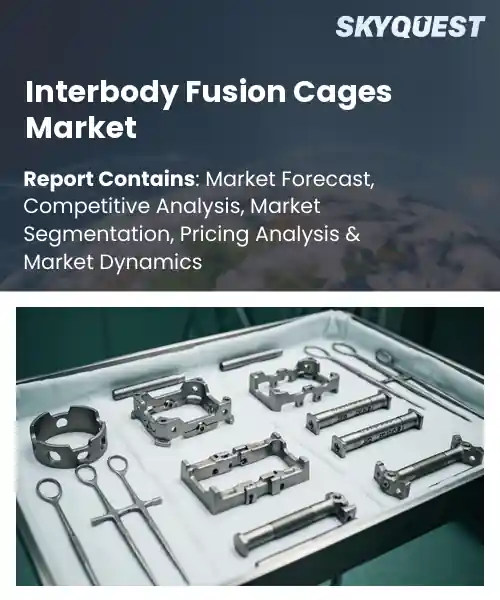
Interbody Fusion Cages Market
Report ID: SQMIG35D2562
Report ID: SQMIG35D2562
[email protected]
USA +1 351-333-4748
Report ID:
SQMIG35D2562 |
Region:
Global |
Published Date: June, 2026
Pages:
157
|Tables:
174
|Figures:
79


Global Interbody Fusion Cages Market size was valued at USD 2.64 Billion in 2024 and is poised to grow from USD 2.8 Billion in 2025 to USD 4.43 Billion by 2033, growing at a CAGR of 5.9% during the forecast period (2026-2033).
The global interbody fusion cage market includes devices that are placed between the vertebral bodies to restore disc height and to promote stability of the spine after degenerative disc disease or trauma. It is important because of the rising incidence of spinal disorders in the ageing population and the trend towards minimally invasive surgery which reduces hospital stay and post-operative complications. The market was historically dominated by titanium cages, but the advent of porous PEEK and 3‑D‑printed titanium constructs in the early 2010s provided more clinical options and fast-tracked uptake. As a result, sales have increased from $350 million in 2015 to more than $1 billion in 2023, showing technological progress and wider indications.
The momentum is based on the use of biologically active coatings that accelerate osseointegration, shortening recovery and expanding the pool of patients. For multi-level lumbar fusions, surgeons now opt for cages infused with hydroxyapatite or BMP‑2, which studies show can decrease revision rates by as much as 15 percent. That advantage is attractive to hospital procurement committees who prefer the product, and manufacturers who invest in R&D and scale the production of customized 3-D-printed solutions. As reimbursement models in Europe and Asia are shifting to value-based outcomes, the European and Asian markets are projected to reach more than $1.5 billion by 2030, driven by technological differentiation and demand from policies.
How is AI influencing design optimization in the interbody fusion cages market?
Machine learning models are fed with large clinical datasets and are used to predict optimal geometry, material distribution, and surface texture for reshaping interbody fusion cage design. These algorithms evaluate the biomechanical performance in thousands of simulated situations, allowing engineers to iterate quickly without the expense of physical prototypes. This approach reduces development times and improves patient-specific fit, a major benefit given the growing global market and the demand from surgeons for better fusion rates with fewer complications. AI can combine the imaging data to suggest cage geometries that fit the individual vertebral anatomy improving stability and reducing the risk of subsidence. A data-driven workflow is becoming a key differentiator for manufacturers competing in a fast growing market.
Camde June 2026 Developed an AI-driven generative design platform that generates patient-specific cage designs. Speeding product launches and market development by designing products faster and more efficiently.
Market snapshot - (2026-2033)
Global Market Size
USD 2.64 Billion
Largest Segment
Fastest Growth
Growth Rate
5.9% CAGR
To get more insights on this market click here to Request a Free Sample Report
Global interbody fusion cages market is segmented by product type, material type, surgical approach, end user, design type, distribution channel and region. Based on product type, the market is segmented into Cervical Fusion Cages, Thoracolumbar Fusion Cages and Lumbar Fusion Cages and Others. Based on material type, the market is segmented into PEEK Cages, Titanium Cages and Composite Cages and Others. Based on surgical approach, the market is segmented into Anterior Fusion Procedures, Posterior Fusion Procedures and Lateral Fusion Procedures and Others. Based on end user, the market is segmented into Hospitals, Specialty Orthopedic Centers and Ambulatory Surgical Centers and Others. Based on design type, the market is segmented into Static Cages and Expandable Cages. Based on distribution channel, the market is segmented into Direct Sales and Medical Device Distributors and Others. Based on region, the market is segmented into North America, Europe, Asia Pacific, Latin America and Middle East & Africa.
Integrated lordotic cages segment is dominating as surgeons are focusing on immediate sagittal alignment restoration that directly reduces postoperative complications and improves fusion rates. The built in angle makes implantation easy, avoids the necessity for additional corrective devices and is in conformity with modern minimally invasive techniques. This functional benefit is propelling widespread adoption across both lumbar and cervical procedures, further cementing its leadership in the interbody fusion cages market.
However, the segment of expandable cages is emerging as the fastest growing segment as they get adapted to different patient anatomies and restore disc height post insertion. The ability of the devices to be delivered through smaller incisions and then expand in situ favors the trend towards less invasive procedures, which drives increased clinical adoption and results in innovation that drives market expansion.
The PEEK portion is dominant because it is radiolucent which allows postoperative imaging so that surgeons can see the progress of the fusion without artifact interference. Its elastic modulus is comparable to that of cancellous bone, it does not cause stress shielding and it can be bio-integrated. The material also offers manufacturing flexibility in complex cage geometries for better stability. These intrinsic features, along with the approval by the regulatory bodies have made these as the preferred choice in the market of interbody fusion cages.
On the other hand, the titanium alloy segment is witnessing the fastest growth owing to the advancements in surface coating technologies that help in improving osseointegration while maintaining structural integrity. The increased bioactivity will appeal to surgeons who want faster fusion times, and compatibility with emergent additive manufacturing techniques opens up design possibilities. These developments are encouraging wider clinical adoption and creating new avenues for market growth.
To get detailed segments analysis, Request a Free Sample Report
North America is the largest regional market owing to its strong healthcare infrastructure, high acceptance of minimally invasive spinal procedures, presence of major device manufacturers, favorable reimbursement policies, and strong clinical research ecosystem. U.S. has big hospital systems and a culture of rapid technology adoption. Canada has universal coverage which provides broad access to patients. Industry partnerships increase product innovation and provide a pipeline of next generation cage designs. Existing regulatory pathways can accelerate the time to market for new devices. In addition, the region is home to a talented community of spine surgeons, which is further driving the demand for advanced fusion solutions, making it the leading region in the global market.
The market for interbody fusion cages in the United States is driven by an established network of specialty hospitals and a large pool of experienced spine surgeons who prefer advanced minimally invasive techniques. The regulatory environment facilitates fast product approvals, and as a result, continuous innovation by domestic and multinational producers. The reimbursement policies are in sync with value based care ensuring hospitals buy cost effective but high performing cages further widening the market depth and improving patient outcomes.
Interbody Fusion Cages Market in Canada Benefits from Universal Health System that Pays for Evidence-Based Spinal Implant Technologies across Provinces Provincial health authorities have set priorities for cost effectiveness and clinical efficacy that have resulted in the use of modern cage designs in hospitals that reduce operative time and length of stay. This collaborative research environment links academic centers with device companies to accelerate clinical trials and facilitates early adoption of novel materials to improve patient recovery pathways nationwide.
European growth accelerating on the back of strong clinical uptake, supportive reimbursement and strong R&D activity across key markets. Stable demand is supported by strong public health budgets and mature insurance schemes. Regulatory harmonization across the region also eases product launches. The best hospitals and spine centers use evidence-based care. Cages which allow earlier patient mobilization and offer better biomechanical stability are preferred. The development of next generation materials and surface technologies is accelerated by collaborative networks of universities, research institutes and device manufacturers. Moreover, with the demographic shift towards an aging population, there is an increasing prevalence of degenerative spinal disorders, emphasizing the need for reliable fusion methods. Together these factors turn Europe into a dynamic centre of market growth and technological innovation.
In Germany, the market for Interbody Fusion Cages is driven by a high concentration of globally leading medical engineering companies and a comprehensive reimbursement framework that incentivizes high-quality implant solutions. The country has stringent clinical guidelines that require cages with proven long-term results, so hospitals buy the state-of-the-art titanium and carbon-fiber designs. Moreover, good academic collaborations promote innovation, so that German surgeons will have access to new technologies which help to heal and reduce complications.
The UK’s Interbody Fusion Cages market is driven by a national health service that is paying for more and more minimally invasive spinal interventions to improve patient throughput. Clinical pathways are fueling fast rehab and this has increased the need for cages with secure fixation and low profile designs that are perfect for outpatient surgery settings. Research hospitals and implant companies have collaborated to develop bioactive coatings and proprietary biomaterials, which have led to ongoing product improvements.
In France, the Interbody Fusion Cages market is increasingly used in collaborative clinical studies in order to evaluate the long term outcomes of new cage geometries. Public health insurers emphasize cost-effectiveness, so hospitals choose cages that are both strong and inexpensive for the procedure. Academic institutions collaborate with device manufacturers to investigate additive manufacturing technologies that allow for tailored cage designs based on individual patient anatomy and contribute to building a pipeline of new solutions that greatly enhance surgical confidence and outcomes.
Asia Pacific is steadily establishing its position, increasing surgical capacity, ramping up investment in medical technology and developing expertise in minimally invasive spine procedures. The region’s governments are upgrading the infrastructure of public hospitals and streamlining regulatory processes to speed up the acceptance of new cage designs. The modern surgeons are trained more and more to the contemporary techniques and need implants that provide better biomechanical performance and faster mobilization of the patients. Regional manufacturers are partnering with global innovators to adopt new materials like porous alloys and bio-resorbable polymers to diversify their product portfolios for regional patient demographics. In addition, the growth in clinical research projects and multicenter trials is generating strong evidence to support wider clinical adoption, making Asia Pacific an emerging hub for both market growth and technological advancement.
Japanese Interbody Fusion Cages Market is driven by strong network of university hospitals promoting minimally invasive spinal surgery Safety and performance drive regulatory pathways, pushing manufacturers to offer highly refined titanium and PEEK cage options that are compatible with the country’s precision-focused surgical culture. The partnership between research institutions and industry is one of the main factors of the innovation of surface coating technologies, providing for the implants’ osteointegration and a sharp reduction of recovery time for patients.
South Korea Interbody Fusion Cages Market is witnessing rapid adoption of digital imaging and navigation systems that improve accuracy in surgery. Hospitals seek cost-effective, high-performance implants and manufacturers respond with innovative porous structures and customized geometry for cages. Government incentives for domestic R&D encourage collaborations between biotech firms and medical device companies to accelerate the development of bio-resorbable cage platforms that are in line with the region’s focus on minimally invasive care.
To know more about the market opportunities by region and country, click here to
Buy The Complete Report
Increasing Spine Surgery Demand
Advancements In Cage Materials
High Device Cost Concerns
Regulatory Approval Complexity
Request Free Customization of this report to help us to meet your business objectives.
Legacy manufacturers are growing their expandable cage portfolios, while new AI-driven entrants are providing personalized design tools and shaping the competitive landscape. Strategic partnerships between device makers and orthopedic research centers to accelerate the clinical validation of new materials and coatings have been a hallmark of recent M&A activity, on top of the acquisition spree of niche technology assets by legacy companies, all of which has put pressure on pricing and product differentiation.
SkyQuest’s ABIRAW (Advanced Business Intelligence, Research & Analysis Wing) is our Business Information Services team that Collects, Collates, Correlates, and Analyses the Data collected by means of Primary Exploratory Research backed by robust Secondary Desk research.
As per SkyQuest analysis, the market’s strongest driver is the rising volume of spine surgeries driven by an ageing population and greater prevalence of degenerative disc disease, which pushes hospitals to adopt interbody fusion cages for quicker recovery. A second catalyst is the infusion of AI and digital planning tools that enable patient‑specific cage designs, shortening development cycles and improving fit. The primary restraint comes from the high cost of advanced cages, which makes payers and some hospitals hesitant to replace legacy implants. North America remains the dominant region, supported by robust infrastructure and early adoption of new technologies. Within product categories, PEEK cages lead the market thanks to their radiolucency and bone‑friendly modulus.
| Report Metric | Details |
|---|---|
| Market size value in 2024 | USD 2.64 Billion |
| Market size value in 2033 | USD 4.43 Billion |
| Growth Rate | 5.9% |
| Base year | 2024 |
| Forecast period | (2026-2033) |
| Forecast Unit (Value) | USD Billion |
| Segments covered |
|
| Regions covered | North America (US, Canada), Europe (Germany, France, United Kingdom, Italy, Spain, Rest of Europe), Asia Pacific (China, India, Japan, Rest of Asia-Pacific), Latin America (Brazil, Rest of Latin America), Middle East & Africa (South Africa, GCC Countries, Rest of MEA) |
| Companies covered |
|
| Customization scope | Free report customization with purchase. Customization includes:-
|
To get a free trial access to our platform which is a one stop solution for all your data requirements for quicker decision making. This platform allows you to compare markets, competitors who are prominent in the market, and mega trends that are influencing the dynamics in the market. Also, get access to detailed SkyQuest exclusive matrix.
Table Of Content
Executive Summary
Market overview
Parent Market Analysis
Market overview
Market size
KEY MARKET INSIGHTS
COVID IMPACT
MARKET DYNAMICS & OUTLOOK
Market Size by Region
KEY COMPANY PROFILES
Methodology
For the Interbody Fusion Cages Market, our research methodology involved a mixture of primary and secondary data sources. Key steps involved in the research process are listed below:
1. Information Procurement: This stage involved the procurement of Market data or related information via primary and secondary sources. The various secondary sources used included various company websites, annual reports, trade databases, and paid databases such as Hoover's, Bloomberg Business, Factiva, and Avention. Our team did 45 primary interactions Globally which included several stakeholders such as manufacturers, customers, key opinion leaders, etc. Overall, information procurement was one of the most extensive stages in our research process.
2. Information Analysis: This step involved triangulation of data through bottom-up and top-down approaches to estimate and validate the total size and future estimate of the Interbody Fusion Cages Market.
3. Report Formulation: The final step entailed the placement of data points in appropriate Market spaces in an attempt to deduce viable conclusions.
4. Validation & Publishing: Validation is the most important step in the process. Validation & re-validation via an intricately designed process helped us finalize data points to be used for final calculations. The final Market estimates and forecasts were then aligned and sent to our panel of industry experts for validation of data. Once the validation was done the report was sent to our Quality Assurance team to ensure adherence to style guides, consistency & design.
Analyst Support
Customization Options
With the given market data, our dedicated team of analysts can offer you the following customization options are available for the Interbody Fusion Cages Market:
Product Analysis: Product matrix, which offers a detailed comparison of the product portfolio of companies.
Regional Analysis: Further analysis of the Interbody Fusion Cages Market for additional countries.
Competitive Analysis: Detailed analysis and profiling of additional Market players & comparative analysis of competitive products.
Go to Market Strategy: Find the high-growth channels to invest your marketing efforts and increase your customer base.
Innovation Mapping: Identify racial solutions and innovation, connected to deep ecosystems of innovators, start-ups, academics, and strategic partners.
Category Intelligence: Customized intelligence that is relevant to their supply Markets will enable them to make smarter sourcing decisions and improve their category management.
Public Company Transcript Analysis: To improve the investment performance by generating new alpha and making better-informed decisions.
Social Media Listening: To analyze the conversations and trends happening not just around your brand, but around your industry as a whole, and use those insights to make better Marketing decisions.
REQUEST FOR SAMPLE
 REQUEST FREE CUSTOMIZATION
Global Interbody Fusion Cages Market size was valued at USD 2.64 Billion in 2024 and is poised to grow from USD 2.8 Billion in 2025 to USD 4.43 Billion by 2033, growing at a CAGR of 5.9% during the forecast period (2026-2033).
The competitive landscape is shaped by established manufacturers expanding expandable cage portfolios while emerging AI‑driven entrants introduce personalized design tools; recent M&A activity sees legacy firms acquiring niche technology assets, and strategic partnerships link device makers with orthopedic research centers to accelerate clinical validation of novel materials and coatings, intensifying pressure on pricing and product differentiation. 'Medtronic plc', 'Globus Medical, Inc.', 'Stryker Corporation', 'Zimmer Biomet Holdings, Inc.', 'Johnson & Johnson MedTech', 'Orthofix Medical Inc.', 'NuVasive, Inc.', 'RTI Surgical Holdings, Inc.', 'Life Spine, Inc.', 'Spine Wave, Inc.', 'Xtant Medical Holdings, Inc.', 'SeaSpine Holdings Corporation', 'CoreLink Surgical, Inc.', 'Centinel Spine, LLC', 'Aurora Spine Corporation', 'Captiva Spine, Inc.', 'ChoiceSpine LLC', 'Providence Medical Technology, Inc.', 'Spinal Elements, Inc.', 'Aesculap Implant Systems, LLC'
The expanding prevalence of degenerative spinal disorders, coupled with an aging population, is driving a higher frequency of spinal fusion procedures. Surgeons are increasingly opting for interbody fusion cages due to their ability to provide immediate structural support and promote bony integration. This clinical preference enhances patient outcomes and reduces postoperative complications, which in turn encourages hospitals to adopt these devices more broadly. Consequently, the growing procedural volume directly fuels market expansion for interbody fusion cages. Industry stakeholders are also investing in training programs to accelerate adoption across healthcare settings.
Minimally Invasive Preference: Surgeons are increasingly favoring minimally invasive approaches, driving demand for interbody fusion cages that can be delivered through reduced‑size access ports while maintaining structural integrity. This shift encourages manufacturers to refine cage designs with advanced biomaterials and low‑profile geometries, ensuring easier implantation and faster patient recovery. The emphasis on preserving soft‑tissue integrity and minimizing intra‑operative blood loss aligns with broader healthcare goals of reducing postoperative complications and shortening hospital stays, and improving overall surgical efficiency across institutions and patient satisfaction.
Why does North America Dominate the Global Interbody Fusion Cages Market? |@12


Want to customize this report? This report can be personalized according to your needs. Our analysts and industry experts will work directly with you to understand your requirements and provide you with customized data in a short amount of time. We offer $1000 worth of FREE customization at the time of purchase.
Feedback From Our Clients


 USA (+1) 351-333-4748

