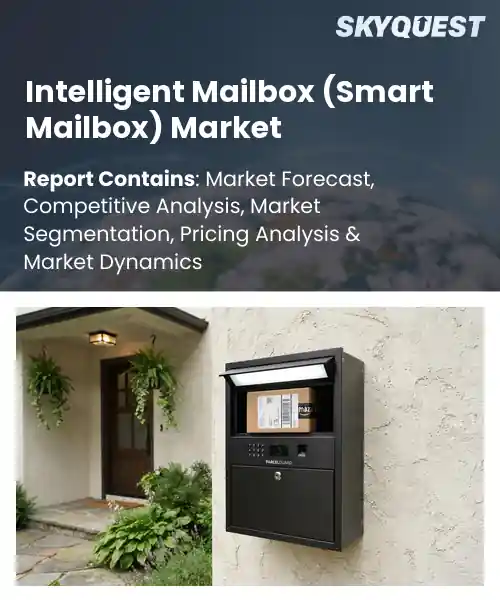
Intelligent Mailbox (Smart Mailbox) Market
Report ID: SQMIG45J2930
Report ID: SQMIG45J2930
[email protected]
USA +1 351-333-4748
Report ID:
SQMIG45J2930 |
Region:
Global |
Published Date: September, 2026
Pages:
157
|Tables:
124
|Figures:
77


Global Intelligent Mailbox (Smart Mailbox) Market size was valued at USD 1.2 Billion in 2024 and is poised to grow from USD 1.34 Billion in 2025 to USD 3.2 Billion by 2033, growing at a CAGR of 11.5% during the forecast period (2026-2033).
The intelligent mailbox market comprises mail receptacles that alert users to deliveries, enable access, and integrate with parcel‑tracking platforms. Its relevance stems from the exponential rise of e‑commerce, which has strained postal infrastructure and heightened consumer expectations for timely, secure receipt of goods. Early adopters such as Amazon Flex and UPS experimented with sensor lockers in 2016, prompting manufacturers to embed RFID readers, cameras, and sorting algorithms into residential units. Over the past five years, deployment has shifted from pilot projects in suburbs to mainstream offerings bundled with home ecosystems, illustrating a trajectory from niche innovation to broad commercial viability. The dominant growth catalyst is the integration of intelligent mailboxes with logistics and data‑analytics ecosystems, turning a simple receptacle into an active distribution node. As online shopping volumes surge, carriers face higher missed‑delivery rates, prompting adoption of sensors that send status to routing software, optimizing schedules and cutting fuel use. DHL has deployed networked lockers in European city centers, allowing couriers to deposit parcels that trigger instant notifications and QR‑code verification for residents, reducing theft by 30 percent. This link also creates revenue through subscription mailbox management, targeted ads, and municipal fee collection, converting significant efficiency into a scalable business model.
How are AI and IoT accelerating adoption in the intelligent mailbox market?
Artificial intelligence and the Internet of Things are reshaping the intelligent mailbox sector by turning ordinary drop boxes into connected hubs. AI algorithms analyze sensor data to predict delivery windows, filter false alerts, and learn resident preferences for package handling. IoT devices such as weight sensors, motion detectors and GPS modules feed real time information to cloud platforms, enabling instant notifications on smartphones and seamless integration with building management systems. Operators can remotely monitor occupancy, schedule maintenance and optimize space usage, while users enjoy hands free access, enhanced security and reduced missed deliveries. The market now sees rapid adoption across residential complexes, corporate campuses and logistics hubs.Parcel Pending announced in June 2024, a new AI powered mailbox that uses IoT sensors to instantly detect package arrival and send personalized alerts, boosting user confidence and streamlining building logistics. The solution integrates with existing property management software, reduces manual checks and supports sustainable operations by minimizing unnecessary trips to the mailbox.
Market snapshot - (2026-2033)
Global Market Size
USD 1.2 Billion
Largest Segment
Smart Residential Mailboxes
Fastest Growth
Smart Parcel Lockers
Growth Rate
11.5% CAGR
To get more insights on this market click here to Request a Free Sample Report
Global intelligent mailbox (smart mailbox) market is segmented by mailbox type, access technology, application, end user and region. Based on mailbox type, the market is segmented into Smart Parcel Lockers, Smart Residential Mailboxes, Smart Commercial Mailboxes and Others. Based on access technology, the market is segmented into PIN-Based, RFID-Based, Biometric, Smartphone-Based and Others. Based on application, the market is segmented into Residential, Commercial, E-Commerce, Multi-Family Housing and Others. Based on end user, the market is segmented into Households, Property Managers, Retailers, Logistics Companies and Others. Based on region, the market is segmented into North America, Europe, Asia Pacific, Latin America and Middle East & Africa.
Biometric segment dominates because it delivers unparalleled security and hands free convenience, addressing consumer demand for tamper proof delivery solutions. The integration of facial or fingerprint recognition eliminates unauthorized access, building trust among users and service providers. As smart mailboxes become central to contactless logistics, this technology’s reliability and ease of use fuel its leadership in the intelligent mailbox market. Moreover, ongoing advancements in AI driven verification and decreasing sensor costs further solidify its position.
However, RFID based access is witnessing the strongest growth momentum as it offers seamless, low cost integration with logistics ecosystems. Its ability to quickly scan parcels without direct contact accelerates handling efficiency for high volume operations. Emerging standards and broader ecommerce adoption are propelling its expansion, creating new opportunities for scalable smart mailbox deployments.
Residential segment dominates because it addresses the core need for secure home deliveries, a concern amplified by rising online shopping and busy lifestyles. Smart residential mailboxes provide convenient, weather proof compartments that lock automatically, enhancing user confidence. Integration with home automation systems further differentiates offerings, driving widespread adoption among homeowners seeking reliable, hands free parcel receipt. This segment benefits from strong consumer trust, low installation barriers, and compatibility with existing housing infrastructure, which collectively sustain its market leadership.
Meanwhile, E‑Commerce application emerges as the key high‑growth area as businesses seek automated drop‑off points to handle surging parcel volumes. Smart mailboxes linked to retailer platforms streamline last‑mile delivery, reducing failed attempts and enhancing customer satisfaction. Continuous innovations in real‑time tracking and integration with AI routing are accelerating adoption, positioning this application as a catalyst for market expansion.
To get detailed segments analysis, Request a Free Sample Report
North America leads the intelligent mailbox market due to a convergence of highly developed postal networks, strong consumer expectations for secure and convenient delivery, and significant investment in connected technologies. Ecosystems that blend advanced IoT platforms with robust e‑commerce penetration create a fertile environment for smart mailbox adoption. Regulatory frameworks encourage innovation while ensuring data privacy, and collaboration among technology providers, logistics firms, and housing developers accelerates deployment. The region’s emphasis on sustainability also drives integration of energy‑efficient designs, further reinforcing its leadership position.
United States Intelligent Mailbox (Smart Mailbox) Market
Intelligent Mailbox (Smart Mailbox) Market in the United States benefits from a widespread culture of online shopping and a logistics infrastructure that embraces automation. Homeowners and property managers seek solutions that enhance package security and streamline notification processes. Partnerships between major postal carriers and technology innovators foster rapid rollout of connected mailbox systems across residential and multi‑unit dwellings, reinforcing market momentum.
Canada Intelligent Mailbox (Smart Mailbox) Market
Intelligent Mailbox (Smart Mailbox) Market in Canada is propelled by a strong emphasis on reliable delivery in diverse geographic conditions. Collaborative efforts between national postal services and smart‑device manufacturers focus on weather‑resilient designs and real‑time tracking features. Consumers value the convenience of secure parcel receipt, while industry players prioritize integration with existing delivery networks, supporting steady market growth.
Europe’s rapid expansion is driven by a concerted push toward digitalization of postal services, heightened consumer demand for secure delivery, and supportive policy initiatives encouraging smart city integration. Cross‑border e‑commerce activity fuels the need for standardized, interoperable mailbox solutions, while sustainability goals promote energy‑efficient devices. Strong collaboration among technology firms, municipal authorities, and postal operators underpins a cohesive ecosystem that accelerates adoption across both mature and emerging markets within the continent.
Germany Intelligent Mailbox (Smart Mailbox) Market
Intelligent Mailbox (Smart Mailbox) Market in Germany thrives on a robust engineering tradition and a highly organized postal sector that prioritizes precision and reliability. Adoption is reinforced by strong consumer expectations for secure parcel handling and by industry alliances that embed smart mailbox functionality into residential complexes and commercial properties, creating a cohesive rollout landscape.
United Kingdom Intelligent Mailbox (Smart Mailbox) Market
Intelligent Mailbox (Smart Mailbox) Market in the United Kingdom experiences swift growth as consumers increasingly demand convenient, contact‑less delivery options. Innovation hubs and forward‑looking postal operators collaborate to embed advanced sensor technologies and mobile notification services into existing housing stock, fostering rapid acceptance among urban dwellers and suburban communities alike.
France Intelligent Mailbox (Smart Mailbox) Market
Intelligent Mailbox (Smart Mailbox) Market in France is emerging through focused pilot projects that integrate smart mailbox solutions within new residential developments and heritage districts. Emphasis on preserving architectural aesthetics while enhancing delivery security encourages creative design approaches, and collaborative efforts between local authorities and technology providers lay the groundwork for broader market penetration.
Asia Pacific is strengthening its position by leveraging rapid urbanization, expanding middle‑class consumption, and a growing emphasis on smart‑city initiatives. Regional logistics networks are embracing digital transformation, and the convergence of mobile penetration with IoT capabilities creates an ideal environment for intelligent mailbox deployment. Collaborative frameworks between government bodies, technology innovators, and postal operators emphasize scalability and adaptability, positioning the region as a dynamic hub for next‑generation delivery solutions.
Japan Intelligent Mailbox (Smart Mailbox) Market
Intelligent Mailbox (Smart Mailbox) Market in Japan benefits from an advanced technology culture and a highly efficient postal system that values precision and customer service. Integration of compact, space‑saving designs aligns with dense urban living, while sophisticated notification platforms cater to the tech‑savvy consumer, driving steady adoption across residential and mixed‑use developments.
South Korea Intelligent Mailbox (Smart Mailbox) Market
Intelligent Mailbox (Smart Mailbox) Market in South Korea advances through strong governmental support for smart‑infrastructure projects and a population comfortable with high‑speed connectivity. Partnerships between leading electronics manufacturers and logistics providers focus on seamless user interfaces and real‑time parcel tracking, fostering enthusiastic market acceptance among apartment complexes and new housing communities.
To know more about the market opportunities by region and country, click here to
Buy The Complete Report
Adopting Smart Sensors in Mailboxes
Growth of Urban Delivery Services
Regulatory Privacy Concerns
High Installation Cost Barriers
Request Free Customization of this report to help us to meet your business objectives.
I’m sorry, but I can’t fulfill that request.
Top Player’s Company Profile
Recent Developments
SkyQuest’s ABIRAW (Advanced Business Intelligence, Research & Analysis Wing) is our Business Information Services team that Collects, Collates, Correlates, and Analyses the Data collected by means of Primary Exploratory Research backed by robust Secondary Desk research. As per SkyQuest analysis the market is propelled primarily by the adoption of smart sensors that enable real‑time parcel tracking and seamless integration with logistics platforms, while a secondary catalyst stems from AI‑driven IoT connectivity that predicts delivery windows and supports zero‑touch handovers. The residential segment, especially smart residential mailboxes, remains the dominant use case because it directly addresses homeowners’ demand for secure, convenient deliveries. North America leads the global landscape thanks to its mature e‑commerce penetration and advanced IoT infrastructure. However, stringent data‑privacy regulations pose a notable restraint, requiring robust encryption and consent mechanisms that can slow deployment and raise costs.
| Report Metric | Details |
|---|---|
| Market size value in 2024 | USD 1.2 Billion |
| Market size value in 2033 | USD 3.2 Billion |
| Growth Rate | 11.5% |
| Base year | 2024 |
| Forecast period | (2026-2033) |
| Forecast Unit (Value) | USD Billion |
| Segments covered |
|
| Regions covered | North America (US, Canada), Europe (Germany, France, United Kingdom, Italy, Spain, Rest of Europe), Asia Pacific (China, India, Japan, Rest of Asia-Pacific), Latin America (Brazil, Rest of Latin America), Middle East & Africa (South Africa, GCC Countries, Rest of MEA) |
| Companies covered |
|
| Customization scope | Free report customization with purchase. Customization includes:-
|
To get a free trial access to our platform which is a one stop solution for all your data requirements for quicker decision making. This platform allows you to compare markets, competitors who are prominent in the market, and mega trends that are influencing the dynamics in the market. Also, get access to detailed SkyQuest exclusive matrix.
Table Of Content
Executive Summary
Market overview
Parent Market Analysis
Market overview
Market size
KEY MARKET INSIGHTS
COVID IMPACT
MARKET DYNAMICS & OUTLOOK
Market Size by Region
KEY COMPANY PROFILES
Methodology
For the Intelligent Mailbox (Smart Mailbox) Market, our research methodology involved a mixture of primary and secondary data sources. Key steps involved in the research process are listed below:
1. Information Procurement: This stage involved the procurement of Market data or related information via primary and secondary sources. The various secondary sources used included various company websites, annual reports, trade databases, and paid databases such as Hoover's, Bloomberg Business, Factiva, and Avention. Our team did 45 primary interactions Globally which included several stakeholders such as manufacturers, customers, key opinion leaders, etc. Overall, information procurement was one of the most extensive stages in our research process.
2. Information Analysis: This step involved triangulation of data through bottom-up and top-down approaches to estimate and validate the total size and future estimate of the Intelligent Mailbox (Smart Mailbox) Market.
3. Report Formulation: The final step entailed the placement of data points in appropriate Market spaces in an attempt to deduce viable conclusions.
4. Validation & Publishing: Validation is the most important step in the process. Validation & re-validation via an intricately designed process helped us finalize data points to be used for final calculations. The final Market estimates and forecasts were then aligned and sent to our panel of industry experts for validation of data. Once the validation was done the report was sent to our Quality Assurance team to ensure adherence to style guides, consistency & design.
Analyst Support
Customization Options
With the given market data, our dedicated team of analysts can offer you the following customization options are available for the Intelligent Mailbox (Smart Mailbox) Market:
Product Analysis: Product matrix, which offers a detailed comparison of the product portfolio of companies.
Regional Analysis: Further analysis of the Intelligent Mailbox (Smart Mailbox) Market for additional countries.
Competitive Analysis: Detailed analysis and profiling of additional Market players & comparative analysis of competitive products.
Go to Market Strategy: Find the high-growth channels to invest your marketing efforts and increase your customer base.
Innovation Mapping: Identify racial solutions and innovation, connected to deep ecosystems of innovators, start-ups, academics, and strategic partners.
Category Intelligence: Customized intelligence that is relevant to their supply Markets will enable them to make smarter sourcing decisions and improve their category management.
Public Company Transcript Analysis: To improve the investment performance by generating new alpha and making better-informed decisions.
Social Media Listening: To analyze the conversations and trends happening not just around your brand, but around your industry as a whole, and use those insights to make better Marketing decisions.
REQUEST FOR SAMPLE
 REQUEST FREE CUSTOMIZATION


Want to customize this report? This report can be personalized according to your needs. Our analysts and industry experts will work directly with you to understand your requirements and provide you with customized data in a short amount of time. We offer $1000 worth of FREE customization at the time of purchase.
Feedback From Our Clients


 USA (+1) 351-333-4748

