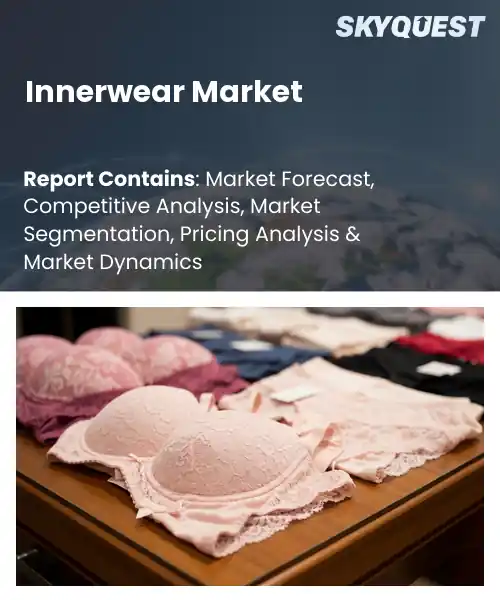
Innerwear Market
Report ID: SQMIG25M2113
Report ID: SQMIG25M2113
[email protected]
USA +1 351-333-4748
Report ID:
SQMIG25M2113 |
Region:
Global |
Published Date: June, 2026
Pages:
157
|Tables:
151
|Figures:
78


Global Innerwear Market size was valued at USD 234.5 Billion in 2024 and is poised to grow from USD 249.04 Billion in 2025 to USD 402.96 Billion by 2033, growing at a CAGR of 6.2% during the forecast period (2026-2033).
Increasing consumer preference for comfort and functionality, increasing focus on body positivity and inclusivity, rising adoption of premium and performance fabrics, advancements in fabric technologies, and expanding e-commerce penetration are driving sales of innerwear products.
Growing consumer demand for better fit, comfort, and personalized apparel experiences is expected to primarily drive innerwear market growth. In addition, the growth in digital retail and the increased trend of personalized shopping are proving to be significant factors for growth of the innerwear market. Customers are now having better insights of their shopping behaviors, preferences and appropriate recommendations through the use of customer data, fit analysis and digital technology; with sizing quiz applications, virtual fitting solutions, and personalized product recommendation aiding in reduction in the return of garments along with boosting customer loyalty and purchase rate of the products. Furthermore, increased trend toward environmental friendliness on part of manufacturers to integrate eco-friendly fabrics like recycled polyester, organic cotton and Tencel fibers is fueling demand for subscription based services, premium product ranges, and unique business models, which are also contributing to the extended life of a product, thereby the market is poised for steady growth.
On the contrary, fluctuations in raw material costs, intense market competition, counterfeit products, and challenges associated with inventory management and sizing standardization are anticipated to slow down innerwear market penetration across the study period and beyond.
How is AI Improving Personalized Fit And Sizing for Global Innerwear Brands?
AI has changed how the innerwear market approaches personalized fit and sizing with an integrated combination of body scanning technology, machine learning and virtual try-on solutions to offer better predictions of size and fit. Applications for the industry include size prediction and adaptive sizing systems and virtual fitting technologies. Using AI, shopping can become easier for customers who know that their recommended product is the correct size, the fitting room doesn't really need to be there, and the selection of the appropriate garment. With the use of AI, customers are more satisfied and a brand has access to new ways to market inclusive sizes to everyone. They can do so by using AI to determine what style the customer is interested in and offer better size predictions.
Market snapshot - (2026-2033)
Global Market Size
USD 234.5 Billion
Largest Segment
Bras
Fastest Growth
Sleepwear & Loungewear Innerwear
Growth Rate
6.2% CAGR
To get more insights on this market click here to Request a Free Sample Report
Global innerwear market is segmented by product type, material type, price range, distribution channel, end user, and region. Based on product type, the market is segmented into bras, panties & briefs, shapewear, thermals & base layers, sleepwear & loungewear innerwear, men’s innerwear, and kids’ innerwear. Based on material type, the market is segmented into cotton, synthetic fibers, blended fabrics, silk & satin, wool & thermal fabrics, and sustainable & organic fabrics. Based on price range, the market is segmented into economy, mid-range, premium, and luxury. Based on distribution channel, the market is segmented into offline retail and online retail. Based on end user, the market is segmented into women, men, and children. Based on region, the market is segmented into North America, Europe, Asia Pacific, Latin America, and Middle East & Africa.
The bras segment is slated to lead the global innerwear market revenue generation over the coming years. It provides the core functional requirements while providing a high level of consumer engagement-leading investment in fit science, material and custom sizing. Brands use structural design, comfort engineering and aesthetics as key differentiators, creating perceived value enabling wide distribution. Retail service based around fit and marketing driven repeat purchase cycles creating a cycle of loyalty for newer items and continued purchasing of existing seasonally updated merchandise.
However, shapewear segment is the most rapidly expanding segment as per this innerwear industry analysis, fueled by body shaping and confidence boosting fashion demand and advancements in fabric properties leading to comfort and effective shaping. E-commerce and social media trends lead to faster adoption and innovation of material, along with inclusive sizing, expand the addressed consumers thereby unlocking new opportunities in both premium and mass markets.
The sustainable & organic fabrics segment is predicted to account for the highest global innerwear market share going forward. Consumer ethics and transparency pressures are forcing the re-evaluation of sourcing, certification, and supply chain transparency. Brands' eco credentials command better brand stories and higher price-points, forcing companies to explore new fiber alternatives and manufacturing processes. This creates consolidations in procurement and encourages longer-term supplier relationships and a unified story at the product and retail level.
Meanwhile, blended fabrics segment is the most rapidly expanding subsegment, driven by the need for a well-balanced combination of comfort, durability and functional performance that only true fiber blends can provide. Technical innovation in fiber combinations and finishes allows for faster new product introduction, wider application across all styles and price levels and lends itself to scale up in both performance oriented and real-life everyday innerwear collections.
To get detailed segments analysis, Request a Free Sample Report
Consumer preference shifts, advanced manufacturing capacity, and strong retail ecosystems are helping this region hold sway over others. Urbanization and lifestyle trends are creating an expanding demand for a wide range of innerwear categories using high-quality fabrics. Regional manufacturers are employing flexible production systems coupled with design innovation that allows them to adapt to new trends quickly and customize their products for their consumers efficiently. The anchored supply chains of regional textile clusters support economies of scale and short delivery cycles. Retailers range from large multichannel retailers to small specialty stores; all provide an opportunity for broad distribution and discovery of products by consumers. The cultural focus on the importance of personal appearance and the growing acceptance of apparel based on comfort are adding to the depth of the market. Strategic partnerships between brands, local designers and technology providers will accelerate product development and increase consumer connection across several geographies. Investing in fabric science, and using sustainable methods to produce fabrics, will improve the competitive position of the region.
Innerwear sales in Japan are characterized by discerning consumers and a strong design heritage. Indigenous brands reflect point of sale to highlight superior fit, quality inputs, pared down aesthetics attractive to status aware consumers. Retail formats extend across classic department stores, high end experienced-based shopping to specialist networks. Advances in fabric technologies and complexity of styling seek to add diversity in offering. Designer-cum-manufacturer partnerships cater to niche segments buildbrand loyalties among urban services and fashion segments.
Innerwear demand in South Korea is defined by trend responsiveness and strong digital retail adoption. New silhouttes, print and multi-functional wear are test driven by young consumers segments. Local players focus on smart design, ease of wear, and quick product lifecycle to achieve current trends and desires. Omnichannel distribution and influencer driven promotion ensure launch presence and uptake. Focus on fabric innovation and body inclusive fit is key for differentiation while a growing interest from abroad increases export potential of certain premium, design-oriented products.
Consumer comfort, adaptability and wellness preferences among consumers will drive the region's innerwear demand until 2033. The relevance of athleisure and other basic wear categories for every occasion is rising with the expanding offer of a varied fit and body diversity range. For many retailers, it's the increase in experience retail to match e-commerce sales, with a higher standard of service and personalized consumer experience. There is increasing demand for brands to sustainably source materials and provide consumers with transparency around their supply chain, which has led to many brands creating new materials or implementing new manufacturing processes. Through partnerships between apparel companies and technology companies, the apparel industry can create new ways to differentiate their products by developing solutions for fabric performance and fit, therefore supporting the momentum of the apparel market and positioning North America as a creative hub for both mainstream and niche innerwear concepts.
Innerwear adoption in United States is shaped by diverse consumer segments, strong brand innovation, and omnichannel retailing. Alongside legacy houses are the digitally native labels that push product innovation and connect directly. A focus on athleisure's overlap with traditional style, fit technology, and size diversity has expanded their customer base. Through collaborations and tailored experiences, retailers and brands connect and stay relevant while the push toward responsible manufacturing and textile development drives newness both in the saturated mainstream channel and across niche categories and customer segments.
Emphasis on quality, thermal comfort considerations, and practical design suited for varied climates are shaping innerwear demand in Canada. Customers seek value for money through quality, multifunctionality and ethical considerations, therefore it is the retailer that will lead to sustainability claims and transparency. Online sites will develop in complement with specialty retail to support the smaller brands and private label businesses. Broader target markets emphasize a more inclusive range of sizes and comfortable basics. Work between the manufacturer, retailer, and designer will result in assortments which are not only performance-oriented but fashionable.
Design excellence, sustainability focus, and diversified retail strategies that reflect distinct national consumer preferences are helping boost innerwear demand in Europe. Established luxury and premium brands are expanding their product lines by developing high-quality underwear collections that offer craftsmanship, superior fit, and high-quality fabrics. Newer brands are focusing on innovation through seamless construction and fabrics with technical qualities. The focus of regulators and consumers on environmental issues is driving the published circular economy initiatives and responsible sourcing of raw materials in all supply chains. Retailers continue to combine traditional department stores, specialty boutiques, and multi-channel online retailing, providing broad-based access for the public along with curated shopping experiences. The collaboration of cross-border designers and textile manufacturers is accelerating the transfer of knowledge, and a strong design culture is providing a competitive advantage through localized design and fit philosophies that connect to what is important for customers in the many regions within Europe. Capital investments in technology-based fit tools and consumer insight tools further enhance the competitive position of retailers in Europe.
Innerwear demand in Germany prioritizes functional design, durable construction, and material performance. Buyers demand functional pieces and want the construction and technology built into clothes to have practical benefits. As a result, brands will highlight the fit and technology of the fabric. Retail outlets include chain, specialized and online stores which carry both mass market and designer brands. Factors that are important in a buying decision include the origin and process of manufacture; this will lead to companies developing and detailing sustainable manufacturing processes and ethical sourcing practices.
Innerwear demand in the United Kingdom is influenced by strong fashion consciousness, established lingerie heritage, and a vibrant retail mix. Trend-led design, innovative fit and storytelling driven by influencers resonates with the consumer. Premium branding coexists with high street and independent retail offers and personalization and discovery through digital. Visibility on sustainable/ethical production within positioning increases. Fit inclusivity and comfort drive assortment updates across all segments.
Robust lingerie tradition, elevated design, and artisanal craftsmanship are shaping innerwear innovation in France. For consumers, well-executed shapes, luxurious fabrication, and finer details indicate a fashion-driven perspective. Boutiques and selectively edited department store collections maintain brand history together with sophisticated, personalized e-tail offers. Tailored fit and sophistication help maintain heritage while satisfying consumer's needs for ease and style. The narratives of sustainability and product origin influence positioning and consumer perception.
To know more about the market opportunities by region and country, click here to
Buy The Complete Report
Rising Demand For Premium Comfort
Expansion Of Online Retail Channels
Supply Chain Disruptions
Pressure From Low Cost Alternatives
Request Free Customization of this report to help us to meet your business objectives.
Market competition is intensifying as direct to consumer disruptors, celebrity-backed entrants and sustainability-focused challengers push differentiated fit, shade and omni channel strategies; key drivers tied to competition include fit technology and retail partnerships. Firms pursue M&A, wholesale deals and tech-led product innovation, for example SKIMS’ rapid retail and collaboration expansion and Savage X Fenty opening physical stores.
SkyQuest’s ABIRAW (Advanced Business Intelligence, Research & Analysis Wing) is our Business Information Services team that Collects, Collates, Correlates, and Analyses the Data collected by means of Primary Exploratory Research backed by robust Secondary Desk research.
As per SkyQuest analysis, increasing focus on body positivity and inclusivity, rising adoption of premium and performance fabrics, advancements in fabric technologies, and expanding e-commerce penetration are anticipated to drive the demand for innerwear products going forward. However, fluctuations in raw material costs, intense market competition, counterfeit products, and challenges associated with inventory management and sizing standardization are slated to slow down the adoption of innerwear products in the future. Asia Pacific is slated to spearhead the demand for innerwear owing to high consumer spending on premium apparel, strong adoption of digital retail platforms, and increasing demand for personalized and inclusive product offerings. Development of AI-powered fit recommendation tools, growing adoption of virtual try-on technologies, and increasing use of sustainable and performance-based fabrics are anticipated to be key trends driving the innerwear industry over the coming years.
| Report Metric | Details |
|---|---|
| Market size value in 2024 | USD 234.5 Billion |
| Market size value in 2033 | USD 402.96 Billion |
| Growth Rate | 6.2% |
| Base year | 2024 |
| Forecast period | (2026-2033) |
| Forecast Unit (Value) | USD Billion |
| Segments covered |
|
| Regions covered | North America (US, Canada), Europe (Germany, France, United Kingdom, Italy, Spain, Rest of Europe), Asia Pacific (China, India, Japan, Rest of Asia-Pacific), Latin America (Brazil, Rest of Latin America), Middle East & Africa (South Africa, GCC Countries, Rest of MEA) |
| Companies covered |
|
| Customization scope | Free report customization with purchase. Customization includes:-
|
To get a free trial access to our platform which is a one stop solution for all your data requirements for quicker decision making. This platform allows you to compare markets, competitors who are prominent in the market, and mega trends that are influencing the dynamics in the market. Also, get access to detailed SkyQuest exclusive matrix.
Table Of Content
Executive Summary
Market overview
Parent Market Analysis
Market overview
Market size
KEY MARKET INSIGHTS
COVID IMPACT
MARKET DYNAMICS & OUTLOOK
Market Size by Region
KEY COMPANY PROFILES
Methodology
For the Innerwear Market, our research methodology involved a mixture of primary and secondary data sources. Key steps involved in the research process are listed below:
1. Information Procurement: This stage involved the procurement of Market data or related information via primary and secondary sources. The various secondary sources used included various company websites, annual reports, trade databases, and paid databases such as Hoover's, Bloomberg Business, Factiva, and Avention. Our team did 45 primary interactions Globally which included several stakeholders such as manufacturers, customers, key opinion leaders, etc. Overall, information procurement was one of the most extensive stages in our research process.
2. Information Analysis: This step involved triangulation of data through bottom-up and top-down approaches to estimate and validate the total size and future estimate of the Innerwear Market.
3. Report Formulation: The final step entailed the placement of data points in appropriate Market spaces in an attempt to deduce viable conclusions.
4. Validation & Publishing: Validation is the most important step in the process. Validation & re-validation via an intricately designed process helped us finalize data points to be used for final calculations. The final Market estimates and forecasts were then aligned and sent to our panel of industry experts for validation of data. Once the validation was done the report was sent to our Quality Assurance team to ensure adherence to style guides, consistency & design.
Analyst Support
Customization Options
With the given market data, our dedicated team of analysts can offer you the following customization options are available for the Innerwear Market:
Product Analysis: Product matrix, which offers a detailed comparison of the product portfolio of companies.
Regional Analysis: Further analysis of the Innerwear Market for additional countries.
Competitive Analysis: Detailed analysis and profiling of additional Market players & comparative analysis of competitive products.
Go to Market Strategy: Find the high-growth channels to invest your marketing efforts and increase your customer base.
Innovation Mapping: Identify racial solutions and innovation, connected to deep ecosystems of innovators, start-ups, academics, and strategic partners.
Category Intelligence: Customized intelligence that is relevant to their supply Markets will enable them to make smarter sourcing decisions and improve their category management.
Public Company Transcript Analysis: To improve the investment performance by generating new alpha and making better-informed decisions.
Social Media Listening: To analyze the conversations and trends happening not just around your brand, but around your industry as a whole, and use those insights to make better Marketing decisions.
REQUEST FOR SAMPLE
 REQUEST FREE CUSTOMIZATION
Global Innerwear Market size was valued at USD 234.5 Billion in 2024 and is poised to grow from USD 249.04 Billion in 2025 to USD 402.96 Billion by 2033, growing at a CAGR of 6.2% during the forecast period (2026-2033).
Market competition is intensifying as direct to consumer disruptors, celebrity-backed entrants and sustainability-focused challengers push differentiated fit, shade and omni channel strategies; key drivers tied to competition include fit technology and retail partnerships. Firms pursue M&A, wholesale deals and tech-led product innovation, for example SKIMS’ rapid retail and collaboration expansion and Savage X Fenty opening physical stores. 'Page Industries Limited', 'Hanesbrands Inc.', 'PVH Corp.', 'Triumph International', 'Victoria’s Secret & Co.', 'Wacoal Holdings Corp.', 'Jockey International Inc.', 'Rupa & Company Limited', 'Lux Industries Limited', 'Dollar Industries Limited', 'VIP Clothing Limited', 'MAS Holdings', 'Zivame', 'Clovia', 'Amante', 'Enamor', 'Calida Holding AG', 'Chantelle Group', 'Hunkemöller International B.V.', 'Fruit of the Loom, Inc.'
Rising consumer preference for comfort and quality fabrics has prompted brands to design innerwear that emphasizes fit, breathability, and durability, encouraging repeat purchases and stronger brand loyalty. As shoppers seek comfortable everyday and specialty options, manufacturers invest in higher-quality materials, refined construction, and differentiated product lines that appeal across age groups. This focus on premium comfort enables companies to expand assortments, command clearer market positioning, and increase retail presence, collectively supporting category expansion and encouraging innovation in design and fabric technology.
Sustainable Material Adoption: Consumers and brands are prioritizing eco-conscious fibers, manufacturing processes, and end-of-life strategies, driving innerwear producers to source biodegradable fabrics, recycled yarns, and lower-impact dyes. This shift influences product design, certification priorities, and supplier partnerships, as retailers emphasize transparency and traceability in collections. Sustainability positioning enhances brand differentiation, supports premium pricing strategies, and aligns with consumer values, prompting investment in circular initiatives such as take-back programs and repairable constructions to extend garment lifecycles and reduce environmental footprint.
Why does Asia Pacific Dominate the Global Innerwear Market? |@12


Want to customize this report? This report can be personalized according to your needs. Our analysts and industry experts will work directly with you to understand your requirements and provide you with customized data in a short amount of time. We offer $1000 worth of FREE customization at the time of purchase.
Feedback From Our Clients


 USA (+1) 351-333-4748

