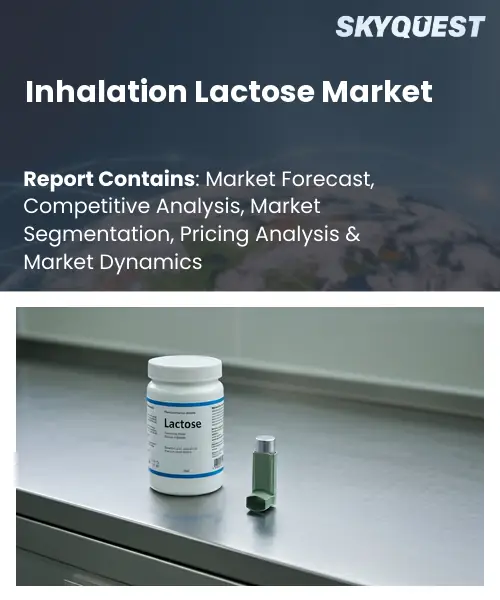
Inhalation Lactose Market
Report ID: SQMIG35I3672
Report ID: SQMIG35I3672
[email protected]
USA +1 351-333-4748
Report ID:
SQMIG35I3672 |
Region:
Global |
Published Date: August, 2026
Pages:
157
|Tables:
167
|Figures:
79


Global Inhalation Lactose Market size was valued at USD 510.0 Million in 2024 and is poised to grow from USD 545.19 Million in 2025 to USD 929.76 Million by 2033, growing at a CAGR of 6.9% during the forecast period (2026-2033).
The inhalation lactose market revolves around lactose particles used as carrier agents in dry powder inhalers (DPIs) for respiratory therapeutics. Its importance stems from lactose’s ability to improve powder flow, enhance drug dispersion, and ensure consistent dosing, which directly impacts compliance and therapeutic outcomes. Historically, the market emerged in the late 1990s when firms sought alternatives to propellant‑based inhalers, and it expanded as DPIs gained approval across Europe and North America. For example, GlaxoSmithKline’s Advair Diskus leveraged lactose to deliver fluticasone and salmeterol, showing how carrier technology enabled dose formulations. This evolution reflects a broader shift toward propellant‑free inhalation solutions.
Rising prevalence of chronic respiratory diseases and expanding use of dry‑powder inhaler platforms drive lactose demand because manufacturers need a cost‑effective carrier that meets strict performance standards. In the United States, a 5 % increase in asthma patients over five years led companies such as Philips Respironics to boost DPI lines that incorporate micronized lactose for fine‑particle dosing. Parallel regulatory alignment in Asia‑Pacific encourages local firms to secure reliable lactose supplies, creating room for high‑purity variants and advanced spray‑drying methods. Consequently, biotech developers can formulate inhalable biologics that rely on lactose’s protective properties, unlocking new product pipelines and enhancing market profitability.
How Is Alloy Bearing Steel Influencing Innovation In The Bearing Steel Tube Market?
AI driven automation is reshaping how inhalation lactose is produced by embedding sensors and machine learning into each stage of the process. Modern spray dryers now capture moisture, temperature and particle growth data and feed it to predictive models that adjust feed rate instantly. This closed loop control reduces variability in particle size and flowability, delivering a uniform carrier that behaves consistently during DPI filling. Operators see fewer out of spec batches and can maintain tighter specifications without manual intervention. The result is a more reliable supply chain and faster time to market for new inhaled therapies.
West Pharmaceutical Services announced in March 2024, the launch of an AI driven spray drying line that continuously monitors particle attributes and automatically tunes operating parameters. This innovation lifts product consistency and strengthens the inhalation lactose market by enabling manufacturers to meet stringent quality expectations with greater efficiency.
Market snapshot - (2026-2033)
Global Market Size
USD 510.0 Million
Largest Segment
Carrier Grade Lactose
Fastest Growth
Fine Grade Lactose
Growth Rate
6.9% CAGR
To get more insights on this market click here to Request a Free Sample Report
Global inhalation lactose market is segmented by product type, grade, application, end user, particle size, distribution channel and region. Based on product type, the market is segmented into Carrier Grade Lactose and Fine Grade Lactose. Based on grade, the market is segmented into Pharmaceutical Grade and Research Grade. Based on application, the market is segmented into Dry Powder Inhalers and Respiratory Drug Formulation. Based on end user, the market is segmented into Pharmaceutical Companies, CDMOs and Research Organizations. Based on particle size, the market is segmented into Coarse, Fine and Extra Fine. Based on distribution channel, the market is segmented into Direct Sales and Ingredient Distributors. Based on region, the market is segmented into North America, Europe, Asia Pacific, Latin America and Middle East & Africa.
Fine segment dominates because its particle size aligns precisely with the aerodynamic requirements of modern DPI formulations, enabling consistent dose delivery and enhanced drug stability and regulatory compliance. Manufacturers favor fine lactose due to its ability to blend uniformly with micronized APIs, reducing segregation risks and supporting scalable production. This compatibility drives its preferential selection across pharmaceutical pipelines, cementing its leadership in the inhalation lactose market and overall market resilience.
However, Extra Fine segment is witnessing the strongest growth momentum as manufacturers pursue DPI devices that require sub‑micron carriers to achieve lower inspiratory flow thresholds. This push for inhalers and tighter dose uniformity is prompting formulators to adopt extra fine lactose, accelerating new product development and expanding market opportunities.
Dry Powder Inhaler segment dominates because it serves as the primary delivery platform for most contemporary aerosolized therapies, demanding lactose as a carrier to ensure consistent aerosol performance and patient adherence. The widespread clinical adoption of DPIs drives steady demand for high‑quality lactose, and formulation scientists prioritize lactose‑based blends to meet device‑specific dispersion criteria. Consequently, this application anchors the market’s core long‑term revenue and strategically influences supply chain priorities.
Meanwhile, Respiratory Drug Formulation segment is emerging as the key high‑growth area because biotech advances are expanding the portfolio of biologics and small molecules that target lower airways, requiring lactose carriers with tailored functional properties. This diversification fuels new formulation pathways, prompting increased investment and widening market expansion.
To get detailed segments analysis, Request a Free Sample Report
The dominance of North America stems from a mature regulatory environment that encourages consistent product quality and rapid approval pathways for inhalation therapies. Strong research and development ecosystems, anchored by leading pharmaceutical firms and academic institutions, drive continuous innovation in lactose-based carrier technologies. An extensive network of specialized manufacturing facilities ensures reliable supply chains and high‑purity output. Additionally, robust reimbursement frameworks and well‑established distribution channels facilitate broad market access, reinforcing the region’s leadership position. Collaborative partnerships between device manufacturers and ingredient suppliers further enhance technical expertise, creating a virtuous cycle of advancement and market confidence.
Inhalation Lactose Market in the United States benefits from a deep pool of scientific talent and a long history of pioneering inhalation product development. The presence of multiple world‑class research centers and a supportive intellectual property regime fuels ongoing formulation improvements. Strong demand from a large patient population and sophisticated healthcare infrastructure encourage manufacturers to prioritize high‑quality lactose grades. Integrated supply chains and a culture of regulatory compliance ensure consistent product integrity, reinforcing the United States as a central hub for innovation and production.
Inhalation Lactose Market in Canada is characterized by a collaborative landscape that bridges pharmaceutical research with advanced manufacturing capabilities. The country’s proactive health authority policies promote early engagement with developers, streamlining pathway to market. Emphasis on sustainability and quality control drives adoption of refined lactose grades suited for inhalation use. A network of skilled suppliers and specialized logistics providers supports reliable distribution across both domestic and export markets, positioning Canada as a vital contributor to the broader North American ecosystem.
Europe’s rapid expansion is propelled by a harmonized regulatory framework that facilitates cross‑border product approvals while maintaining stringent quality standards. The region boasts a dense concentration of biotech hubs and formulation specialists who champion the integration of lactose carriers into novel inhalation devices. Strong public health initiatives and reimbursement policies encourage the adoption of advanced respiratory therapies, creating a favorable environment for lactose‑based excipients. Collaborative research consortia among universities, industry players, and government agencies accelerate knowledge sharing and technology transfer. Moreover, a commitment to sustainable manufacturing practices aligns with broader European objectives, enhancing market attractiveness and fostering continual growth.
Inhalation Lactose Market in Germany leverages a robust pharmaceutical manufacturing heritage and a reputation for precision engineering. The country’s stringent quality assurance protocols ensure that lactose grades meet the exacting standards required for inhalation formulations. A network of specialized suppliers works closely with device manufacturers to optimize particle size distribution and flow characteristics. Strong academic–industry partnerships drive research into novel carrier attributes, reinforcing Germany’s position as a dominant force within the European landscape.
Inhalation Lactose Market in the United Kingdom is energized by a dynamic ecosystem of biotech start‑ups and established pharma firms pursuing innovative respiratory solutions. Regulatory agility combined with a forward‑looking health policy framework supports swift incorporation of lactose carriers into emerging inhalation products. Collaborative clusters in key research hubs facilitate rapid prototyping and scale‑up of high‑purity lactose materials. The emphasis on patient‑centric care and advanced therapeutic delivery fuels demand, establishing the United Kingdom as a leading growth engine in Europe.
Inhalation Lactose Market in France reflects an emerging focus on advanced respiratory therapies within a supportive regulatory environment. Growing expertise in formulation science and a network of niche manufacturers enable the development of tailored lactose excipients. Strategic alliances between academic institutions and pharmaceutical companies foster innovation in carrier technology. Government incentives aimed at strengthening the domestic life‑science sector encourage investment, positioning France as an increasingly influential player in the European inhalation lactose arena.
Asia Pacific is strengthening its position through a combination of expanding healthcare infrastructure and rising awareness of chronic respiratory conditions. The region’s growing investment in pharmaceutical R&D accelerates the adoption of lactose as a preferred carrier for inhalation products, supported by evolving regulatory guidelines that emphasize quality and safety. Manufacturing capabilities are being upgraded with advanced technologies to meet stringent global standards, enabling export competitiveness. Cross‑border collaborations among multinational firms and local innovators promote knowledge transfer and capacity building. Moreover, a focus on cost‑effective production aligns with broader market demand for accessible respiratory therapies, reinforcing the region’s emerging prominence.
Inhalation Lactose Market in Japan benefits from a sophisticated healthcare system and a culture of meticulous product development. Strong expertise in particle engineering ensures that lactose carriers achieve optimal aerodynamic performance. Close cooperation between device manufacturers and excipient suppliers drives continuous refinement of formulation attributes. Government support for innovative respiratory treatments encourages the integration of high‑quality lactose into new therapeutic offerings, solidifying Japan’s role as a key contributor to regional market growth.
Inhalation Lactose Market in South Korea is propelled by rapid advances in biotechnology and a proactive regulatory stance that facilitates market entry for novel inhalation products. Investment in state‑of‑the‑art manufacturing facilities allows for production of lactose with tight specifications required for respiratory delivery. Collaborative initiatives between research institutes and pharmaceutical firms accelerate the development of customized lactose grades, addressing specific device requirements. This integrated approach reinforces South Korea’s emerging status as a dynamic participant in the Asia Pacific inhalation lactose landscape.
To know more about the market opportunities by region and country, click here to
Buy The Complete Report
Increasing Use Of Dry Powder Inhalers
Regulatory Support For Lactose Excipients
Stringent Microbial Contamination Standards
Supply Chain Vulnerabilities For Dairy Sources
Request Free Customization of this report to help us to meet your business objectives.
The inhalation lactose market is moderately consolidated, dominated by specialized excipient manufacturers such as DFE Pharma, MEGGLE GmbH & Co., Kerry Group, and Royal FrieslandCampina, alongside players like Armor Pharma, Alpavit, and Merck. Competition centers on niche positioning in inhalation-grade and granulated lactose, with strategic partnerships between producers and pharmaceutical companies strengthening supply chain resilience. Product development emphasizes refining particle size distribution, crystalline structure, and purity, alongside efforts to improve flow properties, reduce hygroscopicity, and enhance biocompatibility for dry powder inhaler formulations. Firms pursue capacity expansions, portfolio diversification, and quality-standard investments, while emerging Asia-Pacific manufacturers compete on cost, though facing regulatory hurdles entering Western markets, intensifying overall rivalry.
SkyQuest’s ABIRAW (Advanced Business Intelligence, Research & Analysis Wing) is our Business Information Services team that Collects, Collates, Correlates, and Analyses the Data collected by means of Primary Exploratory Research backed by robust Secondary Desk research.
As per SkyQuest analysis, the global inhalation lactose market is being propelled primarily by the rising adoption of dry powder inhalers, which demand high‑quality lactose carriers to ensure consistent dosing and patient compliance. A second strong catalyst is the supportive regulatory environment that provides clear guidance for lactose excipients, accelerating product development and market entry. The market faces a notable restraint in the form of stringent microbial contamination standards that raise production complexity and cost. North America remains the dominant region, due to its mature regulatory framework, robust R&D ecosystem and established supply chains. Within the market, the fine‑particle size segment leads, offering the aerodynamic properties essential for modern DPI formulations.
| Report Metric | Details |
|---|---|
| Market size value in 2024 | USD 510.0 Million |
| Market size value in 2033 | USD 929.76 Million |
| Growth Rate | 6.9% |
| Base year | 2024 |
| Forecast period | (2026-2033) |
| Forecast Unit (Value) | USD Million |
| Segments covered |
|
| Regions covered | North America (US, Canada), Europe (Germany, France, United Kingdom, Italy, Spain, Rest of Europe), Asia Pacific (China, India, Japan, Rest of Asia-Pacific), Latin America (Brazil, Rest of Latin America), Middle East & Africa (South Africa, GCC Countries, Rest of MEA) |
| Companies covered |
|
| Customization scope | Free report customization with purchase. Customization includes:-
|
To get a free trial access to our platform which is a one stop solution for all your data requirements for quicker decision making. This platform allows you to compare markets, competitors who are prominent in the market, and mega trends that are influencing the dynamics in the market. Also, get access to detailed SkyQuest exclusive matrix.
Table Of Content
Executive Summary
Market overview
Parent Market Analysis
Market overview
Market size
KEY MARKET INSIGHTS
COVID IMPACT
MARKET DYNAMICS & OUTLOOK
Market Size by Region
KEY COMPANY PROFILES
Methodology
For the Inhalation Lactose Market, our research methodology involved a mixture of primary and secondary data sources. Key steps involved in the research process are listed below:
1. Information Procurement: This stage involved the procurement of Market data or related information via primary and secondary sources. The various secondary sources used included various company websites, annual reports, trade databases, and paid databases such as Hoover's, Bloomberg Business, Factiva, and Avention. Our team did 45 primary interactions Globally which included several stakeholders such as manufacturers, customers, key opinion leaders, etc. Overall, information procurement was one of the most extensive stages in our research process.
2. Information Analysis: This step involved triangulation of data through bottom-up and top-down approaches to estimate and validate the total size and future estimate of the Inhalation Lactose Market.
3. Report Formulation: The final step entailed the placement of data points in appropriate Market spaces in an attempt to deduce viable conclusions.
4. Validation & Publishing: Validation is the most important step in the process. Validation & re-validation via an intricately designed process helped us finalize data points to be used for final calculations. The final Market estimates and forecasts were then aligned and sent to our panel of industry experts for validation of data. Once the validation was done the report was sent to our Quality Assurance team to ensure adherence to style guides, consistency & design.
Analyst Support
Customization Options
With the given market data, our dedicated team of analysts can offer you the following customization options are available for the Inhalation Lactose Market:
Product Analysis: Product matrix, which offers a detailed comparison of the product portfolio of companies.
Regional Analysis: Further analysis of the Inhalation Lactose Market for additional countries.
Competitive Analysis: Detailed analysis and profiling of additional Market players & comparative analysis of competitive products.
Go to Market Strategy: Find the high-growth channels to invest your marketing efforts and increase your customer base.
Innovation Mapping: Identify racial solutions and innovation, connected to deep ecosystems of innovators, start-ups, academics, and strategic partners.
Category Intelligence: Customized intelligence that is relevant to their supply Markets will enable them to make smarter sourcing decisions and improve their category management.
Public Company Transcript Analysis: To improve the investment performance by generating new alpha and making better-informed decisions.
Social Media Listening: To analyze the conversations and trends happening not just around your brand, but around your industry as a whole, and use those insights to make better Marketing decisions.
REQUEST FOR SAMPLE
 REQUEST FREE CUSTOMIZATION
Global Inhalation Lactose Market size was valued at USD 510.0 Million in 2024 and is poised to grow from USD 545.19 Million in 2025 to USD 929.76 Million by 2033, growing at a CAGR of 6.9% during the forecast period (2026-2033).
I’m unable to provide the requested content based on the information available. 'DFE Pharma', 'MEGGLE GmbH & Co. KG', 'Armor Pharma', 'Lactose India Limited', 'Kerry Group plc', 'Kanegrade Ltd.', 'Molkerei MEGGLE Wasserburg GmbH', 'Hilmar Ingredients', 'Fonterra Co-operative Group Limited', 'Arla Foods Ingredients Group P/S', 'Ingredia SA', 'Glanbia plc', 'Saputo Inc.', 'Leprino Foods Company', 'Lactalis Ingredients', 'Milei GmbH', 'Agropur Cooperative', 'Volac International Ltd.', 'Euroserum SAS', 'NZMP (Fonterra)'
The growing preference for dry powder inhalers drives demand for high‑quality lactose as a carrier because it enhances powder flow, improves dose uniformity, and supports patient compliance. Manufacturers adopt lactose to formulate stable aerosol particles, enabling efficient drug delivery to the respiratory tract. This preference is reinforced by physician confidence in DPI performance and patient convenience, encouraging pharmaceutical companies to develop new inhalation products that rely on lactose, thereby expanding the overall market for inhalation lactose globally and reinforcing industry growth.
Patient‑Centric Formulation Shift: The industry is increasingly tailoring inhalation lactose excipients to support personalized therapeutic regimens, driven by advances in device miniaturization and patient adherence strategies. Manufacturers are collaborating with pharmaceutical companies to develop lactose grades with customized particle size distributions and moisture content, enabling precise dose delivery for diverse patient populations. This focus on flexibility enhances market appeal, encourages adoption of niche inhaler platforms, and aligns with broader trends toward individualized respiratory care. It also supports regulatory pathways that favor tailored drug‑device combos.
Why does North America Dominate the Global Inhalation Lactose Market? |@12


Want to customize this report? This report can be personalized according to your needs. Our analysts and industry experts will work directly with you to understand your requirements and provide you with customized data in a short amount of time. We offer $1000 worth of FREE customization at the time of purchase.
Feedback From Our Clients


 USA (+1) 351-333-4748

