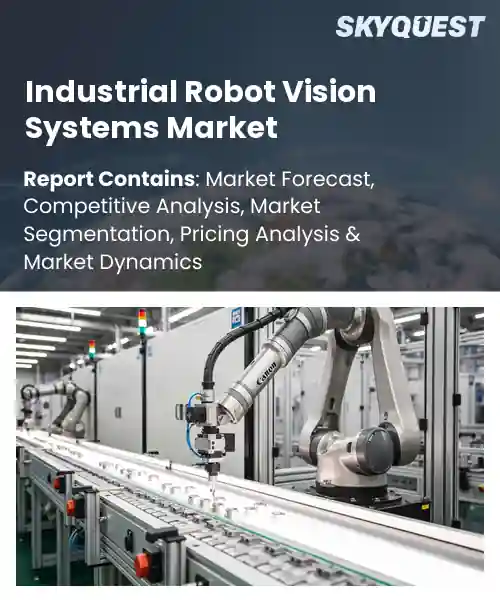
Industrial Robot Vision Systems Market
Report ID: SQMIG20F2090
Report ID: SQMIG20F2090
[email protected]
USA +1 351-333-4748
Report ID:
SQMIG20F2090 |
Region:
Global |
Published Date: July, 2026
Pages:
157
|Tables:
158
|Figures:
78


Global Industrial Robot Vision Systems Market size was valued at USD 4.2 Billion in 2024 and is poised to grow from USD 4.54 Billion in 2025 to USD 8.54 Billion by 2033, growing at a CAGR of 8.2% during the forecast period (2026-2033).
Growing adoption of industrial automation, increasing demand for high-quality manufacturing, rising investments in smart factories, advancements in machine vision technologies, and expanding use of robotics across industries are driving sales of industrial robot vision systems.
High demand for manufacturing automation and precision quality inspection, coupled with increasing adoption of Industry 4.0 technologies are supporting steady industrial robot vision systems market growth. Growing use of vision guided robotics in assembly, inspection, material handling, welding and packing applications is enabling manufacturers to enhance efficiency, lower defects and/or escalate productivity levels. Rising investments in AI based machine vision, advanced 3D imaging techniques, edge computing technology and smart factory platforms are further accelerating the market growth. Ongoing advancements in high definition cameras, smart image processing modules, advanced deep learning methods and the integration of real time visual inspection in manufacturing process are creating multiple opportunities for improving manufacturing precision and adaptability. Additionally, increasing demand for automated quality control processes in automobile, electronic, pharmaceutical and logistic industries is also expected to propel the market.
Contrastingly, high implementation costs, complex system integration, shortage of skilled professionals, and challenges associated with deploying vision systems in highly variable production environments are anticipated to slow down industrial robot vision systems market penetration across the study period.
How is AI Improving Accuracy and Efficiency in Industrial Robot Vision Systems?
AI is revolutionizing industrial robot vision systems by enabling higher inspection quality, higher speed and increased automation. Robots using deep learning algorithms are able to spot defects, identify oddly shaped objects with high levels of precision, and recognize the position of irregular parts even on textured or reflective backgrounds. AI vision systems analyze images directly on the camera and controller, cutting out the need for additional computers and enabling easier and quicker deployment. The ability to adapt to production variations improves quality control and cuts inspection errors.
Market snapshot - (2026-2033)
Global Market Size
USD 4.2 Billion
Largest Segment
2D Vision Systems
Fastest Growth
3D Vision Systems
Growth Rate
8.2% CAGR
To get more insights on this market click here to Request a Free Sample Report
Global industrial robot vision systems market is segmented by vision technology, component, robot type, application, end-use industry, and region. Based on vision technology, the market is segmented into 2D Vision Systems and 3D Vision Systems. Based on component, the market is segmented into cameras, optics & lenses, lighting systems, vision controllers & frame grabbers, vision processing software, and others. Based on robot type, the market is segmented into articulated robots, SCARA Robots, cartesian robots, delta robots, collaborative robots (Cobots), and others. Based on application, the market is segmented into inspection & quality control, guidance & positioning (pick-and-place/bin picking), identification & measurement, assembly verification, packaging & palletizing, welding & dispensing guidance, and others. Based on end-use industry, the market is segmented into automotive, electronics & semiconductor, food & beverage, pharmaceuticals & medical devices, metals & machinery, logistics & warehousing, consumer goods, and others. Based on region, the market is segmented into North America, Europe, Asia Pacific, Latin America, and Middle East & Africa.
The 2D vision systems segment is predicted to lead the global industrial robot vision systems market revenue generation across the study period. It offers a mature, economical sensing method that fulfills most routine inspection and positioning requirements on production lines. Its straightforward technology minimizes integration challenges for industrial robots, providing rapid implementation, stable throughput, and robust application predictability. Established vendor networks around optics, illumination and image processing deliver solid turnkey solutions, however with the installed base and developer experience it is expected two-dimensional imaging will remain popular in production applications.
However, 3D vision systems is emerging as the most rapidly expanding subsegment for its capability to provide depth information for difficult to perform tasks like bin picking or volumetric inspection. Progress in structured light, stereo and time of flight makes guidance and adaptive robotics more reliable, opening up new automation business cases and higher value projects.
The cameras segment is anticipated to account for the highest global industrial robot vision systems market share in the future. In robotics, cameras provide the main sensing platform from which all subsequent robot vision tasks are performed. Camera improvements in sensitivity, shutter mechanisms and robustness against the industrial environment make them more adaptable to a range of manufacturing conditions and eliminate the requirement for machine-specific solutions. Camera's unique capacity to reduce feedback latency through interconnection with robotic controls and conform to common interfaces drives investment in the technology.
Meanwhile, vision processing software is the fastest growing subsegment as per this industrial robot vision systems market forecast, as intelligent algorithms and deep learning are used to provide more flexible inspection capable systems for a wider range of part geometries, software improvements reduce system integration time, a designed to facilitate edge analytics and the potential for ongoing improvement through retraining of techniques, which generates recurrent benefit and for providing a higher margin service offering, thus hastening platform level uptake and future prospect creation for robot vision solutions.
To get detailed segments analysis, Request a Free Sample Report
Concentrated manufacturing strength, integrated supply chains, and early adoption of automation technologies are helping this region maintain its dominance. Major technology companies and robot manufacturers cooperate with component companies and research institutions to improve vision algorithms and sensor equipment for various factory applications. Continuous demand from electronics, automotive and semiconductor production will lead to increasing application of inspection, alignment and guidance solutions. Different government policies in favor of high technology manufacturing and vocational training help adapt the workforce to automated processes. Local companies customize their offerings according to specific needs, driven by high density of manufacturing and cost competition, together with cross-border trade and strong investments in research and development. Close connections between system integrators and end users give the possibility of rapid pilot implementations of customized solutions.
Sales of industrial robot vision systems in Japan benefit from deep industrial robotics heritage, strong system integrator networks and close collaboration between manufacturers and research institutions. Leading automation firms drive innovation in camera technology and vision software while supply chain proximity to electronics and automotive producers ensures rapid adoption. Emphasis on precision manufacturing and continuous improvement fosters demand for advanced inspection, measurement and guidance solutions tailored to complex, high production environments.
Industrial robot vision system demand in South Korea is driven by strong electronics and automotive manufacturing clusters and research in machine vision and semiconductor inspection. Local integrators work with camera & sensor vendors to customize solutions for high throughput lines. Assistance from government and industry cooperation on advanced manufacturing initiatives encourages pilot deployments and enhanced focus on miniaturization and component level inspection drives higher demand for small, high precision vision systems and smarter software.
Integration of robotics in advanced manufacturing sectors, emphasis on automation to improve quality and throughput, and the presence of innovative software and semiconductor companies are creating new opportunities. System integrators and robotics companies are working directly with end-users to bring customized inspection, guidance and bin picking applications to life. Strong investment in industrial R&D, precarious relationships with technology start-ups and established companies and a favorable purchasing landscape are certain to support the rapid prototyping and subsequent up-scaling of vision enabled automation. Reshoring of supply chains coupled with evolving desire for flexible and modular systems continue to promote industry-wide adoption in medium and large-scale industries, even as resilient service infrastructure, partnership with artificial intelligence organizations and a scientific skilled talent pool bolster deployment and statistical analysis, and a extensive funding network enables commercial viability of new age sensors and software towards industry-wide vendor interoperability.
Industrial robot vision system demand in the United States benefits from innovation at software and semiconductor firms, a base of system integrators and collaboration between manufacturers and research institutions. Demand from automotive, electronics and medical manufacturing drives adoption of vision based inspection and guidance solutions. Emphasis on scalable software, cloud analytics and integrated artificial intelligence enable deployment of adaptive inspection and robotic guidance systems at multiple sites with program support.
Sales of industrial robot vision systems in Canada are supported by advanced manufacturing clusters, a collaborative ecosystem of integrators with growing interest from aerospace and automotive suppliers. Flexible automation and access to a global network of local service providers and system integrators seeking to penetrate with enterprise systems provide a strong push for the adoption of modular vision solutions. System integrators provide modules with local service, deployment, and maintenance for customizing solutions tailored to quality and production variations.
Coordinated industrial strategies, strong engineering traditions and collaborative research networks that bridge academia and manufacturers support steady sales of industrial robot vision systems in Europe. Growth in high-quality manufacturing, safety and compliance continues to drive demand for highly capable vision systems across automotive, pharmaceutical and precision engineering sectors. Local system integrators and sophisticated vendors focus on modular, flexible, interoperable technologies that align with sector-specific quality, traceability and safety specifications. International partnerships and industry grouping foster knowledge transfer and standard recognition, while investment in advanced technical skills and test facilities helps speed customer understanding and application of new inspection and location technologies within a broad range of industrial environments. Original equipment manufacturers and niche vision companies work together on solutions that deliver product safety and environmental protection and can be implemented in a network of local service teams across multiple national market variations.
Industrial robot vision systems market in Germany builds on a strong automotive and precision engineering base, experienced system integrators and expertise in industrial control. Local vendors focus on robust solutions that meet manufacturing quality standards and support traceability. Close ties between research institutes and industry speed validation of inspection systems, while attention to interoperability and serviceability encourages adoption for complex assembly and high precision inspection applications with long term support.
Industrial robot vision system demand in the United Kingdom draws on strong robotics research, agile technology startups and industry collaboration on manufacturing automation and quality control. Integrators offer flexible Modular vision solutions that can be easily tuned to specific production lines. A concentrated emphasis on software driven inspection, cloud based analytics and rapid prototyping allows manufacturers to trial new approaches, with testing facilities and servicing networks facilitating deployment to full production across key industrial segments.
Industrial robot vision systems market in France benefits from strong precision manufacturing and aerospace industries that demand exacting inspection and alignment capabilities. Local research centers and startups develop vision algorithms and sensors for miniaturization. System integrators are focusing on customized solutions meeting industry specific quality and traceability requirements, while government innovation programs and clusters put into place pilot initiatives and implementation support, to allow producers to implement vision enabled automation in complex production flows and scalability.
To know more about the market opportunities by region and country, click here to
Buy The Complete Report
Rising Demand For Automated Inspection
Advances In Machine Vision Software
High Integration Complexity And Costs
Shortage Of Skilled Technical Workforce
Request Free Customization of this report to help us to meet your business objectives.
Competitive intensity in industrial robot vision is driven by OEMs embedding vision and AI into robot controllers, prompting consolidation through acquisitive moves and targeted technology partnerships. Recent M&A such as Zebra’s acquisition of Photoneo and strategic alliances like FANUC’s strengthened collaboration with NVIDIA show rivals pursuing scale and edge-AI integration; vendors compete by shipping new 3D and AI-embedded cameras and SDKs to shorten integration time.
SkyQuest’s ABIRAW (Advanced Business Intelligence, Research & Analysis Wing) is our Business Information Services team that Collects, Collates, Correlates, and Analyses the Data collected by means of Primary Exploratory Research backed by robust Secondary Desk research.
As per SkyQuest analysis, increasing demand for high-quality manufacturing, rising investments in smart factories, and advancements in machine vision technologies are anticipated to drive the demand for industrial robot vision systems going forward. However, high implementation costs and complex system integration are slated to slow down the adoption of industrial robot vision systems in the future. Asia Pacific is slated to spearhead the demand for industrial robot vision systems owing to rapid adoption of Industry 4.0 technologies, strong presence of leading robotics and machine vision companies, increasing investments in smart manufacturing, and high demand for automated quality inspection. AI-powered vision inspection and integration of edge AI with 3D machine vision are anticipated to be key trends driving the industrial robot vision systems sector over the coming years.
| Report Metric | Details |
|---|---|
| Market size value in 2024 | USD 4.2 Billion |
| Market size value in 2033 | USD 8.54 Billion |
| Growth Rate | 8.2% |
| Base year | 2024 |
| Forecast period | (2026-2033) |
| Forecast Unit (Value) | USD Billion |
| Segments covered |
|
| Regions covered | North America (US, Canada), Europe (Germany, France, United Kingdom, Italy, Spain, Rest of Europe), Asia Pacific (China, India, Japan, Rest of Asia-Pacific), Latin America (Brazil, Rest of Latin America), Middle East & Africa (South Africa, GCC Countries, Rest of MEA) |
| Companies covered |
|
| Customization scope | Free report customization with purchase. Customization includes:-
|
To get a free trial access to our platform which is a one stop solution for all your data requirements for quicker decision making. This platform allows you to compare markets, competitors who are prominent in the market, and mega trends that are influencing the dynamics in the market. Also, get access to detailed SkyQuest exclusive matrix.
Table Of Content
Executive Summary
Market overview
Parent Market Analysis
Market overview
Market size
KEY MARKET INSIGHTS
COVID IMPACT
MARKET DYNAMICS & OUTLOOK
Market Size by Region
KEY COMPANY PROFILES
Methodology
For the Industrial Robot Vision Systems Market, our research methodology involved a mixture of primary and secondary data sources. Key steps involved in the research process are listed below:
1. Information Procurement: This stage involved the procurement of Market data or related information via primary and secondary sources. The various secondary sources used included various company websites, annual reports, trade databases, and paid databases such as Hoover's, Bloomberg Business, Factiva, and Avention. Our team did 45 primary interactions Globally which included several stakeholders such as manufacturers, customers, key opinion leaders, etc. Overall, information procurement was one of the most extensive stages in our research process.
2. Information Analysis: This step involved triangulation of data through bottom-up and top-down approaches to estimate and validate the total size and future estimate of the Industrial Robot Vision Systems Market.
3. Report Formulation: The final step entailed the placement of data points in appropriate Market spaces in an attempt to deduce viable conclusions.
4. Validation & Publishing: Validation is the most important step in the process. Validation & re-validation via an intricately designed process helped us finalize data points to be used for final calculations. The final Market estimates and forecasts were then aligned and sent to our panel of industry experts for validation of data. Once the validation was done the report was sent to our Quality Assurance team to ensure adherence to style guides, consistency & design.
Analyst Support
Customization Options
With the given market data, our dedicated team of analysts can offer you the following customization options are available for the Industrial Robot Vision Systems Market:
Product Analysis: Product matrix, which offers a detailed comparison of the product portfolio of companies.
Regional Analysis: Further analysis of the Industrial Robot Vision Systems Market for additional countries.
Competitive Analysis: Detailed analysis and profiling of additional Market players & comparative analysis of competitive products.
Go to Market Strategy: Find the high-growth channels to invest your marketing efforts and increase your customer base.
Innovation Mapping: Identify racial solutions and innovation, connected to deep ecosystems of innovators, start-ups, academics, and strategic partners.
Category Intelligence: Customized intelligence that is relevant to their supply Markets will enable them to make smarter sourcing decisions and improve their category management.
Public Company Transcript Analysis: To improve the investment performance by generating new alpha and making better-informed decisions.
Social Media Listening: To analyze the conversations and trends happening not just around your brand, but around your industry as a whole, and use those insights to make better Marketing decisions.
REQUEST FOR SAMPLE
 REQUEST FREE CUSTOMIZATION
Global Industrial Robot Vision Systems Market size was valued at USD 4.2 Billion in 2024 and is poised to grow from USD 4.54 Billion in 2025 to USD 8.54 Billion by 2033, growing at a CAGR of 8.2% during the forecast period (2026-2033).
Competitive intensity in industrial robot vision is driven by OEMs embedding vision and AI into robot controllers, prompting consolidation through acquisitive moves and targeted technology partnerships. Recent M&A such as Zebra’s acquisition of Photoneo and strategic alliances like FANUC’s strengthened collaboration with NVIDIA show rivals pursuing scale and edge-AI integration; vendors compete by shipping new 3D and AI-embedded cameras and SDKs to shorten integration time. 'Cognex Corporation', 'Keyence Corporation', 'OMRON Corporation', 'SICK AG', 'Basler AG', 'Teledyne Technologies Incorporated', 'MVTec Software GmbH', 'National Instruments Corporation', 'Sony Corporation', 'IDS Imaging Development Systems GmbH', 'Baumer Holding AG', 'ISRA VISION GmbH', 'LMI Technologies Inc.', 'TKH Vision B.V.', 'Stemmer Imaging AG', 'Advantech Co., Ltd.', 'Datalogic S.p.A.', 'Zebra Technologies Corporation', 'ABB Ltd.', 'Fanuc Corporation'
Industrial robot vision systems enhance production quality by enabling precise automated inspection and defect detection across manufacturing processes. By providing consistent visual assessment and reducing human error, these systems support manufacturers in achieving higher yields, improved product consistency, and faster identification of faults. The capability to integrate with existing robotic platforms and adapt to varied part geometries promotes wider adoption, as firms seek to maintain competitive quality standards and reduce rework. This quality assurance role directly encourages investment and deployment of vision-enabled robotics throughout manufacturing operations.
Edge Intelligence Adoption: On device vision processing is enabling real time perception and decision making at the robot level, reducing latency while preserving data privacy. Manufacturers benefit from consistent performance and simplified system architectures that scale across production cells. Distributed intelligence supports resilient operations in constrained network settings, facilitates modular upgrades and shortens automation deployment cycles. This trend drives closer integration between vision algorithms and actuator control, unlocking new use cases in flexible manufacturing, adaptive quality inspection and material handling.
Why does Asia Pacific Dominate the Global Industrial Robot Vision Systems Market? |@12


Want to customize this report? This report can be personalized according to your needs. Our analysts and industry experts will work directly with you to understand your requirements and provide you with customized data in a short amount of time. We offer $1000 worth of FREE customization at the time of purchase.
Feedback From Our Clients


 USA (+1) 351-333-4748

