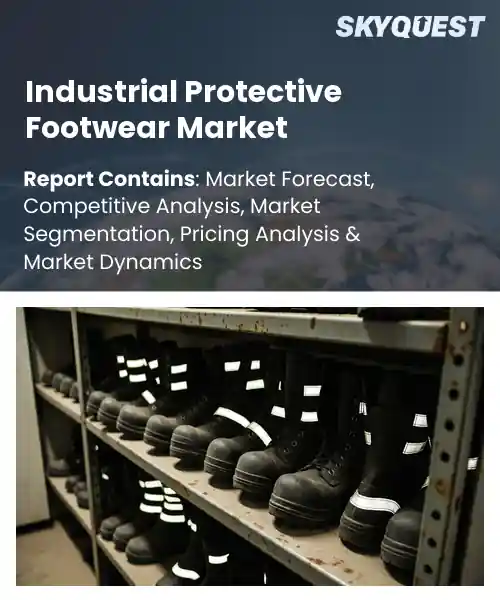
Industrial Protective Footwear Market
Report ID: SQMIG20F2082
Report ID: SQMIG20F2082
[email protected]
USA +1 351-333-4748
Report ID:
SQMIG20F2082 |
Region:
Global |
Published Date: June, 2026
Pages:
157
|Tables:
177
|Figures:
79


Global Industrial Protective Footwear Market size was valued at USD 11.5 Billion in 2024 and is poised to grow from USD 12.31 Billion in 2025 to USD 21.14 Billion by 2033, growing at a CAGR of 7.0% during the forecast period (2026-2033).
The primary driver of the industrial protective footwear market is regulatory and employer-driven workplace safety requirements that mandate protective gear for workers in hazardous environments. As a market, industrial protective footwear encompasses steel-toe boots, composite-toe shoes, puncture-resistant soles and chemical-resistant coatings that reduce injury risk for construction, oil and gas, manufacturing and logistics personnel, and its importance has grown as industrialization and supply chain complexity expanded. Over the past decades the market evolved from heavy, clumsy leather boots to engineered solutions incorporating composite materials, ergonomic design and anti-slip technologies, with examples including ASTM- and EN-compliant steel-toe boots and composite alternatives.Building on evolving standards and material innovations, a key factor driving global market growth is technological advancement in materials and design that directly reduces injury rates while improving worker productivity. When composite toes and anti-slip outsoles replaced heavier steel designs, employers observed fewer musculoskeletal complaints and faster task completion, which encouraged further procurement and set off adoption across construction, logistics and petrochemical sectors. Simultaneously demand for specialized variants such as electrical-hazard-rated boots for utility crews and chemical-resistant footwear for refinery workers creates niche opportunities. These cause increased R&D investment, expansion into emerging markets and development of smart sustainable footwear solutions.
How is AI improving safety in the industrial protective footwear market?
AI is improving safety in the industrial protective footwear market by combining sensor technology with machine learning to address fit, hazard detection, and behavior driven prevention. Key aspects include intelligent sensors for slip and impact detection, models that learn gait and fatigue patterns, and data driven fit optimization that reduces pressure points and trip risk. The current state shows pilots and early products that connect footwear to broader safety platforms so site managers can act on leading indicators rather than react to incidents. This shift makes protective boots not only barriers but proactive safety tools and supports wider adoption across high risk industries.Red Wing April 2026, the IronFlex work boot was launched using millions of foot scans and data informed design, showing how AI enabled fit and analytics can boost worker comfort and reduce injury risk while improving product acceptance and supply chain efficiency.
Market snapshot - (2026-2033)
Global Market Size
USD 11.5 Billion
Largest Segment
Safety Shoes
Fastest Growth
Safety Boots
Growth Rate
7.0% CAGR
To get more insights on this market click here to Request a Free Sample Report
Global industrial protective footwear market is segmented by product type, protection type, material, application, end-user, distribution channel and region. Based on product type, the market is segmented into Safety Shoes, Safety Boots, Gumboots and Clogs & Others. Based on protection type, the market is segmented into Steel Toe, Composite Toe, Alloy Toe and Metatarsal Protection. Based on material, the market is segmented into Leather, Rubber, PVC and Polyurethane. Based on application, the market is segmented into Construction, Manufacturing, Oil & Gas, Chemicals, Mining and Food Processing. Based on end-user, the market is segmented into Industrial Workers, Commercial Users and Government & Defense. Based on distribution channel, the market is segmented into Direct Sales, Distributors and Online. Based on region, the market is segmented into North America, Europe, Asia Pacific, Latin America and Middle East & Africa.
Steel Toe segment dominates because its long established protection profile aligns with industrial hazard typologies and regulatory frameworks, fostering buyer trust and procurement preferences. Proven puncture and impact resistance combined with robust manufacturing supply chains make steel toe footwear a default specification for safety managers. Manufacturers favor steel toe designs for cost efficient production, easy standardization, and straightforward certification processes, which reinforces stocking, specification in tender documents, and sustained demand across heavy industries.
However, composite toe is witnessing the strongest growth momentum as manufacturers introduce lighter, non-metallic caps that improve comfort and bypass metal detectors. Growing adoption in ergonomics-focused roles, coupled with material innovation and clearer certification paths, is broadening application scope and creating opportunities for differentiated product lines and new industrial use cases.
Distributors segment leads because established wholesale and safety specialist distributors provide extensive product assortments, technical specification support, and account management that industrial buyers rely on when sourcing protective footwear. Their deep relationships with procurement teams and capacity to handle complex catalogues enable tailored bundles, compliance documentation, and timely replenishment. These capabilities translate into preferred procurement channels for large employers, underpinning consistent order volume and reinforcing manufacturers’ go to market strategies.
However, online is emerging as the fastest growing area as digital platforms streamline procurement with searchable catalogs, specification filters, and direct manufacturer to buyer ordering. Enhanced product transparency, virtual fitting tools, and buyer reviews boost confidence, while marketplaces extend reach to smaller buyers and niche applications, catalyzing faster product adoption and new distribution models.
To get detailed segments analysis, Request a Free Sample Report
Asia Pacific leads due to a confluence of structural strengths that support both demand and supply. A dense concentration of manufacturing hubs and export oriented production creates steady demand for protective footwear across industrial segments. Regional suppliers combine cost competitiveness with capability to scale, while local design and material innovation drive product differentiation. Regulatory emphasis on worker protection in several economies elevates adoption and formal procurement channels. Strong downstream industries such as automotive, electronics, and construction sustain diverse application needs, encouraging technical advancement. Well developed supply chains and proximity to raw material sources reduce lead times and support competitive pricing. Strategic investments by established manufacturers and the emergence of specialized domestic brands further consolidate the region as a dominant market player.
Industrial Protective Footwear Market in Japan is characterized by a focus on quality, precision, and ergonomic design. End users prioritize certified protection, comfort for long shifts, and integration with advanced workplace safety systems. Domestic manufacturers emphasize materials science and production consistency, while collaboration with industry users yields tailored solutions for automotive, electronics, and heavy machinery sectors. Brand reputation and after sales service influence procurement, and buyers often select premium offerings that align with strict workplace safety expectations.
Industrial Protective Footwear Market in South Korea reflects a strong link between industrial modernization and safety adoption. Manufacturers focus on compact, high performance designs suited to electronics assembly, shipbuilding, and heavy manufacturing environments. Rapid product development cycles and close supplier end user relationships promote application specific features such as improved grip and impact protection. Distribution channels combine traditional safety suppliers with industrial procurement teams, fostering steady demand for certified and technologically enhanced footwear solutions.
North America is expanding rapidly due to an interplay of regulatory reinforcement, corporate safety culture, and diversified end market demand. Heightened attention to occupational health drives institutional procurement and supplier consolidation, while industry leaders seek performance driven footwear that reduces workplace incidents and supports employee well being. Innovation in materials, comfort technology, and specialized designs attracts adoption across construction, energy, manufacturing, and logistics. Distribution sophistication and service oriented supply models make it easier for enterprises to source tailored solutions. Collaboration between safety managers, distributors, and manufacturers accelerates development of compliant products. The combination of strong institutional demand, technological advancement, and robust supply networks is pushing rapid expansion and elevating market expectations for quality and performance.
Industrial Protective Footwear Market in United States is shaped by comprehensive occupational safety practices and large scale institutional procurement. Demand spans construction, energy, manufacturing, and logistics, prompting suppliers to offer a wide range of certified and performance oriented options. Emphasis on durability, comfort for extended wear, and integration with PPE programs drives product development. Distribution networks and specialist dealers support customization and fleet replenishment, while end users prioritize proven efficacy and supplier reliability in purchasing decisions.
Industrial Protective Footwear Market in Canada reflects strong alignment with resource driven industries and regional safety requirements. Buyers value footwear that performs in diverse climatic and site conditions, emphasizing insulation, traction, and protective features suitable for extraction and construction sectors. Suppliers adopt a service minded approach, offering technical guidance and local distribution to meet remote site logistics. Procurement tends to favor certified products that address both regulatory and operator comfort considerations, supporting steady demand across industrial segments.
Europe is reinforcing its role through a combination of regulatory harmonization, innovation focused on sustainability and ergonomics, and a mature industrial ecosystem that demands high performance solutions. Manufacturers emphasize compliance with stringent standards while investing in eco conscious materials and production methods that resonate with corporate responsibility objectives. Strong engineering capabilities support development of technically sophisticated footwear for varied sectors including manufacturing, transport, and construction. Consolidation among suppliers and strengthened distribution networks improve market reach and customer service. Cross border collaboration on testing and certification enhances trust in product claims, while design orientation and premium positioning help European producers compete on quality and specialization.
Industrial Protective Footwear Market in Germany is driven by precision engineering and close ties to heavy industry and automotive manufacturing. Buyers prioritize robust construction, certified protection levels, and integration with industrial safety regimes. Local producers leverage material innovation and stringent quality control to meet demanding application needs. Procurement decisions reflect a preference for durable, performance oriented footwear that supports long service life and aligns with corporate safety management practices.
Industrial Protective Footwear Market in United Kingdom benefits from a strong focus on workplace safety compliance and supplier responsiveness. Demand arises from construction, utilities, and logistics sectors that require versatile protective solutions. Suppliers offer a balance of comfort, protective performance, and rapid distribution to support project driven procurement cycles. Market dynamics favor vendors who can provide technical support, fit management, and effective replacement strategies to maintain workforce protection.
Industrial Protective Footwear Market in France emphasizes ergonomic design, comfort, and regulatory compliance aligned with varied industrial applications. Demand is influenced by manufacturing, infrastructure, and service industries where operator comfort and safety are both procurement priorities. Local suppliers combine design sensibilities with functional performance, and partnerships with occupational safety stakeholders promote adoption of certified solutions. Emphasis on product quality and supplier service supports a market oriented toward reliable, user focused footwear offerings.
To know more about the market opportunities by region and country, click here to
Buy The Complete Report
Enhanced Workplace Safety Regulations
Technological Advancements In Materials
High Cost Of Advanced Footwear
Limited Awareness In Small Employers
Request Free Customization of this report to help us to meet your business objectives.
Competitive landscape in the global industrial protective footwear market is driven by active M&A, strategic investments, and supplier partnerships that secure materials and aftermarket services. Incumbents and challengers pursue concrete moves such as minority stakes in sustainable materials firms and alliances with sensor technology developers to add hazard detection and wear monitoring to boots. Real brand scaling also occurs through accelerated wholesale rollouts and executive hires.
Top Player’s Company Profile
Recent Developments
SkyQuest’s ABIRAW (Advanced Business Intelligence, Research & Analysis Wing) is our Business Information Services team that Collects, Collates, Correlates, and Analyses the Data collected by means of Primary Exploratory Research backed by robust Secondary Desk research. As per SkyQuest analysis, the global industrial protective footwear market is being propelled primarily by regulatory and employer-driven workplace safety requirements that mandate certified protective gear, while growth is tempered by the high cost of advanced footwear which limits adoption among price-sensitive buyers. Asia Pacific remains the dominant region due to its manufacturing base, cost-competitive supply chains and strong downstream demand, and the steel toe segment leads the product mix because of established protection profiles and procurement preferences. A secondary driver is rapid material and design innovation, including lighter composite components and smart sensor integration, which is expanding use cases and encouraging premium, performance-focused procurement.
| Report Metric | Details |
|---|---|
| Market size value in 2024 | USD 11.5 Billion |
| Market size value in 2033 | USD 21.14 Billion |
| Growth Rate | 7.0% |
| Base year | 2024 |
| Forecast period | (2026-2033) |
| Forecast Unit (Value) | USD Billion |
| Segments covered |
|
| Regions covered | North America (US, Canada), Europe (Germany, France, United Kingdom, Italy, Spain, Rest of Europe), Asia Pacific (China, India, Japan, Rest of Asia-Pacific), Latin America (Brazil, Rest of Latin America), Middle East & Africa (South Africa, GCC Countries, Rest of MEA) |
| Companies covered |
|
| Customization scope | Free report customization with purchase. Customization includes:-
|
To get a free trial access to our platform which is a one stop solution for all your data requirements for quicker decision making. This platform allows you to compare markets, competitors who are prominent in the market, and mega trends that are influencing the dynamics in the market. Also, get access to detailed SkyQuest exclusive matrix.
Table Of Content
Executive Summary
Market overview
Parent Market Analysis
Market overview
Market size
KEY MARKET INSIGHTS
COVID IMPACT
MARKET DYNAMICS & OUTLOOK
Market Size by Region
KEY COMPANY PROFILES
Methodology
For the Industrial Protective Footwear Market, our research methodology involved a mixture of primary and secondary data sources. Key steps involved in the research process are listed below:
1. Information Procurement: This stage involved the procurement of Market data or related information via primary and secondary sources. The various secondary sources used included various company websites, annual reports, trade databases, and paid databases such as Hoover's, Bloomberg Business, Factiva, and Avention. Our team did 45 primary interactions Globally which included several stakeholders such as manufacturers, customers, key opinion leaders, etc. Overall, information procurement was one of the most extensive stages in our research process.
2. Information Analysis: This step involved triangulation of data through bottom-up and top-down approaches to estimate and validate the total size and future estimate of the Industrial Protective Footwear Market.
3. Report Formulation: The final step entailed the placement of data points in appropriate Market spaces in an attempt to deduce viable conclusions.
4. Validation & Publishing: Validation is the most important step in the process. Validation & re-validation via an intricately designed process helped us finalize data points to be used for final calculations. The final Market estimates and forecasts were then aligned and sent to our panel of industry experts for validation of data. Once the validation was done the report was sent to our Quality Assurance team to ensure adherence to style guides, consistency & design.
Analyst Support
Customization Options
With the given market data, our dedicated team of analysts can offer you the following customization options are available for the Industrial Protective Footwear Market:
Product Analysis: Product matrix, which offers a detailed comparison of the product portfolio of companies.
Regional Analysis: Further analysis of the Industrial Protective Footwear Market for additional countries.
Competitive Analysis: Detailed analysis and profiling of additional Market players & comparative analysis of competitive products.
Go to Market Strategy: Find the high-growth channels to invest your marketing efforts and increase your customer base.
Innovation Mapping: Identify racial solutions and innovation, connected to deep ecosystems of innovators, start-ups, academics, and strategic partners.
Category Intelligence: Customized intelligence that is relevant to their supply Markets will enable them to make smarter sourcing decisions and improve their category management.
Public Company Transcript Analysis: To improve the investment performance by generating new alpha and making better-informed decisions.
Social Media Listening: To analyze the conversations and trends happening not just around your brand, but around your industry as a whole, and use those insights to make better Marketing decisions.
REQUEST FOR SAMPLE
 REQUEST FREE CUSTOMIZATION


Want to customize this report? This report can be personalized according to your needs. Our analysts and industry experts will work directly with you to understand your requirements and provide you with customized data in a short amount of time. We offer $1000 worth of FREE customization at the time of purchase.
Feedback From Our Clients


 USA (+1) 351-333-4748

