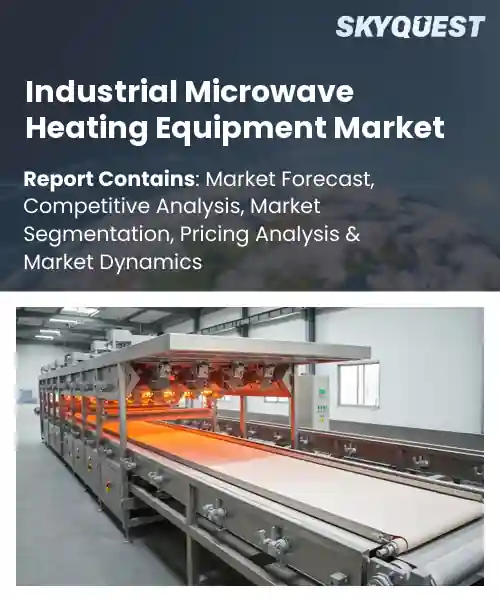
Industrial Microwave Heating Equipment Market
Report ID: SQMIG20I3004
Report ID: SQMIG20I3004
[email protected]
USA +1 351-333-4748
Report ID:
SQMIG20I3004 |
Region:
Global |
Published Date: May, 2026
Pages:
157
|Tables:
119
|Figures:
77


Global Industrial Microwave Heating Equipment Market size was valued at USD 1.82 Billion in 2024 and is poised to grow from USD 1.96 Billion in 2025 to USD 3.52 Billion by 2033, growing at a CAGR of 7.62% during the forecast period (2026-2033).
Factors that will drive industrial microwave heating equipment market growth are the increasing demand for quick, energy-efficient and controllable thermal processing across multiple business sectors. Types of equipment found within the industrial microwave heating market are industrial microwave generators and microwave applicators, which are used to heat, dry, cure or sterilize a variety of materials. Examples of materials that can be processed through industrial microwave heating include food products, chemicals, automotive and aerospace materials. The importance of microwave heating equipment is that it provides manufacturers with reduced cycle time, increased uniformity, reduced energy usage, and reduced facility footprint when compared to traditional heating processes. Additionally, there are many benefits associated with the use of microwave processing technology in terms of costs and sustainability. In addition, over the past several decades, the industrial microwave heating industry has evolved from performing laboratory pilot testing and testing magnetron installations to using microwave heating in production processes by means of fully automated continuous production lines, such as microwave drying tunnels in the food industry and curing composite materials in the aerospace industry.
Another major contributing factor to market growth is the use of solid state microwave sources that have been integrated with controls. Incorporating solid state microwave technology enables more precise control of microwave power output and repeatable steps within a process, which leads to increased application opportunities. While manufacturers are able to develop very uniform heating and closed loop controls using solid state microwave technology, manufacturers are also able to use microwaves in applications such as curing of composite materials in aerospace, sterilizing food, and vulcanizing rubber, all of which is resulting in increased throughput and improved product quality. The increased throughput and improved product quality associated with solid state microwave heating systems are promoting additional capital investment and retrofit service models, which creates new growth opportunities in developing manufacturing centers where energy costs are high and there is an increased demand for higher throughput. Vendors offering modular IoT enabled equipment plus lifecycle support will capture outsized shares of global growth, especially in Asia Pacific.
How is IoT Enabling Predictive Maintenance In The Industrial Microwave Heating Equipment Market?
In industrial microwave heating applications, IoT facilitates predictive maintenance of ovens and generators by enabling them to be seen as autonomously monitored assets. Through use of sensors that provide data on temperature, power reflected, magnetron current, vibration and surrounding environmental conditions, edge analytical processes help eliminate noise in real-time while data is sent to the cloud for machine learning analysis to determine if any abnormality or early drift exists resulting in sending out condition alerts and prompted maintenance events. Additionally, through the use of Digital Twin technologies and historical models, caused-based analysis can be conducted to identify and classify normal variation in process to identify faults.
The continued development of both microwave and connected technologies is driven by end-use market demands for consistent output in the production of food and pharmaceuticals and reduced unplanned maintenance down time in microwave heating installations. An example of this was when Lummus Technology and Resynergi announced the commercial availability of Continuous Microwave Assisted Pyrolysis modules where both Connected Microwave systems could be instrumented for Remote Monitoring. Continuous Microwave Assisted Pyrolysis brings together the use of IoT sensors and analytics leading to Condition Based Maintenance which not only reduces unplanned downtime but also reduces repair times and allows for wider application of industrial microwave solutions.
Market snapshot - (2026-2033)
Global Market Size
USD 1.82 Billion
Largest Segment
Microwave Ovens (Industrial)
Fastest Growth
Microwave Dryers
Growth Rate
7.62% CAGR
To get more insights on this market click here to Request a Free Sample Report
Global industrial microwave heating equipment market is segmented by equipment type, frequency, application, end-use and region. Based on equipment type, the market is segmented into Microwave Ovens (Industrial), Microwave Dryers, Microwave Reactors and Microwave Sterilizers. Based on frequency, the market is segmented into 915 MHz and 2450 MHz. Based on application, the market is segmented into Food Processing, Chemical Processing, Pharmaceutical, Rubber & Plastics and Ceramics & Materials. Based on end-use, the market is segmented into Food & Beverage, Chemical Industry and Pharmaceutical. Based on region, the market is segmented into North America, Europe, Asia Pacific, Latin America and Middle East & Africa.
As per industrial microwave heating equipment market analysis, the Microwave Dryers Segment is growing due to industrial processors' demands for high-speed dry processes that generate consistent moisture removal from products, hence preserving the original product quality. Additionally, this type of process will allow companies to reduce energy usage and drying cycle time. Microwave systems enable continuous flow of products through processors while being able to use a variety of types of done, thus facilitating widespread adoption across food, chemicals, and pharmaceutical processing industries. Because of the gentle volumetric heating performed by microwaves, thermal degradation of materials and finished products is minimized; therefore, overall product yield is more favorable and meets processing standards, leading to the investment of capital and ending up in the existing production lines.
As per industrial microwave heating equipment market forecast, Microwave Reactors have experienced tremendous growth due to the increasing interest in intensifying chemical reactions and using continuous-flow processing to reduce both the amount of solvent used and the rate of reaction. New developments in reactor designs and controls have allowed the use of completely new chemistries and have decreased the development time of a new product, thus attracting drug manufacturers and specialty chemical manufacturers desiring to use intensification techniques and be more sustainable in their production processes.
As per industrial microwave heating equipment market outlook, due to its ability to penetrate deeply into material and provide many layers of heating in bulk and wet environments, with larger batches being created using continuous or batch processing, the 915 MHz frequency band has become dominant for microwave heating applications. Because of this superior performance, fewer hotspots will occur as the result of the uniformity of the provided energy over a large volume of product. This will lead to improved process control for drying, sterilizing, and processing materials. Because of the increasing through-put and predictable processes associated with these microwave heating applications, there has been a corresponding growth in the number of manufacturers and suppliers of industrial microwave heating equipment that provide robust and scalable solutions for a diverse range of industrial applications.
Although the existing 2450 MHz band has experienced steady, slower-than-expected growth as manufacturers and end users have adopted small, higher-energy microwave heating systems for precise surface heating and rapid prototyping, the potential of this frequency range will continue to be explored through new product development and application analysis. With their ability to support small to medium-sized batch processing operations and their ease of integrating with digital controls, the 2450 MHz frequency band’s increasing usage in specialized pharmaceutical and materials applications will also spur the development of new products based on the technology.
To get detailed segments analysis, Request a Free Sample Report
As per industrial microwave heating equipment market regional analysis, manufacturing ecosystems are together, creating a level of concentration that helps make the Asia Pacific region the top supplier of systems for process industries. The region has well-developed supply chains for both electronics and automotive industries and is steadily increasing adoption of microwave technology within food processing and chemicals. The integration of the systems offered by manufacturing systems suppliers (such as microwave ovens) with automation and materials handling is a common practice throughout the region; this is encouraged by well-trained technical employees and a network of local service providers, which reduces friction in system deployment. The regional policy framework and investment priorities support the upgrade of thermal processing equipment and the adoption of energy-efficient technologies and will provide ongoing support for the future purchase and adoption of microwave systems. Equipment manufacturer and university partnerships will help to accelerate the development of microwave applications, demonstrating to end-user decision-makers the end-user value of applying microwave technology in process industries. Proximity to major component suppliers and competitive production costs continue to position the Asia Pacific region as a key area for global suppliers of industrial processing equipment.
The industrial microwave heating equipment sector in Japan is characterized by a strong combination of advanced manufacturing methods and improved automation capabilities, which allows for more specific designs of microwave equipment for electronics, automotive parts, and materials processing. There is a high degree of emphasis by domestic suppliers on dependable, cost-effective equipment with a strong emphasis on design and energy efficiency. This strong supplier emphasis on these values is due in large part to the close working relationship between research organizations and manufacturers. The presence of strong after-sales service networks and system integrators further enhances the use of industrial microwave heating machines in complex production environments. Innovative, specific-use designs that are developed in collaboration with end-user organizations also improve the rate of advancement in innovation and optimization for application use.
The industrial microwave heating equipment industry in South Korea is supported by an intensive presence in the electronics and semiconductor industries that drives demand for precise thermal processing equipment. Local equipment suppliers focus on supplying high-throughput systems, with scalable designs and easy integration into existing operations. Close collaboration with original equipment manufacturers (OEMs) and contract manufacturers helps broaden the use of the machines for various purposes. Emphasis on product quality, low-profile designs, and prompt technical support promotes the use of industrial microwave heating systems by advanced manufacturing and material processing companies.
As per industrial microwave heating equipment market regional outlook, North America's growth is due to extensive industrial modernization, increasing demand for more flexible and energy-efficient thermal processing, and increased use in the food, chemicals, and advanced manufacturing industries. The players in these industries are placing greater emphasis on using modular systems incorporated with process control systems to comply with strict specifications for quality and traceability. Demand is facilitated by having a well-established network of systems integrators and service companies that help with the customisation and implementation of systems for different types of plants. Cooperation between equipment suppliers and their customers is also speeding up the development of application specific equipment, while aftermarket service and training lower operational size barriers. Being close to their primary customers and being productive encourages the adoption of microwave technology and replacement of existing thermal systems, allowing the region's position in the market to become stronger. Regulatory requirements focused on safety and quality assurances also positively contribute to the growth of the market and acceptance of products in the North American market.
The Industrial Microwave Heating Equipment Market in the U.S. is being driven by the many different sectors, such as food, industrial products, and chemicals where microwave heating systems are utilized to provide an alternative heating source. Additionally, the ability to integrate with digital process control systems and traceability is another factor that has been influencing the demand for flexible microwave systems. There is also a fully developed ecosystem of system integrators, microwave heating facility engineers, and after-market microwave heating service providers that facilitate the ability to implement and modify microwave heating technology. Currently, the focus is on improving operational efficiency, safety standards, and promoting collaboration, which has allowed for continued success and technology proliferation in the manufacturing sector.
The Industrial Microwave Heating Equipment Market in Canada has a very solid presence in the food and resource processing industries where efficient thermal heating solutions are needed. Microwave heating suppliers and integrators are continuously developing new ways to utilize microwave heating so that it can be utilized for a variety of use conditions and in a variety of footprint locations. Due to the focus on providing retrofit opportunities, after-sales service support, and developing local service capabilities have made the adoption of microwave heating much more viable to operators. Collaborating with institutions and using their demonstrations to help validate microwave heating performance has also encouraged a much larger level of acceptance for microwave heating throughout the food and manufacturing industries.
Europe is strengthening its market position through focused investment in energy efficient processing, strong collaboration between equipment manufacturers and academic research centers, and emphasis on regulatory compliance and product safety. Regional suppliers differentiate through application engineering, modular system design, and specialized service offerings that address complex process requirements in chemicals, pharmaceuticals, and food sectors. Cross border partnerships and pilot projects enable technology demonstration and accelerate customer confidence. Focus on retrofit solutions and system integration with existing production lines reduces barriers to adoption. Combined with skilled service networks and localized engineering support, these dynamics enhance Europe role as a provider of reliable, standards compliant microwave heating solutions tailored for demanding industrial applications. Emphasis on energy reduction, circular economy principles, and digital monitoring strengthens solution value and aligns with industrial customer priorities.
Industrial Microwave Heating Equipment Market in Germany is anchored by engineering excellence and strong ties to heavy process industries and chemical manufacturers. Suppliers focus on robust, standards compliant systems that integrate with automation platforms and control environments. Application engineering, service agreements, and close cooperation with OEMs enable tailored solutions for demanding processes. Emphasis on safety, reliability, and regulatory conformance supports preference for locally engineered microwave solutions in complex industrial settings.
Industrial Microwave Heating Equipment Market in the United Kingdom is driven by application development in pharmaceuticals, specialty food processing, and advanced materials. Suppliers emphasize flexibility and prototyping to support pilot trials and bespoke process optimization. A network of consultancies and service providers facilitate retrofits and system upgrades within existing plants. Focus on safety standards, quality assurance, and collaborative approaches with end users helps build confidence and adoption across manufacturing operations.
Industrial Microwave Heating Equipment Market in France benefits from strong demand in food processing and cosmetics manufacturing, where thermal uniformity and product quality are priorities. Local suppliers and integrators offer tailored systems that accommodate industrial production scales, supported by service networks. Emphasis on sustainability, efficiency, and compliance with safety protocols encourages consideration of microwave alternatives. Partnerships with technical centers and demonstration projects aid validation and accelerate broader industrial uptake nationally.
To know more about the market opportunities by region and country, click here to
Buy The Complete Report
Rising Demand For Energy Efficiency
Microwave heating’s rapid and direct heat delivery and low energy losses has made it a popular technology amongst manufacturers trying to reduce their operating cost and increase their processing efficiency. By concentrating energy at the point of need and reducing cycle times, microwave systems assist companies in achieving their corporate sustainability objectives and decreasing total energy used in manufacturing their products. The perceived operational savings encourage manufacturers to make capital investments in microwave equipment and encourage the retrofitting of their existing production lines, creating additional demand throughout food processing, chemical, and industrial drying industries that place a high priority on energy efficiency.
Automation and Process Integration
High Initial Capital Costs
High upfront costs required for industrial microwave systems create a barrier to purchase for many buyers, most notably small-to-medium-sized manufacturers with limited budgets. The increased cost creates a greater perception of risk as well as extends the payback period for the buyer’s investment. Because of the cost of equipment and integration, companies tend to favor proven lower-cost conventional heating systems, thus limiting their ability to convert to microwave systems and/or retrofit existing lines. Lengthened procurement cycles will occur because companies will conduct extensive financing options evaluations as well as validate operational benefits prior to making a purchase decision resulting in slower adoption into the market, thereby limiting the long-term operational benefits attributed to the technology by proponents.
Material Compatibility and Performance Limits
Request Free Customization of this report to help us to meet your business objectives.
Competitive landscape in industrial microwave heating is marked by consolidation and technology led partnerships that accelerate commercialization. Strategic M&A moves such as Microwave Techniques acquiring specialized component makers have concentrated capabilities, while university spinouts and solid state innovators push product differentiation. Suppliers now compete through licensing deals, integration partnerships and targeted product innovations, exemplified by LyoWave’s commercial tie up with Millrock Technology and recent component acquisitions in the sector.
SkyQuest’s ABIRAW (Advanced Business Intelligence, Research & Analysis Wing) is our Business Information Services team that Collects, Collates, Correlates, and Analyses the Data collected by means of Primary Exploratory Research backed by robust Secondary Desk research.
As per SkyQuest analysis, the global industrial microwave heating equipment market is propelled primarily by demand for faster, energy efficient and precisely controlled thermal processing across sectors, which shortens cycle times and cuts energy use. Growth is tempered by high initial capital costs that can slow adoption among smaller manufacturers. Asia Pacific leads the market supported by dense manufacturing ecosystems and localized service networks, while microwave dryers dominate due to their rapid, uniform moisture removal and compatibility with continuous lines. A further growth driver is the increasing adoption of solid state sources and IoT enabled controls that deliver finer power modulation, predictive maintenance and reproducible processing recipes, expanding viable industrial applications.
| Report Metric | Details |
|---|---|
| Market size value in 2024 | USD 1.82 Billion |
| Market size value in 2033 | USD 3.52 Billion |
| Growth Rate | 7.62% |
| Base year | 2024 |
| Forecast period | (2026-2033) |
| Forecast Unit (Value) | USD Billion |
| Segments covered |
|
| Regions covered | North America (US, Canada), Europe (Germany, France, United Kingdom, Italy, Spain, Rest of Europe), Asia Pacific (China, India, Japan, Rest of Asia-Pacific), Latin America (Brazil, Rest of Latin America), Middle East & Africa (South Africa, GCC Countries, Rest of MEA) |
| Companies covered |
|
| Customization scope | Free report customization with purchase. Customization includes:-
|
To get a free trial access to our platform which is a one stop solution for all your data requirements for quicker decision making. This platform allows you to compare markets, competitors who are prominent in the market, and mega trends that are influencing the dynamics in the market. Also, get access to detailed SkyQuest exclusive matrix.
Table Of Content
Executive Summary
Market overview
Parent Market Analysis
Market overview
Market size
KEY MARKET INSIGHTS
COVID IMPACT
MARKET DYNAMICS & OUTLOOK
Market Size by Region
KEY COMPANY PROFILES
Methodology
For the Industrial Microwave Heating Equipment Market, our research methodology involved a mixture of primary and secondary data sources. Key steps involved in the research process are listed below:
1. Information Procurement: This stage involved the procurement of Market data or related information via primary and secondary sources. The various secondary sources used included various company websites, annual reports, trade databases, and paid databases such as Hoover's, Bloomberg Business, Factiva, and Avention. Our team did 45 primary interactions Globally which included several stakeholders such as manufacturers, customers, key opinion leaders, etc. Overall, information procurement was one of the most extensive stages in our research process.
2. Information Analysis: This step involved triangulation of data through bottom-up and top-down approaches to estimate and validate the total size and future estimate of the Industrial Microwave Heating Equipment Market.
3. Report Formulation: The final step entailed the placement of data points in appropriate Market spaces in an attempt to deduce viable conclusions.
4. Validation & Publishing: Validation is the most important step in the process. Validation & re-validation via an intricately designed process helped us finalize data points to be used for final calculations. The final Market estimates and forecasts were then aligned and sent to our panel of industry experts for validation of data. Once the validation was done the report was sent to our Quality Assurance team to ensure adherence to style guides, consistency & design.
Analyst Support
Customization Options
With the given market data, our dedicated team of analysts can offer you the following customization options are available for the Industrial Microwave Heating Equipment Market:
Product Analysis: Product matrix, which offers a detailed comparison of the product portfolio of companies.
Regional Analysis: Further analysis of the Industrial Microwave Heating Equipment Market for additional countries.
Competitive Analysis: Detailed analysis and profiling of additional Market players & comparative analysis of competitive products.
Go to Market Strategy: Find the high-growth channels to invest your marketing efforts and increase your customer base.
Innovation Mapping: Identify racial solutions and innovation, connected to deep ecosystems of innovators, start-ups, academics, and strategic partners.
Category Intelligence: Customized intelligence that is relevant to their supply Markets will enable them to make smarter sourcing decisions and improve their category management.
Public Company Transcript Analysis: To improve the investment performance by generating new alpha and making better-informed decisions.
Social Media Listening: To analyze the conversations and trends happening not just around your brand, but around your industry as a whole, and use those insights to make better Marketing decisions.
REQUEST FOR SAMPLE
 REQUEST FREE CUSTOMIZATION
Global Industrial Microwave Heating Equipment Market size was valued at USD 1.82 Billion in 2024 and is poised to grow from USD 1.96 Billion in 2025 to USD 3.52 Billion by 2033, growing at a CAGR of 7.62% during the forecast period (2026-2033).
Competitive landscape in industrial microwave heating is marked by consolidation and technology led partnerships that accelerate commercialization. Strategic M&A moves such as Microwave Techniques acquiring specialized component makers have concentrated capabilities, while university spinouts and solid state innovators push product differentiation. Suppliers now compete through licensing deals, integration partnerships and targeted product innovations, exemplified by LyoWave’s commercial tie up with Millrock Technology and recent component acquisitions in the sector. 'Püschner GmbH', 'Sairem SAS', 'Industrial Microwave Systems (IMS)', 'Muegge GmbH', 'AMTek Microwaves', 'Linn High Therm GmbH', 'MAX Industrial Microwave', 'Thermex Thermatron', 'Advanced Energy Industries', 'Microwave Research & Applications', 'CEM Corporation', 'Anton Paar', 'Milestone srl', 'ITECA Socadei', 'Microwave Power Technology', 'Fricke und Mallah Microwave Technology', 'Enovatia', 'Stalam SpA', 'HeatWave Technologies', 'C-Tech Innovation'
Microwave heating’s ability to deliver rapid, selective heating with reduced energy loss drives adoption by manufacturers seeking lower operational costs and improved process efficiency. By concentrating energy where needed and shortening cycle times, these systems help companies meet corporate sustainability goals and reduce overall energy consumption in production. The perceived operational savings encourage capital investment in microwave equipment and promote retrofitting of existing lines, stimulating demand across food processing, chemicals, and industrial drying applications where energy efficiency is a high priority.
Sustainable Manufacturing Adoption: Manufacturers increasingly prioritize sustainable microwave heating solutions to reduce energy consumption and align with environmental goals. Demand is driven by interest in lower operational footprints, improved resource efficiency, and compliance with evolving sustainability standards. Suppliers respond with energy optimized designs, recyclable materials, and integration with heat recovery systems. Stakeholders emphasize lifecycle considerations and supplier transparency, while end users seek equipment that supports green certification and strengthens brand reputation. It encourages collaborations emphasizing improvement and transparent performance to reduce environmental impact.
Why does Asia Pacific Dominate the Global Industrial Microwave Heating Equipment Market? |@12


Want to customize this report? This report can be personalized according to your needs. Our analysts and industry experts will work directly with you to understand your requirements and provide you with customized data in a short amount of time. We offer $1000 worth of FREE customization at the time of purchase.
Feedback From Our Clients


 USA (+1) 351-333-4748

