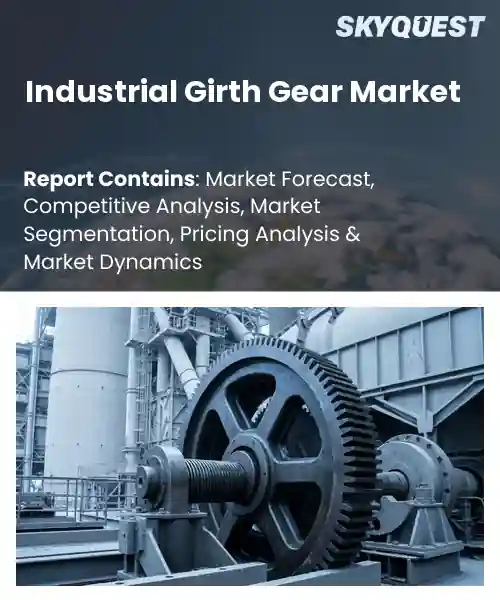
Industrial Girth Gear Market
Report ID: SQMIG20I3257
Report ID: SQMIG20I3257
[email protected]
USA +1 351-333-4748
Report ID:
SQMIG20I3257 |
Region:
Global |
Published Date: July, 2026
Pages:
157
|Tables:
146
|Figures:
78


Global Industrial Girth Gear Market size was valued at USD 1.18 Billion in 2024 and is poised to grow from USD 1.23 Billion in 2025 to USD 1.65 Billion by 2033, growing at a CAGR of 3.82% during the forecast period (2026-2033).
The industrial girth gear market has a mix of manufacturers plus suppliers that make gears for moving torque in conveyors, crushers, and other handling setups. What stands out is that these gears can take heavy loads without the overall size getting out of spec. That matters a lot for mining, cement, and steel plants, where there isn’t much room but downtime still has to stay low, like reliability is non-negotiable.
Right now, the energy sector is pulling demand along, which is why the industrial girth gear market growth has momentum. Wind‑turbine gearboxes and solar‑farm tracking systems need torque transmission that can cope with harsh conditions. And as governments push more wind capacity, turbine makers are increasingly swapping to welded girth gears instead of helical designs. The result can reach as much as 12% less mass, plus longer service intervals, which then trims the operational costs in a practical way. At the same time, the rise of recycling facilities is driving the use of duty crushers, and they lean on the same gear structure for steady work. All of this nudges investment into manufacturing steps like welding, and it opens opportunities for suppliers who can provide corrosion‑resistant offerings, helping them expand market presence in different regional economies.
IoT is getting built into the girth gear housings so sensors can watch vibration, temperature ,and torque or load conditions in real time. That steady data feed gets sent into machine‑learning models that spot unusual patterns early, before a component fully fails. So maintenance teams can step in during planned stops instead of reacting after something breaks. In the end this cuts unexpected outages, stretches overall gear life and reduces how many spare parts sit idle in inventory. Operators also get a wider picture across an entire fleet, and they can adjust lubrication routines more precisely while also tightening energy use. When manufacturers roll out cloud based dashboards, the insights spread across multiple sites, and it supports more proactive decisions that line up with broader production targets.
Market snapshot - (2026-2033)
Global Market Size
USD 1.18 Billion
Largest Segment
Fastest Growth
Growth Rate
3.82% CAGR
To get more insights on this market click here to Request a Free Sample Report
The global industrial girth gear market is segmented by design configuration, material base, manufacturing process, machinery application, end-use industry and region. Based on design configuration, the market is segmented into Split Girth Gears. Based on material base, the market is segmented into Cast Steel, Forged Steel and Ductile Iron. Based on manufacturing process, the market is segmented into Cast Girth Gears and Fabricated Girth Gears. Based on machinery application, the market is segmented into Rotary Kilns, Rotary Dryers, Ball Mills, Rod Mills, SAG Mills and Crushers. Based on end-use industry, the market is segmented into Cement Production, Mining Processing, Chemical Processing, Power Generation and Others. Based on region, the market is segmented into North America, Europe, Asia Pacific, Latin America and Middle East & Africa.
As per the industrial girth gear market analysis, the Forged steel segment leads mostly because it has this superior tensile strength and fatigue resistance thing, which lets girth gear sets last longer between overhauls ,so there’s less maintenance downtime for heavy duty work. The people making these parts like forging as well, since it helps keep grain flow consistent , and that ends up meaning more dependable torque transfer when conditions get harsh. So the whole “stay running” priority customers usually want, clicks with that, and then original equipment makers start specifying forged steel as the go to material across a bunch of different industrial setups.
Meanwhile, the ductile iron segment shows up as the fastest growing, since its built in damping characteristics lower the vibration levels in gear assemblies, and that’s what a lot of operators ask for when they want quieter motion. Casting technology improvements have also raised the toughness level ,so it’s more usable in medium load situations too. This upward trend opens more design options and pushes market diversification further along.
According to the industrial girth gear market forecast, the Rotary kilns application tends to dominate because continuous processing matches the high throughput expectations in cement clinker production, where girth gears still have to handle steady torque while things are abrasive. The cylindrical shape also helps with fairly uniform heat distribution ,so it offers fewer thermal gradients that could threaten gear integrity. OEMs tend to focus on that reliability, which is why rotary kilns are integrated broadly into plant layouts, and they keep reinforcing their position as the machinery choice plants keep coming back to.
On the other hand, the ball mills segment is seeing the strongest growth momentum, since manufacturers are leaning into high speed grinding solutions to boost ore liberation rates, and this then drives demand for precision girth gears that can manage shifting loading patterns. When advanced monitoring systems get integrated ,they help gear performance stay stable, and that makes the whole investment conversation easier, so more mining facilities extend their usage. This chain effect also pushes the overall market expansion forward, bit by bit.
To get detailed segments analysis, Request a Free Sample Report
As per the industrial girth gear market regional forecast, Asia Pacific leads the market through a messy mix of advanced manufacturing know-how, plenty of engineering talent, and a deep, almost seamless, integration of supply chains that help produce high-performance gear sets. The region seems to lean hard on research and development too, so materials and design keep getting tweaked, improved, refreshed. Labor costs are generally competitive, and the workforce stays skilled, which makes large-scale output more efficient while quality standards still get respected. Also, being close to key automotive, heavy machinery, and renewable energy ecosystems keeps demand steady, and then strategic investments in automation plus digital manufacturing push productivity, and even responsiveness. Industry clusters, plus some government backing for advanced manufacturing, reinforce the leadership story, and so Asia Pacific ends up acting like the main hub for industrial girth gear excellence.
Japan Industrial Girth Gear Market
In Japan, the industrial girth gear sector grows on a legacy of precision engineering, but also on a clear preference for high-value applications like robotics and automotive. Domestic demand stays robust, and there’s this culture of continuous improvement that goes hand in hand with strict quality control. That combination encourages customers to adopt more sophisticated gear solutions. Meanwhile, strong manufacturer–research institution partnerships support new lightweight and high-strength material pathways, so Japan remains at the front of technology-led gear systems.
South Korea Industrial Girth Gear Market
The South Korean industrial girth gear industry is pushed forward by a fast-moving manufacturing environment that values speed, efficiency, and the integration of smart tech. Big investments in automation and digital twins help teams build rapid prototypes, and also tailor designs to different industry requirements. The country’s export focus, together with attention on heavy-duty equipment, expands market reach. And collaboration between large conglomerates and specialized suppliers helps with better material development, plus process optimization that actually sticks.
North America’s rapid industrial girth gear market penetration looks tied to stronger demand across automotive, construction, and renewable energy, each one wanting power transmission that feels reliable, and durable in real use. Sustainability and energy efficiency goals are also steering adoption toward lightweight, high-performance girth gears that lower system losses. Then, modernization efforts in manufacturing infrastructure encourage firms to pull in advanced materials and precision engineering practices. There are also collaborative ecosystems, involving OEMs, tier-one suppliers, and research institutions, and those relationships speed up technology transfer and product innovation. On top of that, there’s a growing emphasis on resilience and supply-chain diversification, which supports more domestic production capabilities and helps position the region as a place for cutting-edge gear technologies that match evolving industrial requirements.
United States Industrial Girth Gear Market
The United States industrial girth gear market benefits from a wide industrial base, including automotive, aerospace, and heavy equipment production. Engineering excellence is emphasized a lot, and rigorous testing standards push adoption of high-performance gears. Companies invest in advanced manufacturing methods, like additive manufacturing and high-speed machining, which makes it easier to develop customized solutions quickly. OEMs working closely with specialized gear producers also keeps driving continual improvements in durability and efficiency, so the U.S. stays competitive and visible in this market.
Canada Industrial Girth Gear Market
The Canadian industrial girth gear market outlook is shaped by a diversified economy covering natural resources, forestry, and renewable energy projects. The market leans on a reputation for reliability, and on strict quality compliance, which matters because equipment often operates in tough environments. Increased focus on sustainable infrastructure, and clean-technology initiatives, is boosting demand for efficient power transmission components. Plus, joint research programs between universities and industry partners support innovative gear design work, tuned to Canadian market needs, even when conditions are demanding.
Europe is enhancing its industrial girth gear market share by leaning hard into high-precision engineering, tight regulatory expectations, and a real commitment to sustainability across many industrial areas. Big automotive players and heavy-machinery producers keep pushing demand for durable, lighter gears, designed so they run more efficiently and help lower emissions. And because the region is so deeply tied into materials science plus digital production know-how, it can turn out more sophisticated gear designs that satisfy very strict performance rules, all the way from load behavior to long-term wear. Also, the collaboration style there, research centers, specialist suppliers, and OEMs working side by side, helps innovation move in faster cycles. On top of that, Europe’s push toward circular-economy practices nudges makers to design gear parts that are recyclable, which further supports its reputation as a benchmark hub for environmentally responsible industrial tech.
Germany Industrial Girth Gear Market
In Germany, the industrial girth gear market is anchored in world-class engineering capability and a long-running tradition of precision manufacturing, so it feels steady rather than rushed. The market supports a dense group of automotive and industrial machinery producers, many of whom care most about dependability and output consistency. Ongoing spending on R&D keeps driving improvements in alloy formulations and more refined heat treatment methods, which basically translates into better gear life. There’s also close day-to-day cooperation between manufacturers and technical universities, and that helps speed up the rollout of modern gear geometries suited for tough, high-demand use cases.
United Kingdom Industrial Girth Gear Market
The United Kingdom’s industrial girth gear market benefits from a lively ecosystem that mixes older manufacturing strength with newer digital approaches, sometimes in a surprisingly smooth way. There’s noticeable focus on innovation using lightweight materials, plus additive manufacturing, so companies can build custom gear solutions for aerospace, marine, and renewable energy applications. Strong connections between universities, research institutes, and industry partners help knowledge move quickly, and that encourages faster adoption of next-generation gear technologies that improve both efficiency and operational reliability. In practice, it’s like they iterate faster because the feedback loops are tighter.
France Industrial Girth Gear Market
France’s industrial girth gear market is shaped by a diversified industrial environment spanning automotive, rail systems, and energy infrastructure. A strong commitment to quality standards plus rigorous testing makes sure gear solutions can meet demanding performance expectations, even when conditions get harsh. Collaboration among major engineering firms and specialized materials experts supports progress in advanced composites and coating methods. That blend of innovation and quality is why France continues to show up as an important contributor within the broader European industrial girth gear ecosystem.
To know more about the market opportunities by region and country, click here to
Buy The Complete Report
Rising Industrial Automation is Expanding Demand
Advanced Materials are Enhancing Gear Performance
Raw Material Costs are Limiting Adoption
Stringent Environmental Regulations are Slowing Production
Request Free Customization of this report to help us to meet your business objectives.
The competitive terrain in the Global Industrial Girth Gear Market is influenced by established names like David Brown Santasalo, SEW‑Eurodrive, CMD Gears, and Van Der Wegen, who are clearly chasing tech upgrades via advanced gear‑design platforms, plus they form partnerships to broaden the range of products. On top of that, some of them do selective M&A , to tighten their market grip and speed up the move into fresh regional markets.
Top Player’s Company Profile
Recent Developments in the Industrial Girth Gear Market
SkyQuest’s ABIRAW (Advanced Business Intelligence, Research & Analysis Wing) is our Business Information Services team that Collects, Collates, Correlates, and Analyses the Data collected by means of Primary Exploratory Research backed by robust Secondary Desk research.
As per SkyQuest analysis, the global industrial girth gear market is being driven mainly by rising industrial automation, which is creating continuous demand for compact, high torque transmission solutions for cement, mining and renewable energy equipment. A second trigger is the quick progress of high strength alloys , plus composite materials, that raise load capacity and improve wear resistance, so gear life stretches out and new applications show up. Still, higher raw material prices act like a brake, because margins get squeezed, and some buyers start looking for cheaper alternatives. Asia Pacific currently dominates, mainly due to its advanced manufacturing capacity and its closeness to major end users. Meanwhile, split girth gears stay the leading segment, taking the largest portion of installations.
| Report Metric | Details |
|---|---|
| Market size value in 2024 | USD 1.18 Billion |
| Market size value in 2033 | USD 1.65 Billion |
| Growth Rate | 3.82% |
| Base year | 2024 |
| Forecast period | (2026-2033) |
| Forecast Unit (Value) | USD Billion |
| Segments covered |
|
| Regions covered | North America (US, Canada), Europe (Germany, France, United Kingdom, Italy, Spain, Rest of Europe), Asia Pacific (China, India, Japan, Rest of Asia-Pacific), Latin America (Brazil, Rest of Latin America), Middle East & Africa (South Africa, GCC Countries, Rest of MEA) |
| Companies covered |
|
| Customization scope | Free report customization with purchase. Customization includes:-
|
To get a free trial access to our platform which is a one stop solution for all your data requirements for quicker decision making. This platform allows you to compare markets, competitors who are prominent in the market, and mega trends that are influencing the dynamics in the market. Also, get access to detailed SkyQuest exclusive matrix.
Table Of Content
Executive Summary
Market overview
Parent Market Analysis
Market overview
Market size
KEY MARKET INSIGHTS
COVID IMPACT
MARKET DYNAMICS & OUTLOOK
Market Size by Region
KEY COMPANY PROFILES
Methodology
For the Industrial Girth Gear Market, our research methodology involved a mixture of primary and secondary data sources. Key steps involved in the research process are listed below:
1. Information Procurement: This stage involved the procurement of Market data or related information via primary and secondary sources. The various secondary sources used included various company websites, annual reports, trade databases, and paid databases such as Hoover's, Bloomberg Business, Factiva, and Avention. Our team did 45 primary interactions Globally which included several stakeholders such as manufacturers, customers, key opinion leaders, etc. Overall, information procurement was one of the most extensive stages in our research process.
2. Information Analysis: This step involved triangulation of data through bottom-up and top-down approaches to estimate and validate the total size and future estimate of the Industrial Girth Gear Market.
3. Report Formulation: The final step entailed the placement of data points in appropriate Market spaces in an attempt to deduce viable conclusions.
4. Validation & Publishing: Validation is the most important step in the process. Validation & re-validation via an intricately designed process helped us finalize data points to be used for final calculations. The final Market estimates and forecasts were then aligned and sent to our panel of industry experts for validation of data. Once the validation was done the report was sent to our Quality Assurance team to ensure adherence to style guides, consistency & design.
Analyst Support
Customization Options
With the given market data, our dedicated team of analysts can offer you the following customization options are available for the Industrial Girth Gear Market:
Product Analysis: Product matrix, which offers a detailed comparison of the product portfolio of companies.
Regional Analysis: Further analysis of the Industrial Girth Gear Market for additional countries.
Competitive Analysis: Detailed analysis and profiling of additional Market players & comparative analysis of competitive products.
Go to Market Strategy: Find the high-growth channels to invest your marketing efforts and increase your customer base.
Innovation Mapping: Identify racial solutions and innovation, connected to deep ecosystems of innovators, start-ups, academics, and strategic partners.
Category Intelligence: Customized intelligence that is relevant to their supply Markets will enable them to make smarter sourcing decisions and improve their category management.
Public Company Transcript Analysis: To improve the investment performance by generating new alpha and making better-informed decisions.
Social Media Listening: To analyze the conversations and trends happening not just around your brand, but around your industry as a whole, and use those insights to make better Marketing decisions.
REQUEST FOR SAMPLE
 REQUEST FREE CUSTOMIZATION
Global Industrial Girth Gear Market size was valued at USD 1.18 Billion in 2024 and is poised to grow from USD 1.23 Billion in 2025 to USD 1.65 Billion by 2033, growing at a CAGR of 3.82% during the forecast period (2026-2033).
The competitive landscape of the Global Industrial Girth Gear Market is shaped by established manufacturers such as David Brown Santasalo, SEW‑Eurodrive, CMD Gears and Van Der Wegen, which are actively pursuing technology innovation through advanced gear‑design platforms and forming strategic partnerships to expand product portfolios, while also engaging in selective M&A to consolidate market share and accelerate entry into emerging geographic regions. 'FLSmidth A/S', 'Thyssenkrupp AG', 'Siemens Energy AG', 'SEW-EURODRIVE GmbH & Co KG', 'David Brown Santasalo', 'FCMD SA', 'Hofmann Engineering Pty Ltd', 'CMD Gears', 'Pekrun Getriebebau GmbH', 'Wikov Industry a.s.', 'Indian Premium Gears', 'Gears and Gear Drives India Pvt Ltd', 'Aero Gearbox International', 'Horsburgh & Scott', 'Brad Foote Gear Works, Inc.', 'Chongqing Gearbox Co., Ltd.', 'NGC Gears', 'Kobe Steel, Ltd.', 'Ishibashi Manufacturing Co., Ltd.', 'GearTek'
The shift toward greater automation in manufacturing, logistics, and material handling creates a continuous demand for reliable power transmission components, and girth gears provide the necessary torque capacity and compact design to integrate seamlessly with automated equipment. As factories adopt robotic cells and conveyor systems, the requirement for durable, low‑maintenance gear solutions rises, prompting manufacturers to prefer industrial girth gears that support higher productivity while reducing downtime and simplifying maintenance procedures. These advantages drive manufacturers to increasingly specify girth gears in new automation projects.
Smart Automation Integration: Manufacturers are embedding advanced sensor networks and AI-driven control systems into girth gear assemblies, enabling real‑time condition monitoring, predictive maintenance, and dynamic torque adjustments. This digital overlay enhances equipment reliability, reduces unplanned downtime, and supports seamless integration with Industry 4.0 production platforms. As suppliers standardize open communication protocols, end users gain greater visibility across the supply chain, accelerating adoption of smart gear solutions in high‑precision sectors like aerospace and renewable energy and contributing to overall operational excellence across global manufacturing networks.
Why does Asia Pacific Dominate the Global Industrial Girth Gear Market? |@12


Want to customize this report? This report can be personalized according to your needs. Our analysts and industry experts will work directly with you to understand your requirements and provide you with customized data in a short amount of time. We offer $1000 worth of FREE customization at the time of purchase.
Feedback From Our Clients


 USA (+1) 351-333-4748

