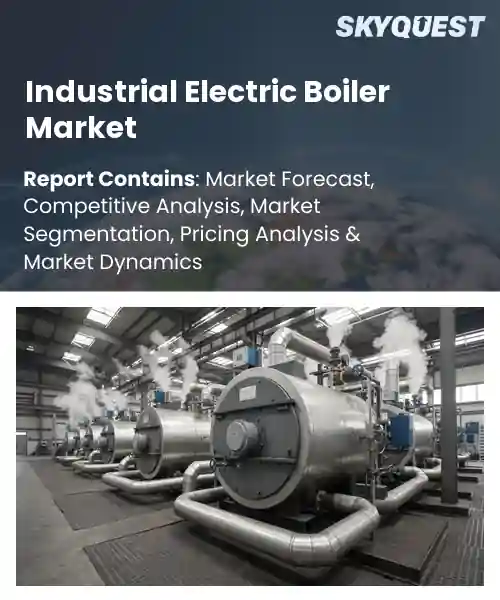
Industrial Electric Boiler Market
Report ID: SQMIG20B2168
Report ID: SQMIG20B2168
[email protected]
USA +1 351-333-4748
Report ID:
SQMIG20B2168 |
Region:
Global |
Published Date: June, 2026
Pages:
157
|Tables:
93
|Figures:
76


Global Industrial Electric Boiler Market size was valued at USD 16.55 Billion in 2024 and is poised to grow from USD 17.15 Billion in 2025 to USD 22.75 Billion by 2033, growing at a CAGR of 3.6% during the forecast period (2026-2033).
The industrial electric boiler industry comprises electrically driven steam and hot water systems deployed across manufacturing facilities, and its primary driver is the accelerating global imperative to decarbonize industrial heat. Industry historically relied on coal and gas boilers, but rising renewable electricity and stricter emissions rules have shifted investment toward electric alternatives. For example, food processors in Europe and chemical plants in East Asia are replacing fossil boilers to meet compliance targets and reduce local pollution. Industrial electric boiler market is significant because they provide precise control, compact footprints and lower maintenance burdens that facilitate integration with building energy management and renewable supplies.
A decisive factor shaping the global industrial electric boiler market is the availability and carbon intensity of electricity, because cheap increasingly low-carbon power converts electric heating into a credible decarbonization pathway for industry. As wind and solar capacity expand and storage flattens price volatility, plants can run electric boilers during low-price periods and couple them with thermal storage to shift consumption, which reduces operating costs and smooths grid demand. Policy levers such as emissions trading, clean heat mandates and investment subsidies drive adoption by altering project economics, while manufacturers see retrofit and modular factory opportunities requiring smaller, flexible heat sources.
How is AI enabling predictive maintenance in industrial electric boiler systems?
AI is reshaping predictive maintenance for industrial electric boiler systems by turning continuous sensor readings into actionable insights. Major components of this new approach are real time monitoring of flow temperature, electrical signatures, machine learning models that identify anomalies and predict component degradation and digital twin simulations used to evaluate repair method options. Operators in the current market are electrifying their process heating and are looking to achieve maximum up time and minimum operating cost therefore AI based condition monitoring allows operators to replace rigid schedule based maintenance with condition based; meaning when conditions warrant maintenance. Some examples include the early identification of element hotspots, predicting pump or valve failures and optimizing heating cycles to maximize asset life and reliability of production.
In February 2026, Honeywell introduced a hybrid heating solution that incorporated predictive diagnostics and remote monitoring using AI for industrial process heating. This new solution will help electric boiler operators avoid unscheduled outages as well as improve their operating efficiency by providing action oriented maintenance notifications and enabling the use of condition-based servicing; thereby accelerating the adoption of electrification within the market.
Market snapshot - (2026-2033)
Global Market Size
USD 16.55 Billion
Largest Segment
Electrode Boilers
Fastest Growth
Electrode Boilers
Growth Rate
3.6% CAGR
To get more insights on this market click here to Request a Free Sample Report
Global industrial electric boiler market is segmented by boiler type, voltage, application and region. Based on boiler type, the market is segmented into Resistance Boilers, Electrode Boilers and Others. Based on voltage, the market is segmented into Low Voltage, Medium Voltage, High Voltage and Others. Based on application, the market is segmented into Chemicals and Petrochemicals, Food and Beverages, Pharmaceuticals, Paper and Pulp and Others. Based on region, the market is segmented into North America, Europe, Asia Pacific, Latin America and Middle East & Africa.
Electrode boilers segment dominates with large global industrial electric boiler market share because it directly converts electrical energy into steam through conductive heating, delivering rapid start up and near-instant load response that align with industrial process needs. Their compact footprint and simpler heat transfer design reduce auxiliary equipment and maintenance complexity, making them attractive for plants seeking predictable operating costs and tight temperature control. These technical traits drive adoption where continuous steam reliability and grid-electrified decarbonization objectives intersect.
As per global industrial electric boiler market outlook, resistance boilers are rapidly expanding due to material and control improvements that boost efficiency and modularity, enabling easier scaling across diverse plant sizes. Straightforward heating elements and simpler interconnection simplify retrofits and decentralized installations, accelerating electrification of industrial processes and creating broader opportunities for suppliers and integrators.
As per global industrial electric boiler market analysis, medium voltage segment dominates because it matches capacity and resilience requirements of mid-to-large industrial steam systems while enabling efficient power transfer with manageable switchgear and transformer footprints. Its compatibility with standard plant power distribution reduces integration complexity and cost for operators, supporting continuous heavy-duty operation and safety compliance. This alignment with industrial electrical infrastructure and operational reliability drives specification preferences in process industries pursuing electrification.
As per global industrial electric boiler market regional forecast, high voltage is rapidly expanding as advances in power electronics and grid interconnection reduce barriers to connecting large electric boilers directly to transmission systems. Its support for very large continuous steam loads appeals to heavy industrial operators and utility partners, enabling utility-scale electrification projects and fostering supplier specialization in high-capacity solutions.
To get detailed segments analysis, Request a Free Sample Report
As per global industrial electric boiler market regional outlook, Asia Pacific market dominates due to the convergence of industrial electrification priorities, dense manufacturing bases, and strong legislative incentives for low emission thermal solutions. Robust investment in energy infrastructure and electric heating preference in the emission and space sensitive sectors have created a persistent demand. The region's competence in electrical equipment production, coupled with its competitive supplier environment, helps to facilitate quick implementation and cost management. Utilities and industrial end users favor electrification to solve local air quality issues and to ease the incorporation of variable renewable generation.
As per global industrial electric boiler market regional forecast, Japan has developed electrical engineering capabilities, a concentrated industrial client base and a culture of precision in equipment manufacture, which is expected to boost the growth of global industrial electric boiler market. End users choose electric systems for district heating projects and for process industries, because of pollution control and operational flexibility. Domestic vendors and integrators highlight reliability and compact designs, while service networks and standards alignment provide easy deployment and lifecycle support across diverse industrial segments and maintenance.
As per global industrial electric boiler industry analysis, South Korea is characterized by strong adoption in industries and electronics manufacturing, where compact footprint and response support process control. Local manufacturers combine power electronics expertise with system integration strengths to deliver tailored solutions. Collaboration between utilities and industrial customers advances grid friendly operation and load management. Aftermarket services and skilled installer networks reinforce reliability, while policy incentives encourage electrified thermal options in urban industrial hubs.
Europe’s swift growth is underpinned by rigorous clean air and decarbonisation objectives, robust industrial demand for low emission thermal solutions and a mature energy services industry, with an emphasis on electrification. Mature manufacturers and engineering companies have advanced integration capabilities and tailored products for various industrial processes. Grid modernization and more renewable power availability stimulate the use of electric boilers as flexible loads. Pilot projects and scale deployments are supported by aligning policy across markets and incentivizing electrified heating. Cross border supply chains, robust aftermarket ecosystems and focus on energy efficiency are further boosting the industry, helping Europe to turn regulatory pressure into commercial opportunity for electric boiler providers and system integrators across important industrial clusters.
Germany leverages deep engineering expertise, extensive industrial heating requirements, and supplier networks to sustain demand. Strong integration capabilities among boiler manufacturers, electrical equipment firms, and service providers enable project delivery for heavy process industries. Emphasis on reliability, energy efficiency, and compliance with stringent environmental standards drives adoption of advanced electric boiler configurations. Robust aftermarket support and training ecosystems ensure ongoing performance and facilitate retrofits across facilities.
United Kingdom is driven by policy signals, deployment of electrified heating programs, and growing industrial demand for low emission solutions. Innovative energy service providers and flexibility market participants support integration with renewable generation. Suppliers emphasize modular designs and commissioning to meet varied industrial needs. Financing mechanisms and industry engagement enable scaling of projects, while skills development and retrofit experience create a favorable environment for market acceleration.
France reflects growing interest in electrified thermal solutions across scale industries and urban heating networks. Local engineering firms and equipment manufacturers adapt modular offerings to meet process requirements, while energy agencies promote demonstration projects to validate performance and integration. Emphasis on emissions reduction and urban air quality drives consideration of electric options. Strong installation and maintenance capabilities support viable deployment pathways and confidence among industrial adopters.
North America is strengthening position through integration of utility planning, industrial demand response strategies, and growing interest in electrified thermal solutions by major manufacturing sectors. Large OEMs and engineering firms are working on scalable electric boiler platforms and service offerings based on process needs and operational continuity. Investment in staff training, standardization of installation techniques and aftermarket service networks creates confidence among industrial buyers. Partnerships between utilities, energy service businesses, and industrial end users promote demonstration projects that demonstrate operational performance and grid interaction. Public and private funding approaches and technological partnerships with renewable developers and control system providers lower hurdles to deployment and accelerate integration into complicated plant operations. North America is well-positioned to broaden adoption with a regional emphasis on air quality, efficiency and flexible load control, customizing equipment development to utility and industrial needs.
United States benefits from industrial modernization efforts, utility engagement in demand side management, and OEM presence offering integrated solutions. End users in processing and manufacturing sectors prioritize reliability and process control, which drives interest in electric alternatives. Equipment suppliers pair controls with service packages to meet uptime requirements. Demonstration projects and partnerships with grid operators validate performance, while financing structures and service models support wider adoption.
Canada is shaped by utility programs promoting load flexibility, industrial interest in cleaner thermal options, a supplier base focused on modular electric systems. Emphasis on operations and installations aligns with electric boiler advantages in process continuity. Local service providers and integrators offer maintenance and commissioning support that addresses operational challenges in distributed facilities. Cooperative initiatives between utilities and industrial partners advance pilot deployments and build confidence.
To know more about the market opportunities by region and country, click here to
Buy The Complete Report
Rising Industrial Electrification Adoption
Favorable Environmental Regulations Encouraging Adoption
High Initial Capital Expenditure Requirements
Regional Grid Reliability Constraints
Request Free Customization of this report to help us to meet your business objectives.
Competition in the global industrial electric boiler industry intensifies as incumbents pursue M&A and product consolidation while startups secure venture financing and pilots to prove low-carbon steam. Examples include Diversified Heat Transfer’s acquisition of Sussman, AtmosZero’s commercial pilots and Series A, and Exergy3 partnering with Cochran to integrate thermal storage with steam boilers, forcing differentiated modular designs and strategic partnerships.
SkyQuest’s ABIRAW (Advanced Business Intelligence, Research & Analysis Wing) is our Business Information Services team that Collects, Collates, Correlates, and Analyses the Data collected by means of Primary Exploratory Research backed by robust Secondary Desk research.
As per SkyQuest analysis, the global industrial electric boiler market growth is propelled by rising industrial electrification adoption as a key driver, supported further by expanding low-carbon electricity supplies that make electric heating a viable decarbonization pathway. Adoption faces restraint from high initial capital expenditure and necessary electrical upgrades that slow retrofit decisions. Asia Pacific remains the dominating region due to dense manufacturing, strong policy support and competitive supplier ecosystems, while the medium voltage segment is the dominating segment as it balances capacity and integration with plant power systems. Manufacturers are responding with modular designs and service offerings to reduce project risk and accelerate deployments. The global industrial electric boiler market trend is driven by increasing adoption of clean energy technologies, stringent emission reduction regulations, and rising demand for energy-efficient heating systems across manufacturing, food processing, chemical, and pharmaceutical industries.
| Report Metric | Details |
|---|---|
| Market size value in 2024 | USD 16.55 Billion |
| Market size value in 2033 | USD 22.75 Billion |
| Growth Rate | 3.6% |
| Base year | 2024 |
| Forecast period | (2026-2033) |
| Forecast Unit (Value) | USD Billion |
| Segments covered |
|
| Regions covered | North America (US, Canada), Europe (Germany, France, United Kingdom, Italy, Spain, Rest of Europe), Asia Pacific (China, India, Japan, Rest of Asia-Pacific), Latin America (Brazil, Rest of Latin America), Middle East & Africa (South Africa, GCC Countries, Rest of MEA) |
| Companies covered |
|
| Customization scope | Free report customization with purchase. Customization includes:-
|
To get a free trial access to our platform which is a one stop solution for all your data requirements for quicker decision making. This platform allows you to compare markets, competitors who are prominent in the market, and mega trends that are influencing the dynamics in the market. Also, get access to detailed SkyQuest exclusive matrix.
Table Of Content
Executive Summary
Market overview
Parent Market Analysis
Market overview
Market size
KEY MARKET INSIGHTS
COVID IMPACT
MARKET DYNAMICS & OUTLOOK
Market Size by Region
KEY COMPANY PROFILES
Methodology
For the Industrial Electric Boiler Market, our research methodology involved a mixture of primary and secondary data sources. Key steps involved in the research process are listed below:
1. Information Procurement: This stage involved the procurement of Market data or related information via primary and secondary sources. The various secondary sources used included various company websites, annual reports, trade databases, and paid databases such as Hoover's, Bloomberg Business, Factiva, and Avention. Our team did 45 primary interactions Globally which included several stakeholders such as manufacturers, customers, key opinion leaders, etc. Overall, information procurement was one of the most extensive stages in our research process.
2. Information Analysis: This step involved triangulation of data through bottom-up and top-down approaches to estimate and validate the total size and future estimate of the Industrial Electric Boiler Market.
3. Report Formulation: The final step entailed the placement of data points in appropriate Market spaces in an attempt to deduce viable conclusions.
4. Validation & Publishing: Validation is the most important step in the process. Validation & re-validation via an intricately designed process helped us finalize data points to be used for final calculations. The final Market estimates and forecasts were then aligned and sent to our panel of industry experts for validation of data. Once the validation was done the report was sent to our Quality Assurance team to ensure adherence to style guides, consistency & design.
Analyst Support
Customization Options
With the given market data, our dedicated team of analysts can offer you the following customization options are available for the Industrial Electric Boiler Market:
Product Analysis: Product matrix, which offers a detailed comparison of the product portfolio of companies.
Regional Analysis: Further analysis of the Industrial Electric Boiler Market for additional countries.
Competitive Analysis: Detailed analysis and profiling of additional Market players & comparative analysis of competitive products.
Go to Market Strategy: Find the high-growth channels to invest your marketing efforts and increase your customer base.
Innovation Mapping: Identify racial solutions and innovation, connected to deep ecosystems of innovators, start-ups, academics, and strategic partners.
Category Intelligence: Customized intelligence that is relevant to their supply Markets will enable them to make smarter sourcing decisions and improve their category management.
Public Company Transcript Analysis: To improve the investment performance by generating new alpha and making better-informed decisions.
Social Media Listening: To analyze the conversations and trends happening not just around your brand, but around your industry as a whole, and use those insights to make better Marketing decisions.
REQUEST FOR SAMPLE
 REQUEST FREE CUSTOMIZATION
Global Industrial Electric Boiler Market size was valued at USD 16.55 Billion in 2024 and is poised to grow from USD 17.15 Billion in 2025 to USD 22.75 Billion by 2033, growing at a CAGR of 3.6% during the forecast period (2026-2033).
Competition in the global industrial electric boiler market intensifies as incumbents pursue M&A and product consolidation while startups secure venture financing and pilots to prove low-carbon steam. Examples include Diversified Heat Transfer’s acquisition of Sussman, AtmosZero’s commercial pilots and Series A, and Exergy3 partnering with Cochran to integrate thermal storage with steam boilers, forcing differentiated modular designs and strategic partnerships. 'AO Smith', 'Ariston Holding', 'Babcock and Wilcox', 'BDR Thermea Group', 'Bosch', 'Bradford White Corporation', 'Carrier Global', 'Clayton Industries', 'Cleaver Brooks', 'Daikin Industries', 'Ferroli', 'Fulton', 'Hurst Boiler and Welding', 'IHI Corporation', 'Lochinvar', 'Viessmann', 'PVI Industries', 'Thermon Group', 'Chromalox', 'Acme Engineering'
Demand for electric boilers grows as industries shift from fossil fuels to electric heating because of cleaner onsite operations and simplified emissions compliance. Electrical systems allow easier integration with renewable power and distributed energy resources, which supports long-term operational flexibility. Manufacturers and plant operators perceive electric boilers as enabling improved energy management and reduced maintenance complexity compared with combustion systems, prompting procurement preferences. This cumulative change in procurement priorities and operational planning directly stimulates market expansion by increasing installations and encouraging suppliers to develop tailored electric boiler solutions.
Decarbonization Driven Demand: Growing corporate and regulatory commitments to lower carbon emissions are increasing interest in electric boilers as a low-emission heat source. Industries seeking to replace fossil-fired steam and hot water systems view electric boilers as a flexible tool to meet sustainability targets while reducing onsite combustion. This trend is driving procurement strategies focused on lifecycle emissions, compatibility with clean electricity supplies, and partnerships with utilities. Suppliers are responding with product positioning, demonstration projects, and service offerings aligned to corporate decarbonization roadmaps.
Why does Asia Pacific Dominate the Global Industrial Electric Boiler Market? |@12


Want to customize this report? This report can be personalized according to your needs. Our analysts and industry experts will work directly with you to understand your requirements and provide you with customized data in a short amount of time. We offer $1000 worth of FREE customization at the time of purchase.
Feedback From Our Clients


 USA (+1) 351-333-4748

