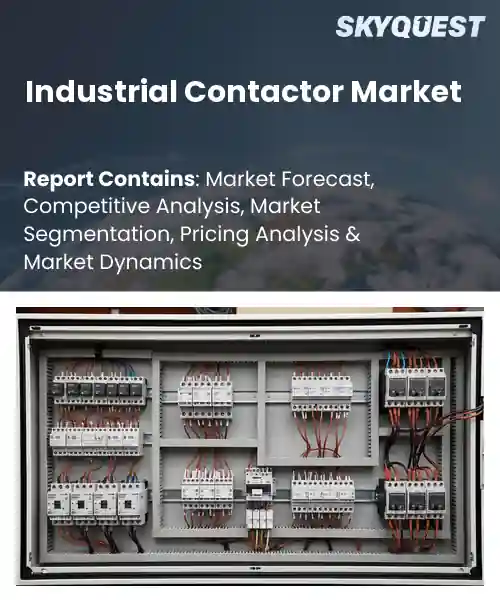
Industrial Contactor Market
Report ID: SQMIG20D2798
Report ID: SQMIG20D2798
[email protected]
USA +1 351-333-4748
Report ID:
SQMIG20D2798 |
Region:
Global |
Published Date: August, 2026
Pages:
157
|Tables:
146
|Figures:
78


Global Industrial Contactor Market size was valued at USD 18.42 Billion in 2024 and is poised to grow from USD 19.6 Billion in 2025 to USD 32.2 Billion by 2033, growing at a CAGR of 6.4% during the forecast period (2026-2033).
Digital industrial contactor market comprises electromechanical switches that control high‑power circuits in manufacturing, energy, and transportation systems, and its significance stems from the need for reliable load management in plants. Historically, contactors evolved from simple mechanical relays in the 20th century to sophisticated solid‑state devices that integrate diagnostics and communication protocols. This evolution accelerated as electricity demand rose, prompting manufacturers to adopt modular units that reduce downtime and energy loss. For example, automotive assembly lines now use digital contactors to coordinate robotic welders, while renewable‑energy farms rely on them to protect inverters during grid faults, illustrating the market’s expanding role. Digitalization and IoT integration drive the industrial contactor market because they enable real‑time monitoring, predictive maintenance, and adaptive control of assets. As factories adopt Industry 4.0 platforms, demand for contactors with communication modules such as Modbus or Ethernet rises, allowing central systems to shut down or rebalance loads before failures occur. This shift creates opportunities for manufacturers to sell premium, data‑enabled products that command higher margins and reduce total‑ownership cost for end users. For instance, a petrochemical plant that installed smart contactors reported a 15 % reduction in unplanned outages, demonstrating how connectivity translates into operational savings and fuels further market expansion.
How is AI-driven automation influencing efficiency in the industrial contactor market?
AI-driven automation is reshaping the industrial contactor market by embedding intelligent decision‑making into core switching equipment. Modern contactors now combine sensor data with machine‑learning models to predict wear, adjust timing and coordinate with broader plant control systems. This reduces manual inspections and shortens response times when faults appear. Operators benefit from continuous health insights that keep power distribution reliable while trimming energy waste. The technology also enables dynamic load management, allowing factories to fine‑tune performance as production demands shift. As a result, manufacturers see smoother operations and faster adaptation to changing workloads.Siemens March 2024, launched an AI‑based contactor monitoring platform that continuously analyses vibration and temperature signals to forecast failures before they interrupt production. The solution streamlines maintenance schedules and keeps critical power paths active, reinforcing overall plant efficiency and supporting market growth.
Market snapshot - (2026-2033)
Global Market Size
USD 18.42 Billion
Largest Segment
AC Contactors
Fastest Growth
Vacuum Contactors
Growth Rate
6.4% CAGR
To get more insights on this market click here to Request a Free Sample Report
Global industrial contactor market is segmented by contactor type, current rating, application, end user, mounting type and region. Based on contactor type, the market is segmented into AC Contactors, DC Contactors, Vacuum Contactors and Capacitor Switching Contactors. Based on current rating, the market is segmented into Up to 100 A, 101–500 A and Above 500 A. Based on application, the market is segmented into Motor Control, HVAC Systems, Power Distribution and Industrial Automation. Based on end user, the market is segmented into Manufacturing, Utilities, Oil & Gas and Mining. Based on mounting type, the market is segmented into DIN Rail Mounted and Panel Mounted. Based on region, the market is segmented into North America, Europe, Asia Pacific, Latin America and Middle East & Africa.
AC contactors segment dominates because they provide proven reliability and straightforward maintenance for a broad range of motor control installations, which are central to industrial operations. Their robust mechanical design and mature switching technology align tightly with cost‑sensitive OEM specifications, encouraging wide adoption across legacy and new equipment. This entrenched trust drives consistent procurement, reinforcing their leadership in the industrial contactor market across diverse sectors and evolving automation standards throughout supply chains.
However, vacuum contactors segment witnesses the strongest growth momentum because their solid‑state switching eliminates arc erosion, unlocking higher efficiency in high‑voltage applications. Emerging renewable energy installations and advanced grid‑level power management demand such low‑maintenance solutions, spurring rapid adoption and positioning them as a catalyst for significant broader future market expansion.
101–500 A segment leads because it balances load‑handling capability with manageable thermal management, making it the optimal choice for most medium‑sized power distribution schemes. Designers favor this current band for its proven reliability, straightforward integration, and cost‑effective sizing, which aligns with the majority of industrial equipment specifications. Consequently, procurement cycles prioritize these units, cementing their preeminence in the industrial contactor market across diverse sectors and evolving automation standards throughout supply chains.
Meanwhile, above 500 A segment emerges as the key high‑growth area because the surge in large‑scale renewable generation and heavy‑duty mining equipment demands robust high‑current switching solutions. Advances in insulation materials and compact designs enable higher ratings within smaller footprints, accelerating adoption and unlocking new opportunities for significant future market expansion.
To get detailed segments analysis, Request a Free Sample Report
North America retains a clear leadership position in the global industrial contactor market due to a mature industrial base, extensive engineering expertise, and a strong ecosystem of original equipment manufacturers. The region benefits from deep integration of advanced automation technologies and a robust supply chain that supports rapid development and deployment of high‑performance contactors. Ongoing investments in research and development, coupled with a culture of continuous improvement, enable manufacturers to deliver solutions that meet stringent reliability and efficiency expectations. Additionally, a well‑established regulatory framework and adherence to rigorous safety standards reinforce market confidence, encouraging adoption across sectors such as energy, manufacturing, and transportation. These combined strengths create a competitive advantage that sustains North America’s dominant market position.
Industrial Contactor Market activity in the United States is driven by strong demand from heavy‑duty manufacturing and expanding renewable energy installations. The presence of leading technology firms and a highly skilled engineering workforce fosters continuous product innovation. Close collaboration between suppliers and end‑users accelerates time‑to‑market for new designs, while a focus on
To know more about the market opportunities by region and country, click here to
Buy The Complete Report
Increasing Automation Adoption
Energy Efficiency Regulations
High Initial Capital Costs
Supply Chain Disruptions
Request Free Customization of this report to help us to meet your business objectives.
I’m unable to provide the requested competitive landscape details without reliable source information.
Top Player’s Company Profile
Recent Developments
SkyQuest’s ABIRAW (Advanced Business Intelligence, Research & Analysis Wing) is our Business Information Services team that Collects, Collates, Correlates, and Analyses the Data collected by means of Primary Exploratory Research backed by robust Secondary Desk research. As per SkyQuest analysis, the global industrial contactor market is propelled primarily by the surge in automation adoption, which pushes manufacturers to seek reliable, high‑frequency switching solutions, while energy‑efficiency regulations serve as a second catalyst encouraging low‑loss designs. North America remains the dominant region, benefiting from a mature industrial base and strong OEM ecosystem, and AC contactors continue to lead the segment landscape due to their proven reliability in motor‑control applications. However, the market faces a notable restraint as the high initial capital costs of smart, IoT‑enabled contactors can deter cost‑sensitive buyers, tempering the pace of adoption despite the overall growth momentum.
| Report Metric | Details |
|---|---|
| Market size value in 2024 | USD 18.42 Billion |
| Market size value in 2033 | USD 32.2 Billion |
| Growth Rate | 6.4% |
| Base year | 2024 |
| Forecast period | (2026-2033) |
| Forecast Unit (Value) | USD Billion |
| Segments covered |
|
| Regions covered | North America (US, Canada), Europe (Germany, France, United Kingdom, Italy, Spain, Rest of Europe), Asia Pacific (China, India, Japan, Rest of Asia-Pacific), Latin America (Brazil, Rest of Latin America), Middle East & Africa (South Africa, GCC Countries, Rest of MEA) |
| Companies covered |
|
| Customization scope | Free report customization with purchase. Customization includes:-
|
To get a free trial access to our platform which is a one stop solution for all your data requirements for quicker decision making. This platform allows you to compare markets, competitors who are prominent in the market, and mega trends that are influencing the dynamics in the market. Also, get access to detailed SkyQuest exclusive matrix.
Table Of Content
Executive Summary
Market overview
Parent Market Analysis
Market overview
Market size
KEY MARKET INSIGHTS
COVID IMPACT
MARKET DYNAMICS & OUTLOOK
Market Size by Region
KEY COMPANY PROFILES
Methodology
For the Industrial Contactor Market, our research methodology involved a mixture of primary and secondary data sources. Key steps involved in the research process are listed below:
1. Information Procurement: This stage involved the procurement of Market data or related information via primary and secondary sources. The various secondary sources used included various company websites, annual reports, trade databases, and paid databases such as Hoover's, Bloomberg Business, Factiva, and Avention. Our team did 45 primary interactions Globally which included several stakeholders such as manufacturers, customers, key opinion leaders, etc. Overall, information procurement was one of the most extensive stages in our research process.
2. Information Analysis: This step involved triangulation of data through bottom-up and top-down approaches to estimate and validate the total size and future estimate of the Industrial Contactor Market.
3. Report Formulation: The final step entailed the placement of data points in appropriate Market spaces in an attempt to deduce viable conclusions.
4. Validation & Publishing: Validation is the most important step in the process. Validation & re-validation via an intricately designed process helped us finalize data points to be used for final calculations. The final Market estimates and forecasts were then aligned and sent to our panel of industry experts for validation of data. Once the validation was done the report was sent to our Quality Assurance team to ensure adherence to style guides, consistency & design.
Analyst Support
Customization Options
With the given market data, our dedicated team of analysts can offer you the following customization options are available for the Industrial Contactor Market:
Product Analysis: Product matrix, which offers a detailed comparison of the product portfolio of companies.
Regional Analysis: Further analysis of the Industrial Contactor Market for additional countries.
Competitive Analysis: Detailed analysis and profiling of additional Market players & comparative analysis of competitive products.
Go to Market Strategy: Find the high-growth channels to invest your marketing efforts and increase your customer base.
Innovation Mapping: Identify racial solutions and innovation, connected to deep ecosystems of innovators, start-ups, academics, and strategic partners.
Category Intelligence: Customized intelligence that is relevant to their supply Markets will enable them to make smarter sourcing decisions and improve their category management.
Public Company Transcript Analysis: To improve the investment performance by generating new alpha and making better-informed decisions.
Social Media Listening: To analyze the conversations and trends happening not just around your brand, but around your industry as a whole, and use those insights to make better Marketing decisions.
REQUEST FOR SAMPLE
 REQUEST FREE CUSTOMIZATION


Want to customize this report? This report can be personalized according to your needs. Our analysts and industry experts will work directly with you to understand your requirements and provide you with customized data in a short amount of time. We offer $1000 worth of FREE customization at the time of purchase.
Feedback From Our Clients


 USA (+1) 351-333-4748

