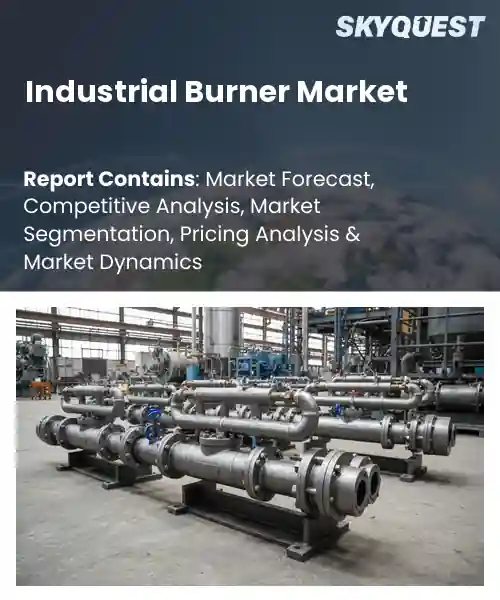
Industrial Burner Market
Report ID: SQMIG20I3256
Report ID: SQMIG20I3256
[email protected]
USA +1 351-333-4748
Report ID:
SQMIG20I3256 |
Region:
Global |
Published Date: July, 2026
Pages:
157
|Tables:
155
|Figures:
78


Global Industrial Burner Market size was valued at USD 7.08 Billion in 2024 and is poised to grow from USD 7.47 Billion in 2025 to USD 11.46 Billion by 2033, growing at a CAGR of 5.5% during the forecast period (2026-2033).
The global industrial burner market trends includes equipment that provides combustion for processes such as metal melting, ceramic firing and chemical synthesis. That matters because it allows operations that boost productivity in the energy, automotive and aerospace sectors. The main driver is the push for energy efficiency, with manufacturers replacing old burners with low-NOx, efficient burners to meet tighter emissions standards. The market grew in the 1990s with investment in complexes driven by deregulation and then again after the financial crisis in 2008 as companies sought to cut costs. Modern examples include Europe’s shift to hydrogen-fuelled burners, and Asia’s shift to modular gas-turbo units. One of the major factors impacting the global industrial burner market is the growth of renewable integration.
This is leading to the upgradation of burners in plants to accommodate fuels like biomass, biogas, and hydrogen. This change creates an appetite for burners with flame control systems, forcing manufacturers to spend on R&D and alliances with fuel technology companies. For example, a top European steelmaker has introduced dual-fuel burners, which can burn either natural gas or 20% hydrogen blends, reducing carbon intensity by 12%. Cost savings and compliance advantage drive adoption further. Modular burners are being adopted in Asia as a solution for new cement kilns, creating sizable industrial burner market growth opportunities.
How is AI-driven Predictive Maintenance Reshaping the Industrial Burner Market?
The industrial burner market share is being transformed by AI-driven predictive maintenance, moving away from reactive repairs towards proactive strategies. Embedded sensors in burners continuously gather information on temperature, pressure and emissions, and machine-learning models detect trends that warn of wear or inefficiency before a failure occurs. This change leads to less unplanned downtime, longer equipment life and lower operating costs, thereby increasing the reliability of combustion systems for manufacturers. Operators now receive real-time alerts that direct maintenance crews to the exact component that requires attention, allowing for strategic stocking of spare parts. The technology also supports greener operations by ensuring that burners operate at optimal efficiency, in line with stricter environmental regulations and the industry’s drive for sustainable production.
In July 2026, a leading industrial burner manufacturer announced an AI-enabled predictive maintenance platform, demonstrating how advanced analytics can further enhance reliability and efficiency, bolstering market growth.
Market snapshot - (2026-2033)
Global Market Size
USD 7.08 Billion
Largest Segment
Regenerative Burners
Fastest Growth
High Velocity Burners
Growth Rate
5.5% CAGR
To get more insights on this market click here to Request a Free Sample Report
Global industrial burner market is segmented by burner type, fuel type, automation level, capacity, end-use industry and region. Based on burner type, the market is segmented into regenerative burners, high velocity burners, radiant burners, flat flame burners, line burners, air staged burners, self-recuperative burners and others. Based on fuel type, the market is segmented into gas burners, oil burners, dual fuel burners and others. Based on automation level, the market is segmented into fully automatic burners, semi-automatic burners and manual burners. Based on capacity, the market is segmented into low capacity, medium capacity and high capacity. Based on end-use industry, the market is segmented into metal and metallurgy, power generation, chemicals and petrochemicals, food processing, automotive, pulp and paper, textile industry and others. Based on region, the market is segmented into North America, Europe, Asia Pacific, Latin America and Middle East & Africa.
Regenerative burners segment held the largest share as they recover the heat from exhaust gases and recycle it to preheat the incoming combustion air, which dramatically reduces the fuel consumption. This thermodynamic advantage is in line with manufacturers’ drive to reduce operating costs and meet strict environmental mandates. The recuperative surface burners provide stable flame characteristics over a range of loads and can be depended upon in high temperature processes. This makes them the technology of choice for energy-intensive applications and underlines their market leadership throughout the industry.
However, high velocity burners segment is witnessing the highest growth momentum as their high flame speeds allow for quick heating in compact furnace designs which are in demand as the need for space-efficient equipment is increasing. The developments in nozzle engineering and digital control are paving ways for their use in the metal processing and automotive manufacturing industries, aiding the market expansion.
The gas burners segment is projected to be the largest segment Natural gas is the most common energy source for many process heating applications as it provides clean combustion, reduced emissions and is available in abundance. Its predictable flame characteristics aid system design and integration, and regulatory pressures push for low-sulfur fuels, driving faster adoption across power generation and petrochemical facilities. The ease of piped infrastructure further solidifies its position as the go-to choice for low-cost, environmentally friendly operations throughout the industry.
At the same time, the dual fuel burners segment is marked as the major high-growth segment for its ability to switch between gas and oil, which gives operational resilience in times of fuel price volatility. This flexibility meets the need for continuous production that is pushing manufacturers to adopt dual-fuel solutions and increasing the market.
To get detailed segments analysis, Request a Free Sample Report
Asia Pacific has a strong position in the industrial burner market due to its advanced manufacturing base, strong engineering talent pool and proximity to downstream process industries. The region has a well-established supply chain that provides high-quality components in a timely fashion, allowing for rapid customization for a range of applications, such as petrochemical refining, steel making and new clean-energy processes. Burner manufacturers and OEMs are collaborating closely to accelerate the pace of innovation in fuel efficiency and emissions control. Furthermore, the demand for modern burner solutions is underpinned by supportive policy frameworks driving energy optimization and low-emission technologies. Furthermore, the emphasis on digitalization and predictive maintenance in the region improves operational reliability, driving the adoption of advanced burner systems across multiple sectors.
Industrial burner market outlook in Japan is characterized by a strong emphasis on high‑efficiency designs that meet stringent environmental standards. Domestic manufacturers collaborate closely with heavy‑industry users to tailor burners for petrochemical, glass, and food‑processing applications. Continuous investment in research drives improvements in flame stability and emissions reduction, while the widespread adoption of smart control systems enhances operational flexibility. These factors collectively sustain Japan’s reputation for cutting‑edge burner technology global leadership.
Industrial burner market forecast in South Korea is driven by a proactive approach to integrating materials and combustion science. Local firms focus on delivering compact, high‑performance burners for the shipbuilding, metal‑treatment, and chemical sectors. Emphasis on energy conservation aligns with national sustainability goals, prompting adoption of low‑NOx technologies. Collaborative engineering programs with academic institutions accelerate innovation, while expanding export activities reinforce South Korea’s position as a key supplier of sophisticated burner solutions.
North America’s industrial burner market is booming, driven by the region’s focus on energy optimization and stringent emissions regulations that are forcing manufacturers to adopt cutting-edge combustion technologies. Demand for high-efficiency burners with flexible fuel handling is being driven by large-scale petrochemical complexes, food-processing facilities and renewable-energy projects. Closer collaboration between burner suppliers and original equipment manufacturers is accelerating the deployment of modular, digitally integrated solutions that improve process control and reduce operational costs. Also, a mature engineering services ecosystem enables ongoing performance tuning and predictive maintenance to contribute to reliability. All of these factors add up to a fertile ground for innovative burner designs and market adoption in North America.
Industrial burner market regional outlook in the United States is shaped by extensive industrial activity across chemicals, refining, and power generation. High expectations for fuel efficiency drive adoption of burners equipped with smart monitoring and low‑emission features. Collaborative research between industry and universities fosters breakthroughs in alternative fuel combustion, while a robust regulatory framework pushes continuous improvement in emissions performance. These dynamics sustain a vibrant ecosystem that encourages domestic innovation and strategic imports of advanced burner technology.
Industrial burner market regional forecast in Canada benefits from a strong focus on sustainable industrial practices and a diversified energy mix. The country's emphasis on reducing carbon intensity encourages the deployment of burners that can efficiently combust bio‑derived fuels and natural gas with minimal emissions. Close ties between equipment manufacturers and the mining, pulp, and aerospace sectors enable tailored solutions that meet specific performance criteria. This collaborative environment supports ongoing advancements in burner reliability and environmental compliance.
Europe is developing a strong position in the industrial burner market by combining stringent environmental legislation, high-value engineering capabilities and a mature network of specialized suppliers. Decarbonization is driving the need for burners that can efficiently operate on low carbon and renewable fuels, while meeting stringent emission limits. Collaborative clusters of universities, research institutes and manufacturers speed up the transfer of technology, leading to sophisticated combustion control systems and advanced materials. Well established standards and certification processes ensure consistent product quality across a broad spectrum of industrial applications, from steel to chemicals. In addition, continuous improvement is driven by a healthy culture of constant innovation and the adherence to circular economy principles, which form the basis for Europe’s reputation for reliable, high-performance burner solutions. Such joint efforts also attract multi-national investments looking for strong, compliant burner technologies to boost European production capacities.
Industrial burner market analysis in Germany is distinguished by an engineering tradition and a focus on precision manufacturing. German manufacturers prioritize burners that deliver high thermal efficiency and ultra‑low emissions, catering to the country's extensive chemical and automotive industries. Integration with digital platforms enables real‑time performance monitoring and predictive maintenance, enhancing operational uptime. Strong collaboration with research institutes drives refinement of combustion algorithms and materials, reinforcing Germany’s status as a benchmark for high‑quality industrial burner solutions.
Industrial burner market penetration in the United Kingdom benefits from a strong emphasis on research collaboration and strict compliance standards. British firms develop burners that combine energy efficiency with flexible fuel compatibility, addressing the needs of petrochemical, food‑processing, and renewable‑energy sectors. Adoption of advanced control algorithms and IoT connectivity improves process optimization and reduces emissions. Government incentives for low‑carbon technologies further stimulate investment, positioning the United Kingdom as a hub for innovative, environmentally‑conscious burner solutions.
Industrial burner industry in France is driven by a commitment to environmental performance and a robust network of specialized engineering firms. French manufacturers focus on burners that achieve high combustion efficiency while meeting rigorous EU emission directives, serving the chemical, glass, and aerospace industries. Integration of AI‑based monitoring tools enables continuous optimization and predictive maintenance, reducing downtime. Collaborative projects with research laboratories foster the development of alternative‑fuel combustion technologies, reinforcing France’s role as a leader in sustainable industrial heating solutions.
To know more about the market opportunities by region and country, click here to
Buy The Complete Report
Increasing Demand for Energy Efficiency
Adoption of Low‑Emission Technologies
Stringent Emission Regulations
High Capital Investment Costs
Request Free Customization of this report to help us to meet your business objectives.
The industrial burner market is characterized by strong competition as established combustion equipment manufacturers strengthen their market positions through product innovation, strategic partnerships, and acquisitions, while technology-focused companies accelerate the development of low-emission and fuel-flexible burner systems. Increasing industrial decarburization initiatives are encouraging manufacturers to invest in hydrogen-ready combustion technologies, digital burner management systems, and advanced combustion controls that improve energy efficiency and reduce emissions. At the same time, collaborations with engineering firms, industrial plant operators, and automation providers are enabling companies to expand their global footprint and address evolving regulatory requirements across the power generation, metals, chemicals, food processing, and oil & gas industries.
Top Player’s Company Profile
Recent Developments in the Industrial Burner Market
SkyQuest’s ABIRAW (Advanced Business Intelligence, Research & Analysis Wing) is our Business Information Services team that Collects, Collates, Correlates, and Analyses the Data collected by means of Primary Exploratory Research backed by robust Secondary Desk research. As per SkyQuest analysis the global industrial burner market is driven primarily by the increasing demand for energy efficiency as manufacturers seek to cut fuel use and meet sustainability targets, a second important catalyst is the adoption of low‑emission technologies that reduce pollutants and help comply with tightening environmental rules. The market is led by Asia Pacific, where strong manufacturing bases and supportive policies fuel demand, while regenerative burners dominate the segment landscape thanks to their heat‑recovery capability. However, stringent emission regulations act as a restraint, raising design complexity and cost, which can slow investment cycles.
| Report Metric | Details |
|---|---|
| Market size value in 2024 | USD 7.08 Billion |
| Market size value in 2033 | USD 11.46 Billion |
| Growth Rate | 5.5% |
| Base year | 2024 |
| Forecast period | (2026-2033) |
| Forecast Unit (Value) | USD Billion |
| Segments covered |
|
| Regions covered | North America (US, Canada), Europe (Germany, France, United Kingdom, Italy, Spain, Rest of Europe), Asia Pacific (China, India, Japan, Rest of Asia-Pacific), Latin America (Brazil, Rest of Latin America), Middle East & Africa (South Africa, GCC Countries, Rest of MEA) |
| Companies covered |
|
| Customization scope | Free report customization with purchase. Customization includes:-
|
To get a free trial access to our platform which is a one stop solution for all your data requirements for quicker decision making. This platform allows you to compare markets, competitors who are prominent in the market, and mega trends that are influencing the dynamics in the market. Also, get access to detailed SkyQuest exclusive matrix.
Table Of Content
Executive Summary
Market overview
Parent Market Analysis
Market overview
Market size
KEY MARKET INSIGHTS
COVID IMPACT
MARKET DYNAMICS & OUTLOOK
Market Size by Region
KEY COMPANY PROFILES
Methodology
For the Industrial Burner Market, our research methodology involved a mixture of primary and secondary data sources. Key steps involved in the research process are listed below:
1. Information Procurement: This stage involved the procurement of Market data or related information via primary and secondary sources. The various secondary sources used included various company websites, annual reports, trade databases, and paid databases such as Hoover's, Bloomberg Business, Factiva, and Avention. Our team did 45 primary interactions Globally which included several stakeholders such as manufacturers, customers, key opinion leaders, etc. Overall, information procurement was one of the most extensive stages in our research process.
2. Information Analysis: This step involved triangulation of data through bottom-up and top-down approaches to estimate and validate the total size and future estimate of the Industrial Burner Market.
3. Report Formulation: The final step entailed the placement of data points in appropriate Market spaces in an attempt to deduce viable conclusions.
4. Validation & Publishing: Validation is the most important step in the process. Validation & re-validation via an intricately designed process helped us finalize data points to be used for final calculations. The final Market estimates and forecasts were then aligned and sent to our panel of industry experts for validation of data. Once the validation was done the report was sent to our Quality Assurance team to ensure adherence to style guides, consistency & design.
Analyst Support
Customization Options
With the given market data, our dedicated team of analysts can offer you the following customization options are available for the Industrial Burner Market:
Product Analysis: Product matrix, which offers a detailed comparison of the product portfolio of companies.
Regional Analysis: Further analysis of the Industrial Burner Market for additional countries.
Competitive Analysis: Detailed analysis and profiling of additional Market players & comparative analysis of competitive products.
Go to Market Strategy: Find the high-growth channels to invest your marketing efforts and increase your customer base.
Innovation Mapping: Identify racial solutions and innovation, connected to deep ecosystems of innovators, start-ups, academics, and strategic partners.
Category Intelligence: Customized intelligence that is relevant to their supply Markets will enable them to make smarter sourcing decisions and improve their category management.
Public Company Transcript Analysis: To improve the investment performance by generating new alpha and making better-informed decisions.
Social Media Listening: To analyze the conversations and trends happening not just around your brand, but around your industry as a whole, and use those insights to make better Marketing decisions.
REQUEST FOR SAMPLE
 REQUEST FREE CUSTOMIZATION
Global Industrial Burner Market size was valued at USD 7.08 Billion in 2024 and is poised to grow from USD 7.47 Billion in 2025 to USD 11.46 Billion by 2033, growing at a CAGR of 5.5% during the forecast period (2026-2033).
The industrial burner market is shaped by intense competition among established manufacturers and emerging technology firms, driving consolidation through strategic M&A and joint ventures that expand product portfolios and geographic reach. Companies are accelerating innovation by integrating advanced combustion control systems and low‑emission technologies, while forming partnerships with equipment integrators and energy service providers to capture new industrial applications and meet tightening environmental standards. 'Honeywell International Inc.', 'Andritz AG', 'Nippon Combustion Chugai Ro Co., Ltd.', 'Ariston Holding N.V.', 'Bloom Engineering Company, Inc.', 'John Zink Hamworthy Combustion', 'Riello S.p.A.', 'Weishaupt Group', 'Zeeco, Inc.', 'Fives Group', 'Limpsfield Combustion Engineering Ltd.', 'Baltur S.p.A.', 'Oilon Group Oy', 'Selas Heat Technology Co. LLC', 'Dreizler GmbH', 'Dunphy Combustion Ltd.', 'Preferred Utilities Manufacturing Corporation', 'Ecostar Burners', 'Fabrika Burners', 'Polzen GmbH'
Manufacturers are integrating advanced control systems and heat recovery solutions that reduce fuel consumption while maintaining process reliability. This focus on energy efficiency enables end‑users to lower operating expenses and meet sustainability targets, creating a compelling value proposition for industrial burners. As organizations prioritize cost‑effective thermal management, the demand for burners that deliver higher efficiency at comparable performance levels accelerates market expansion and encourages continuous product innovation. Additionally, the shift towards greener operational standards reinforces the preference for high‑efficiency burner configurations across diverse manufacturing sectors.
Advanced Combustion Controls: Manufacturers are integrating sophisticated combustion control systems that dynamically adjust air‑fuel ratios, flame stability, and heat distribution. These intelligent controllers use sensor feedback and predictive algorithms to optimize burner performance, reduce fuel consumption, and extend equipment life. The shift toward real‑time monitoring enables rapid response to process variations, improves product quality, and aligns operations with sustainability goals. As a result, industrial users are prioritising burners that offer adaptive control, fostering higher efficiency and lower operational risk across diverse applications industries.
Why does Asia Pacific Dominate the Global Industrial Burner Market? |@12


Want to customize this report? This report can be personalized according to your needs. Our analysts and industry experts will work directly with you to understand your requirements and provide you with customized data in a short amount of time. We offer $1000 worth of FREE customization at the time of purchase.
Feedback From Our Clients


 USA (+1) 351-333-4748

