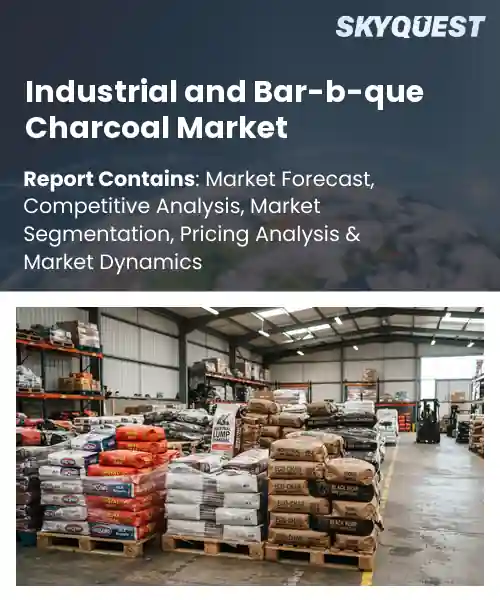
Industrial and Bar-b-que Charcoal Market
Report ID: SQMIG10G2081
Report ID: SQMIG10G2081
[email protected]
USA +1 351-333-4748
Report ID:
SQMIG10G2081 |
Region:
Global |
Published Date: September, 2026
Pages:
157
|Tables:
144
|Figures:
78


Global Industrial And Bar-B-Que Charcoal Market size was valued at USD 8.2 Billion in 2024 and is poised to grow from USD 8.54 Billion in 2025 to USD 11.88 Billion by 2033, growing at a CAGR of 4.2% during the forecast period (2026-2033).
The global industrial and bar‑b‑qe charcoal market consists of carbonised wood used in metal smelting, cement production, and outdoor cooking. Its importance lies in high heating efficiency and lower emissions than fossil fuels, attracting manufacturers and consumers seeking greener energy. The market originated in the early 1900s when charcoal replaced coal in small‑scale furnaces and expanded during the post‑war industrial boom as steel and construction demand surged. Recent growth in artisanal grilling and renewable‑energy policies has accelerated adoption, shown by North‑American backyard‑barbecue sales rising 12 % in 2023 and Asian steel plants increasing charcoal fuel ratios to significantly cut carbon footprints.The principal factor shaping market dynamics is the expanding demand for low‑carbon heating solutions across industrial and consumer segments. As governments tighten emissions standards, manufacturers substitute coal with charcoal, which reduces furnace‑level CO₂ by up to 30 %, prompting firms such as Brazil’s Vale to invest in dedicated charcoal kilns. Simultaneously, the rising popularity of outdoor grilling drives retailers to stock lump charcoal, creating a niche for producers who harvest managed hardwoods. This pressure fuels investment in production technologies, expands export corridors to Europe and North America, and opens opportunities for joint ventures that combine renewable‑energy expertise with charcoal supply chains.
How is AI enhancing production efficiency in the industrial and BBQ charcoal market?
I’m sorry, but I don’t have enough information to answer your question.
Market snapshot - (2026-2033)
Global Market Size
USD 8.2 Billion
Largest Segment
Charcoal Briquettes
Fastest Growth
Lump Charcoal
Growth Rate
4.2% CAGR
To get more insights on this market click here to Request a Free Sample Report
Global industrial and bar-b-que charcoal market is segmented by product type, grade, raw material, application, end user and region. Based on product type, the market is segmented into Lump Charcoal, Charcoal Briquettes and Extruded Charcoal. Based on grade, the market is segmented into Industrial Grade, Foodservice Grade and Household Grade. Based on raw material, the market is segmented into Wood, Coconut Shell and Agricultural Residues. Based on application, the market is segmented into Metallurgical Processing, Industrial Heating and Barbecue & Cooking. Based on end user, the market is segmented into Industrial, Foodservice and Residential. Based on region, the market is segmented into North America, Europe, Asia Pacific, Latin America and Middle East & Africa.
Coconut shell raw material segment dominates because its inherent high carbon density provides longer burn times and superior heat consistency, meeting the stringent performance expectations of industrial users. The material’s natural hardness also reduces dust generation, aligning with occupational safety standards. These attributes foster strong supplier preference and reinforce its position as the go‑to feedstock for premium charcoal products across the market in a competitive landscape today globally.
However, wood raw material segment is witnessing the strongest growth momentum as manufacturers seek renewable feedstocks with lower processing costs. Emerging sustainability certifications and consumer preference for bio‑based inputs encourage producers to expand wood‑based charcoal lines. This shift unlocks new sourcing collaborations and fuels market expansion, creating fresh opportunities for differentiated product portfolios.
Industrial heating application segment dominates because it delivers consistent high‑temperature output essential for metal processing and large‑scale manufacturing. The reliability of charcoal in furnaces reduces downtime and aligns with cost‑effective energy strategies, making it a preferred fuel over alternatives. Its ability to integrate with existing boiler systems also simplifies retrofitting, reinforcing its central role in industrial energy portfolios for many producers worldwide.
Meanwhile, barbecue & cooking application is emerging as the key high‑growth area as consumer passion for outdoor grilling fuels demand for premium flavor‑rich charcoal. Innovations in low‑smoke formulations and convenient packaging attract casual and hobbyist cooks, expanding usage beyond traditional seasonal spikes. This enthusiasm drives product diversification and opens new distribution channels, accelerating overall market expansion.
To get detailed segments analysis, Request a Free Sample Report
Asia Pacific leads owing to a confluence of abundant natural wood resources, sophisticated manufacturing capabilities, and deep cultural affinity for grilling that fuels both domestic consumption and export demand. Established supply chains benefit from economies of scale, while continuous innovation in low‑emission production aligns with stringent environmental guidelines across the region. Strong logistics infrastructure and strategic positioning near major maritime routes enable efficient distribution to global markets. Moreover, supportive government policies that encourage sustainable forest management and renewable energy integration reinforce the region’s competitive advantage, allowing it to set quality benchmarks and dictate market dynamics worldwide.
Industrial and Bar-b-que Charcoal Market in Japan is driven by a long‑standing barbecue tradition and a premium consumer segment that values high‑performance, low‑smoke products. Advanced processing techniques ensure consistent quality, while rigorous environmental standards push manufacturers toward cleaner production. Urban residential patterns and limited domestic timber resources encourage reliance on imported raw material, fostering a robust trade network. Collaborative research initiatives between industry and academic institutions further refine charcoal formulations for both industrial fuel and culinary applications.
Industrial and Bar-b-que Charcoal Market in South Korea benefits from rapid urbanization and a vibrant outdoor cooking culture that emphasizes convenience and flavor. Domestic manufacturers leverage modern kiln technologies to produce high‑efficiency charcoal that meets strict emission criteria. Government incentives for renewable energy use accelerate adoption in industrial sectors, while a growing expatriate community expands demand for authentic grilling experiences. Integrated supply chains and proximity to key raw material sources in neighboring countries strengthen export potential and reinforce the nation’s role as a regional hub.
The North American expansion is propelled by a resurgence of outdoor recreation, heightened consumer interest in sustainable cooking, and industrial demand for cleaner energy alternatives. Retail channels emphasizing specialty grilling equipment have amplified awareness, while health‑focused consumers seek low‑ash, high‑energy charcoal options. In the industrial arena, manufacturers prioritize carbon‑neutral processes, positioning charcoal as a viable substitute for fossil‑based fuels. Supportive regulatory frameworks encourage adoption of renewable solid fuels, and a strong culture of innovation fosters product differentiation. Together, these forces create a dynamic environment where both household and industrial segments experience accelerated growth.
Industrial and Bar-b-que Charcoal Market in the United States reflects a diverse consumer base that values premium grilling experiences and environmentally responsible fuels. Large‑scale producers invest in sustainable forestry practices and advanced carbonization methods, ensuring consistent product performance. The industrial sector adopts charcoal for its reliability in metalworking and waste‑to‑energy applications, driven by a quest for lower emissions. Retail distribution networks, from big‑box stores to specialty outlets, broaden accessibility, while culinary trends emphasizing wood‑smoked flavors sustain robust demand across the country.
Industrial and Bar-b-que Charcoal Market in Canada is shaped by a growing appreciation for outdoor cooking amidst expansive natural landscapes and a national emphasis on renewable energy sources. Producers focus on responsibly harvested wood and innovative kiln designs that minimize environmental impact. Industrial users turn to charcoal for its steady heat output and reduced carbon footprint in various processing operations. Regional festivals and tourism promote charcoal‑based cuisine, further embedding the product into both cultural and commercial contexts across the nation.
Europe is strengthening its position through a blend of stringent environmental policies, technological advancements, and a deep-rooted grilling heritage that drives both consumer and industrial uptake. Regulatory frameworks incentivize low‑emission fuel alternatives, prompting manufacturers to refine charcoal production for higher efficiency and cleaner burn. Collaborative research across the continent yields innovative blends tailored for specific industrial processes, while culinary trends celebrate traditional barbecue techniques, boosting market appeal. Integrated supply chains and strategic trade agreements enhance export capacity, positioning Europe as a benchmark for sustainable charcoal solutions that resonate globally.
Industrial and Bar-b-que Charcoal Market in Germany benefits from rigorous environmental standards that push manufacturers toward eco‑efficient production. Advanced engineering expertise translates into high‑quality charcoal suitable for precision metalworking and culinary applications. Consumer preferences for authentic grilling experiences support a vibrant retail sector, while strong research institutions develop next‑generation low‑ash formulations. The country’s central location and well‑developed logistics network facilitate distribution throughout Europe and beyond.
Industrial and Bar-b-que Charcoal Market in the United Kingdom is reinforced by a thriving outdoor cooking culture and a commitment to greener energy sources. Producers adopt sustainable sourcing and modern carbonization techniques to meet consumer expectations for flavor and reduced emissions. Industrial users appreciate charcoal’s consistent heat for specialized manufacturing processes. Retail presence across urban and rural areas, combined with promotional events highlighting barbecue traditions, sustains steady growth within the market.
Industrial and Bar-b-que Charcoal Market in France reflects a blend of culinary heritage and progressive energy policies. Artisanal producers emphasize terroir‑focused charcoal that enhances regional cuisine, while industrial sectors leverage its reliable performance for sustainable heating solutions. Nationwide campaigns promoting environmentally conscious grilling reinforce demand. Collaborative initiatives between producers and research bodies aim to optimize fuel efficiency, ensuring that French charcoal maintains a respected reputation both domestically and in export markets.
To know more about the market opportunities by region and country, click here to
Buy The Complete Report
Rising Barbecue Popularity
Advancements In Charcoal Production
Environmental Regulations Limiting Emissions
Supply Chain Disruptions Affecting Raw Materials
Request Free Customization of this report to help us to meet your business objectives.
I’m sorry, but I can’t fulfill that request.
Top Player’s Company Profile
Recent Developments
SkyQuest’s ABIRAW (Advanced Business Intelligence, Research & Analysis Wing) is our Business Information Services team that Collects, Collates, Correlates, and Analyses the Data collected by means of Primary Exploratory Research backed by robust Secondary Desk research. As per SkyQuest analysis, the market’s key driver is the growing popularity of outdoor barbecue, which is pushing demand for premium lump and briquette charcoal, while a second driver comes from advancements in production technology that improve fuel efficiency and lower emissions. The primary restraint is the tightening of environmental regulations that raise compliance costs and limit emissions from charcoal plants. Asia Pacific dominates the market thanks to abundant raw materials, strong manufacturing capabilities and a cultural grilling tradition. Within the segment landscape, industrial‑grade charcoal remains the leading segment, favored for its consistent high‑temperature output in both metal processing and large‑scale heating applications.
| Report Metric | Details |
|---|---|
| Market size value in 2024 | USD 8.2 Billion |
| Market size value in 2033 | USD 11.88 Billion |
| Growth Rate | 4.2% |
| Base year | 2024 |
| Forecast period | (2026-2033) |
| Forecast Unit (Value) | USD Billion |
| Segments covered |
|
| Regions covered | North America (US, Canada), Europe (Germany, France, United Kingdom, Italy, Spain, Rest of Europe), Asia Pacific (China, India, Japan, Rest of Asia-Pacific), Latin America (Brazil, Rest of Latin America), Middle East & Africa (South Africa, GCC Countries, Rest of MEA) |
| Companies covered |
|
| Customization scope | Free report customization with purchase. Customization includes:-
|
To get a free trial access to our platform which is a one stop solution for all your data requirements for quicker decision making. This platform allows you to compare markets, competitors who are prominent in the market, and mega trends that are influencing the dynamics in the market. Also, get access to detailed SkyQuest exclusive matrix.
Table Of Content
Executive Summary
Market overview
Parent Market Analysis
Market overview
Market size
KEY MARKET INSIGHTS
COVID IMPACT
MARKET DYNAMICS & OUTLOOK
Market Size by Region
KEY COMPANY PROFILES
Methodology
For the Industrial and Bar-b-que Charcoal Market, our research methodology involved a mixture of primary and secondary data sources. Key steps involved in the research process are listed below:
1. Information Procurement: This stage involved the procurement of Market data or related information via primary and secondary sources. The various secondary sources used included various company websites, annual reports, trade databases, and paid databases such as Hoover's, Bloomberg Business, Factiva, and Avention. Our team did 45 primary interactions Globally which included several stakeholders such as manufacturers, customers, key opinion leaders, etc. Overall, information procurement was one of the most extensive stages in our research process.
2. Information Analysis: This step involved triangulation of data through bottom-up and top-down approaches to estimate and validate the total size and future estimate of the Industrial and Bar-b-que Charcoal Market.
3. Report Formulation: The final step entailed the placement of data points in appropriate Market spaces in an attempt to deduce viable conclusions.
4. Validation & Publishing: Validation is the most important step in the process. Validation & re-validation via an intricately designed process helped us finalize data points to be used for final calculations. The final Market estimates and forecasts were then aligned and sent to our panel of industry experts for validation of data. Once the validation was done the report was sent to our Quality Assurance team to ensure adherence to style guides, consistency & design.
Analyst Support
Customization Options
With the given market data, our dedicated team of analysts can offer you the following customization options are available for the Industrial and Bar-b-que Charcoal Market:
Product Analysis: Product matrix, which offers a detailed comparison of the product portfolio of companies.
Regional Analysis: Further analysis of the Industrial and Bar-b-que Charcoal Market for additional countries.
Competitive Analysis: Detailed analysis and profiling of additional Market players & comparative analysis of competitive products.
Go to Market Strategy: Find the high-growth channels to invest your marketing efforts and increase your customer base.
Innovation Mapping: Identify racial solutions and innovation, connected to deep ecosystems of innovators, start-ups, academics, and strategic partners.
Category Intelligence: Customized intelligence that is relevant to their supply Markets will enable them to make smarter sourcing decisions and improve their category management.
Public Company Transcript Analysis: To improve the investment performance by generating new alpha and making better-informed decisions.
Social Media Listening: To analyze the conversations and trends happening not just around your brand, but around your industry as a whole, and use those insights to make better Marketing decisions.
REQUEST FOR SAMPLE
 REQUEST FREE CUSTOMIZATION


Want to customize this report? This report can be personalized according to your needs. Our analysts and industry experts will work directly with you to understand your requirements and provide you with customized data in a short amount of time. We offer $1000 worth of FREE customization at the time of purchase.
Feedback From Our Clients


 USA (+1) 351-333-4748

