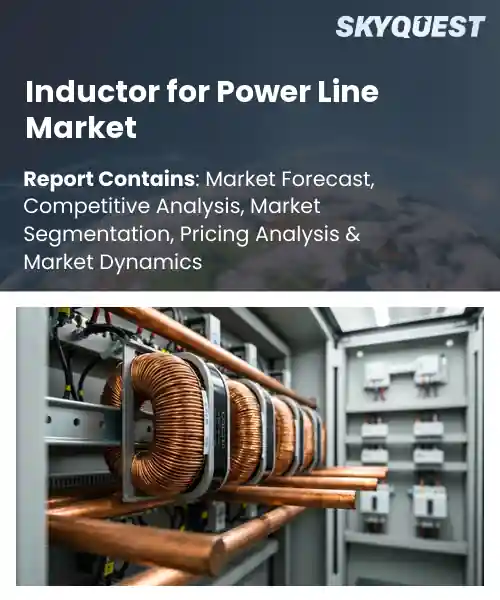
Inductor for Power Line Market
Report ID: SQMIG20D2832
Report ID: SQMIG20D2832
[email protected]
USA +1 351-333-4748
Report ID:
SQMIG20D2832 |
Region:
Global |
Published Date: August, 2026
Pages:
157
|Tables:
127
|Figures:
77


Global Inductor For Power Line Market size was valued at USD 2.46 Billion in 2024 and is poised to grow from USD 2.67 Billion in 2025 to USD 5.09 Billion by 2033, growing at a CAGR of 8.4% during the forecast period (2026-2033).
A catalyst for increasing inductor for power line market trends demand is the faster integration of renewable energy, where fluctuating generation requires grid operators to install reactors to damp voltage swings and limit fault currents. This need also provides manufacturers an opportunity to innovate low-loss, high-temperature materials and create new sources of income in emerging markets such as India and Brazil, where solar farms are proliferating. Simultaneously, the deployment of monitoring systems creates opportunities for smart inductors with communication modules that enable tuning of the impedance to improve stability. So, firms that marry technology and analytics win the contracts to upgrade utilities, illustrating how the convergence of policy, technology and pressure drives growth.
How are AI and IoT Driving Innovation in the Power Line Inductor Market?
AI and IoT are transforming the inductor for power line market share with intelligent design, predictive maintenance and adaptive performance. Machine learning algorithms analyze load patterns to recommend optimal core materials and winding configurations and IoT sensors embed real time monitoring into inductors installed on distribution lines. The convergence allows manufacturers to develop components that can adjust themselves to voltage variations and minimizes downtime by early fault detection. Utilities are modernizing their grids and this is driving a growing demand for inductors that can communicate their status and integrate with control systems, making the market more dynamic and technology driven.
TDK announced a new AI optimized power line inductor in March 2024, enabling real time condition monitoring and automatic tuning, improving grid efficiency and enabling the wider adoption of smart energy solutions. The device is equipped with IoT connectivity that reports performance data to utility control platforms for predictive adjustments that reduce losses and extend equipment life.
Market snapshot - (2026-2033)
Global Market Size
USD 2.46 Billion
Largest Segment
Power Inductors
Fastest Growth
Common Mode Chokes
Growth Rate
8.4% CAGR
To get more insights on this market click here to Request a Free Sample Report
Global inductor for power line market is segmented by inductor type, core material, application, end user and region. Based on inductor type, the market is segmented into power inductors, coupled inductors, common mode chokes, line chokes and others. Based on core material, the market is segmented into ferrite, iron powder, metal composite and others. Based on application, the market is segmented into power supplies, power conversion, renewable energy systems, industrial equipment, automotive electronics, consumer electronics and others. Based on end user, the market is segmented into automotive, industrial, consumer electronics, energy & power, telecommunications and others. Based on region, the market is segmented into North America, Europe, Asia Pacific, Latin America and Middle East & Africa.
Power inductors segment dominates because they provide the fundamental energy storage required for high‑current transmission lines, ensuring low loss and reliable performance across a wide frequency range. Their simple construction and proven thermal stability make them the default choice for power line designers seeking cost‑effective solutions. This reliability, combined with extensive supplier ecosystems and mature manufacturing processes, drives continuous preference and entrenches their leadership in the inductor for power line market.
However, coupled inductors emerge as the most rapidly expanding area, driven by the rise of multi‑phase power conversion that requires tight magnetic coupling for efficiency. Their integrated windings shrink board space and improve electromagnetic compatibility, drawing designers of advanced converters. This momentum creates fresh opportunities for compact, high‑performance power line solutions.
Ferrite segment dominates because its high magnetic permeability and low core loss at elevated frequencies make it ideally suited for the demanding ripple suppression in power line networks. The material’s inherent thermal resilience enables stable operation under continuous high‑current stress, while its cost‑effective production supports widespread adoption across diverse designs. These technical advantages, coupled with long‑standing industry confidence, cement ferrite’s preeminence in the inductor for power line market.
Meanwhile, metal composite core segment is witnessing strong growth, driven by its high saturation flux density and mechanical robustness that suit emerging high‑power density applications. Engineers adopt metal composites to shrink footprints while preserving performance under harsh conditions. This transition fuels market expansion as renewable and automotive power systems seek compact, resilient inductors.
To get detailed segments analysis, Request a Free Sample Report
The region has an extensive engineering tradition coupled with strong investment in next generation power infrastructure. Strong manufacturing ecosystems support fast ramping of advanced magnetic components and local demand from expanding smart grid initiatives and high-speed rail networks and renewable energy integration drive continued consumption. Government policies promote technology adoption and offer incentives for energy efficiency, strengthening a virtuous cycle of innovation and production capacity. The emergence of collaborative research centers and a large, highly skilled talent pool further strengthen the ability to deliver high-performance inductors customized to a variety of applications, cementing the region’s leadership.
Inductor for power line market outlook in Japan benefits from an entrenched electronics supply chain and a commitment to precision engineering. Domestic utilities prioritize grid resilience and modernize transmission assets, creating steady demand for robust magnetic solutions. Close ties between manufacturers and research institutes accelerate product refinement, while a culture of quality assurance ensures reliability across high voltage environments. These factors together sustain a vibrant market for power line inductors.
Inductor for power line market forecast in South Korea is propelled by a strategic focus on digital infrastructure and renewable integration. The nation’s aggressive rollout of smart grid technologies and emphasis on energy storage demand sophisticated inductive components. Strong collaboration between conglomerates and university laboratories fosters rapid prototyping and cost effective production. Additionally, supportive trade policies and export oriented manufacturing reinforce the country’s role as a key supplier in the regional ecosystem.
Infrastructure renewal and new clean energy projects are converging in North America, driving demand for power line inductors. Utilities are upgrading aging transmission networks to improve reliability and accommodate distributed generation. Large scale renewable rollouts require efficient power conversion. The need to meet regulatory compliance and safety requirements is driving investment in high quality magnetic components. Moreover, a strong engineering talent pool and advanced manufacturing capabilities propel innovation, creating a perfect storm of growth across the residential, commercial and industrial markets.
Inductor for power line market regional forecast in the United States is shaped by extensive grid modernization programs and a surge in renewable integration. Utility operators seek low loss inductive solutions to enhance transmission efficiency and support variable energy sources. A dynamic ecosystem of technology firms and research institutions promotes continual advancement of magnetic materials and design techniques. This environment encourages the adoption of next generation inductors that meet stringent performance criteria.
Inductor for power line market regional outlook in Canada benefits from a national agenda focused on clean energy transition and grid resilience. Vast transmission corridors across diverse terrains demand reliable inductive devices capable of withstanding harsh conditions. Collaborative initiatives between government, utilities, and manufacturers foster the development of customized solutions. Emphasis on environmental stewardship and energy efficiency further fuels demand for advanced power line inductors within the Canadian market.
Europe strengthens its position on the market thru its extensive regulatory structures and its commitment to decarbonization. It provides an enabling environment for advanced inductive technologies thru strategic investments in cross-border transmission infrastructure and smart grid pilots. The region’s wide expertise in precision engineering and strong performance and safety standards drive adoption of high-efficiency inductors. Industry players, research and policy bodies collaborate thru platforms to accelerate innovation and to put European solutions on top of power transmission efficiency.
Inductor for power line market analysis in Germany is underpinned by a strong manufacturing tradition and a proactive energy transition strategy. Grid operators prioritize the integration of renewable sources, necessitating reliable inductors that minimize losses. Close cooperation between engineering firms and technical universities fuels continuous improvement in magnetic design. Commitment to stringent quality standards ensures that German produced inductors meet the exacting requirements of both domestic and export markets.
Inductor for power line market penetration in the United Kingdom is driven by ambitious net zero targets and extensive upgrade of transmission assets. Utility companies focus on deploying smart grid technologies that rely on sophisticated inductive components for stability and efficiency. A vibrant ecosystem of research institutions and specialized manufacturers encourages rapid prototyping and adoption of cutting edge magnetic solutions. Regulatory emphasis on safety and performance further supports market expansion.
Inductor for power line industry in France is shaped by a national drive toward sustainable energy distribution and grid modernization. Investments in high voltage networks and renewable integration create consistent demand for precision engineered inductors. Collaborative efforts between public research agencies and industry leaders promote innovation in magnetic materials and compact designs. Strong adherence to European standards ensures that French products are recognized for reliability and efficiency across the continent.
To know more about the market opportunities by region and country, click here to
Buy The Complete Report
Increasing Renewable Energy Integration
Smart Grid Deployment Expands
High Material Cost Constraints
Regulatory Compliance Burdens
Request Free Customization of this report to help us to meet your business objectives.
The global inductor market is characterized by strong competition among established passive-component manufacturers, with companies focusing on miniaturization, higher-frequency operation, improved thermal performance, and greater energy efficiency. Leading players are expanding their portfolios through new multilayer, power, RF, and automotive-grade inductors designed for applications including electric vehicles, renewable-energy systems, telecommunications, consumer electronics, and industrial automation. Strategic investments in advanced magnetic materials, automated manufacturing, and high-reliability components are further intensifying competition, while growing demand for compact power-conversion and high-frequency circuits is encouraging manufacturers to differentiate through lower power losses, higher current-handling capability, and improved reliability.
Top Player’s Company Profile
Recent Developments in the Inductor for Power Line Market
SkyQuest’s ABIRAW (Advanced Business Intelligence, Research & Analysis Wing) is our Business Information Services team that Collects, Collates, Correlates, and Analyses the Data collected by means of Primary Exploratory Research backed by robust Secondary Desk research. As per SkyQuest analysis the global power‑line inductor market is propelled primarily by the key driver of increasing renewable‑energy integration which pushes utilities to adopt low‑loss inductors for voltage stabilization, while smart‑grid deployment serves as a second driver by demanding high‑precision, communicative components for real‑time control. The market is restrained by high material‑cost constraints that limit investment in premium magnetic cores, especially in price‑sensitive zones. Asia Pacific emerges as the dominating region due to its strong manufacturing base and aggressive grid‑upgrade programs, and the power‑inductor segment remains the dominating segment because of its proven reliability and cost‑effectiveness across applications.
| Report Metric | Details |
|---|---|
| Market size value in 2024 | USD 2.46 Billion |
| Market size value in 2033 | USD 5.09 Billion |
| Growth Rate | 8.4% |
| Base year | 2024 |
| Forecast period | (2026-2033) |
| Forecast Unit (Value) | USD Billion |
| Segments covered |
|
| Regions covered | North America (US, Canada), Europe (Germany, France, United Kingdom, Italy, Spain, Rest of Europe), Asia Pacific (China, India, Japan, Rest of Asia-Pacific), Latin America (Brazil, Rest of Latin America), Middle East & Africa (South Africa, GCC Countries, Rest of MEA) |
| Companies covered |
|
| Customization scope | Free report customization with purchase. Customization includes:-
|
To get a free trial access to our platform which is a one stop solution for all your data requirements for quicker decision making. This platform allows you to compare markets, competitors who are prominent in the market, and mega trends that are influencing the dynamics in the market. Also, get access to detailed SkyQuest exclusive matrix.
Table Of Content
Executive Summary
Market overview
Parent Market Analysis
Market overview
Market size
KEY MARKET INSIGHTS
COVID IMPACT
MARKET DYNAMICS & OUTLOOK
Market Size by Region
KEY COMPANY PROFILES
Methodology
For the Inductor for Power Line Market, our research methodology involved a mixture of primary and secondary data sources. Key steps involved in the research process are listed below:
1. Information Procurement: This stage involved the procurement of Market data or related information via primary and secondary sources. The various secondary sources used included various company websites, annual reports, trade databases, and paid databases such as Hoover's, Bloomberg Business, Factiva, and Avention. Our team did 45 primary interactions Globally which included several stakeholders such as manufacturers, customers, key opinion leaders, etc. Overall, information procurement was one of the most extensive stages in our research process.
2. Information Analysis: This step involved triangulation of data through bottom-up and top-down approaches to estimate and validate the total size and future estimate of the Inductor for Power Line Market.
3. Report Formulation: The final step entailed the placement of data points in appropriate Market spaces in an attempt to deduce viable conclusions.
4. Validation & Publishing: Validation is the most important step in the process. Validation & re-validation via an intricately designed process helped us finalize data points to be used for final calculations. The final Market estimates and forecasts were then aligned and sent to our panel of industry experts for validation of data. Once the validation was done the report was sent to our Quality Assurance team to ensure adherence to style guides, consistency & design.
Analyst Support
Customization Options
With the given market data, our dedicated team of analysts can offer you the following customization options are available for the Inductor for Power Line Market:
Product Analysis: Product matrix, which offers a detailed comparison of the product portfolio of companies.
Regional Analysis: Further analysis of the Inductor for Power Line Market for additional countries.
Competitive Analysis: Detailed analysis and profiling of additional Market players & comparative analysis of competitive products.
Go to Market Strategy: Find the high-growth channels to invest your marketing efforts and increase your customer base.
Innovation Mapping: Identify racial solutions and innovation, connected to deep ecosystems of innovators, start-ups, academics, and strategic partners.
Category Intelligence: Customized intelligence that is relevant to their supply Markets will enable them to make smarter sourcing decisions and improve their category management.
Public Company Transcript Analysis: To improve the investment performance by generating new alpha and making better-informed decisions.
Social Media Listening: To analyze the conversations and trends happening not just around your brand, but around your industry as a whole, and use those insights to make better Marketing decisions.
REQUEST FOR SAMPLE
 REQUEST FREE CUSTOMIZATION
Global Inductor For Power Line Market size was valued at USD 2.46 Billion in 2024 and is poised to grow from USD 2.67 Billion in 2025 to USD 5.09 Billion by 2033, growing at a CAGR of 8.4% during the forecast period (2026-2033).
I’m sorry, but I don’t have enough information to complete this request. 'TDK Corporation', 'Murata Manufacturing Co., Ltd.', 'Vishay Intertechnology, Inc.', 'Taiyo Yuden Co., Ltd.', 'Sumida Corporation', 'Bourns, Inc.', 'Coilcraft, Inc.', 'Würth Elektronik eiSos GmbH & Co. KG', 'Littelfuse, Inc.', 'Bel Fuse Inc.', 'KEMET Corporation', 'Panasonic Holdings Corporation', 'Schaffner Holding AG', 'Eaton Corporation plc', 'Pulse Electronics Corporation', 'Chilisin Electronics Corp.', 'Choke Electronic Co., Ltd.', 'Sagami Elec Co., Ltd.', 'TOKO, Inc.', 'Laird Connectivity Inc.'
The shift toward renewable energy sources such as solar and wind drives demand for efficient power transmission solutions, and inductors are essential for filtering and stabilizing voltage fluctuations in these systems. As grid operators adopt higher levels of renewable penetration, the need for reliable power line components that can mitigate harmonic distortion and improve power quality becomes critical, thereby fostering growth in the global inductor market for power line applications. Manufacturers are also investing in advanced magnetic materials to enhance performance, which further accelerates adoption across utility and industrial sectors.
Grid Modernization Drives Demand: The shift toward resilient power distribution is prompting utilities to upgrade legacy infrastructure with advanced monitoring, fault‑tolerance, and dynamic load‑balancing capabilities. Inductors for power lines become essential components in voltage regulation and harmonic suppression within digital substations and microgrid interconnections. Their ability to improve efficiency and reduce losses aligns with utility goals of minimizing outage durations and supporting renewable integration. Consequently, manufacturers are tailoring designs for temperature ratings and modular form factors to meet evolving specifications of modern grid architectures.
Why does Asia Pacific Dominate the Global Inductor for Power Line Market? |@12


Want to customize this report? This report can be personalized according to your needs. Our analysts and industry experts will work directly with you to understand your requirements and provide you with customized data in a short amount of time. We offer $1000 worth of FREE customization at the time of purchase.
Feedback From Our Clients


 USA (+1) 351-333-4748

