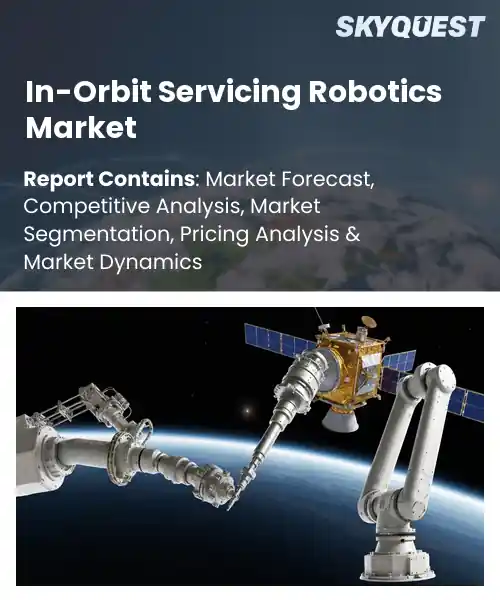
In-Orbit Servicing Robotics Market
Report ID: SQMIG20A2788
Report ID: SQMIG20A2788
[email protected]
USA +1 351-333-4748
Report ID:
SQMIG20A2788 |
Region:
Global |
Published Date: July, 2026
Pages:
157
|Tables:
120
|Figures:
77


Global In-Orbit Servicing Robotics Market size was valued at USD 118.76 Million in 2024 and is poised to grow from USD 165.91 Million in 2025 to USD 2406.79 Million by 2033, growing at a CAGR of 39.7% during the forecast period (2026-2033).
The global in‑orbit servicing robotics market encompasses robotic platforms designed to perform maintenance, refueling, assembly, and debris removal on satellites already operating in space. Its significance stems from the escalating cost of launching new spacecraft and the growing reliance on high‑value assets in low‑Earth orbit. The primary driver is the economic pressure to extend the useful life of existing satellites, a trend that became evident after the 2010s when commercial operators saw rapid congestion in key orbital slots. Early demonstrations such as ESA’s RemoveDEBRIS and NASA’s Restore‑L mission illustrated robotic capture, sparking significant and substantial private investment that has propelled the market forward.
The emergence of on‑orbit manufacturing and assembly forms a feedback loop that amplifies demand for robotic servicers while enabling the construction of structures too large for launch. When firms plan habitats, telescopes, or solar power stations beyond launch‑vehicle limits, they must rely on robotic arms for joining and component placement, creating revenue streams for service providers. Northrop Grumman’s Mission Extension Vehicle demonstrated viability by docking with a defunct communications satellite and restoring its function, showing how life‑extension services can be monetized. Tighter debris‑mitigation regulations push operators toward robotics for maintenance and clean‑up, sustaining market growth for companies that combine AI autonomy with hardware.
What role does AI-powered Automation Play In The In‑orbit Servicing Robotics Market?
AI powered automation is becoming the brain of in orbit servicing robots, enabling them to perceive, decide and act without constant human input. Machine vision lets a manipulator identify a satellite’s grapple points while deep learning predicts optimal force profiles. Autonomous navigation merges sensor data to chart safe approach paths around debris. Real time fault detection allows the system to reconfigure tasks when a joint stalls, reducing downtime. These capabilities turn a single robotic platform into a versatile service asset that can refuel, repair or reposition multiple spacecraft, accelerating mission turnover and lowering operational costs.
In June 2023, Astroscale completed a successful on orbit demonstration of its ELSA d service vehicle, showing how AI driven guidance and autonomous docking can capture a defunct satellite. The mission proved that intelligent automation reduces crew intervention and speeds up servicing cycles, supporting market expansion.
Market snapshot - (2026-2033)
Global Market Size
USD 118.76 Million
Largest Segment
Satellite Refueling
Fastest Growth
Debris Removal
Growth Rate
39.7% CAGR
To get more insights on this market click here to Request a Free Sample Report
Global in-orbit servicing robotics market is segmented by service type, target orbit, robotic mechanism, end user segment and region. Based on service type, the market is segmented into Satellite Refueling, Inspection Diagnostics, Repair Upgrade, Debris Removal, Relocation Tug and Others. Based on target orbit, the market is segmented into LEO Space, GEO Space and MEO Space. Based on robotic mechanism, the market is segmented into Robotic Arms, Docking Couplers and Capture Nets. Based on end user segment, the market is segmented into Commercial Telecoms, Space Agencies and Defense Units. Based on region, the market is segmented into North America, Europe, Asia Pacific, Latin America and Middle East & Africa.
Satellite refueling segment dominates because it directly extends the functional lifespan of high value assets, reducing the need for costly replacements. Operators value the ability to replenish propellant without launching new hardware, which drives demand for reliable transfer systems. The maturity of fluid handling technologies and growing commercial constellations create a clear incentive hierarchy that elevates refueling as the core service offering within in orbit robotics.
However, repair upgrade segment emerges as the fastest expanding because satellite operators seek to refresh aging hardware and add new capabilities without full replacement. Advances in modular component design and standardized interface protocols lower integration effort, while mission planners value flexibility to respond to evolving service demands, spurring heightened investment in upgrade robotics.
Robotic arms segment leads because they provide the highest degree of manipulation precision, enabling intricate tasks such as connector handling and hardware replacement. Their multi joint architecture supports versatile reach across diverse satellite geometries, which encourages system designers to rely on arm based solutions. The ongoing refinement of force feedback and autonomous control loops further cements their central role in service execution.
Meanwhile, capture nets segment is witnessing growth momentum because debris mitigation and on demand relocation require low mass, capacity capture methods. Material innovations deliver lightweight net structures, while deployment mechanisms reduce mission risk. These advances open new business cases for removal services, driving heightened interest from operators and accelerating market expansion for capture focused robotics.
To get detailed segments analysis, Request a Free Sample Report
North America’s lead in the In‑Orbit Servicing Robotics market stems from a convergence of mature aerospace ecosystems, deep government‑backed research programs, and a vibrant private sector that continuously pushes technological boundaries. The United States hosts a network of leading universities and research labs that generate advanced robotics expertise, while federal agencies provide strategic funding and policy frameworks encouraging on‑orbit servicing concepts. Canada contributes a robust satellite manufacturing base and strong collaborations with U.S. partners, creating a seamless supply chain. A culture of public‑private partnership accelerates prototype development and rapid commercialization, and a regulatory environment that balances safety with innovation further reinforces market leadership. These combined strengths enable North America to set standards, attract talent, and sustain a pipeline of cutting‑edge servicing solutions.
In-Orbit Servicing Robotics Market in the United States benefits from a dense cluster of launch providers, defense contractors, and venture‑backed start‑ups that together accelerate technology transfer from labs to orbit. Federal research initiatives combine with industry consortia to address complex tasks such as refueling, debris removal and component upgrades. This collaborative ecosystem nurtures a continuous flow of talent and funding, reinforcing the United States’ position as a global hub for servicing innovation.
In-Orbit Servicing Robotics Market in Canada is driven by a strong heritage in satellite communications and a government that emphasizes collaboration with North American partners. Canadian research institutions excel in autonomous navigation and precision manipulation, feeding capabilities into commercial ventures focused on servicing missions. The presence of niche manufacturers and a supportive regulatory framework encourages experimental demonstrations, positioning Canada as an essential contributor to cross‑border servicing initiatives and fostering a pipeline of innovative robotic solutions.
Europe’s rapid expansion in the In‑Orbit Servicing Robotics market is propelled by a cohesive policy landscape that prioritizes sustainable space operations and a collective ambition to lead in orbital maintenance. Strong funding mechanisms across the European Union and national agencies encourage multi‑nation research consortia, blending expertise from high‑precision engineering, artificial intelligence and advanced materials. Germany anchors the region with a sophisticated industrial base and deep integration of aerospace suppliers, while the United Kingdom accelerates progress through agile regulatory reforms and vibrant start‑up ecosystems. France contributes emerging capabilities in autonomous navigation and niche satellite services. This synergistic environment fosters cross‑border collaboration, reduces development risk, and creates a fertile ground for innovative servicing solutions that address both commercial demand and debris mitigation objectives.
In-Orbit Servicing Robotics Market in Germany benefits from a world‑class aerospace supply chain and deep engineering expertise that translate into reliable robotic platforms. German research institutes excel at precision manufacturing and systems integration, feeding capabilities into both government‑driven projects and commercial ventures. Strong collaboration between automotive robotics specialists and space agencies accelerates technology transfer, while a supportive financing environment encourages long‑term development of servicing solutions that are recognized across Europe for their robustness and scalability.
In-Orbit Servicing Robotics Market in the United Kingdom is energized by an agile regulatory approach and a thriving start‑up culture that bridges academic breakthroughs with commercial applications. UK universities lead in artificial intelligence for autonomous docking, while private firms leverage this expertise to develop modular servicing kits for a range of satellite platforms. Government incentives promote risk‑sharing collaborations, fostering rapid prototyping and field trials that position the United Kingdom as a fast‑moving hub for innovative on‑orbit service technologies.
In-Orbit Servicing Robotics Market in France is emerging through focused investment in autonomous navigation and miniaturized manipulation technologies. French research centers partner with aerospace firms to create compact servicing modules that can be integrated onto existing satellite buses. A regulatory framework that emphasizes safety and collaborative standards encourages cross‑border projects, while national space agencies provide test‑bed opportunities for validation. These efforts collectively position France as an innovative contributor to the European servicing ecosystem.
Asia Pacific is strengthening its position in the In‑Orbit Servicing Robotics market through a combination of rapid launch growth, strategic governmental roadmaps and a burgeoning ecosystem of technology firms focused on space applications. Nations such as Japan and South Korea are channeling resources into autonomous rendezvous capabilities and modular servicing hardware, aligning these developments with national ambitions for sustainable satellite constellations. Close collaboration between defense research establishments and commercial start‑ups accelerates the translation of advanced robotics into operational tools. Moreover, the region’s emphasis on cost‑effective manufacturing and integration with high‑frequency launch services creates a synergistic environment where servicing solutions can be rapidly deployed, supporting both regional and global demand for orbital maintenance and debris mitigation.
In-Orbit Servicing Robotics Market in Japan is propelled by a long‑standing expertise in precision robotics and a national commitment to space sustainability. Japanese research institutions excel at developing high‑reliability manipulators and advanced vision systems, which are integrated into collaborative projects with satellite operators. Governmental space agencies provide dedicated test facilities that enable iterative validation of servicing concepts, while a vibrant industrial base ensures scalable production. This cohesive approach positions Japan as a leader in delivering dependable on‑orbit maintenance capabilities.
In-Orbit Servicing Robotics Market in South Korea benefits from aggressive national space initiatives and a strong foundation in autonomous systems engineering. Korean research labs focus on compact robotics that can perform refueling and repair tasks in microgravity, while private firms harness these technologies to create plug‑and‑play servicing modules. Government subsidies encourage joint ventures between defense contractors and commercial satellite providers, fostering rapid technology transfer. Together these elements advance South Korea’s capability to offer cost‑effective, reliable on‑orbit services within the broader Asia Pacific landscape.
To know more about the market opportunities by region and country, click here to
Buy The Complete Report
Increasing Satellite Maintenance Demand
Advancements In Autonomous Robotics
High Development Cost Barriers
Limited Operational Experience
Request Free Customization of this report to help us to meet your business objectives.
The competitive landscape is shaped by a cluster of newly founded firms racing to secure niche capabilities in autonomous satellite repair, refueling and debris removal, while incumbents accelerate M&A and partnership deals to integrate these services into existing constellations. Recent strategic moves include joint development agreements between servicing startups and launch providers, and the acquisition of niche robotics IP by larger aerospace groups, intensifying pressure on market share and technology leadership.
SkyQuest’s ABIRAW (Advanced Business Intelligence, Research & Analysis Wing) is our Business Information Services team that Collects, Collates, Correlates, and Analyses the Data collected by means of Primary Exploratory Research backed by robust Secondary Desk research.
As per SkyQuest analysis, the global in‑orbit servicing robotics market is propelled primarily by the rising demand for satellite maintenance, which pushes operators to seek cost‑effective refueling and repair solutions, while breakthroughs in autonomous robotics and AI further accelerate adoption by lowering mission risk. The satellite‑refueling segment leads the market, reflecting its role in extending high‑value assets. North America dominates due to its mature aerospace ecosystem and extensive public‑private partnerships. However, the high development cost of reliable space‑qualified hardware remains a significant restraint, slowing entry for smaller innovators and tempering overall growth. In addition, growing regulatory incentives for sustainable space operations encourage investment in on‑orbit services, and these factors together shape a rapidly expanding market outlook.
| Report Metric | Details |
|---|---|
| Market size value in 2024 | USD 118.76 Million |
| Market size value in 2033 | USD 2406.79 Million |
| Growth Rate | 39.7% |
| Base year | 2024 |
| Forecast period | (2026-2033) |
| Forecast Unit (Value) | USD Million |
| Segments covered |
|
| Regions covered | North America (US, Canada), Europe (Germany, France, United Kingdom, Italy, Spain, Rest of Europe), Asia Pacific (China, India, Japan, Rest of Asia-Pacific), Latin America (Brazil, Rest of Latin America), Middle East & Africa (South Africa, GCC Countries, Rest of MEA) |
| Companies covered |
|
| Customization scope | Free report customization with purchase. Customization includes:-
|
To get a free trial access to our platform which is a one stop solution for all your data requirements for quicker decision making. This platform allows you to compare markets, competitors who are prominent in the market, and mega trends that are influencing the dynamics in the market. Also, get access to detailed SkyQuest exclusive matrix.
Table Of Content
Executive Summary
Market overview
Parent Market Analysis
Market overview
Market size
KEY MARKET INSIGHTS
COVID IMPACT
MARKET DYNAMICS & OUTLOOK
Market Size by Region
KEY COMPANY PROFILES
Methodology
For the In-Orbit Servicing Robotics Market, our research methodology involved a mixture of primary and secondary data sources. Key steps involved in the research process are listed below:
1. Information Procurement: This stage involved the procurement of Market data or related information via primary and secondary sources. The various secondary sources used included various company websites, annual reports, trade databases, and paid databases such as Hoover's, Bloomberg Business, Factiva, and Avention. Our team did 45 primary interactions Globally which included several stakeholders such as manufacturers, customers, key opinion leaders, etc. Overall, information procurement was one of the most extensive stages in our research process.
2. Information Analysis: This step involved triangulation of data through bottom-up and top-down approaches to estimate and validate the total size and future estimate of the In-Orbit Servicing Robotics Market.
3. Report Formulation: The final step entailed the placement of data points in appropriate Market spaces in an attempt to deduce viable conclusions.
4. Validation & Publishing: Validation is the most important step in the process. Validation & re-validation via an intricately designed process helped us finalize data points to be used for final calculations. The final Market estimates and forecasts were then aligned and sent to our panel of industry experts for validation of data. Once the validation was done the report was sent to our Quality Assurance team to ensure adherence to style guides, consistency & design.
Analyst Support
Customization Options
With the given market data, our dedicated team of analysts can offer you the following customization options are available for the In-Orbit Servicing Robotics Market:
Product Analysis: Product matrix, which offers a detailed comparison of the product portfolio of companies.
Regional Analysis: Further analysis of the In-Orbit Servicing Robotics Market for additional countries.
Competitive Analysis: Detailed analysis and profiling of additional Market players & comparative analysis of competitive products.
Go to Market Strategy: Find the high-growth channels to invest your marketing efforts and increase your customer base.
Innovation Mapping: Identify racial solutions and innovation, connected to deep ecosystems of innovators, start-ups, academics, and strategic partners.
Category Intelligence: Customized intelligence that is relevant to their supply Markets will enable them to make smarter sourcing decisions and improve their category management.
Public Company Transcript Analysis: To improve the investment performance by generating new alpha and making better-informed decisions.
Social Media Listening: To analyze the conversations and trends happening not just around your brand, but around your industry as a whole, and use those insights to make better Marketing decisions.
REQUEST FOR SAMPLE
 REQUEST FREE CUSTOMIZATION
Global In-Orbit Servicing Robotics Market size was valued at USD 118.76 Million in 2024 and is poised to grow from USD 165.91 Million in 2025 to USD 2406.79 Million by 2033, growing at a CAGR of 39.7% during the forecast period (2026-2033).
The competitive landscape is shaped by a cluster of newly founded firms racing to secure niche capabilities in autonomous satellite repair, refueling and debris removal, while incumbents accelerate M&A and partnership deals to integrate these services into existing constellations. Recent strategic moves include joint development agreements between servicing startups and launch providers, and the acquisition of niche robotics IP by larger aerospace groups, intensifying pressure on market share and technology leadership. 'Northrop Grumman Corporation', 'SpaceLogistics LLC', 'Astroscale Holdings Inc', 'Maxar Technologies Inc', 'Airbus Defence and Space', 'Thales Alenia Space', 'ClearSpace SA', 'Honeybee Robotics LLC', 'D-Orbit SpA', 'Telespazio SpA', 'Leonardo SpA', 'Avio SpA', 'Lockheed Martin Corporation', 'L3Harris Technologies Inc', 'Saab AB', 'MDA Space Ltd', 'Redwire Corporation', 'Momentus Inc', 'Orbit Fab Inc', 'Starfish Space Inc'
The growing number of operational satellites creates a need for on‑orbit servicing to extend mission lifespans, reduce debris, and maximize asset value, which encourages investment in robotic platforms capable of refueling, repair, and component replacement, thereby driving market expansion as operators seek cost‑effective solutions to maintain functionality without launching new hardware. These services also enable strategic flexibility for future constellation upgrades and support emerging commercial activities such as in‑space manufacturing, further reinforcing the attractiveness of in‑orbit robotics to both governmental agencies and private enterprises seeking sustainable space operations.
Satellite Re‑Fueling Acceleration: Satellite refueling acceleration is reshaping mission economics as operators seek to extend asset lifespans without costly replacements. Emerging service providers are demonstrating plug‑and‑play fuel transfer modules compatible with multiple platform families, reducing integration barriers. This capability enables flexible constellation management, supports on‑demand orbital repositioning, and opens new revenue streams for satellite owners. The trend is reinforced by government incentives encouraging sustainable space operations and by joint industry consortia establishing shared standards that simplify cross‑vendor collaboration in the coming years worldwide.
Why does North America Dominate the Global In‑Orbit Servicing Robotics Market? |@12


Want to customize this report? This report can be personalized according to your needs. Our analysts and industry experts will work directly with you to understand your requirements and provide you with customized data in a short amount of time. We offer $1000 worth of FREE customization at the time of purchase.
Feedback From Our Clients


 USA (+1) 351-333-4748

