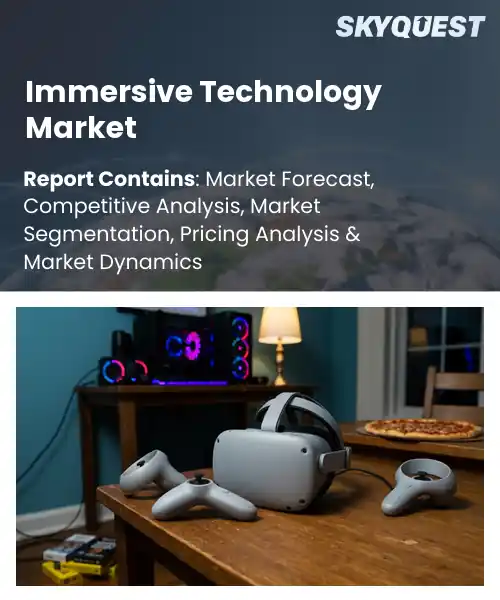
Immersive Technology Market
Report ID: SQMIG45I2416
Report ID: SQMIG45I2416
[email protected]
USA +1 351-333-4748
Report ID:
SQMIG45I2416 |
Region:
Global |
Published Date: June, 2026
Pages:
157
|Tables:
139
|Figures:
78


Global Immersive Technology Market size was valued at USD 7.4 Billion in 2024 and is poised to grow from USD 7.72 Billion in 2025 to USD 10.81 Billion by 2033, growing at a CAGR of 4.3% during the forecast period (2026-2033).
The primary driver of the immersive technology market is advances in hardware performance and connectivity that lower barriers to realistic virtual and augmented experiences. Immersive technology includes virtual reality, augmented reality and mixed reality platforms used across entertainment and enterprise; it matters because these systems transform how people access information and complete tasks. The market evolved from research prototypes to consumer and enterprise ready products as chip efficiency improved, displays gained resolution and networks reduced latency. Consumer hits like Pokémon Go and Oculus Rift sparked interest while Microsoft's HoloLens illustrated practical industrial applications such as remote assistance and design visualization.
When companies deploy virtual simulations for employee training, error rates fall and throughput rises, which motivates further investment in tailored content and integration with AI driven analytics. In healthcare, surgical simulation shortens learning curves and reduces complications, leading hospitals to adopt head mounted displays and supporting software. In manufacturing, remote augmented guidance cuts downtime and travel costs, prompting OEMs to embed immersive modules into service contracts, thereby creating recurring revenue and scaled opportunities in adjacent sectors.
How is AI transforming the immersive technology market?
The immersive technology industry is evolving with the inclusion of AI technology in the understanding of scenes as well as the development and use of content and interactivity within virtual and augmented environments. Key elements of these technologies include: Scene understanding by AI, Generative content for runtime generation of content (creating worlds), and Adaptive agents used to personalize the user experience. Current implementations are automating the creation of environments, enhancing hand/eye tracking and powering smart collaboration and training tools that make Enterprise solutions more viable. The impact of these developments is reducing friction in production and expanding the types of use cases from entertainment to healthcare and industrial training. AI-assisted tooling for WebX and the increased naturalness of passthrough experiences are typical examples of enhancing the ability to adopt mixed realities.
In May 2026, Google at their developer event showcased their Android XR smart glasses powered by Gemini AI and demonstrated real-time translation as well as context-aware assistants that function within the user's field of vision. By integrating AI, the content creation process and day-to-day use are streamlined, increasing the rate of growth for the immersive market and improving overall operational efficiency.
Market snapshot - (2026-2033)
Global Market Size
USD 7.4 Billion
Largest Segment
Consumer VR
Fastest Growth
Enterprise VR
Growth Rate
4.3% CAGR
To get more insights on this market click here to Request a Free Sample Report
Global immersive technology market is segmented by virtual reality, augmented reality, mixed reality, haptic technology, 3d reconstruction and region. Based on virtual reality, the market is segmented into Consumer VR and Enterprise VR. Based on augmented reality, the market is segmented into Mobile AR and AR Glasses. Based on mixed reality, the market is segmented into MR Devices and MR Applications. Based on haptic technology, the market is segmented into Wearable Devices and Non-Wearable Devices. Based on 3d reconstruction, the market is segmented into Software Solutions and Hardware Solutions. Based on region, the market is segmented into North America, Europe, Asia Pacific, Latin America and Middle East & Africa.
Enterprise VR segment leads because corporate buyers prioritize solutions that deliver measurable training outcomes and operational efficiencies, driving demand for robust headsets, specialized software, and secure deployment models. Large-scale implementations incentivize vendors to develop enterprise-grade integrations, professional services, and compliance features, which in turn establish durable vendor relationships and a steady pipeline of industry-specific content that reinforces market credibility and long-term procurement cycles.
However, consumer vr is emerging as the most rapidly expanding area due to growing content ecosystems, social immersive experiences, and improving affordability of headsets that stimulate mass-market adoption. Developers and platforms are innovating user-friendly interfaces and entertainment formats, expanding addressable audiences and creating new commercial opportunities across retail, leisure, and creator economies.
Wearable Devices segment stands out because body-mounted haptic gear and tactile controllers provide direct, personalized feedback that significantly heightens presence and task accuracy across applications. Advances in miniaturization, wireless connectivity, and sensor fidelity make wearable haptics practical for integration with VR, AR, and MR environments, prompting adoption in healthcare training, industrial simulation, and premium entertainment where realistic touch cues improve learning outcomes and user engagement.
However, non-wearable devices are witnessing the strongest growth momentum as room-scale haptic arrays, mid-air feedback systems, and environmental actuators enable shared and location-based immersive experiences attractive to venues and enterprises. Improvements in actuator efficiency and scalable deployment approaches reduce integration friction for public installations, unlocking new business models and revenue opportunities for content producers and system integrators.
To get detailed segments analysis, Request a Free Sample Report
North America is well placed with a dense concentration of technical infrastructure, mature commercialization channels and a deep pool of expertise in hardware, software and content production. There is close collaboration between universities, research institutes and industry that accelerates applied innovation and minimizes time to market. Practical use cases are being created by broad enterprise adoption spanning healthcare, defense, training and entertainment, drawing investment and talented teams. An environment where platforms, devices and immersive experiences can scale swiftly and iteratively, with strong cloud and network capabilities, existing content production ecosystems and a hunger for early adoption among consumers and companies.
United States is driven by leading platform providers, major content studios and a concentration of investment. Strong ties between universities and industry fuel applied research, while enterprise demand from healthcare, defense and media creates practical deployment pathways. Robust cloud infrastructure and device development enable rapid iteration. Cross sector partnerships and a consumer base receptive to experiential products support a dynamic environment for diverse immersive offerings.
Canada benefits from a strong creative sector and supportive public programs that nurture startups and studios. Regional hubs host collaborative networks linking universities, private developers and cultural institutions to pilot experiential initiatives. Emphasis on content quality, bilingual markets and export oriented studios fosters global partnerships. Government incentives and focused talent development encourage commercialization, while proximity to United States markets facilitates cross border collaboration and scale opportunities.
Asia Pacific expansion is being driven by strong device manufacturing capabilities, dynamic consumer demand and a vibrant entertainment and gaming culture that rapidly absorbs new interaction paradigms. Regional vendors and global partners collaborate to optimize hardware, platforms and distribution, with next generation mobile networks and expanding internet reach facilitating richer experiences for consumers and enterprises alike. Governments and corporate sector leaders are focusing on digital transformation in retail, education and manufacturing, developing feasible implementation strategies. Local content development and export orientation increase regional influence, investment ecosystems and urban testbeds reduce barriers to experimental deployments. Partnerships between industry and education institutions develop applied skills and help to speed up commercialization in a range of markets.
Japan leverages strengths in precision hardware, consumer electronics and robotics to advance device innovation. Corporations and startups collaborate with universities to convert research into applications across healthcare, manufacturing and entertainment. Cultural focus on design quality fosters sophisticated content development, while domestic appetite for practical solutions drives enterprise pilots. Integration between component manufacturers and platform developers supports export oriented strategies and the emergence of refined immersive offerings.
South Korea is shaped by a strong gaming culture, high digital connectivity and world class device manufacturers that drive hardware availability. Local creative studios and platform companies produce competitive content and experiences, while corporate and public sector pilots showcase use cases in retail, education and training. Export development and tight integration with telecom and electronics suppliers enable rapid commercialization and innovation across consumer and enterprise segments.
As per immersive technology industry analysis, Europe is reinforcing its position through coordinated research programs, an emphasis on interoperability and privacy standards and a targeted public procurement that creates early demand for immersive solutions. Robust industrial clusters in the fields of manufacturing, automotive and cultural sectors are applying immersive methods for design, training and customer involvement, while public and private research centers are fostering applied innovation. National initiatives and cross-border alliances stimulate technology transfer and talent mobility, while investment in skills development feeds a developing ecosystem of startups and established enterprises. European standards agencies and industry consortia are working on alignment of technical and content requirements to reduce fragmentation and enable easier cross border deployments. Immersive exhibitions, developed in cooperation between cultural institutions and tourism operators, highlight creative uses and stimulate consumer demand.
As per immersive technology market regional forecast, Germany market demonstrates considerable industrial adoption in automotive and manufacturing sectors where immersive tools are used for design, simulation and workforce training. Applied research centers and engineering companies collaborate on developing scalable solutions and trial deployments across supply chains. Specialist vendors and system integrators assist with integration while public innovation programmes assist with commercialization. Focus on reliability, safety and standards helps transition prototypes into solid commercial offers for home and foreign markets.
As per immersive technology market regional outlook, United Kingdom draws strength from a vibrant creative and media ecosystem, cultural institutions and research. Creative studios, film and game developers pioneer immersive narratives while startups translate concepts into services. Public sector initiatives and cultural commissions support experimental deployments in museums and public spaces, fostering consumer engagement. Collaboration between media and technology sectors facilitates investment and scaling, positioning the market for enterprise and consumer offerings.
France is grounded in a rich cultural landscape and strong game development studios that nurture immersive experiences. Luxury brands and retail firms experiment with experiential marketing, while museums and heritage sites adopt immersive exhibits to engage visitors. Public support for creative industries and research networks enables pilots and commercialization. Cross sector partnerships between creative houses and technology firms drive immersive offerings that resonate domestically and internationally.
To know more about the market opportunities by region and country, click here to
Buy The Complete Report
Technological Advancements In Hardware
Growing Enterprise and Consumer Adoption
High Development and Deployment Costs
Content Production Complexity and Skills
Request Free Customization of this report to help us to meet your business objectives.
Intense competition in the global immersive technology industry is driven by platform integrations, AI content tools, and device interoperability, prompting concrete strategies such as enterprise partnerships, targeted acquisitions, and rapid product innovation to secure developer ecosystems and corporate contracts; notable examples include Meta’s enterprise partnership with Microsoft for Teams and Windows cloud services and hardware makers acquiring content capabilities to accelerate enterprise offerings.
SkyQuest’s ABIRAW (Advanced Business Intelligence, Research & Analysis Wing) is our Business Information Services team that Collects, Collates, Correlates, and Analyses the Data collected by means of Primary Exploratory Research backed by robust Secondary Desk research.
As per SkyQuest analysis, the global immersive technology market growth is poised for steady growth driven by improvements in hardware performance and connectivity that lower barriers to realistic virtual and augmented experiences, and by measurable enterprise adoption that ties immersive deployments to efficiency and revenue outcomes. North America remains the dominant region due to deep talent, infrastructure and commercialization channels, while enterprise VR leads as the primary segment due to corporate demand for training and operational solutions. High development and deployment costs represent a key restraint that slows broader adoption, particularly among smaller organizations, making cost reduction and streamlined content pipelines critical for wider market expansion.
| Report Metric | Details |
|---|---|
| Market size value in 2024 | USD 7.4 Billion |
| Market size value in 2033 | USD 10.81 Billion |
| Growth Rate | 4.3% |
| Base year | 2024 |
| Forecast period | (2026-2033) |
| Forecast Unit (Value) | USD Billion |
| Segments covered |
|
| Regions covered | North America (US, Canada), Europe (Germany, France, United Kingdom, Italy, Spain, Rest of Europe), Asia Pacific (China, India, Japan, Rest of Asia-Pacific), Latin America (Brazil, Rest of Latin America), Middle East & Africa (South Africa, GCC Countries, Rest of MEA) |
| Companies covered |
|
| Customization scope | Free report customization with purchase. Customization includes:-
|
To get a free trial access to our platform which is a one stop solution for all your data requirements for quicker decision making. This platform allows you to compare markets, competitors who are prominent in the market, and mega trends that are influencing the dynamics in the market. Also, get access to detailed SkyQuest exclusive matrix.
Table Of Content
Executive Summary
Market overview
Parent Market Analysis
Market overview
Market size
KEY MARKET INSIGHTS
COVID IMPACT
MARKET DYNAMICS & OUTLOOK
Market Size by Region
KEY COMPANY PROFILES
Methodology
For the Immersive Technology Market, our research methodology involved a mixture of primary and secondary data sources. Key steps involved in the research process are listed below:
1. Information Procurement: This stage involved the procurement of Market data or related information via primary and secondary sources. The various secondary sources used included various company websites, annual reports, trade databases, and paid databases such as Hoover's, Bloomberg Business, Factiva, and Avention. Our team did 45 primary interactions Globally which included several stakeholders such as manufacturers, customers, key opinion leaders, etc. Overall, information procurement was one of the most extensive stages in our research process.
2. Information Analysis: This step involved triangulation of data through bottom-up and top-down approaches to estimate and validate the total size and future estimate of the Immersive Technology Market.
3. Report Formulation: The final step entailed the placement of data points in appropriate Market spaces in an attempt to deduce viable conclusions.
4. Validation & Publishing: Validation is the most important step in the process. Validation & re-validation via an intricately designed process helped us finalize data points to be used for final calculations. The final Market estimates and forecasts were then aligned and sent to our panel of industry experts for validation of data. Once the validation was done the report was sent to our Quality Assurance team to ensure adherence to style guides, consistency & design.
Analyst Support
Customization Options
With the given market data, our dedicated team of analysts can offer you the following customization options are available for the Immersive Technology Market:
Product Analysis: Product matrix, which offers a detailed comparison of the product portfolio of companies.
Regional Analysis: Further analysis of the Immersive Technology Market for additional countries.
Competitive Analysis: Detailed analysis and profiling of additional Market players & comparative analysis of competitive products.
Go to Market Strategy: Find the high-growth channels to invest your marketing efforts and increase your customer base.
Innovation Mapping: Identify racial solutions and innovation, connected to deep ecosystems of innovators, start-ups, academics, and strategic partners.
Category Intelligence: Customized intelligence that is relevant to their supply Markets will enable them to make smarter sourcing decisions and improve their category management.
Public Company Transcript Analysis: To improve the investment performance by generating new alpha and making better-informed decisions.
Social Media Listening: To analyze the conversations and trends happening not just around your brand, but around your industry as a whole, and use those insights to make better Marketing decisions.
REQUEST FOR SAMPLE
 REQUEST FREE CUSTOMIZATION
Global Immersive Technology Market size was valued at USD 7.4 Billion in 2024 and is poised to grow from USD 7.72 Billion in 2025 to USD 10.81 Billion by 2033, growing at a CAGR of 4.3% during the forecast period (2026-2033).
Intense competition in the global immersive technology landscape is driven by platform integrations, AI content tools, and device interoperability, prompting concrete strategies such as enterprise partnerships, targeted acquisitions, and rapid product innovation to secure developer ecosystems and corporate contracts; notable examples include Meta’s enterprise partnership with Microsoft for Teams and Windows cloud services and hardware makers acquiring content capabilities to accelerate enterprise offerings. 'Oculus', 'Unity Technologies', 'Epic Games', 'Niantic', 'Magic Leap', 'Varjo', 'Pimax', 'HTC Vive', 'Sony Interactive Entertainment', 'Microsoft HoloLens', 'Immersive Tech', 'Dreamscape Immersive', 'Infinadeck', 'VIVE Studios', 'Figment Productions', 'IKEA Place', 'Sphericam', 'Voodoo Manufacturing', 'Tilt Five', 'Ultrahaptics'
Advancements in display resolution, sensor fidelity, and processing efficiency have significantly improved the realism and comfort of immersive experiences, making solutions more attractive to businesses and consumers. Better tracking and lower latency reduce motion discomfort and broaden practical applications, while refinement in haptic feedback and ergonomics increases user session duration and satisfaction. These cumulative hardware improvements reduce perceived barriers to adoption by enhancing usability and perceived value, encouraging enterprise deployment for training, design, and collaboration as well as stimulating consumer interest in entertainment and social uses.
Enterprise Adoption Of Immersive Platforms: Enterprises across industries are shifting from pilots to strategic deployment of immersive platforms to enhance collaboration, training, and customer engagement. Focus is moving to platform consolidation, integration with existing enterprise systems, and governance frameworks that ensure scalability and security. Vendors and architects emphasize interoperability, management tools, and verticalized content to meet enterprise workflows. This trend accelerates demand for end to end services and managed offerings, reducing integration friction and enabling firms to realize process and experience improvements from immersive investments.
Why does North America Dominate the Global Immersive Technology Market? |@12


Want to customize this report? This report can be personalized according to your needs. Our analysts and industry experts will work directly with you to understand your requirements and provide you with customized data in a short amount of time. We offer $1000 worth of FREE customization at the time of purchase.
Feedback From Our Clients


 USA (+1) 351-333-4748

