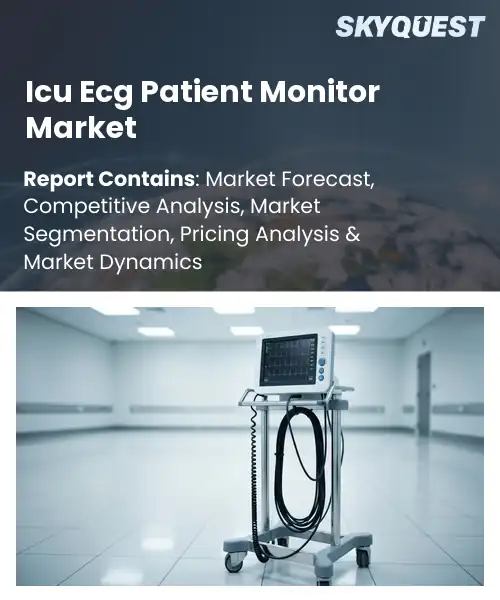
Icu Ecg Patient Monitor Market
Report ID: SQMIG35A4021
Report ID: SQMIG35A4021
[email protected]
USA +1 351-333-4748
Report ID:
SQMIG35A4021 |
Region:
Global |
Published Date: June, 2026
Pages:
157
|Tables:
171
|Figures:
79


Global Icu Ecg Patient Monitor Market size was valued at USD 2.7 Billion in 2024 and is poised to grow from USD 2.85 Billion in 2025 to USD 4.41 Billion by 2033, growing at a CAGR of 5.6% during the forecast period (2026-2033).
The global ICU ECG patient monitor market comprises of devices used in intensive care units to monitor critically ill patients for electrocardiographic signals, vital signs and hemodynamic parameters. Importance: The importance is in the early detection of arrhythmias thus reducing mortality and length of stay. One of the major factors is the increasing prevalence of cardiovascular disorders coupled with the aging population, thereby enlarging the patient pool needing cardiac surveillance. Previously, monitors were large and displayed only waveforms. Signal processing was added in the 1990s. The 2010s brought integration with information systems and wireless telemetry; Philips’ IntelliVue series and GE’s CARESCAPE platform are examples.
The rising use of tele-intensive care is driving the ICU ECG patient monitor market, as visualizing cardiac data enables physicians to intervene earlier and use resources effectively. Hospitals in China and the United Arab Emirates have adopted cloud-based suites that aggregate bedside ECG streams so command centers can triage alarms and reduce nurse fatigue. This shift further drives the demand for connected monitors with AI-based arrhythmia detection and cyber security certifications. Platform launches in this regard by manufacturers such as Mindray and Nihon Kohden have been witnessed. As a result, revenues from software upgrades and service contracts are higher than those from hardware, creating income and encouraging market consolidation.
How is AI enhancing real-time analytics in the ICU ECG patient monitor market?
AI is transforming ICU ECG patient monitors by turning raw waveforms into real-time actionable insights. Machine learning algorithms sift noise, identify arrhythmias in real time and predict deterioration before alarms sound. Integrated dashboards provide clinicians with at-a-glance trends that reduce cognitive load. Cloud based models learn from every admission and ever improving accuracy across units. Vendors embed AI chips directly into the monitor, so that processing can be done at the edge and not on hospital IT. This change turns the device from a passive recorder to an active decision support tool, in line with the wider push towards smarter intensive care environments.
In November 2025, QluPod introduced an AI enhanced real time analytics suite that integrates ECG streams with predictive alerts that guide bedside interventions. This system reduces response times, simplifies workflow and is a demonstration of how smart monitoring drives efficiency and enables the growing ICU ECG market.
Market snapshot - (2026-2033)
Global Market Size
USD 2.7 Billion
Largest Segment
Fastest Growth
Growth Rate
5.6% CAGR
To get more insights on this market click here to Request a Free Sample Report
Global icu ecg patient monitor market is segmented by product type, lead configuration, end user, patient group, connectivity type, procurement type and region. Based on product type, the market is segmented into Bedside ECG Monitors, Portable ECG Monitors, Wearable ECG Monitors and Others. Based on lead configuration, the market is segmented into 3-Lead ECG Monitors, 5-Lead ECG Monitors and 12-Lead ECG Monitors. Based on end user, the market is segmented into Hospitals, Cardiac Care Centers, Ambulatory Care Centers and Others. Based on patient group, the market is segmented into Adult Patients, Pediatric Patients and Neonatal Patients. Based on connectivity type, the market is segmented into Wired Monitors and Wireless Monitors. Based on procurement type, the market is segmented into New Equipment Purchases and Replacement Equipment Purchases. Based on region, the market is segmented into North America, Europe, Asia Pacific, Latin America and Middle East & Africa.
Multi lead segment dominates, as clinicians require comprehensive cardiac visibility provided by multiple electrodes to allow accurate detection of arrhythmia and hemodynamic correlation in critical care. The potential to acquire a full twelve lead equivalent in the ICU facilitates more sophisticated diagnostic decision making and lends itself well to advanced decision support algorithms. This depth of data drives confidence in treatment pathways, preference for multi lead devices and solidifies its leading position in the market.
Meanwhile, single lead segment is growing at the fastest pace owing to its portability, ease of deployment and less cable clutter, which is in line with emerging bedside scenarios. These units are being welcomed in hospitals in overflow areas for rapid triage and ongoing monitoring, speeding up market penetration and opening the way for integration with mobile health platforms.
The wireless segment is prevalent because it removes physical restrictions and facilitates flexible placement at the bedside, reducing the risk of infection associated with cable handling. Wireless connectivity improves the efficiency of workflow, allows rapid reconfiguration when patients are transferred, and helps hospitals in their efforts to create modern care environments. Real time data transmission that integrates with electronic health records improves operational efficiency and patient safety and reinforces wireless leadership in the market, says clinicians.
On the other hand, wired segment is witnessing the strongest growth momentum as hospitals upgrade legacy infrastructure with high bandwidth Ethernet supporting multiplexed data streams and ensuring reliable low latency transmission. This demand drives investment into robust cabling solutions and creates new avenues for integrated monitoring ecosystems.
To get detailed segments analysis, Request a Free Sample Report
North America’s advantage is a deeply integrated ecosystem that blends the best of clinical practice with the latest in technology. Reimbursement schemes by healthcare providers promote the early adoption of advanced monitoring solutions. Device manufacturers, research institutions and regulatory agencies work closely to speed product innovation and rapid market entry. A mature hospital infrastructure enables a seamless deployment of advanced ICU ECG platforms with a continuing demand for patient safety and outcome driven care. This further solidifies the region’s leadership in corporate investment in training and digital health projects, creating a feedback loop of expertise and market growth.
The hospital market is underpinned by a highly sophisticated network of US hospitals with a focus on precision diagnostics and integrated care pathways. Top tech companies are delivering a flood of new devices to meet advanced cardiac monitoring needs. Strong reimbursement policies and a culture of evidence-based practice are driving hospitals to upgrade to newer monitoring platforms. Industry partnering with academic medical centers allows for speed of clinical validation further building market confidence and continuing a path of high value adoption.
The ICU ECG Patient Monitor Market is influenced by the publicly funded healthcare system in Canada, which stresses the significance of equal access to advanced clinical tools. Provincial health authorities are actively supporting state of the art monitoring equipment to improve standards of critical care. The rapid deployment of innovative ECG solutions is further accelerated by strong regulatory convergence with international standards. The emphasis on multi-disciplinary teamwork and continuous professional development enables the clinicians to use complex monitoring data to the fullest, thereby boosting the growth potential of the market.
Europe is growing fast, thanks to a single regulatory framework that makes it easier to transfer technology across borders, and to do joint research. The trend toward outcome-based and patient-centric models of care by health systems in the region is fueling investment in high-resolution cardiac monitoring in the intensive care setting. Data interoperability and remote monitoring are some of the digital health solutions being integrated to improve clinical decision-making and support broader sustainability goals. Europe is a vibrant growth region with significant government incentives for innovation and an established network of medical device manufacturers that is leading the way for adoption of next-generation ICU ECG platforms.
Germany Icu Ecg Patient Monitor Market is driven by a strong engineering culture leading to high quality devices and rigorous validation in a clinical environment. The country has a huge network of tertiary care hospitals with advanced monitoring technologies to help manage complicated cardiac cases. Industry-research institutes-health authorities partnerships speed up the product development cycle. The market reputation for reliability continues to drive procurement activity, supported by a commitment to precision medicine and exacting quality standards.
The United Kingdom Icu Ecg Patient Monitor Market is witnessing the rapid adoption of demand due to the modernization initiatives in critical care by the country. NHS trusts are investing in interoperable monitoring solutions that work with electronic health record platforms to improve the real-time data analytics. Academic partnerships and clinical research networks provide the infrastructure that enables the rapid evaluation of emerging technologies. The UK is a fast moving segment of the European landscape with policy focus on improving patient outcomes and operational efficiency driving a proactive procurement mindset.
France Icu Ecg Patient Monitor Market is emerging with the vigorous efforts being made to upgrade the intensive care capabilities across the country. Public hospitals are increasingly using advanced ECG monitoring as a way to achieve national health goals around patient safety and quality of care. The collaboration of French device innovators and healthcare providers accelerates the adoption of state-of-the-art technologies. Training programs and clinical guidelines are the basis for effective integration of advanced monitoring tools, which in turn is driving an increasing market presence.
Asia Pacific is cementing its position with increased critical care capacity and government support for purchase of health technology. Demographic changes and changing disease patterns are driving demand for advanced cardiac monitoring and countries across the region are upgrading their hospital infrastructure. The collaboration of local manufacturers and international innovators is putting money into research and development that is improving the availability of tailored ICU ECG solutions. The clinical value is further enhanced with the focus on digital health platforms and data connectivity, making the region an emerging leader in intensive care monitoring.
The Icu Ecg Patient Monitor Market has been fuelled by Japan’s long-term commitment to precision medicine and meticulous clinical practice. The high-tech hospital is acquiring more sophisticated monitoring systems that offer a lot of cardiac data. Japanese electronics giants are joining hands with medical institutions to continuously create new small, high-resolution ECG devices. Government health policies promoting the use of technology in critical care settings are also driving the market growth. A culture of rigorous quality assurance is helping to maintain the confidence of clinicians.
South Korea Icu Ecg Patient Monitor Market is propelled by rapid digital transformation initiatives in the healthcare industry. China’s advanced manufacturing base provides rapid development and scale-up of advanced ICU ECG platforms. Public and private hospitals are also turning to data-driven monitoring solutions to improve patient outcomes and operational efficiency. A strong focus on research collaborations and regulatory agility for introduction of the latest cardiac monitoring technologies, supports South Korea’s growing influence in the regional market.
To know more about the market opportunities by region and country, click here to
Buy The Complete Report
Rising Demand for Continuous Monitoring
Advancements In Integrated Connectivity
High Cost Of Advanced Devices
Regulatory Complexity Across Regions
Request Free Customization of this report to help us to meet your business objectives.
Big players like Becton Dickinson, Nihon Kohden and Biotronik are acquiring companies and entering joint development agreements to embed AI-powered analytics into ICU ECG monitors, laying the competitive groundwork. New entrants are collaborating with health-system networks to embed remote monitoring capabilities and accelerate market access. The industry’s move to adopt new technology has been exemplified recently by heightened competition and faster innovation such as Becton Dickinson’s partnership with a leading AI company to improve arrhythmia detection and Nihon Kohden’s acquisition of a cloud-based data platform.
Our Business Information Services team, ABIRAW (Advanced Business Intelligence, Research & Analysis Wing), Collects, Collates, Correlates and Analyses the Data collected through means of Primary Exploratory Research supported by robust Secondary Desk research.
Based on SkyQuest analysis, the global ICU ECG patient monitor market is majorly driven by the rising need for continuous cardiac monitoring for early detection of arrhythmias and better patient outcomes. The rapid development of integrated wireless connectivity that can connect the monitor with hospital information systems and cloud platforms is also contributing to the growth of the market. High cost of acquisition and maintenance of sophisticated devices are major restraints that limit adoption in budget constrained facilities. North America continues to dominate the segment landscape supported by a robust reimbursement landscape and mature hospital infrastructure and multi-lead monitor configurations dominate the segment landscape as clinicians prefer multi-lead monitor configurations for full cardiac visibility for accurate diagnosis.
| Report Metric | Details |
|---|---|
| Market size value in 2024 | USD 2.7 Billion |
| Market size value in 2033 | USD 4.41 Billion |
| Growth Rate | 5.6% |
| Base year | 2024 |
| Forecast period | (2026-2033) |
| Forecast Unit (Value) | USD Billion |
| Segments covered |
|
| Regions covered | North America (US, Canada), Europe (Germany, France, United Kingdom, Italy, Spain, Rest of Europe), Asia Pacific (China, India, Japan, Rest of Asia-Pacific), Latin America (Brazil, Rest of Latin America), Middle East & Africa (South Africa, GCC Countries, Rest of MEA) |
| Companies covered |
|
| Customization scope | Free report customization with purchase. Customization includes:-
|
To get a free trial access to our platform which is a one stop solution for all your data requirements for quicker decision making. This platform allows you to compare markets, competitors who are prominent in the market, and mega trends that are influencing the dynamics in the market. Also, get access to detailed SkyQuest exclusive matrix.
Table Of Content
Executive Summary
Market overview
Parent Market Analysis
Market overview
Market size
KEY MARKET INSIGHTS
COVID IMPACT
MARKET DYNAMICS & OUTLOOK
Market Size by Region
KEY COMPANY PROFILES
Methodology
For the Icu Ecg Patient Monitor Market, our research methodology involved a mixture of primary and secondary data sources. Key steps involved in the research process are listed below:
1. Information Procurement: This stage involved the procurement of Market data or related information via primary and secondary sources. The various secondary sources used included various company websites, annual reports, trade databases, and paid databases such as Hoover's, Bloomberg Business, Factiva, and Avention. Our team did 45 primary interactions Globally which included several stakeholders such as manufacturers, customers, key opinion leaders, etc. Overall, information procurement was one of the most extensive stages in our research process.
2. Information Analysis: This step involved triangulation of data through bottom-up and top-down approaches to estimate and validate the total size and future estimate of the Icu Ecg Patient Monitor Market.
3. Report Formulation: The final step entailed the placement of data points in appropriate Market spaces in an attempt to deduce viable conclusions.
4. Validation & Publishing: Validation is the most important step in the process. Validation & re-validation via an intricately designed process helped us finalize data points to be used for final calculations. The final Market estimates and forecasts were then aligned and sent to our panel of industry experts for validation of data. Once the validation was done the report was sent to our Quality Assurance team to ensure adherence to style guides, consistency & design.
Analyst Support
Customization Options
With the given market data, our dedicated team of analysts can offer you the following customization options are available for the Icu Ecg Patient Monitor Market:
Product Analysis: Product matrix, which offers a detailed comparison of the product portfolio of companies.
Regional Analysis: Further analysis of the Icu Ecg Patient Monitor Market for additional countries.
Competitive Analysis: Detailed analysis and profiling of additional Market players & comparative analysis of competitive products.
Go to Market Strategy: Find the high-growth channels to invest your marketing efforts and increase your customer base.
Innovation Mapping: Identify racial solutions and innovation, connected to deep ecosystems of innovators, start-ups, academics, and strategic partners.
Category Intelligence: Customized intelligence that is relevant to their supply Markets will enable them to make smarter sourcing decisions and improve their category management.
Public Company Transcript Analysis: To improve the investment performance by generating new alpha and making better-informed decisions.
Social Media Listening: To analyze the conversations and trends happening not just around your brand, but around your industry as a whole, and use those insights to make better Marketing decisions.
REQUEST FOR SAMPLE
 REQUEST FREE CUSTOMIZATION
Global Icu Ecg Patient Monitor Market size was valued at USD 2.7 Billion in 2024 and is poised to grow from USD 2.85 Billion in 2025 to USD 4.41 Billion by 2033, growing at a CAGR of 5.6% during the forecast period (2026-2033).
The competitive landscape is shaped by established manufacturers such as Becton Dickinson, Nihon Kohden and Biotronik pursuing strategic acquisitions and joint development agreements to integrate AI‑driven analytics into ICU ECG monitors, while new entrants leverage partnerships with health‑system networks to embed remote monitoring capabilities and accelerate market penetration. Recent moves include Nihon Kohden’s acquisition of a cloud‑based data platform and Becton Dickinson’s collaboration with a leading AI firm to enhance arrhythmia detection, intensifying rivalry and driving rapid innovation. 'Koninklijke Philips N.V.', 'GE HealthCare Technologies Inc.', 'Medtronic plc', 'Nihon Kohden Corporation', 'Mindray Medical International Limited', 'Drägerwerk AG & Co. KGaA', 'Masimo Corporation', 'OSI Systems, Inc.', 'Schiller AG', 'BPL Medical Technologies Pvt. Ltd.', 'Edan Instruments, Inc.', 'Fukuda Denshi Co., Ltd.', 'Spacelabs Healthcare, Inc.', 'Contec Medical Systems Co., Ltd.', 'Lepu Medical Technology Co., Ltd.', 'Hillrom Holdings, Inc.', 'Innomed Medical Zrt.', 'Advanced Instrumentations', 'Progetti S.r.l.', 'Mortara Instrument, Inc.'
The increasing requirement for real‑time cardiac data in intensive care settings drives hospitals to adopt ICU ECG patient monitors that provide continuous waveform analysis. Continuous monitoring enables clinicians to detect arrhythmias promptly, adjust therapies, and improve patient safety, which in turn enhances overall treatment outcomes. As care protocols prioritize early intervention, healthcare providers invest in reliable monitoring solutions, creating sustained demand for advanced devices that integrate seamlessly into critical care workflows and support multidisciplinary coordination, reinforcing the value proposition of these monitoring systems.
Ai Diagnostic Integration: This trend sees intensive care units adopting AI‑enhanced ECG analysis within patient monitors, enabling real‑time arrhythmia detection and predictive risk scoring. Clinicians benefit from automated alerts that reduce manual interpretation time, while continuous learning algorithms improve accuracy as data accumulates. The shift supports higher staffing efficiency, facilitates earlier intervention, and aligns with broader hospital digitization strategies, positioning manufacturers that embed robust AI capabilities as preferred suppliers in an increasingly data‑centric care environment for hospitals seeking measurable outcome improvements across departments.
Why does North America Dominate the Global Icu Ecg Patient Monitor Market? |@12


Want to customize this report? This report can be personalized according to your needs. Our analysts and industry experts will work directly with you to understand your requirements and provide you with customized data in a short amount of time. We offer $1000 worth of FREE customization at the time of purchase.
Feedback From Our Clients


 USA (+1) 351-333-4748

