Hyperspectral Imaging Market
Report ID: SQMIG45J2128
Report ID: SQMIG45J2128
[email protected]
USA +1 351-333-4748
Report ID:
SQMIG45J2128 |
Region:
Global |
Published Date: June, 2025
Pages:
197
|Tables:
121
|Figures:
77


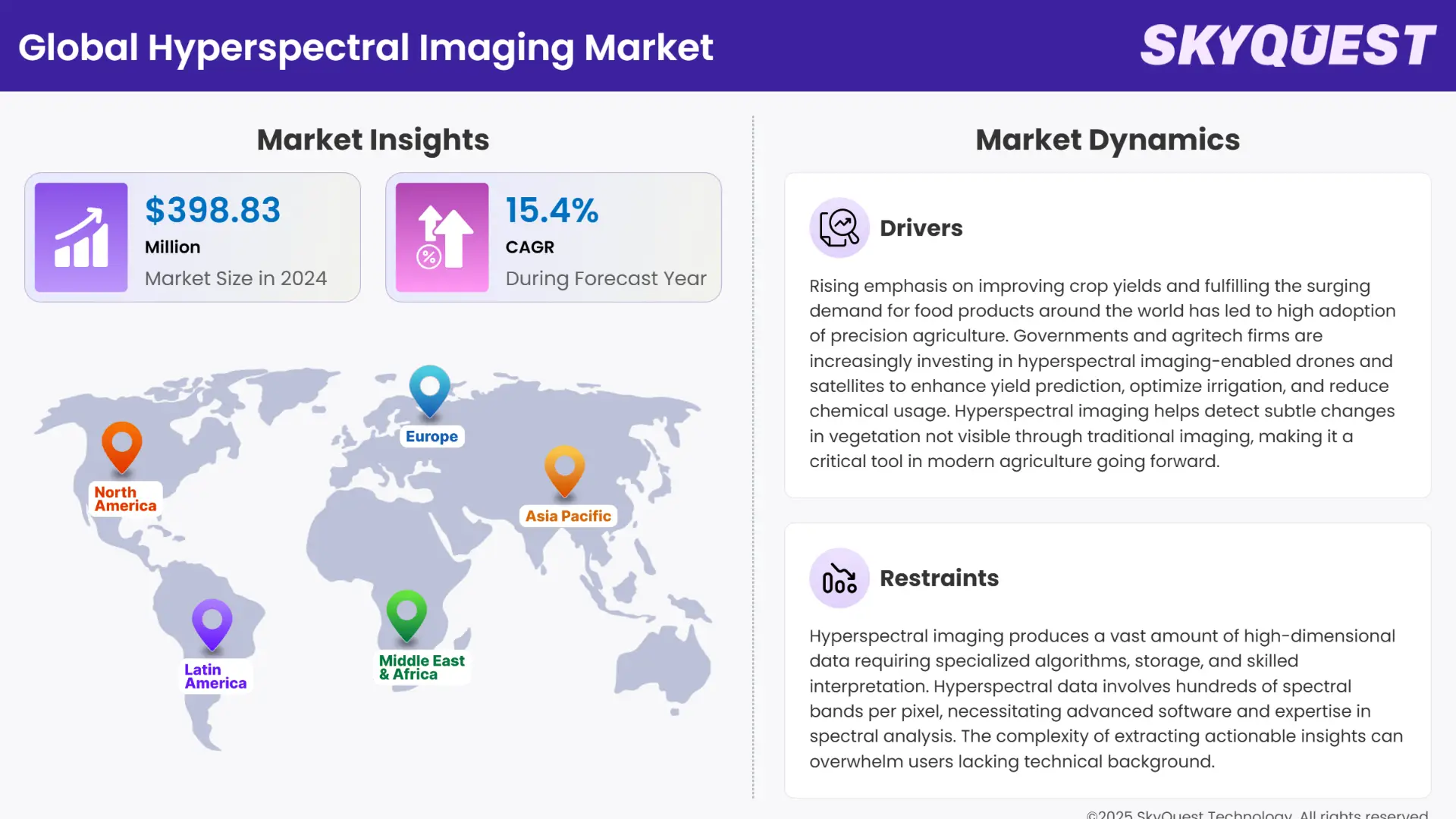
Hyperspectral Imaging Market size was valued at USD 398.83 Million in 2024 and is poised to grow from USD 460.25 Million in 2025 to USD 1447.57 Million by 2033, growing at a CAGR of 15.4% during the forecast period (2026–2033).
Growing adoption of precision agriculture, adoption of hyperspectral imaging in medical and diagnostics applications, growing spending on military & defense, high adoption of industrial automation, and advancements in sensor technologies are slated to bolster the demand for hyperspectral imaging solutions in the future.
The medical field embraces hyperspectral imaging for non-invasive diagnostics, surgical guidance, and early disease detection, which in turn boosts hyperspectral imaging market growth. Industries integrate hyperspectral imaging into automated inspection systems for quality assurance and material sorting. Hyperspectral imaging plays a vital role in environmental surveillance by enabling the detection of pollutants, vegetation stress, mineral compositions, and water quality from airborne or satellite platforms. Continuous advancements in hyperspectral sensor miniaturization, cost reduction, and spectral resolution have made the technology more accessible across various applications. Portable and compact hyperspectral cameras are now being integrated into drones, smartphones, and handheld devices, broadening their usability
However, complexity in data analysis and processing, lack of standardization, challenges in portability, and limited awareness regarding benefits are slated to be major restraints for hyperspectral imaging market penetration in the long run.
How Artificial Intelligence and Machine Learning Influencing the Adoption of Hyperspectral Imaging?
Combining hyperspectral imaging with artificial intelligence (AI) and machine learning (ML) to extract actionable insights from vast spectral datasets is gaining popularity. AI enables real-time data classification, pattern recognition, and anomaly detection, improving HSI’s effectiveness in applications like medical diagnostics, agriculture, and industrial quality control. These algorithms reduce human intervention, speed up analysis, and enhance decision-making accuracy. As data complexity grows, AI integration becomes essential for scalable deployment. Tech companies are investing in AI-enhanced HSI platforms, while open-source tools and cloud-based processing further democratize access. This convergence is transforming hyperspectral imaging from a research tool into a powerful commercial analytics engine.
To get more insights on this market click here to Request a Free Sample Report
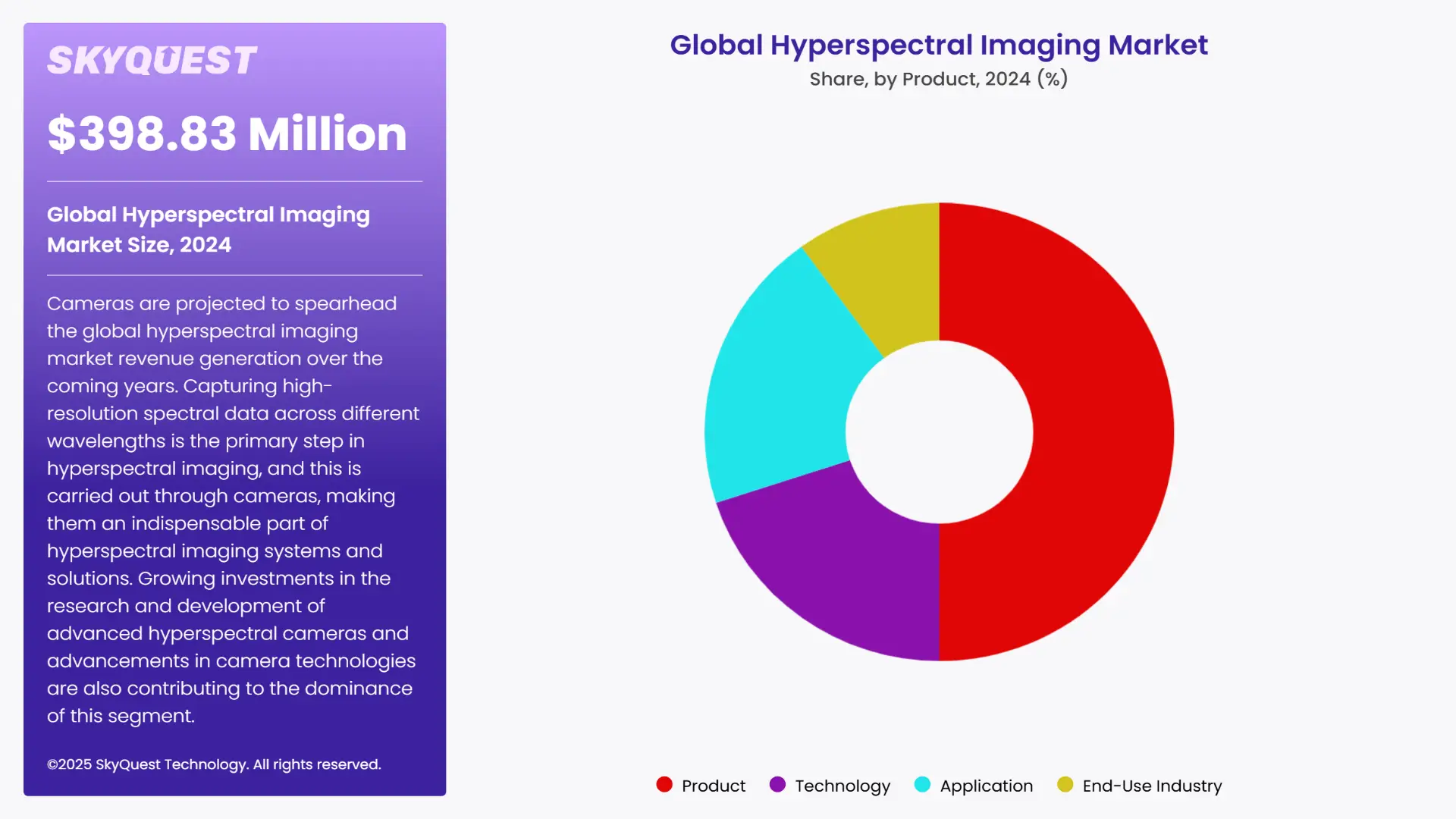
The hyperspectral imaging market is segmented based on the product, application, technology, end-use industry, and region. Based on the product, the hyperspectral imaging market is segmented into cameras and accessories. Based on application, the market is divided into process control, manufacturing, quality assurance, military surveillance, remote sensing, and others. In terms of end-use industry, the market is segmented into food & beverages, healthcare & pharmaceutical, defense, chemical, and others. Based on technology, the market is divided into pushbroom/line scans, snapshot, and other technologies. Based on Region it is categorized into North America, Europe, Asia-Pacific, Latin America, Middle East and Africa.
Cameras are projected to spearhead the global hyperspectral imaging market revenue generation over the coming years. Capturing high-resolution spectral data across different wavelengths is the primary step in hyperspectral imaging, and this is carried out through cameras, making them an indispensable part of hyperspectral imaging systems and solutions. Growing investments in the research and development of advanced hyperspectral cameras and advancements in camera technologies are also contributing to the dominance of this segment.
On the other hand, the demand for accessories is slated to rise at an impressive CAGR as per this global hyperspectral imaging industry analysis. The use of accessories to add additional functionality to hyperspectral imaging systems and enhance the efficiency of hyperspectral imaging solutions creates new business scope for companies.
The healthcare and pharmaceutical industry is projected to account for a prominent chunk of the global hyperspectral imaging market share in the future. Growing use of hyperspectral imaging in diagnostic and medical imaging applications is estimated to primarily aid the dominance of this segment going forward. Increasing demand for advanced imaging technologies in the healthcare industry and growing investments in medical research and development are also slated to benefit the demand for hyperspectral imaging over the coming years.
On the other hand, the demand for hyperspectral imaging in the defense industry is slated to increase at a notable pace through 2032 and beyond. Rapidly surging investments in the R&D of novel military and defense technology R&D around the world are slated to create new opportunities via this segment.
To get detailed segments analysis, Request a Free Sample Report
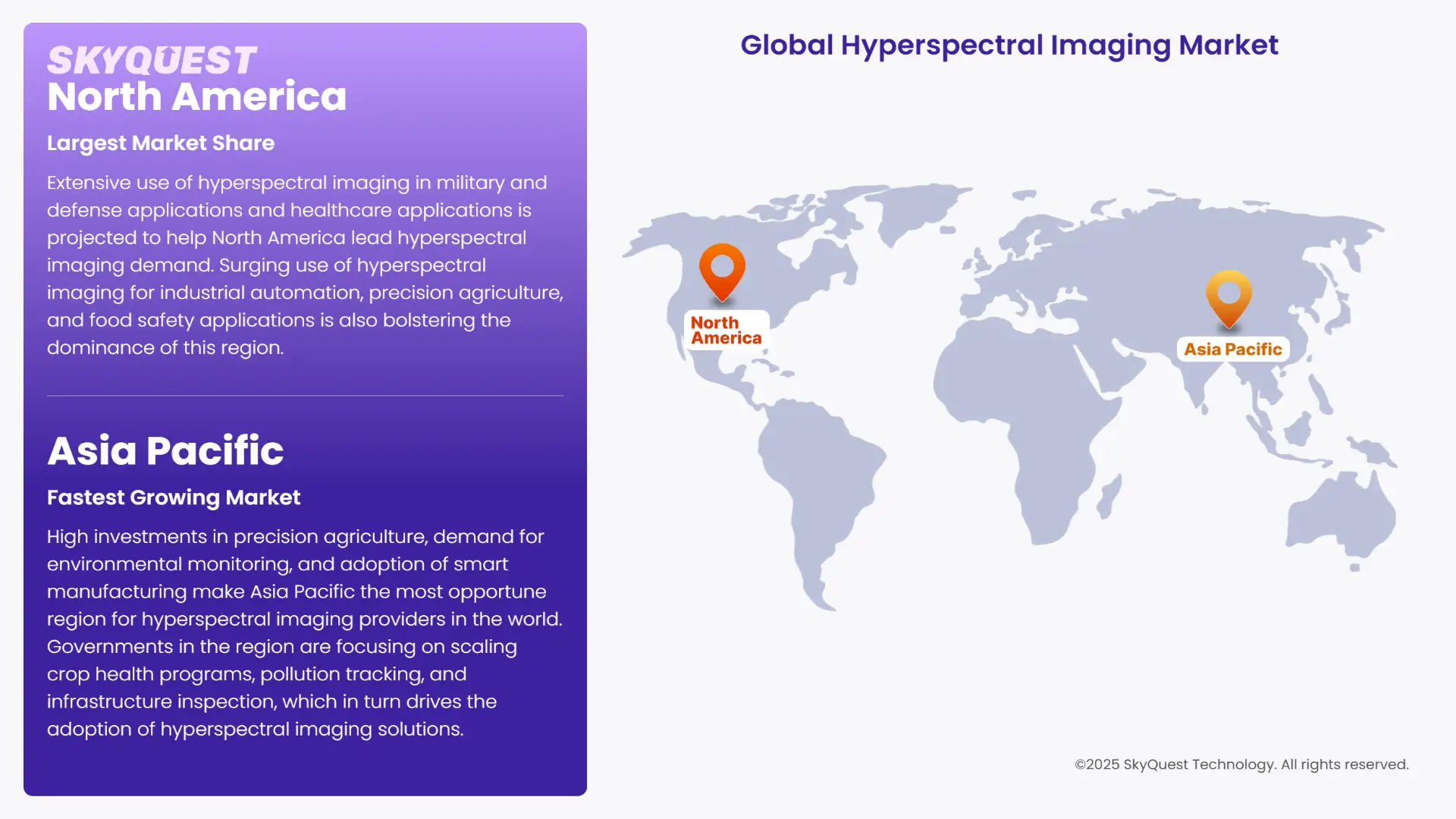
Extensive use of hyperspectral imaging in military and defense applications and healthcare applications is projected to help North America lead hyperspectral imaging demand. Surging use of hyperspectral imaging for industrial automation, precision agriculture, and food safety applications is also bolstering the dominance of this region. Regulatory frameworks, funding opportunities, and the presence of leading hyperspectral imaging companies are providing a lucrative setting for innovation in hyperspectral imaging technologies going forward.
With a well-established tech ecosystem and funding landscape, the United States is slated to emerge as a global leader in hyperspectral imaging innovation through 2032. Agencies like NASA, DARPA, and the Department of Defense in the country actively invest in the use of hyperspectral imaging for remote sensing and surveillance applications. Growing spending on imaging tech R&D, government support, and commercial scalability is further cementing the dominance of this country in the long run.
Strong environmental stewardship and growing mining activity are helping promote the demand for hyperspectral imaging in this country. Use of hyperspectral imaging in forest health monitoring, oil spill detection, and mineral exploration is expected to rise rapidly in the country going forward. Academic research partnerships and pilot projects in precision farming and water quality analysis are also promoting the adoption of hyperspectral imaging technologies. Canada’s emphasis on remote sensing, clean technology, and its vast, resource-rich geography makes it a promising market for hyperspectral imaging providers in the long run.
High investments in precision agriculture, demand for environmental monitoring, and adoption of smart manufacturing make Asia Pacific the most opportune region for hyperspectral imaging providers in the world. Governments in the region are focusing on scaling crop health programs, pollution tracking, and infrastructure inspection, which in turn drives the adoption of hyperspectral imaging solutions. As industries modernize and climate concerns escalate, Asia Pacific is expected to witness a robust hike in demand for cost-effective, scalable hyperspectral imaging solutions.
Precision agriculture, semiconductor inspection, and biomedical imaging are key areas where the demand for hyperspectral imaging is rising rapidly in Japan. The country’s advanced electronics, semiconductor, and robotics sectors are slated to bolster the integration of hyperspectral imaging solutions. The country’s strong manufacturing base, emphasis on quality control, and commitment to research make it a key player in the global hyperspectral imaging industry, particularly for compact, integrated solutions suited for dense and technology-driven environments. Use of hyperspectral imaging for early disease detection and crop monitoring, aligns with Japan’s automation goals.
Rising investments in smart defense, environmental monitoring, and digital healthcare are primarily driving hyperspectral imaging adoption in South Korea. The Ministry of Science and ICT supports hyperspectral R&D through AI integration and satellite initiatives South Korea’s dense urbanization, tech-forward industries, and 5G-enabled infrastructure are expected to bolster the demand for mobile and real-time hyperspectral imaging solutions.
High emphasis on environmental conservation, adoption of sustainable agriculture practices, and growing medical research activity are helping bolster the adoption of hyperspectral imaging in this region. EU directives on food safety, industrial emissions, and climate action are also slated to boost the adoption of advanced hyperspectral imaging systems. The adoption of hyperspectral imaging for heritage conservation and forensic science is also slated to create new opportunities in Europe.
The presence of academic centers such as Oxford and Cambridge which are pioneering research in biomedical and environmental hyperspectral imaging applications in the country. Precision farming and food quality sectors are also expected to influence the adoption of hyperspectral imaging solutions in the United Kingdom. Government innovation funding and partnerships with tech startups are helping promote commercialization of hyperspectral imaging technologies in the United Kingdom through 2032.
Robust innovation in manufacturing, environmental science, and medical technology allows Germany to emerge as one of the largest markets for hyperspectral imaging in Europe. The country’s focus on sustainability drives applications in precision agriculture, waste sorting, and air quality monitoring. Public research bodies like DLR (German Aerospace Center) and Fraunhofer Institutes are expected to advance adoption of AI-driven hyperspectral imaging and analytics. Germany’s strong regulatory framework and engineering expertise encourages industry-wide integration of hyperspectral imaging technologies.
Industries such as defense, aerospace, and food security are anticipated to lead the adoption of hyperspectral imaging in France. Organizations such as CNES (French Space Agency) and ONERA are investing in airborne and satellite-based hyperspectral imaging for land use and climate monitoring. Government-backed research and EU programs are also promoting the integration of hyperspectral imaging technology in sustainability, defense modernization, and healthcare transformation. Academic-industry collaboration also plays a crucial role in driving hyperspectral imaging adoption in the country.
To know more about the market opportunities by region and country, click here to
Buy The Complete Report
Surge in Adoption of Precision Agriculture Practices
Growing Adoption in Defense and Surveillance
Complexity in Data Analysis and Processing
Lack of Standardization Across Platforms
Request Free Customization of this report to help us to meet your business objectives.
Developing affordable and advanced hyperspectral imaging solutions suitable for multiple industry verticals will create new opportunities for market players. The launch of new hyperspectral imaging solutions will also be a key strategy for almost all new as well as established companies going forward. Integration of advanced technologies with hyperspectral imaging will also expand the business scope of all hyperspectral imaging providers through 2032.
New companies are exploring advanced applications for novel hyperspectral imaging technology adoption. Developing custom solutions is also a key opportunity for new hyperspectral imaging providers going forward.
SkyQuest’s ABIRAW (Advanced Business Intelligence, Research & Analysis Wing) is our Business Information Services team that Collects, Collates, Correlates, and Analyses the Data collected by means of Primary Exploratory Research backed by robust Secondary Desk research.
As per SkyQuest analysis, rising investments in the development of advanced imaging technologies and growing use of hyperspectral imaging in defense and medical applications are projected to drive market development. However, complexity in data processing and analytics and lack of standardization are expected to impede the sales of hyperspectral imaging systems and solutions in the long run. High spending on defense and surveillance in North America allows it to spearhead the global hyperspectral imaging demand outlook in the long run. Integration of artificial intelligence and miniaturization of hyperspectral imaging devices are expected to emerge as key trends driving the hyperspectral imaging industry through 2032 and beyond.
| Report Metric | Details |
|---|---|
| Market size value in 2024 | USD 398.83 Million |
| Market size value in 2033 | USD 1447.57 Million |
| Growth Rate | 15.4% |
| Base year | 2024 |
| Forecast period | 2026-2033 |
| Forecast Unit (Value) | USD Million |
| Segments covered |
|
| Regions covered | North America (US, Canada), Europe (Germany, France, United Kingdom, Italy, Spain, Rest of Europe), Asia Pacific (China, India, Japan, Rest of Asia-Pacific), Latin America (Brazil, Rest of Latin America), Middle East & Africa (South Africa, GCC Countries, Rest of MEA) |
| Companies covered |
|
| Customization scope | Free report customization with purchase. Customization includes:-
|
To get a free trial access to our platform which is a one stop solution for all your data requirements for quicker decision making. This platform allows you to compare markets, competitors who are prominent in the market, and mega trends that are influencing the dynamics in the market. Also, get access to detailed SkyQuest exclusive matrix.
Table Of Content
Executive Summary
Market overview
Parent Market Analysis
Market overview
Market size
KEY MARKET INSIGHTS
COVID IMPACT
MARKET DYNAMICS & OUTLOOK
Market Size by Region
KEY COMPANY PROFILES
Methodology
For the Hyperspectral Imaging Market, our research methodology involved a mixture of primary and secondary data sources. Key steps involved in the research process are listed below:
1. Information Procurement: This stage involved the procurement of Market data or related information via primary and secondary sources. The various secondary sources used included various company websites, annual reports, trade databases, and paid databases such as Hoover's, Bloomberg Business, Factiva, and Avention. Our team did 45 primary interactions Globally which included several stakeholders such as manufacturers, customers, key opinion leaders, etc. Overall, information procurement was one of the most extensive stages in our research process.
2. Information Analysis: This step involved triangulation of data through bottom-up and top-down approaches to estimate and validate the total size and future estimate of the Hyperspectral Imaging Market.
3. Report Formulation: The final step entailed the placement of data points in appropriate Market spaces in an attempt to deduce viable conclusions.
4. Validation & Publishing: Validation is the most important step in the process. Validation & re-validation via an intricately designed process helped us finalize data points to be used for final calculations. The final Market estimates and forecasts were then aligned and sent to our panel of industry experts for validation of data. Once the validation was done the report was sent to our Quality Assurance team to ensure adherence to style guides, consistency & design.
Analyst Support
Customization Options
With the given market data, our dedicated team of analysts can offer you the following customization options are available for the Hyperspectral Imaging Market:
Product Analysis: Product matrix, which offers a detailed comparison of the product portfolio of companies.
Regional Analysis: Further analysis of the Hyperspectral Imaging Market for additional countries.
Competitive Analysis: Detailed analysis and profiling of additional Market players & comparative analysis of competitive products.
Go to Market Strategy: Find the high-growth channels to invest your marketing efforts and increase your customer base.
Innovation Mapping: Identify racial solutions and innovation, connected to deep ecosystems of innovators, start-ups, academics, and strategic partners.
Category Intelligence: Customized intelligence that is relevant to their supply Markets will enable them to make smarter sourcing decisions and improve their category management.
Public Company Transcript Analysis: To improve the investment performance by generating new alpha and making better-informed decisions.
Social Media Listening: To analyze the conversations and trends happening not just around your brand, but around your industry as a whole, and use those insights to make better Marketing decisions.
REQUEST FOR SAMPLE
 REQUEST FREE CUSTOMIZATION


Want to customize this report? This report can be personalized according to your needs. Our analysts and industry experts will work directly with you to understand your requirements and provide you with customized data in a short amount of time. We offer $1000 worth of FREE customization at the time of purchase.
Feedback From Our Clients


 USA (+1) 351-333-4748

