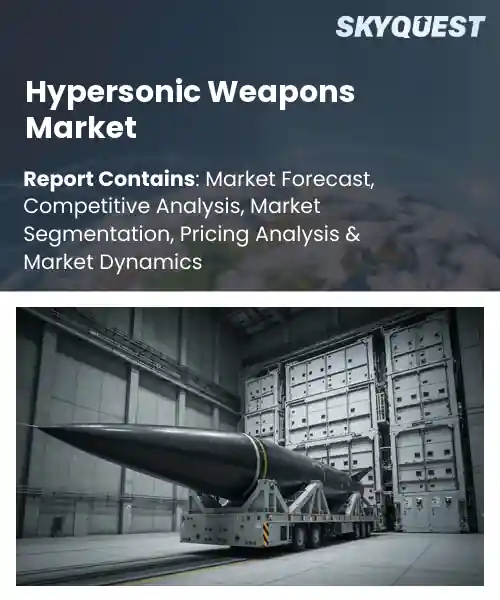
Hypersonic Weapons Market
Report ID: SQMIG20R2092
Report ID: SQMIG20R2092
[email protected]
USA +1 351-333-4748
Report ID:
SQMIG20R2092 |
Region:
Global |
Published Date: June, 2026
Pages:
157
|Tables:
186
|Figures:
79


Global Hypersonic Weapons Market size was valued at USD 7.4 Billion in 2024 and is poised to grow from USD 8.2 Billion in 2025 to USD 18.62 Billion by 2033, growing at a CAGR of 10.8% during the forecast period (2026-2033).
The primary driver of the global hypersonic weapons market is strategic competition among major powers, which has converted academic research into defense procurement programs. Hypersonic weapons are platforms and delivery systems that sustain flight above Mach 5 and include boost-glide vehicles and high-speed cruise missiles; they matter because their velocity and maneuverability compress decision timelines, complicate missile defense, and change deterrence dynamics. Development progressed from theoretical propulsion and materials work during the Cold War to practical flight tests in the twenty-first century, exemplified by Russia’s Avangard and Kinzhal systems, China’s DF-ZF prototypes, and U.S. experimental programs, which collectively accelerated investment.Building on that strategic imperative, a central factor shaping market expansion is the interplay between offensive capability and defensive countermeasures, which creates simultaneous demand for weapon systems and sensing and intercept technologies. As hypersonic glide vehicles and cruise missiles demonstrated higher survivability against legacy missile shields, procurement shifted toward precision guidance and survivable platforms, which in turn spurred investment in scramjet propulsion, advanced composites, and avionics. Real-world use cases such as rapid strikes on time-sensitive targets and contested anti-access environments drove governments to fund test ranges, command-and-control upgrades, and allied industrial partnerships, thereby opening export markets and industrial opportunities globally.
How is AI enhancing targeting and guidance systems in the hypersonic weapons market?
AI is improving targeting and guidance for hypersonic weapons by combining advanced sensor fusion with fast machine learning based trajectory prediction. Key aspects include onboard models that adapt guidance in real time, multi sensor inputs that refine target discrimination, and edge AI that reduces latency when communications are contested. The current state is one of rapid prototyping and integration with new radar and space sensors as primes and startups prioritize resilient guidance architectures. These advances make terminal maneuvers more precise and make intercept solutions and countermeasures harder to achieve, increasing operational confidence and market demand.GE Aerospace May 2026, completed generative AI design studies for a hypersonic ramjet that illustrate how AI shortens design cycles and enables closer coupling between propulsion and guidance systems. That capability helps suppliers deliver more efficient AI enabled targeting suites and supports faster market adoption through reduced development risk.
Market snapshot - (2026-2033)
Global Market Size
USD 7.4 Billion
Largest Segment
Hypersonic Cruise Missiles
Fastest Growth
Air-Launched Hypersonic Weapons
Growth Rate
10.8% CAGR
To get more insights on this market click here to Request a Free Sample Report
Global hypersonic weapons market is segmented by type, range, launch platform, technology, component, end user and region. Based on type, the market is segmented into Hypersonic Glide Vehicles (HGV), Hypersonic Cruise Missiles, Boost-Glide Systems, Air-Launched Hypersonic Weapons, Sea-Launched Hypersonic Weapons and Land-Based Hypersonic Weapons. Based on range, the market is segmented into Short Range (Below 1,000 km), Medium Range (1,000–3,000 km) and Long Range (Above 3,000 km). Based on launch platform, the market is segmented into Land-Based Platforms, Airborne Platforms, Naval Platforms and Submarine-Launched Platforms. Based on technology, the market is segmented into Scramjet Propulsion, Boost-Glide Technology, Dual-Mode Ramjet (DMRJ), Advanced Guidance & Navigation Systems and Thermal Protection Systems. Based on component, the market is segmented into Airframe, Propulsion System, Guidance, Navigation & Control System, Warhead, Avionics & Sensors and Others. Based on end user, the market is segmented into Defense Forces, Government & Homeland Security Agencies, Research & Defense Organizations and Others. Based on region, the market is segmented into North America, Europe, Asia Pacific, Latin America and Middle East & Africa.
Boost-Glide Technology segment dominates because its architecture enables unpredictable, maneuvering high altitude trajectories that complicate layered defenses and prioritize procurement. Defense planners favor capabilities that combine sustained hypersonic glide with extended reach to penetrate sophisticated intercept systems, which channels sustained funding, test programs, and industrial integration efforts. Mature booster interfaces and a strategic emphasis on survivable, prompt strike options further drive program prioritization across development pipelines and prime contractors.
However, Scramjet Propulsion is the most rapidly expanding technology area as advances in high temperature materials and fuel cycles enable sustained hypersonic cruise profiles and broaden mission sets. Rising R&D, demonstrator programs, and cross-domain applications drive adoption, creating supplier specialization and opening pathways for longer endurance, operationally flexible hypersonic missile families that expand market opportunity.
Airborne Platforms segment dominates because aircraft enable rapid launch, flexible stand-off delivery, and frequent operational testing that accelerate maturation and deployment. Integration with existing airframes and logistics chains reduces program risk while allowing iterative avionics updates and mission-tailored payloads, which attracts sustained investment. Platform agility supports diverse mission sets from strike to rapid interception, shaping doctrine and prioritizing air-delivered hypersonic solutions in defense acquisition plans.
However, Submarine-Launched Platforms are emerging fastest as stealthy undersea deployment concepts and quieter launch methods gain traction. Advances in encapsulated canisters, cold launch techniques, and integration pathways with submerged platforms stimulate new procurement priorities, enabling covert deployment and second-strike options, which expand mission envelopes and create fresh industrial opportunities across launch system suppliers and naval modernization programs.
To get detailed segments analysis, Request a Free Sample Report
North America dominates the global hypersonic weapons market due to a concentrated combination of technological leadership, mature defense research ecosystems, and integrated industrial capabilities. Deep collaboration between government research agencies, prime contractors, and academic institutions accelerates prototype development and system integration. Extensive test and evaluation infrastructure supports rapid iteration and risk reduction. Strategic policy priorities prioritize advanced strike and deterrence capabilities, driving sustained procurement and concept maturation. Robust supply chain networks, experienced systems engineers, and established program management practices enable complex program execution. Significant investment in advanced materials, propulsion technologies, and precision guidance complements systems engineering strengths, while experienced logistics and sustainment frameworks support long term operational deployment.
Hypersonic Weapons Market in the United States is driven by concentrated technological expertise across propulsion, materials, and guidance, supported by an extensive defense industrial base and specialized testing infrastructure. Collaborative programs link government laboratories, academic centers, and prime contractors to accelerate maturation. Emphasis on operational integration, program management rigor, and sustainment planning enables transition from prototypes to fielded capabilities. Export controls and strategic partnerships shape procurement and alliance interoperability priorities.
Hypersonic Weapons Market in Canada emphasizes collaborative research, niche industrial contributions, and alignment with allied development efforts. Canadian laboratories and specialized suppliers support materials, sensors, and integration activities that complement larger program led by partners. Policy frameworks prioritize sovereign access to advanced technologies while enabling industrial participation in multinational programs. Investment in skilled workforce development, testing facilities, and supply chain resilience positions Canada as a reliable collaborator for hypersonic projects.
Asia Pacific is experiencing rapid expansion in the hypersonic weapons market driven by shifting strategic priorities, increased defense modernization efforts, and the emergence of domestic technological capabilities. Governments are fostering close ties between military planners, national research institutions, and private sector innovators to accelerate prototype development and system integration. Regional security dynamics create urgency for advanced strike and deterrence options, prompting investment in propulsion, materials, and guidance technologies. Growing industrial ecosystems, focused workforce development, and the opening of international partnerships support technology transfer and joint programs. Enhanced testing infrastructure and rising supplier specialization further enable programs to move from concept exploration toward demonstrator and operational planning phases. Policy support and more flexible collaboration frameworks encourage cross border research and co development, while a maturing supplier base improves indigenous manufacturing and sustainment planning. Partnerships with established allies provide access to critical testing methodologies and program management practices that accelerate capability delivery.
Hypersonic Weapons Market in Japan is characterized by focused national efforts to develop indigenous propulsion, materials, and guidance expertise within a collaborative industrial and academic ecosystem. Strategic partnerships with allied nations complement domestic programs and enable technology exchange and testing access. Workforce development supports program execution, while policy emphasis on territorial defense and deterrence shapes requirements. Japanese suppliers aim to contribute specialized components and integration expertise to multinational hypersonic initiatives.
Hypersonic Weapons Market in South Korea combines modernization priorities with strong government industry collaboration to build indigenous propulsion, guidance, and sensor capabilities. Domestic primes and specialized suppliers contribute to rapid prototyping and integration efforts, supported by testing and workforce training. Security imperatives and regional dynamics drive requirements for advanced strike and interception concepts. South Korean policy fosters international partnerships while nurturing domestic manufacturing and sustainment foundations to increase strategic autonomy.
Europe is strengthening its position in the hypersonic weapons market through deliberate coordination of national research agendas, multinational industrial consortia, and closer alignment with NATO capability priorities. Increased emphasis on joint programs and shared testing infrastructure reduces duplication and speeds development cycles. European defense firms leverage specialized knowledge in guidance, materials, and systems integration, while governments facilitate collaboration through funding frameworks and regulatory alignment. Cross border supply chain integration and collaborative procurement approaches enhance industrial scale and export readiness. Strategic dialogues with allied partners provide access to advanced methodologies and program management practices, enabling Europe to field interoperable solutions and nurture a sustainable industrial base capable of competing on technical and strategic grounds. Focused investment in skilled workforce development, standardization efforts, and demonstrator projects complements regulatory measures that balance security with collaboration, strengthening the region's ability to translate research into deployable capabilities.
Hypersonic Weapons Market in Germany leverages established engineering expertise, advanced materials research, and coordinated industrial partnerships focused on systems integration. German firms provide precision manufacturing, sensors, and testing support to multinational programs, backed by national research centers and cross border collaborations. Policy priorities on interoperability within European frameworks promote participation in joint demonstrators. The market balances sovereign capability development with industrial competitiveness and collaborative access to highly specialized testing infrastructure.
Hypersonic Weapons Market in the United Kingdom is supported by a mature defense industrial base, concentrated research in propulsion and guidance, and test facilities. Collaboration among government agencies, prime contractors, and universities accelerates development and systems integration. Strategic procurement emphasizes interoperability with alliance partners and transitions demonstrators toward operational concepts. UK suppliers focus on electronics, targeting, and integration while policy frameworks navigate export control and industrial participation in multinational programs.
Hypersonic Weapons Market in France reflects strong aerospace heritage, with prime contractors and specialized suppliers advancing propulsion, guidance, and materials expertise. National policy supports sovereign capability development alongside cooperative projects with European partners. Research centers and industrial test facilities underpin demonstrator programs and integration, while emphasis on strategic autonomy shapes procurement. French industry focuses on precision components, thermal protection, and mission systems contributing to multinational development initiatives and interoperability goals.
To know more about the market opportunities by region and country, click here to
Buy The Complete Report
Advances In Hypersonic Propulsion
Increased Investment In Defense Programs
Stringent Export Control Regimes
Complex Integration Requirements
Request Free Customization of this report to help us to meet your business objectives.
Competition in the global hypersonic weapons market is intensifying as primes and agile startups race to field operational systems. Procurement urgency and great power rivalry drive consolidation through strategic acquisitions and partnerships. Examples include L3Harris acquiring a major propulsion supplier to secure propulsion capabilities and industry access, and DoD innovation contracts and propulsion collaborations that accelerate prototype maturation and prime-startup teaming.
Top Player’s Company Profile
Recent Developments
SkyQuest’s ABIRAW (Advanced Business Intelligence, Research & Analysis Wing) is our Business Information Services team that Collects, Collates, Correlates, and Analyses the Data collected by means of Primary Exploratory Research backed by robust Secondary Desk research. As per SkyQuest analysis, the global hypersonic weapons market is driven primarily by strategic competition among major powers that has converted research into procurement and accelerated investment, with advances in hypersonic propulsion serving as a second major growth driver. Growth is tempered by stringent export control regimes that complicate collaboration and slow technology diffusion. North America leads the market thanks to deep research ecosystems, testing infrastructure and integrated industrial bases, while boost-glide technology dominates product priorities due to its maneuverable high altitude trajectories and survivability against layered defenses. Together these forces shape procurement, supply chain modernization and accelerating demonstrator to deployment timelines.
| Report Metric | Details |
|---|---|
| Market size value in 2024 | USD 7.4 Billion |
| Market size value in 2033 | USD 18.62 Billion |
| Growth Rate | 10.8% |
| Base year | 2024 |
| Forecast period | (2026-2033) |
| Forecast Unit (Value) | USD Billion |
| Segments covered |
|
| Regions covered | North America (US, Canada), Europe (Germany, France, United Kingdom, Italy, Spain, Rest of Europe), Asia Pacific (China, India, Japan, Rest of Asia-Pacific), Latin America (Brazil, Rest of Latin America), Middle East & Africa (South Africa, GCC Countries, Rest of MEA) |
| Companies covered |
|
| Customization scope | Free report customization with purchase. Customization includes:-
|
To get a free trial access to our platform which is a one stop solution for all your data requirements for quicker decision making. This platform allows you to compare markets, competitors who are prominent in the market, and mega trends that are influencing the dynamics in the market. Also, get access to detailed SkyQuest exclusive matrix.
Table Of Content
Executive Summary
Market overview
Parent Market Analysis
Market overview
Market size
KEY MARKET INSIGHTS
COVID IMPACT
MARKET DYNAMICS & OUTLOOK
Market Size by Region
KEY COMPANY PROFILES
Methodology
For the Hypersonic Weapons Market, our research methodology involved a mixture of primary and secondary data sources. Key steps involved in the research process are listed below:
1. Information Procurement: This stage involved the procurement of Market data or related information via primary and secondary sources. The various secondary sources used included various company websites, annual reports, trade databases, and paid databases such as Hoover's, Bloomberg Business, Factiva, and Avention. Our team did 45 primary interactions Globally which included several stakeholders such as manufacturers, customers, key opinion leaders, etc. Overall, information procurement was one of the most extensive stages in our research process.
2. Information Analysis: This step involved triangulation of data through bottom-up and top-down approaches to estimate and validate the total size and future estimate of the Hypersonic Weapons Market.
3. Report Formulation: The final step entailed the placement of data points in appropriate Market spaces in an attempt to deduce viable conclusions.
4. Validation & Publishing: Validation is the most important step in the process. Validation & re-validation via an intricately designed process helped us finalize data points to be used for final calculations. The final Market estimates and forecasts were then aligned and sent to our panel of industry experts for validation of data. Once the validation was done the report was sent to our Quality Assurance team to ensure adherence to style guides, consistency & design.
Analyst Support
Customization Options
With the given market data, our dedicated team of analysts can offer you the following customization options are available for the Hypersonic Weapons Market:
Product Analysis: Product matrix, which offers a detailed comparison of the product portfolio of companies.
Regional Analysis: Further analysis of the Hypersonic Weapons Market for additional countries.
Competitive Analysis: Detailed analysis and profiling of additional Market players & comparative analysis of competitive products.
Go to Market Strategy: Find the high-growth channels to invest your marketing efforts and increase your customer base.
Innovation Mapping: Identify racial solutions and innovation, connected to deep ecosystems of innovators, start-ups, academics, and strategic partners.
Category Intelligence: Customized intelligence that is relevant to their supply Markets will enable them to make smarter sourcing decisions and improve their category management.
Public Company Transcript Analysis: To improve the investment performance by generating new alpha and making better-informed decisions.
Social Media Listening: To analyze the conversations and trends happening not just around your brand, but around your industry as a whole, and use those insights to make better Marketing decisions.
REQUEST FOR SAMPLE
 REQUEST FREE CUSTOMIZATION


Want to customize this report? This report can be personalized according to your needs. Our analysts and industry experts will work directly with you to understand your requirements and provide you with customized data in a short amount of time. We offer $1000 worth of FREE customization at the time of purchase.
Feedback From Our Clients


 USA (+1) 351-333-4748

