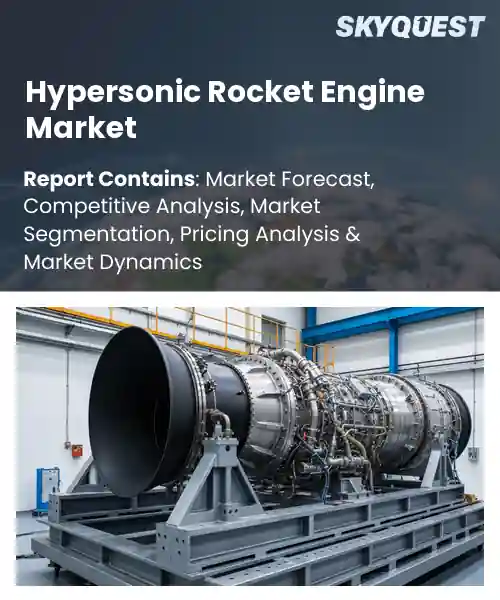
Hypersonic Rocket Engine Market
Report ID: SQMIG20A2790
Report ID: SQMIG20A2790
[email protected]
USA +1 351-333-4748
Report ID:
SQMIG20A2790 |
Region:
Global |
Published Date: July, 2026
Pages:
157
|Tables:
116
|Figures:
77


Global Hypersonic Rocket Engine Market size was valued at USD 5.28 Billion in 2024 and is poised to grow from USD 6.3 Billion in 2025 to USD 26.04 Billion by 2033, growing at a CAGR of 19.4% during the forecast period (2026-2033).
Among the global hypersonic rocket engine market comprises firms that design, manufacture, and test propulsion systems capable of sustaining velocities above Mach 5 for both military and civilian applications. Its importance stems from the promise of drastically reduced travel times, heightened maneuverability, and the ability to overcome traditional thermal constraints, positioning hypersonic technology as a cornerstone of next‑generation aerospace strategy. Historically the sector emerged from Cold‑War missile programs, later accelerated by U.S. and Chinese investments in scramjet demonstrators such as NASA’s X‑43 and the PLA’s DF‑17. Over the past decade, capital and collaborations have shifted the focus from research toward reusable engines. Among the forces shaping the market, the pursuit of hypersonic strike capability is the growth catalyst, because defense ministries view sub‑orbital speed as a decisive edge in penetrating advanced air‑defense networks. This strategic imperative drives governments to award contracts to engine makers, prompting firms such as Aerojet Rocketdyne and Reaction Engines to accelerate development of scram‑turbo systems. The resulting funding spurs opportunities in materials, additive manufacturing, and simulation software, which lower entry barriers for startups. Consequently, the commercial sector gains access to proven technology, allowing concepts like cargo transport and hypersonic launchers to move from trials to viable business models.
How is AI-driven design accelerating the hypersonic rocket engine market?
AI‑driven design is reshaping hypersonic rocket engines by automating geometry optimization, material selection and thermal management. Machine‑learning models evaluate thousands of design permutations in minutes, revealing unconventional inlet shapes and cooling channels that traditional methods miss. These tools also predict performance across extreme speed regimes, reducing the need for costly physical prototypes. As a result, development timelines are shortening and risk is decreasing, encouraging both defense contractors and commercial players to invest more aggressively. The market is buzzing with collaborations between aerospace engineers and data scientists, turning complex simulations into actionable design choices that keep pace with rapid government funding cycles and emerging threats.In May 2026, the U.S.-supported advanced rocket engine program completed two successful supersonic flight tests, showcasing AI‑enhanced design that cut iteration time and boosted engine efficiency, reinforcing market momentum.
Market snapshot - (2026-2033)
Global Market Size
USD 5.28 Billion
Largest Segment
Combined Cycle Engines
Fastest Growth
Scramjet Engines
Growth Rate
19.4% CAGR
To get more insights on this market click here to Request a Free Sample Report
Global hypersonic rocket engine market is segmented by engine type, fuel type, application, end user and region. Based on engine type, the market is segmented into Scramjet Engines, Dual-Mode Ramjet Engines and Combined Cycle Engines. Based on fuel type, the market is segmented into Hydrogen and Hydrocarbon. Based on application, the market is segmented into Defense Missiles, Space Launch Systems and Research Programs. Based on end user, the market is segmented into Defense Organizations, Space Agencies and Aerospace Companies. Based on region, the market is segmented into North America, Europe, Asia Pacific, Latin America and Middle East & Africa.
Scramjet Engines segment dominates because its ability to sustain combustion at extreme velocities eliminates the need for bulky onboard oxidizers, enabling lighter thrust packages and higher specific impulse. This intrinsic efficiency aligns with the core performance goals of hypersonic propulsion, driving sustained investment from defense and space programs. The technology’s maturity, proven flight demonstrations, and compatibility with existing airframe designs reinforce its leading position in the market today worldwide overall sector.
However, Dual-Mode Ramjet Engines segment is witnessing the strongest growth momentum as it bridges the performance gap between pure ramjets and scramjets, offering versatile operation across a broader speed envelope. Emerging launch concepts and adaptive missile designs are prompting adoption, positioning this technology as a catalyst for expanding market opportunities.
Hydrogen segment dominates because its high energy density and clean combustion enable superior thrust-to-weight ratios while reducing thermal signatures, a critical advantage for stealthy hypersonic platforms. The alignment with emerging green propulsion policies and the strategic priority of minimizing logistical footprints further entrench hydrogen as the preferred power source across defense and space initiatives. Additionally, advances in cryogenic storage and turbine materials have alleviated earlier handling challenges, fostering broader program integration and supplier confidence.
Meanwhile, Hydrocarbon segment emerges as the fastest growing area as legacy fuel infrastructure and lower storage complexity accelerate adoption in emerging missile programs. Ongoing advances in high temperature materials and catalytic combustion are expanding performance envelopes, while cost effective production fuels incentivize investment, propelling this segment to become a key driver of market expansion.
To get detailed segments analysis, Request a Free Sample Report
North America maintains a decisive lead through a confluence of sustained defense investment, mature aerospace infrastructure, and deep integration between governmental agencies and private innovators. The region benefits from a longstanding culture of high‑risk technology development, supported by extensive test ranges and research laboratories that accelerate prototype validation. Collaborative ecosystems linking universities, defense contractors, and commercial launch providers generate a pipeline of talent and intellectual property that fuels continuous advancement. Additionally, robust supply chains for advanced materials and precision manufacturing ensure that critical components are readily available, reinforcing market confidence. These strategic advantages collectively reinforce North America’s position as the preeminent hub for hypersonic propulsion innovation.
Hypersonic Rocket Engine Market activity in the United States is shaped by extensive defense programs and a vibrant commercial space sector that together drive rapid technology cycles. Established testing facilities provide realistic flight environments, while a deep talent pool emerging from leading research universities fuels innovative design approaches. Strategic partnerships between legacy aerospace firms and agile start‑ups accelerate the transition from concept to flight‑ready hardware. The integration of advanced manufacturing techniques further shortens development timelines, sustaining the United States as a central engine for global hypersonic progress.
Hypersonic Rocket Engine Market prospects in Canada are anchored by strong research institutions and a collaborative approach to defense procurement. Federal initiatives emphasize modular development and cost‑effective testing, encouraging partnerships across the aerospace value chain. Canadian expertise in cryogenic propulsion and high‑temperature materials contributes valuable specialization to the broader North American ecosystem. Close proximity to United States facilities enables joint exercises and knowledge exchange, reinforcing Canada’s role as a supportive yet innovative participant in the hypersonic domain.
Europe’s expansion is propelled by coordinated governmental strategies that prioritize strategic autonomy in defense and space capabilities, fostering cross‑border collaboration among member states. Investment in next‑generation propulsion research centers and shared testing assets reduces duplication and accelerates collective progress. The region’s strong heritage in high‑precision engineering and advanced composite manufacturing provides a solid foundation for sophisticated engine designs. Academic‑industry consortia enhance knowledge transfer, while emerging market entrants inject fresh concepts and agile development processes. This synergistic environment positions Europe as a rapidly growing contender in the hypersonic propulsion landscape.
Hypersonic Rocket Engine Market development in Germany is emerging through focused research initiatives and a robust industrial base renowned for precision engineering. Partnerships between federal research institutes and automotive‑derived high‑performance manufacturers drive innovative propulsion solutions. Access to sophisticated test facilities and a skilled engineering workforce enables rapid iteration of design concepts. Germany’s commitment to collaborative European projects further integrates its emerging capabilities within the broader continental ecosystem, strengthening its foothold in the evolving market.
Hypersonic Rocket Engine Market momentum in the United Kingdom is accelerated by ambitious defense modernization plans and a thriving aerospace supply chain. Government‑backed programmes encourage joint ventures between historic aerospace contractors and new technology firms, fostering rapid prototyping. The UK’s expertise in high‑temperature alloys and additive manufacturing supports the creation of lightweight, resilient engine components. Access to dedicated test ranges and a strong regulatory framework ensures that development proceeds with both safety and speed, positioning the United Kingdom as a leading growth engine within Europe.
Hypersonic Rocket Engine Market leadership in France rests on a deep tradition of aerospace excellence and extensive state support for strategic technologies. National research agencies coordinate closely with leading aerospace corporations, enabling the seamless transfer of cutting‑edge research into practical engine designs. France’s advanced capabilities in propulsion testing and high‑energy material science provide critical advantages in achieving performance benchmarks. Collaborative European frameworks amplify French contributions, reinforcing its dominant role in shaping the continent’s hypersonic trajectory.
Asia Pacific is enhancing its position through a blend of ambitious national space agendas, increasing defense modernization, and a rapidly expanding commercial launch sector. Nations in the region invest heavily in indigenous propulsion research, leveraging strong manufacturing bases that deliver cost‑effective, high‑quality components. Collaborative platforms and regional testing sites foster knowledge sharing and reduce entry barriers for emerging players. The convergence of private venture capital with governmental backing accelerates technology transfer, while a focus on next‑generation materials and digital design tools shortens development cycles. These dynamics collectively elevate Asia Pacific’s influence in the global hypersonic engine landscape.
Hypersonic Rocket Engine Market activity in Japan benefits from a long‑standing commitment to high‑precision engineering and extensive experience in supersonic and re‑entry technologies. Government‑led research programs coordinate closely with leading electronics and aerospace firms to develop advanced propulsion concepts. Japan’s sophisticated material science capabilities, particularly in high‑temperature ceramics, support the creation of durable engine components. Integrated testing facilities and a disciplined approach to risk management enable steady progression from laboratory demonstration to flight validation, reinforcing Japan’s growing contribution to the field.
Hypersonic Rocket Engine Market initiatives in South Korea are driven by a dynamic blend of defense priorities and a vibrant commercial aerospace industry. Strong emphasis on rapid prototyping and digital manufacturing equips Korean firms with the agility to iterate designs swiftly. Collaboration between national research institutes and private aerospace enterprises fuels innovative propulsion architectures. Access to state‑of‑the‑art test complexes and a skilled engineering workforce underpins the region’s capability to deliver reliable, high‑performance engines, positioning South Korea as an emerging force in the hypersonic arena.
To know more about the market opportunities by region and country, click here to
Buy The Complete Report
Increasing Defense Investment
Advancements In Propulsion Technology
High Development Cost
Stringent Regulatory Requirements
Request Free Customization of this report to help us to meet your business objectives.
The competitive landscape is shaped by aggressive technology roll‑outs and strategic partnerships, as firms race to secure hypersonic propulsion capabilities that can differentiate launch services and defense applications. Recent M&A activity, such as larger aerospace groups acquiring niche engine developers, and joint ventures with advanced manufacturing firms, accelerate time‑to‑market. Companies are leveraging 3D‑printing and rotating‑detonation technologies to lower costs and improve performance, intensifying rivalry for government contracts and commercial launch slots.
Top Player’s Company Profile
Recent Developments
SkyQuest’s ABIRAW (Advanced Business Intelligence, Research & Analysis Wing) is our Business Information Services team that Collects, Collates, Correlates, and Analyses the Data collected by means of Primary Exploratory Research backed by robust Secondary Desk research. As per SkyQuest analysis, the global hypersonic rocket engine market is propelled primarily by rising defense investment, which secures steady procurement pipelines and encourages manufacturers to scale production. A second powerful catalyst is the rapid advancement of propulsion technology, especially additive‑manufacturing and AI‑driven design that cut development cycles and boost performance. The market’s growth is tempered by high development costs, which limit entry for smaller firms and slow broader commercialization. North America remains the dominant region, leveraging deep defense budgets, mature aerospace supply chains, and extensive test facilities. Within the segment hierarchy, scramjet engines lead the market thanks to their high specific impulse and proven flight demonstrations.
| Report Metric | Details |
|---|---|
| Market size value in 2024 | USD 5.28 Billion |
| Market size value in 2033 | USD 26.04 Billion |
| Growth Rate | 19.4% |
| Base year | 2024 |
| Forecast period | (2026-2033) |
| Forecast Unit (Value) | USD Billion |
| Segments covered |
|
| Regions covered | North America (US, Canada), Europe (Germany, France, United Kingdom, Italy, Spain, Rest of Europe), Asia Pacific (China, India, Japan, Rest of Asia-Pacific), Latin America (Brazil, Rest of Latin America), Middle East & Africa (South Africa, GCC Countries, Rest of MEA) |
| Companies covered |
|
| Customization scope | Free report customization with purchase. Customization includes:-
|
To get a free trial access to our platform which is a one stop solution for all your data requirements for quicker decision making. This platform allows you to compare markets, competitors who are prominent in the market, and mega trends that are influencing the dynamics in the market. Also, get access to detailed SkyQuest exclusive matrix.
Table Of Content
Executive Summary
Market overview
Parent Market Analysis
Market overview
Market size
KEY MARKET INSIGHTS
COVID IMPACT
MARKET DYNAMICS & OUTLOOK
Market Size by Region
KEY COMPANY PROFILES
Methodology
For the Hypersonic Rocket Engine Market, our research methodology involved a mixture of primary and secondary data sources. Key steps involved in the research process are listed below:
1. Information Procurement: This stage involved the procurement of Market data or related information via primary and secondary sources. The various secondary sources used included various company websites, annual reports, trade databases, and paid databases such as Hoover's, Bloomberg Business, Factiva, and Avention. Our team did 45 primary interactions Globally which included several stakeholders such as manufacturers, customers, key opinion leaders, etc. Overall, information procurement was one of the most extensive stages in our research process.
2. Information Analysis: This step involved triangulation of data through bottom-up and top-down approaches to estimate and validate the total size and future estimate of the Hypersonic Rocket Engine Market.
3. Report Formulation: The final step entailed the placement of data points in appropriate Market spaces in an attempt to deduce viable conclusions.
4. Validation & Publishing: Validation is the most important step in the process. Validation & re-validation via an intricately designed process helped us finalize data points to be used for final calculations. The final Market estimates and forecasts were then aligned and sent to our panel of industry experts for validation of data. Once the validation was done the report was sent to our Quality Assurance team to ensure adherence to style guides, consistency & design.
Analyst Support
Customization Options
With the given market data, our dedicated team of analysts can offer you the following customization options are available for the Hypersonic Rocket Engine Market:
Product Analysis: Product matrix, which offers a detailed comparison of the product portfolio of companies.
Regional Analysis: Further analysis of the Hypersonic Rocket Engine Market for additional countries.
Competitive Analysis: Detailed analysis and profiling of additional Market players & comparative analysis of competitive products.
Go to Market Strategy: Find the high-growth channels to invest your marketing efforts and increase your customer base.
Innovation Mapping: Identify racial solutions and innovation, connected to deep ecosystems of innovators, start-ups, academics, and strategic partners.
Category Intelligence: Customized intelligence that is relevant to their supply Markets will enable them to make smarter sourcing decisions and improve their category management.
Public Company Transcript Analysis: To improve the investment performance by generating new alpha and making better-informed decisions.
Social Media Listening: To analyze the conversations and trends happening not just around your brand, but around your industry as a whole, and use those insights to make better Marketing decisions.
REQUEST FOR SAMPLE
 REQUEST FREE CUSTOMIZATION


Want to customize this report? This report can be personalized according to your needs. Our analysts and industry experts will work directly with you to understand your requirements and provide you with customized data in a short amount of time. We offer $1000 worth of FREE customization at the time of purchase.
Feedback From Our Clients


 USA (+1) 351-333-4748

