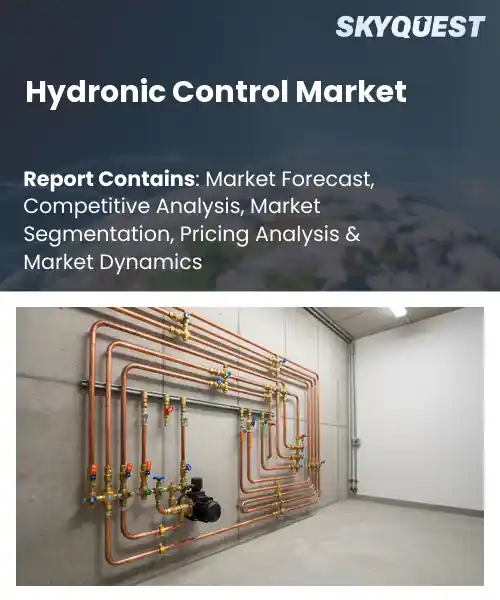
Hydronic Control Market
Report ID: SQMIG20B2226
Report ID: SQMIG20B2226
[email protected]
USA +1 351-333-4748
Report ID:
SQMIG20B2226 |
Region:
Global |
Published Date: July, 2026
Pages:
157
|Tables:
117
|Figures:
77


Global Hydronic Control Market size was valued at USD 5.12 Billion in 2024 and is poised to grow from USD 5.39 Billion in 2025 to USD 8.08 Billion by 2033, growing at a CAGR of 5.2% during the forecast period (2026-2033).
Global hydronic control market growth is a huge segment of hydronic control systems for controlling water based heating and cooling distribution. The increasing need for energy efficient climate management in commercial and residential buildings is their major driver. Historically, the market has evolved from simple thermostatic valves in the 1970s, to programmable logic controllers in the 1990s, and accelerated with digital communication protocols such as BACnet and Modbus in the 2000s. And as governments ramp up stricter codes on energy use, more developers are looking to sophisticated hydronic controls to reduce operating costs and carbon footprints, such as in office towers in Singapore and complexes in Germany.
Internet-of-things connectivity is a key driver of the global hydronic control market trends, turning previously passive hardware into networked nodes that can be monitored and optimized remotely. This allows facilities to shift load to reduce peak demand based on pricing (e.g., 15 % reduction in heating electricity use for a university campus in Canada after deploying controllers). This has led manufacturers to broaden their modular product lines based on open protocols in response to architects’ requirements for retrofit and building projects. The increased demand provides opportunities for software providers, data analysts and companies specializing in predicting maintenance and verification.
How is AI Enhancing Energy Efficiency in the Global Hydronic Control Market?
AI is changing the game of hydronic control market share by bringing predictive analytics that are always learning building use patterns and weather forecasts. Machine learning algorithms constantly optimize valve positions and pump speeds in real time, reducing waste while preserving comfort. Integrated sensors send data to cloud platforms where algorithms detect inefficiencies such as oversized loops or leaks and recommend corrective actions. The technology also enables remote diagnostics, allowing operators to fine-tune systems without having to visit the site. By connecting AI and IoT, controllers can collaborate with other building systems to enable a holistic energy management strategy that adjusts to variations in occupancy and seasonal variations, making the market more responsive and sustainable.
Northwest Energy Efficiency Alliance, June 2026, rolled out an AI-powered dual-fuel control platform that optimizes the coordination between heat pumps and gas furnaces to provide greater efficiency and foster market growth.
Market snapshot - (2026-2033)
Global Market Size
USD 5.12 Billion
Largest Segment
Control Valves
Fastest Growth
Hot Water Circulators
Growth Rate
5.2% CAGR
To get more insights on this market click here to Request a Free Sample Report
Global hydronic control market is segmented by product category, system setup, project mode, end-use sector and region. Based on product category, the market is segmented into control valves, actuators, controllers, thermostats and hot water circulators. Based on system setup, the market is segmented into hydronic heating systems and hydronic cooling systems. Based on project mode, the market is segmented into new construction installations and retrofit upgrades. Based on end-use sector, the market is segmented into residential buildings, commercial buildings and industrial facilities. Based on region, the market is segmented into North America, Europe, Asia Pacific, Latin America and Middle East & Africa.
Control valves segment is projected to hold the largest market share due to their primary role in regulating flow and pressure in hydronic networks, directly impacting system efficiency and reliability. Engineers prefer complex valve designs with smart actuation and diagnostic capabilities that enable precise modulation and predictive maintenance. This key function ensures that control valves are essential to new build and retrofit applications and are at the heart of the matter that drives the adoption of advanced hydronic control solutions.
The controllers segment is the fastest growing area as intelligence and connectivity are being embedded into every new hydronic device creating demand for centralized monitoring and adaptive algorithms. The explosion of IoT platforms and energy-performance mandates is forcing manufacturers to develop open-protocol controllers, which is accelerating market expansion and opening up new streams of revenue for service and software integration.
The residential buildings segment is expected to lead the market owing to the emphasis that homeowners and developers are placing on indoor comfort and lower utility costs, making accurate temperature regulation a priority. More and more hydronic systems in single-family homes, apartments and multi-unit dwellings are being equipped with smart thermostats and zone-control valves that enable users to schedule and receive real-time feedback. The drive for energy aware living is fueling strong demand for integrated control solutions, with the residential segment as the market’s key growth engine.
The commercial buildings segment is the fastest growing segment however as office towers, hospitality venues and retail complexes are adopting centralized hydronic management to meet sustainability certifications and occupant wellness standards. The increasing need for demand-controlled ventilation and heat-recovery integration is motivating owners to move toward more sophisticated controllers, fueling rapid growth and lucrative opportunities for system integrators and service providers.
To get detailed segments analysis, Request a Free Sample Report
North America is at the forefront with a mature construction ecosystem deploying advanced heating and cooling strategies. Deep integration of advanced control technologies in residential, commercial and industrial projects benefits market participants. Strong sustainability culture fuels continued adoption of energy efficient solutions. Extensive retrofit activities keep legacy systems up to date. Innovation in sensor networks and cloud-based management is driven by strong research institutions and a capable engineering workforce. Supportive regulations promoting low-carbon building practices reinforce the demand for intelligent hydronic control devices across a variety of climate zones.
Hydronic control market outlook in the United States is shaped by a high volume of new construction that incorporates smart building concepts. Engineers and designers prioritize precision climate management, leading to widespread deployment of digitally connected valves and thermostats. The market benefits from a collaborative ecosystem of manufacturers, system integrators, and technology providers who focus on interoperability and user‑friendly interfaces. End users value the ability to fine‑tune energy consumption, fostering ongoing interest in upgraded control solutions for both new builds and extensive retrofits.
Hydronic control market forecast in Canada reflects a strong commitment to energy conservation within diverse climatic regions. Builders and facility managers rely on advanced control platforms to balance heating demands while minimizing waste. The country's emphasis on high‑performance building envelopes amplifies the relevance of precise hydronic regulation. Collaborative partnerships between local manufacturers and research institutions promote the introduction of innovative control algorithms that address seasonal variability. This environment sustains a steady appetite for intelligent solutions across residential, commercial, and institutional sectors.
Europe’s growth is driven by strict energy-efficiency directives, steering players towards smarter heating infrastructure. Decarbonization has been a long-standing focus which encourages the integration of renewable heat sources which require sophisticated control mechanisms to optimize performance. Collaborative standards across the region support interoperability, allowing manufacturers to scale solutions efficiently. Accurate temperature control is becoming increasingly important due to growing concerns for occupant comfort and indoor air quality. Leading research hubs and a culture of continuous improvement help to encourage digital monitoring and predictive maintenance use, further reinforcing Europe’s position as a dynamic growth area.
Hydronic control market regional outlook in Germany benefits from a strong engineering tradition that emphasizes precision and reliability. Industry players invest heavily in developing high‑quality control components that seamlessly integrate with complex building management systems. Compliance with rigorous energy standards drives continuous upgrades of existing installations, creating fertile ground for advanced valve and sensor technologies. Collaboration between manufacturers and academic institutes nurtures innovation in adaptive control algorithms, ensuring that German projects remain at the forefront of efficient heating management.
Hydronic control market regional forecast in the United Kingdom is accelerated by ambitious climate targets that mandate smarter heating solutions. Retrofit projects across historic and modern building stock generate significant opportunities for modern control devices. The market embraces open‑protocol communication, enabling diverse technologies to work together and simplify user interaction. Growing consumer awareness of operational cost savings fuels demand for intuitive interfaces and remote monitoring capabilities. This dynamic environment supports rapid adoption of next‑generation hydronic control innovations.
Hydronic control market analysis in France is emerging alongside a national drive toward low‑carbon construction practices. Policy incentives encourage the integration of renewable heat sources, creating a need for intelligent control strategies to balance supply and demand. French manufacturers focus on modular, easy‑to‑install solutions that cater to both new builds and extensive retrofitting programs. Partnerships with research organizations promote the development of predictive control analytics, enhancing system efficiency and occupant comfort across diverse building typologies.
Asia Pacific is expanding its role through rapid urbanisation and a heightened focus on sustainable building practices. The region’s expanding middle class is boosting demand for a comfortable indoor environment, pushing developers to employ sophisticated hydronic control technology. Collaborative ecosystems between local manufacturers and technology companies enable cost-effective innovation, bringing sophisticated solutions to the widest range of market segments. The increasing focus on smart city initiatives is integrating hydronic control into larger IoT systems, allowing for improved energy management of entire districts. All these factors combined increase the region’s influence on the global hydronic control landscape.
Hydronic control market penetration in Japan is characterized by meticulous attention to energy stewardship and space efficiency. Builders prioritize compact, high‑performance control units that align with limited floor areas and stringent energy guidelines. Integration with advanced building automation platforms enables precise temperature regulation, supporting occupant well‑being. Collaboration between domestic equipment producers and research institutes fuels continuous refinement of sensor accuracy and algorithmic responsiveness. This focus on refined control solutions sustains strong demand across residential and commercial projects.
Hydronic control industry in South Korea reflects a dynamic blend of high‑tech manufacturing capabilities and strong government support for green building initiatives. Industry leaders emphasize seamless connectivity between hydronic components and smart home ecosystems, delivering intuitive user experiences. Investments in research and development drive the creation of adaptive control logic that responds to real‑time occupancy and weather patterns. The market benefits from a proactive approach to retrofit modernization, ensuring existing infrastructure can leverage cutting‑edge control technologies.
To know more about the market opportunities by region and country, click here to
Buy The Complete Report
Increasing Energy Efficiency Regulations
Adoption Of Smart Building Systems
High Initial Installation Costs
Complex Integration With Legacy Systems
Request Free Customization of this report to help us to meet your business objectives.
The hydronic control market is becoming increasingly competitive as established HVAC and building automation manufacturers expand their digital building portfolios through product innovation, strategic acquisitions, and software integration. Companies are investing in intelligent balancing valves, connected actuators, IoT-enabled controllers, and cloud-based energy management platforms to improve HVAC efficiency and support building decarbonization initiatives. At the same time, the growing adoption of smart buildings and heat pump systems is encouraging manufacturers to strengthen interoperability with building management systems (BMS) while expanding solutions that optimize hydronic balancing, reduce energy consumption, and simplify retrofit installations.
Top Player’s Company Profile
Recent Developments in the Hydronic Control Market
SkyQuest’s ABIRAW (Advanced Business Intelligence, Research & Analysis Wing) is our Business Information Services team that Collects, Collates, Correlates, and Analyses the Data collected by means of Primary Exploratory Research backed by robust Secondary Desk research. As per SkyQuest analysis, the global hydronic control market is being propelled primarily by tightening energy‑efficiency regulations that compel builders to adopt precise temperature‑control solutions, while the surge in smart‑building integration offers a second driver by linking controllers to IoT platforms for real‑time optimization. The market is led by North America, where mature construction practices and strong sustainability policies drive demand. Control valves emerge as the dominating segment because they directly manage flow and pressure, making them essential in new builds and retrofits. However, high initial installation costs act as a restraint, slowing adoption especially among cost‑sensitive developers.
| Report Metric | Details |
|---|---|
| Market size value in 2024 | USD 5.12 Billion |
| Market size value in 2033 | USD 8.08 Billion |
| Growth Rate | 5.2% |
| Base year | 2024 |
| Forecast period | (2026-2033) |
| Forecast Unit (Value) | USD Billion |
| Segments covered |
|
| Regions covered | North America (US, Canada), Europe (Germany, France, United Kingdom, Italy, Spain, Rest of Europe), Asia Pacific (China, India, Japan, Rest of Asia-Pacific), Latin America (Brazil, Rest of Latin America), Middle East & Africa (South Africa, GCC Countries, Rest of MEA) |
| Companies covered |
|
| Customization scope | Free report customization with purchase. Customization includes:-
|
To get a free trial access to our platform which is a one stop solution for all your data requirements for quicker decision making. This platform allows you to compare markets, competitors who are prominent in the market, and mega trends that are influencing the dynamics in the market. Also, get access to detailed SkyQuest exclusive matrix.
Table Of Content
Executive Summary
Market overview
Parent Market Analysis
Market overview
Market size
KEY MARKET INSIGHTS
COVID IMPACT
MARKET DYNAMICS & OUTLOOK
Market Size by Region
KEY COMPANY PROFILES
Methodology
For the Hydronic Control Market, our research methodology involved a mixture of primary and secondary data sources. Key steps involved in the research process are listed below:
1. Information Procurement: This stage involved the procurement of Market data or related information via primary and secondary sources. The various secondary sources used included various company websites, annual reports, trade databases, and paid databases such as Hoover's, Bloomberg Business, Factiva, and Avention. Our team did 45 primary interactions Globally which included several stakeholders such as manufacturers, customers, key opinion leaders, etc. Overall, information procurement was one of the most extensive stages in our research process.
2. Information Analysis: This step involved triangulation of data through bottom-up and top-down approaches to estimate and validate the total size and future estimate of the Hydronic Control Market.
3. Report Formulation: The final step entailed the placement of data points in appropriate Market spaces in an attempt to deduce viable conclusions.
4. Validation & Publishing: Validation is the most important step in the process. Validation & re-validation via an intricately designed process helped us finalize data points to be used for final calculations. The final Market estimates and forecasts were then aligned and sent to our panel of industry experts for validation of data. Once the validation was done the report was sent to our Quality Assurance team to ensure adherence to style guides, consistency & design.
Analyst Support
Customization Options
With the given market data, our dedicated team of analysts can offer you the following customization options are available for the Hydronic Control Market:
Product Analysis: Product matrix, which offers a detailed comparison of the product portfolio of companies.
Regional Analysis: Further analysis of the Hydronic Control Market for additional countries.
Competitive Analysis: Detailed analysis and profiling of additional Market players & comparative analysis of competitive products.
Go to Market Strategy: Find the high-growth channels to invest your marketing efforts and increase your customer base.
Innovation Mapping: Identify racial solutions and innovation, connected to deep ecosystems of innovators, start-ups, academics, and strategic partners.
Category Intelligence: Customized intelligence that is relevant to their supply Markets will enable them to make smarter sourcing decisions and improve their category management.
Public Company Transcript Analysis: To improve the investment performance by generating new alpha and making better-informed decisions.
Social Media Listening: To analyze the conversations and trends happening not just around your brand, but around your industry as a whole, and use those insights to make better Marketing decisions.
REQUEST FOR SAMPLE
 REQUEST FREE CUSTOMIZATION
Global Hydronic Control Market size was valued at USD 5.12 Billion in 2024 and is poised to grow from USD 5.39 Billion in 2025 to USD 8.08 Billion by 2033, growing at a CAGR of 5.2% during the forecast period (2026-2033).
In 2026 the hydronic control market intensified competition as established manufacturers accelerated M&A activity, notably acquiring niche IoT valve specialists to broaden digital offering suites, while new entrants forged strategic partnerships with building‑automation software firms to embed predictive analytics into legacy control hardware. Concurrently, firms invested heavily in low‑temperature, energy‑efficient actuator technologies, positioning these innovations as differentiators in commercial‑building retrofits. 'Danfoss A/S', 'IMI plc', 'Honeywell International Inc.', 'Siemens AG', 'Johnson Controls International plc', 'Schneider Electric SE', 'Caleffi S.p.A.', 'Watts Water Technologies, Inc.', 'Giacomini S.p.A.', 'Oventrop GmbH & Co. KG', 'Flamco BV', 'Armstrong Fluid Technology', 'Taco Comfort Solutions', 'Resideo Technologies, Inc.', 'Belimo Holding AG', 'REHAU AG + Co', 'Uponor Corporation', 'Zilmet S.p.A.', 'Reliance Worldwide Corporation Limited', 'Spirotech BV'
Regulatory bodies across major regions are imposing stringent energy efficiency standards that require precise temperature control and reduced thermal losses. This environment is driving manufacturers to develop advanced hydronic control solutions that can meet benchmarked performance criteria. By ensuring compliance, building owners can avoid penalties and achieve sustainability certifications, which in turn enhances property value and tenant satisfaction. Consequently, the demand for sophisticated control units that can adapt to variable setpoints and optimize system operations is expanding rapidly through global adoption.
Smart Building Integration: Building owners are increasingly adopting intelligent hydronic control platforms that seamlessly connect with broader building management ecosystems. Real‑time data analytics enable precise temperature modulation, predictive maintenance, and adaptive load balancing across heating networks. This integration reduces energy waste, enhances occupant comfort, and supports compliance with emerging green building certifications. As IoT connectivity expands, manufacturers are delivering open‑protocol solutions that simplify retrofitting and future‑proof legacy installations, driving market momentum toward fully networked thermal management and long‑term operational savings for facilities globally.
Why does North America Dominate the Global Hydronic Control Market? |@12


Want to customize this report? This report can be personalized according to your needs. Our analysts and industry experts will work directly with you to understand your requirements and provide you with customized data in a short amount of time. We offer $1000 worth of FREE customization at the time of purchase.
Feedback From Our Clients


 USA (+1) 351-333-4748

