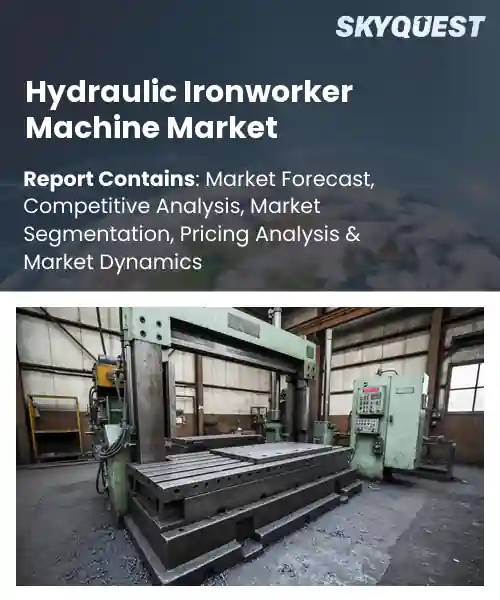
Hydraulic Ironworker Machine Market
Report ID: SQMIG20I3261
Report ID: SQMIG20I3261
[email protected]
USA +1 351-333-4748
Report ID:
SQMIG20I3261 |
Region:
Global |
Published Date: July, 2026
Pages:
157
|Tables:
146
|Figures:
78


Global Hydraulic Ironworker Machine Market size was valued at USD 912.4 Million in 2024 and is poised to grow from USD 953.46 Million in 2025 to USD 1355.91 Million by 2033, growing at a CAGR of 4.5% during the forecast period (2026-2033).
Hydraulic ironworker machine market trends includes hydraulic ironworker machines that combine punching, shearing, notching and bending on a hydraulic platform. They are relevant in terms of reduction of floor space and labor while delivering tolerances. This has become more and more appreciated as construction projects become more complex. The market started in the 1970’s, when the manufacturers replaced the big mechanical presses with hydraulic units, for example, the brands like GPP and O.F. Smith in North America. Over the past 20 years, increased infrastructure spending in China and the Middle East has turned these machines from niche tools to standard equipment on fabrication floors.
This foundation, digital integration has become the catalyst accelerating the hydraulic ironworker machine market share, as manufacturers embed IoT sensors and maintenance algorithms into the hydraulic circuitry. This connectivity reduces downtime by alerting operators to pressure anomalies before failure, thus decreasing the production costs of yards that depend on operation, such as shipyards and bridge-fabrication yards. One Mediterranean shipbuilder, for example, saw throughput jump 15 % after installing a networked ironworker that automatically adjusts force settings for metal thickness. The gains create opportunities for suppliers to provide service contracts and for emerging economies to scale up infrastructure projects while adhering to tighter delivery schedules.
How is AI-driven Automation Reshaping the Hydraulic Ironworker Machine Market?
AI-driven automation is helping make hydraulic ironworker machine market growth, more flexible tools on the shop floor. Now sensors record force, position and wear information in real time and machine-learning algorithms predict the optimal settings for each job. Improves cut quality, Reduces set up time and extends component life. Manufacturers are embedding predictive maintenance modules that alert operators before a hydraulic seal fails, so that production lines can continue running smoothly. The technology also allows for remote monitoring, so engineers can fine tune performance across multiple sites without having to be on site. That is increasing market efficiency, reducing operating costs and making reliable, high-throughput solutions more attractive to construction companies.
In July 2026, a top hydraulic ironworker manufacturer rolled out an AI-driven control system that offers a simplified workflow and precision, directly in line with the market’s push for more automation and productivity.
Market snapshot - (2026-2033)
Global Market Size
USD 912.4 Million
Largest Segment
50 Tons to 100 Tons
Fastest Growth
Above 100 Tons
Growth Rate
4.5% CAGR
To get more insights on this market click here to Request a Free Sample Report
Global hydraulic ironworker machine market is segmented by tonnage capacity, workstation configuration, operational station type, drive system mechanism, end-use industry and region. Based on tonnage capacity, the market is segmented into under 50 tons, 50 tons to 100 tons and above 100 tons. Based on workstation configuration, the market is segmented into single station machines and multi station machines. Based on operational station type, the market is segmented into punching stations, flat shearing stations, angle shearing stations, notching stations and bending stations. Based on drive system mechanism, the market is segmented into single cylinder drive and dual cylinder drive. Based on end-use industry, the market is segmented into construction steel fabrication, industrial manufacturing plant operations, shipbuilding yards, automotive repair facilities and general metal workshops. Based on region, the market is segmented into North America, Europe, Asia Pacific, Latin America and Middle East & Africa.
The segment below 50 tons is the most dominant as it serves the widespread demand for lightweight, high-precision fabrication in construction and small-scale workshops. Its lower investment cost and easier integration into existing shop layouts makes it the go-to product for manufacturers looking for flexibility without compromise on performance. Ease of handling and reduced footprint drive adoption creating a strong value proposition which maintains its leadership in the hydraulic ironworker market.
The over 100 tons segment is emerging as the key high growth area as major infrastructure projects require heavy duty capacity for large structural members. Progress in hydraulic power and reinforced frames means reliable operation at higher loads, attracting manufacturers focused on complex steel assemblies and driving rapid market expansion.
Multi station segment leads because it combines multiple functions into one footprint to allow continuous flow and to reduce changeover time. Manufacturers can integrate punching, shearing and bending capabilities to improve throughput and reduce the need for labor intensive repositioning. The ability to rapidly switch operations and the reduced floor space required reduces total capital and operational costs. Such efficiency gains help these machines find acceptance in a wide variety of fabrication environments, making multi station machines a staple of modern production lines.
Meanwhile, the single station segment is growing the fastest as small workshops and niche fabricators look for compact, cost effective solutions that do not add any unnecessary complexity but rather fulfill specific functions. Single function machines are also gaining market penetration and attracting new users due to continuous improvements in modular tooling and digital controls that increase precision and ease of use.
To get detailed segments analysis, Request a Free Sample Report
North America continues to lead, drawing on its mature industrial infrastructure, high utilization of sophisticated fabrication techniques and an intense focus on productivity improvement. The area has a deep bench of engineering talent and a culture that embraces automation to meet demanding construction schedules.” Strong supply chains ensure ready access to components and support services and ongoing innovation is fueled by leading suppliers located in the United States. Regulatory structures that emphasize safety and efficiency further amplify investments in hydraulic ironworking solutions. Additionally, large infrastructure projects and a strong construction sector lead to consistent demand, which helps the region’s dominance in the global market.
Hydraulic ironworker machine market outlook in the United States is characterized by a high concentration of original equipment manufacturers that prioritize cutting‑edge technology and customization. The market benefits from strong collaboration between manufacturers and end users, fostering rapid integration of new features that enhance precision and cycle time. A well‑developed service network provides timely maintenance and parts availability, reinforcing confidence among contractors. The United States also leverages its extensive construction pipeline, which drives continuous demand for reliable and high‑performance ironworking equipment.
Hydraulic ironworker machine market forecast in Canada reflects a focus on reliability and adaptability to diverse climatic conditions. Canadian manufacturers emphasize robust design and energy efficiency to meet the stringent requirements of northern construction projects. Close partnerships with local fabricators enable tailored solutions that address specific project challenges. The market is supported by a skilled workforce and a regulatory environment that encourages safety and environmental stewardship, fostering steady adoption of hydraulic ironworking technology across the country.
Asia Pacific is the fastest-growing regional market for hydraulic ironworker machines, supported by rapid industrialization, expanding manufacturing capacity, and rising investments in infrastructure development. Countries across the region continue to strengthen their metal fabrication, construction, shipbuilding, and automotive industries, creating sustained demand for high-productivity fabrication equipment. Government initiatives promoting domestic manufacturing and industrial automation have accelerated the adoption of advanced hydraulic ironworking machines. Additionally, increasing investments in smart factories, expanding industrial parks, and the availability of cost-competitive manufacturing further support market growth. The region's growing emphasis on improving production efficiency and reducing labor dependency is expected to sustain strong demand throughout the forecast period.
Hydraulic ironworker machine market regional outlook in China owing to its extensive metal fabrication industry, large-scale manufacturing base, and continuous investments in industrial modernization. The country's well-established machinery manufacturing ecosystem enables the production of technologically advanced and cost-effective hydraulic ironworkers. Strong demand from construction, infrastructure, railway, shipbuilding, and heavy equipment manufacturing industries continues to drive equipment adoption. Furthermore, China's increasing focus on factory automation and precision metal processing strengthens its leadership position in the regional market.
Hydraulic ironworker machine market regional forecast in India, driven by rapid infrastructure development, expanding manufacturing activities, and government initiatives such as "Make in India" that encourage domestic industrial production. Rising investments in steel fabrication, commercial construction, renewable energy projects, and industrial machinery manufacturing are increasing the need for efficient metalworking equipment. Growing adoption of automated fabrication technologies among small and medium-sized enterprises, coupled with expanding industrial corridors and smart city developments, is expected to support robust market growth over the forecast period.
Europe represents a significant market for hydraulic ironworker machines due to its advanced manufacturing capabilities, strong engineering expertise, and widespread adoption of precision metalworking technologies. The region emphasizes high-quality production standards, workplace safety, and energy-efficient industrial equipment, encouraging continuous investment in modern fabrication machinery. Well-established automotive, aerospace, industrial machinery, and structural steel fabrication sectors generate consistent demand for hydraulic ironworkers. Additionally, increasing adoption of Industry 4.0 technologies and sustainable manufacturing practices supports ongoing market expansion across Europe.
Hydraulic ironworker machine market analysis in Germany supported by its globally recognized mechanical engineering sector and highly developed manufacturing industry. The country maintains strong demand from automotive production, industrial equipment manufacturing, structural steel fabrication, and precision engineering applications. German manufacturers continuously invest in automation, digital manufacturing technologies, and high-performance fabrication equipment to improve productivity and maintain global competitiveness. Strong research and development capabilities further reinforce Germany's leadership in the regional market.
Hydraulic ironworker machine market penetration in Poland, increasing the foreign direct investment, and growing manufacturing capacity. Rising investments in construction, metal fabrication, automotive component production, and logistics infrastructure are fueling demand for efficient metalworking machinery. The country's competitive manufacturing costs, expanding industrial base, and increasing adoption of automated fabrication technologies continue to attract equipment investments, positioning Poland as one of Europe's fastest-growing markets for hydraulic ironworker machines.
Hydraulic ironworker machine industry in Italy is supported by the country's well-established metalworking and industrial machinery sectors, which have a long history of manufacturing high-quality fabrication equipment. Demand is driven by structural steel fabrication, construction, automotive component production, and general engineering industries. Italian manufacturers increasingly focus on automation, precision machining, and energy-efficient production processes to improve operational efficiency and meet evolving customer requirements. The country's strong export-oriented manufacturing base and continued investment in advanced fabrication technologies further contribute to steady market growth and reinforce Italy's position as one of the leading markets for hydraulic ironworker machines in Europe.
To know more about the market opportunities by region and country, click here to
Buy The Complete Report
Rising Demand For Infrastructure Projects
Advancements In Hydraulic Technology
High Capital Investment Costs
Complex Maintenance and Downtime
Request Free Customization of this report to help us to meet your business objectives.
The ironworker machine market is characterized by strong competition among established manufacturers that continue to strengthen their market positions through product innovation, expanded distribution networks, and investments in automation and digital manufacturing technologies. Companies are developing more energy-efficient hydraulic systems, CNC-enabled processing capabilities, and improved operator safety features to meet the evolving requirements of metal fabrication, structural steel, and industrial manufacturing customers. In addition, manufacturers are expanding their global dealer and service networks while enhancing aftermarket support to improve customer retention and compete in both mature and emerging markets.
Top Player’s Company Profile
Recent Developments
SkyQuest’s ABIRAW (Advanced Business Intelligence, Research & Analysis Wing) is our Business Information Services team that Collects, Collates, Correlates, and Analyses the Data collected by means of Primary Exploratory Research backed by robust Secondary Desk research. As per SkyQuest analysis, the market is being propelled primarily by the rising demand for infrastructure projects which push contractors toward faster, high precision joining solutions, while continued advancements in hydraulic technology, such as sensor integrated controls and energy efficient actuators, further boost productivity and appeal. However, the high capital investment required to purchase and install these machines remains a notable restraint, especially for smaller firms. North America retains its lead as the dominant region thanks to mature infrastructure, strong engineering talent and robust supply chains, and the under 50 ton capacity segment continues to dominate the market because of its lower cost, compact footprint and flexibility for a wide range of fabricators.
| Report Metric | Details |
|---|---|
| Market size value in 2024 | USD 912.4 Million |
| Market size value in 2033 | USD 1355.91 Million |
| Growth Rate | 4.5% |
| Base year | 2024 |
| Forecast period | (2026-2033) |
| Forecast Unit (Value) | USD Million |
| Segments covered |
|
| Regions covered | North America (US, Canada), Europe (Germany, France, United Kingdom, Italy, Spain, Rest of Europe), Asia Pacific (China, India, Japan, Rest of Asia-Pacific), Latin America (Brazil, Rest of Latin America), Middle East & Africa (South Africa, GCC Countries, Rest of MEA) |
| Companies covered |
|
| Customization scope | Free report customization with purchase. Customization includes:-
|
To get a free trial access to our platform which is a one stop solution for all your data requirements for quicker decision making. This platform allows you to compare markets, competitors who are prominent in the market, and mega trends that are influencing the dynamics in the market. Also, get access to detailed SkyQuest exclusive matrix.
Table Of Content
Executive Summary
Market overview
Parent Market Analysis
Market overview
Market size
KEY MARKET INSIGHTS
COVID IMPACT
MARKET DYNAMICS & OUTLOOK
Market Size by Region
KEY COMPANY PROFILES
Methodology
For the Hydraulic Ironworker Machine Market, our research methodology involved a mixture of primary and secondary data sources. Key steps involved in the research process are listed below:
1. Information Procurement: This stage involved the procurement of Market data or related information via primary and secondary sources. The various secondary sources used included various company websites, annual reports, trade databases, and paid databases such as Hoover's, Bloomberg Business, Factiva, and Avention. Our team did 45 primary interactions Globally which included several stakeholders such as manufacturers, customers, key opinion leaders, etc. Overall, information procurement was one of the most extensive stages in our research process.
2. Information Analysis: This step involved triangulation of data through bottom-up and top-down approaches to estimate and validate the total size and future estimate of the Hydraulic Ironworker Machine Market.
3. Report Formulation: The final step entailed the placement of data points in appropriate Market spaces in an attempt to deduce viable conclusions.
4. Validation & Publishing: Validation is the most important step in the process. Validation & re-validation via an intricately designed process helped us finalize data points to be used for final calculations. The final Market estimates and forecasts were then aligned and sent to our panel of industry experts for validation of data. Once the validation was done the report was sent to our Quality Assurance team to ensure adherence to style guides, consistency & design.
Analyst Support
Customization Options
With the given market data, our dedicated team of analysts can offer you the following customization options are available for the Hydraulic Ironworker Machine Market:
Product Analysis: Product matrix, which offers a detailed comparison of the product portfolio of companies.
Regional Analysis: Further analysis of the Hydraulic Ironworker Machine Market for additional countries.
Competitive Analysis: Detailed analysis and profiling of additional Market players & comparative analysis of competitive products.
Go to Market Strategy: Find the high-growth channels to invest your marketing efforts and increase your customer base.
Innovation Mapping: Identify racial solutions and innovation, connected to deep ecosystems of innovators, start-ups, academics, and strategic partners.
Category Intelligence: Customized intelligence that is relevant to their supply Markets will enable them to make smarter sourcing decisions and improve their category management.
Public Company Transcript Analysis: To improve the investment performance by generating new alpha and making better-informed decisions.
Social Media Listening: To analyze the conversations and trends happening not just around your brand, but around your industry as a whole, and use those insights to make better Marketing decisions.
REQUEST FOR SAMPLE
 REQUEST FREE CUSTOMIZATION
Global Hydraulic Ironworker Machine Market size was valued at USD 912.4 Million in 2024 and is poised to grow from USD 953.46 Million in 2025 to USD 1355.91 Million by 2033, growing at a CAGR of 4.5% during the forecast period (2026-2033).
The competitive landscape is defined by established manufacturers such as Amada, Baileigh Industrial, Dake, Kingsland, Piranha, Accurpress, Haco and Edwards leveraging strategic partnerships and technology upgrades to protect market share; recent joint ventures between Amada and regional distributors have expanded service networks, while Baileigh’s introduction of an energy‑efficient hydraulic ironworker underscores a focus on product innovation to differentiate amid intensifying price competition. 'Kingsland Engineering Co. Ltd.', 'Geka Group', 'Scotchman Industries, Inc.', 'JPW Industries, Inc.', 'Piranha LLC', 'Sunrise Fluid Power Inc.', 'Durmazlar Makina A.S.', 'Ermaksan Machinery', 'Baykal Makina', 'MVD Inan', 'Selva Marine', 'Peddinghaus Corporation', 'Baileigh Industrial', 'Metalika d.o.o.', 'Bendpak Inc.', 'Barer Engineering Co.', 'Cleveland Punch & Die Company', 'Sahinler Group', 'Morgan Rushworth', 'Voortman Steel Machinery'
The growing demand for infrastructure projects is prompting contractors to seek faster, more efficient joining solutions, and hydraulic ironworker machines meet this need by delivering high‑precision drilling and punching capabilities that accelerate assembly, reduce manual effort, and enhance project timelines, thereby supporting market expansion through increased equipment adoption across construction segments. These machines also contribute to improved safety standards by minimizing exposure of workers to hazardous operations, and their adaptability to various steel profiles enables applicability in residential and commercial developments, reinforcing the positive outlook for the hydraulic ironworker segment.
Smart Automation Integration: The hydraulic ironworker market is witnessing rapid adoption of advanced control systems that link machines to enterprise resource planning platforms. Real‑time monitoring, predictive maintenance alerts, and remote programming reduce downtime and enable factories to respond instantly to design changes. This seamless connectivity also supports data‑driven optimization of cycle times and energy consumption, fostering higher productivity while meeting stringent safety standards. Manufacturers increasingly view intelligent automation as a core differentiator for competitive positioning in global construction and infrastructure projects throughout 2025.
Why does North America Dominate the Global Hydraulic Ironworker Machine Market? |@12


Want to customize this report? This report can be personalized according to your needs. Our analysts and industry experts will work directly with you to understand your requirements and provide you with customized data in a short amount of time. We offer $1000 worth of FREE customization at the time of purchase.
Feedback From Our Clients


 USA (+1) 351-333-4748

