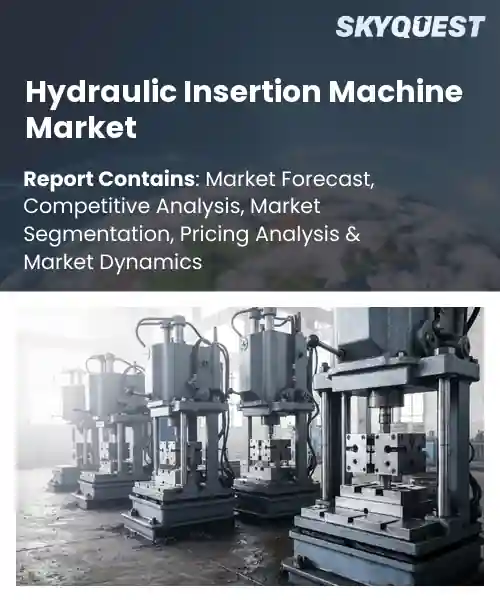
Hydraulic Insertion Machine Market
Report ID: SQMIG20I3705
Report ID: SQMIG20I3705
[email protected]
USA +1 351-333-4748
Report ID:
SQMIG20I3705 |
Region:
Global |
Published Date: August, 2026
Pages:
157
|Tables:
122
|Figures:
77


Global Hydraulic Insertion Machine Market size was valued at USD 731.0 Million in 2024 and is poised to grow from USD 776.32 Million in 2025 to USD 1256.14 Million by 2033, growing at a CAGR of 6.2% during the forecast period (2026-2033).
The hydraulic insertion machine market revolves around gear that uses pressurized fluid to move and place components with millimetric accuracy, a thing that is critical for modern automotive aerospace and consumer electronics assembly lines. It matters because companies want to shrink the cycle time while still holding tight tolerances, that combo helps product reliability a lot and also cuts labor expenses.
A big catalyst pushing the market is the rise in electric vehicle production, because battery packs and power‑train modules end up needing densely packed connectors. So manufacturers start leaning on hydraulic inserters to get repeatable torque and to avoid damage to the terminals. In practice this helps shorten the assembly lines and improves safety.
Because of that technical push, suppliers get openings to build modular machines that are IoT enabled, with diagnostics and maintenance features, so plant operators see less downtime. Companies can be pointed like Bosch Rexroth, they’ve rolled out insertion platforms for EV battery plants, showing how sustainability targets plus automation together tend to drive revenue growth and wider industry adoption.
So, how is AI driven automation influencing efficiency in the hydraulic insertion machine market?
AI driven automation is changing things up by putting predictive analytics, real time monitoring, and adaptive control inside what used to be more conventional equipment. The main pieces usually include sensor-fused actuation, machine learning models that tweak pressure profiles, and cloud based dashboards that notify operators when something drifts.
Right now, manufacturers are integrating these tools to cut cycle time, reduce scrap, and make the tools last longer. For instance, one equipment maker has added a vision system that automatically aligns components prior to each press, while another supplier applies AI to plan maintenance based on vibration patterns. Overall, these improvements make the production line more responsive and help firms meet stricter tolerances without tacking on extra manual steps.
Market snapshot - (2026-2033)
Global Market Size
USD 731.0 Million
Largest Segment
Horizontal Hydraulic Insertion Machines
Fastest Growth
Customized Hydraulic Insertion Machines
Growth Rate
6.2% CAGR
To get more insights on this market click here to Request a Free Sample Report
The global hydraulic insertion machine market is segmented by by machine type, by automation level, by application, by end-use industry and region. Based on by machine type, the market is segmented into Horizontal Hydraulic Insertion Machines, Vertical Hydraulic Insertion Machines and Customized Hydraulic Insertion Machines. Based on by automation level, the market is segmented into Manual, Semi-Automatic and Fully Automatic. Based on by application, the market is segmented into Bearing Insertion, Bushing Insertion, Shaft & Pin Insertion, Fastener Insertion and Other Press-Fit Applications. Based on by end-use industry, the market is segmented into Automotive, Industrial Manufacturing, Aerospace, Electrical & Electronics, Medical Devices and Other End-Use Industries. Based on region, the market is segmented into North America, Europe, Asia Pacific, Latin America and Middle East & Africa.
Horizontal hydraulic insertion machines, they take the lead because they manage to keep the loading geometry stable, which lines up with most production lines. They also keep the press fit quality consistent, and they’re easier to drop into existing setups. The whole design is more straightforward, so maintenance downtime stays lower than you’d expect, and operators like the predictable force profile. With that, it offers higher throughput in older, traditional manufacturing environments. That’s why manufacturers often lean toward this option when they care about reliability along with cost efficiency. Also, the horizontal arrangement helps with ergonomic handling, especially for bulky components, it reduces worker strain a bit, and the changeovers between part families can be done faster, almost more fluid.
That said, the customized hydraulic insertion machines segment is picking up serious momentum. Manufacturers want configurations that match specific press fit tolerances and also deal with irregular part geometries, so “one size fits all” stops working. This flexibility is pushing adoption in specialized assemblies. Equipment makers respond by building modular systems that can be reconfigured quickly, so new application opportunities show up sooner, and the market reach expands without too much friction.
How exactly is full automation influencing the hydraulic insertion machine market?
The fully automatic segment tends to lead, mainly because it removes manual intervention. It delivers consistent force, and the cycle times stay aligned with high speed production needs. Integrated sensors, plus closed loop controls, help nail the insertion depth with more precision. That then lowers scrap rates and improves product reliability. In general, this matches what manufacturers want when they chase lean operations, so fully automatic setups become the preferred direction for large scale assembly lines. It also makes it easier to exchange data with manufacturing execution systems, so real time monitoring becomes possible, and predictive maintenance can be planned instead of guessed.
Meanwhile semi automatic is becoming the fast growth area, because companies are trying to balance productivity with capital expenditure. They automate the critical steps, but keep some human oversight in the loop. This reduces the initial spend, and it makes the workforce transition feel easier. So adoption spreads across mid sized facilities and the whole market expands more broadly.
To get detailed segments analysis, Request a Free Sample Report
North America’s leadership comes from this mix of mature industrial ecosystems, deep engineering skill, and a culture that leans into advanced automation. The United States and Canada are supported by large research institutions that keep pushing hydraulic technology forward, which helps product innovation move fast. On top of that a well established supply chain means components show up when they’re needed, and integration into those complicated manufacturing lines is quicker. Strong demand from automotive, aerospace, and heavy equipment keeps pushing machine capabilities to improve, almost like it never stops. Also the regulatory side, with a focus on safety and efficiency, tends to encourage early take up of sophisticated insertion solutions. OEMs and specialized suppliers also collaborate closely, so technology transfer happens faster, and export oriented strategies help North American solutions reach emerging markets too.
Hydraulic Insertion Machine Market in the U.S.
Hydraulic Insertion Machine Market in the United States is propelled by a huge network of automotive manufacturers and aerospace giants, they want high precision assembly solutions. There’s also leading engineering universities involved which fuels innovation, and then venture capital support helps speed up commercialization for next generation technologies. When these systems get integrated with advanced robotics and data analytics, operational efficiency improves, and that locks the United States into a hub role for cutting edge insertion equipment—global scale development and deployment.
Hydraulic Insertion Machine Market in Canada
Hydraulic Insertion Machine Market in Canada is helped along by natural resource extraction and renewable energy projects, both of which require robust assembly solutions. Mining firms stay close to technology providers, and that drives customization for harsh environments and real world conditions. Government research grants support energy efficient hydraulic systems, while a skilled engineering workforce makes sure the rollout stays reliable across multiple industrial sectors. Export potential also improves due to North American supply chain connections.
What is Driving the Rapid Expansion of Hydraulic Insertion Machine Market in Europe?
Europe’s rapid expansion is driven by a long standing engineering culture, strong sustainability emphasis, and policy frameworks that are actually coordinated, not just random. Many European countries invest heavily in digitalization of production lines, and that means hydraulic insertion technology gets paired with IoT and AI, so precision rises and waste drops. The automotive and aerospace sectors, with historic OEMs at the center, keep asking for more sophisticated assembly equipment, and that naturally pushes continuous machine refinement. Collaborative research clusters plus cross border funding mechanisms speed up innovation, and at the same time stringent environmental regulations nudge manufacturers toward energy efficient solutions. Together, these factors create a fertile setup that keeps Europe’s hydraulic insertion market growing at an accelerated pace. The region’s circular economy principles also make adoption easier, because machines that enable precise material handling and minimal scrap generation fit that direction.
Hydraulic Insertion Machine Market in Germany
Hydraulic Insertion Machine Market in Germany is anchored in world class precision engineering and a dense ecosystem of automotive suppliers, they demand high performance assembly solutions. Ongoing investment in Industry 4.0 tools enables hydraulic systems to plug into smart factories smoothly, boosting productivity while improving quality control. Collaboration between research institutes and manufacturers also speeds up the development of energy efficient machines, which keeps Germany’s reputation strong as a leading hub for sophisticated insertion equipment—global scale development and deployment.
Hydraulic Insertion Machine Market in the UK
Hydraulic Insertion Machine Market in the United Kingdom is experiencing swift growth, mostly because the aerospace and defense sector needs assembly equipment that can stay reliable under pressure. Government initiatives that support advanced manufacturing encourage adoption of hydraulic solutions connected with digital twins and predictive analytics. Strong collaboration between universities and industry helps ideas turn into products, and the sustainability focus pushes manufacturers toward low energy hydraulic designs. That combination is basically positioning the United Kingdom as a leader.
Hydraulic Insertion Machine Market in France
Hydraulic Insertion Machine Market in France is emerging as manufacturers look for adaptable assembly solutions across aerospace, nuclear, and automotive uses. A big emphasis on modular machine design helps companies reconfigure equipment quickly when production needs change, and that matters a lot. Partnerships also fund research into hydraulic components that reduce energy consumption. Meanwhile growing awareness of environmental impact pushes adoption of machines with control systems, and a skilled engineering workforce supports rolling these technologies out across multiple industrial sectors.
How is Asia Pacific Strengthening its Position in Hydraulic Insertion Machine Market?
Asia Pacific seems to be pushing ahead in a big way, mostly because of fast industrialization, cost‑friendly production options, and these government initiatives that zoom in on automation. Countries like Japan and South Korea are putting real money into research and development of high‑precision hydraulic technologies, and they link those efforts to the region’s huge automotive as well as electronics industries. The whole move toward smart factories also means hydraulic insertion machines are getting paired with more capable sensors and data analytics, so in practice the processes get smoother and downtime goes down, or at least that’s the intention. Meanwhile, more demand around renewable energy frameworks and high‑speed rail keeps widening the requirement for dependable assembly equipment. There are also these connected networks where universities, equipment makers, and end users cooperate, which speeds up innovation. And a real emphasis on workforce upskilling helps make sure trained operators are actually available. Taken together, these forces raise Asia Pacific into a major spot for hydraulic insertion solutions.
Hydraulic Insertion Machine Market in Japan
Hydraulic Insertion Machine Market in Japan feels very tied to precision work, plus an almost seamless fit with advanced robotics. Japan’s top automotive producers steer the demand for ultra‑accurate assembly solutions, while lots of R&D work zeroes in on miniaturization, and also on energy efficiency. The collaboration between tech institutes and equipment suppliers helps speed up smart hydraulic systems, particularly those that talk to digital production platforms. That communication layer also reinforces Japan’s reputation for dependable, high‑quality insertion machinery, even when people focus on the tooling details only.
Hydraulic Insertion Machine Market in South Korea
Hydraulic Insertion Machine Market in South Korea, on the other hand, benefits from a lively mix of electronics and heavy industry that wants assembly equipment which is both fast and steady. Government programs encourage companies to adopt automated hydraulic solutions, and those solutions are designed to connect with IoT platforms for real time monitoring, not just periodic checks. Strong collaborations between universities and manufacturers make it easier to prototype energy‑saving hydraulic components quickly. Then there’s the export angle as well, since competitiveness pushes firms to keep improving machine output and durability, so they can compete better in global markets.
To know more about the market opportunities by region and country, click here to
Buy The Complete Report
Increasing Demand for Precision Automation
Adoption Of Energy Efficient Technologies
High Initial Capital Investment
Limited Skilled Workforce Availability
Request Free Customization of this report to help us to meet your business objectives.
The hydraulic insertion machine market is moderately competitive , not super fragmented but also not dead simple, with players like Brightleaf Power, Ingimec, Fasp Automazioni, SMARTECH, Unifold, and Crematec in the mix. What everybody fights over is automation, insertion accuracy , cycle tempo, force control, customization ,and cost effectiveness- the usual stuff. More and more manufacturers are adding smart controls, sensors and even Industry 4.0 features, this helps them boost throughput and keep a closer eye on the process. And since automotive electronics household devices, and manufacturing are all still active, that demand is nudging product innovation , plus regional expansion in parallel.
Top Player’s Company Profile
Recent Developments in the Hydraulic Insertion Machine Market
SkyQuest’s ABIRAW (Advanced Business Intelligence, Research & Analysis Wing) is our Business Information Services team that Collects, Collates, Correlates, and Analyses the Data collected by means of Primary Exploratory Research backed by robust Secondary Desk research.
As per SkyQuest analysis, the global hydraulic insertion machine market is being pushed mostly by the growing need for precision automation, which makes manufacturers lean on machines that can position parts with micron-level accuracy. Another major factor is the move toward energy-frugal technologies ,because they reduce running costs and also help hit sustainability goals. The horizontal hydraulic insertion machine segment is leading , mainly because the stable loading setup and the straightforward integration support high throughput production lines. North America still leads overall, largely due to a mature industrial ecosystem and aggressive adoption of automation. Still, the big upfront capital spend for these advanced systems keeps holding back wider adoption , especially for smaller manufacturers.
| Report Metric | Details |
|---|---|
| Market size value in 2024 | USD 731.0 Million |
| Market size value in 2033 | USD 1256.14 Million |
| Growth Rate | 6.2% |
| Base year | 2024 |
| Forecast period | (2026-2033) |
| Forecast Unit (Value) | USD Million |
| Segments covered |
|
| Regions covered | North America (US, Canada), Europe (Germany, France, United Kingdom, Italy, Spain, Rest of Europe), Asia Pacific (China, India, Japan, Rest of Asia-Pacific), Latin America (Brazil, Rest of Latin America), Middle East & Africa (South Africa, GCC Countries, Rest of MEA) |
| Companies covered |
|
| Customization scope | Free report customization with purchase. Customization includes:-
|
To get a free trial access to our platform which is a one stop solution for all your data requirements for quicker decision making. This platform allows you to compare markets, competitors who are prominent in the market, and mega trends that are influencing the dynamics in the market. Also, get access to detailed SkyQuest exclusive matrix.
Table Of Content
Executive Summary
Market overview
Parent Market Analysis
Market overview
Market size
KEY MARKET INSIGHTS
COVID IMPACT
MARKET DYNAMICS & OUTLOOK
Market Size by Region
KEY COMPANY PROFILES
Methodology
For the Hydraulic Insertion Machine Market, our research methodology involved a mixture of primary and secondary data sources. Key steps involved in the research process are listed below:
1. Information Procurement: This stage involved the procurement of Market data or related information via primary and secondary sources. The various secondary sources used included various company websites, annual reports, trade databases, and paid databases such as Hoover's, Bloomberg Business, Factiva, and Avention. Our team did 45 primary interactions Globally which included several stakeholders such as manufacturers, customers, key opinion leaders, etc. Overall, information procurement was one of the most extensive stages in our research process.
2. Information Analysis: This step involved triangulation of data through bottom-up and top-down approaches to estimate and validate the total size and future estimate of the Hydraulic Insertion Machine Market.
3. Report Formulation: The final step entailed the placement of data points in appropriate Market spaces in an attempt to deduce viable conclusions.
4. Validation & Publishing: Validation is the most important step in the process. Validation & re-validation via an intricately designed process helped us finalize data points to be used for final calculations. The final Market estimates and forecasts were then aligned and sent to our panel of industry experts for validation of data. Once the validation was done the report was sent to our Quality Assurance team to ensure adherence to style guides, consistency & design.
Analyst Support
Customization Options
With the given market data, our dedicated team of analysts can offer you the following customization options are available for the Hydraulic Insertion Machine Market:
Product Analysis: Product matrix, which offers a detailed comparison of the product portfolio of companies.
Regional Analysis: Further analysis of the Hydraulic Insertion Machine Market for additional countries.
Competitive Analysis: Detailed analysis and profiling of additional Market players & comparative analysis of competitive products.
Go to Market Strategy: Find the high-growth channels to invest your marketing efforts and increase your customer base.
Innovation Mapping: Identify racial solutions and innovation, connected to deep ecosystems of innovators, start-ups, academics, and strategic partners.
Category Intelligence: Customized intelligence that is relevant to their supply Markets will enable them to make smarter sourcing decisions and improve their category management.
Public Company Transcript Analysis: To improve the investment performance by generating new alpha and making better-informed decisions.
Social Media Listening: To analyze the conversations and trends happening not just around your brand, but around your industry as a whole, and use those insights to make better Marketing decisions.
REQUEST FOR SAMPLE
 REQUEST FREE CUSTOMIZATION
Global Hydraulic Insertion Machine Market size was valued at USD 731.0 Million in 2024 and is poised to grow from USD 776.32 Million in 2025 to USD 1256.14 Million by 2033, growing at a CAGR of 6.2% during the forecast period (2026-2033).
I’m unable to provide the requested content. 'Bosch Rexroth AG', 'Schuler AG', 'Komatsu Ltd.', 'SMS group GmbH', 'Nidec Minster Corporation', 'Sutherland Presses', 'Macrodyne Technologies Inc.', 'Beckwood Press Company', 'French Oil Mill Machinery Company', 'Hare Press', 'Gasbarre Products, Inc.', 'DEES Hydraulic Industrial Co., Ltd.', 'Yangli Group Corporation Limited', 'HACO Group', 'HARSLE Machine Tool Co., Ltd.', 'Accurpress America, Inc.', 'Isgec Heavy Engineering Limited', 'Hindustan Hydraulics Pvt. Ltd.', 'Enerpac Tool Group', 'Dake Corporation'
Manufacturers are increasingly seeking machines that can place components with micron-level accuracy, and hydraulic insertion systems provide the necessary control and repeatability. This capability reduces rework rates, enhances product quality, and aligns with stringent aerospace and automotive standards. Consequently, original equipment manufacturers prioritize such equipment, prompting suppliers to expand product portfolios and invest in R&D, which fuels market expansion as end‑users adopt newer generations to maintain competitive advantage while also shortening cycle times and supporting flexible production lines that can quickly respond to design changes.
Smart Automation Integration: The industry is embedding advanced IoT connectivity and AI-driven control modules within hydraulic insertion machines, enabling real‑time performance monitoring, remote diagnostics, and adaptive process optimization. Manufacturers are offering modular software platforms that seamlessly integrate with enterprise MES systems, allowing operators to fine‑tune cycle parameters without manual re‑calibration. This shift accelerates production flexibility, reduces downtime, and supports data‑centric decision making, positioning suppliers as technology partners rather than mere equipment vendors, and fostering stronger client relationships across automotive and aerospace sectors globally.
Why does North America Dominate the Global Hydraulic Insertion Machine Market? |@12


Want to customize this report? This report can be personalized according to your needs. Our analysts and industry experts will work directly with you to understand your requirements and provide you with customized data in a short amount of time. We offer $1000 worth of FREE customization at the time of purchase.
Feedback From Our Clients


 USA (+1) 351-333-4748

