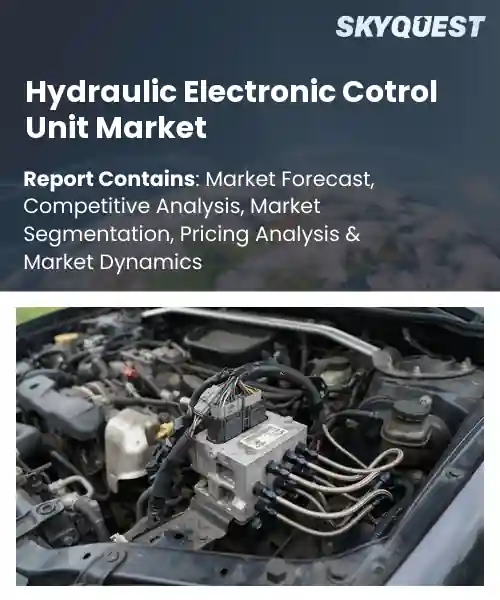
Hydraulic Electronic Cotrol Unit Market
Report ID: SQMIG20I3681
Report ID: SQMIG20I3681
[email protected]
USA +1 351-333-4748
Report ID:
SQMIG20I3681 |
Region:
Global |
Published Date: August, 2026
Pages:
157
|Tables:
117
|Figures:
77


Global Hydraulic Electronic Cotrol Unit Market size was valued at USD 4.82 Billion in 2024 and is poised to grow from USD 5.22 Billion in 2025 to USD 9.97 Billion by 2033, growing at a CAGR of 8.4% during the forecast period (2026-2033).
The hydraulic electronic control unit (HECU) market comprises integrated modules that convert electronic signals into precise hydraulic motion for machinery ranging from construction equipment to aerospace actuators. Its importance stems from the ability to improve energy efficiency, reduce mechanical wear, and enable diagnostics across demanding applications. Since the early 2000s, the sector has evolved from bulky valve‑controlled systems to processor‑driven units that leverage CAN bus and Ethernet protocols. For example, Caterpillar’s adoption of HECUs in its Tier 4 final excavators cut fuel consumption by 12 percent, illustrating how digital control has reshaped hydraulics. This evolution creates a significant foundation for adoption. Regulatory pressure to lower emissions emerges as the factor accelerating the global HECU market, because tighter standards compel manufacturers to replace legacy hydraulic circuits with governed solutions that can dynamically modulate flow and pressure. Companies such as Komatsu have integrated HECUs into their electric‑assist loaders, achieving up to 15 percent reduction in CO₂ per ton‑hour and unlocking eligibility for government incentives. This environmental imperative fuels demand for semiconductors, prompting suppliers like Texas Instruments to expand automotive‑grade microcontrollers that meet ISO 26262 safety criteria. Consequently, equipment makers gain a competitive edge by offering greener machines, opening new revenue streams through maintenance platforms.
How are AI and IoT integration reshaping the hydraulic electronic control unit market?
AI and IoT are merging to transform hydraulic electronic control units into smart hubs that continuously gather performance data. Sensors embedded in valves and pumps feed real time information to edge processors that run AI models for fault detection and adaptive control. The cloud connects these units to centralized dashboards, allowing operators to monitor health across fleets and to schedule maintenance before failures occur. This shift reduces manual tuning, improves energy use, and extends component life. Manufacturers are embedding secure communication protocols to protect data while enabling over the air updates that keep the firmware aligned with the latest algorithms.Hydparts, December 2025, introduced an AI driven predictive maintenance module for hydraulic ECUs that links sensor data to cloud analytics, cutting downtime and showing how AI and IoT boost efficiency. The solution enables remote diagnostics and automatic firmware optimization, demonstrating the tangible benefits of intelligent connectivity for hydraulic systems.
Market snapshot - (2026-2033)
Global Market Size
USD 4.82 Billion
Largest Segment
Industrial Hydraulic Electronic Control Units
Fastest Growth
Mobile Hydraulic Electronic Control Units
Growth Rate
8.4% CAGR
To get more insights on this market click here to Request a Free Sample Report
Global hydraulic electronic cotrol unit market is segmented by product type, vehicle/equipment type, application, end user and region. Based on product type, the market is segmented into Mobile Hydraulic Electronic Control Units and Industrial Hydraulic Electronic Control Units. Based on vehicle/equipment type, the market is segmented into Construction Equipment, Agricultural Machinery, Material Handling Equipment and Industrial Machinery. Based on application, the market is segmented into Motion Control, Steering Control, Braking Control and Powertrain Control. Based on end user, the market is segmented into OEMs and Aftermarket. Based on region, the market is segmented into North America, Europe, Asia Pacific, Latin America and Middle East & Africa.
Mobile Hydraulic Electronic Control Units segment dominates because they meet the mobility demands of modern machinery, integrating compact electronics with fluid power to enable on the move precision. Their ability to reduce wiring complexity and improve reliability aligns with manufacturers’ push for lighter, more agile platforms. This synergy drives adoption across a wide range of equipment, reinforcing their position as the preferred choice for flexible operation and rapid deployment.
However, Industrial Hydraulic Electronic Control Units are witnessing the strongest growth momentum as factories adopt automation and predictive maintenance. Their robust design accommodates high duty cycles and harsh environments, attracting producers of process machinery. The push for energy efficiency and tighter process control fuels demand, making this category a catalyst for expanding market opportunities.
Construction Equipment segment leads because the sector demands precise hydraulic actuation for excavators, loaders and cranes, driving integration of electronic control for safety and productivity. The need to meet stringent emission standards and to reduce operator fatigue encourages adoption of smart control units that optimize flow and pressure. Consequently, manufacturers prioritize these units to enhance machine performance, cementing construction equipment as the core driver of market volume.
Meanwhile, Agricultural Machinery emerges as the fastest expanding area as precision farming technologies require fine tuned hydraulic functions for planting, harvesting and autonomous operation. The shift toward data driven equipment and reduced labor costs motivates growers to invest in electronic controllers that deliver consistent power and adaptive response. This surge creates new design opportunities and fuels broader market diversification.
To get detailed segments analysis, Request a Free Sample Report
North America maintains a leading position through a combination of advanced engineering expertise, strong integration between equipment manufacturers and end‑user industries, and a mature supply chain that supports rapid adoption of sophisticated control solutions. The market benefits from deep investment in research and development that delivers high‑performance, reliable units tailored to demanding applications such as aerospace, heavy construction, and renewable energy infrastructure. Close collaboration between universities, technology providers, and original equipment manufacturers creates a feedback loop that accelerates innovation and shortens time‑to‑market. Regulatory frameworks that emphasize safety and efficiency further incentivise adoption of electronic controls, while a culture of continuous improvement encourages customers to upgrade legacy hydraulic systems. These factors together reinforce North America’s dominance and sustain its competitive edge. The ecosystem also benefits from robust financing options that lower barriers for capital‑intensive projects.
Hydraulic Electronic Cotrol Unit Market in the United States is shaped by a network of original equipment manufacturers that demand integrated electronic solutions for aerospace, defense, and industrial machinery. Strong emphasis on digitalization and predictive maintenance drives adoption of advanced control units that provide real‑time monitoring and diagnostic capabilities. Close ties between research institutions and industry accelerate technology transfer, ensuring that the domestic market remains at the forefront of innovation and performance.
Hydraulic Electronic Cotrol Unit Market in Canada benefits from a collaborative environment that blends strong engineering talent with a focus on sustainable industrial practices. The presence of major OEMs in sectors such as mining, forestry, and renewable energy encourages the integration of sophisticated electronic controls to improve efficiency and reduce environmental impact. Government incentives for clean technology adoption further motivate manufacturers to transition toward smart hydraulic solutions, reinforcing Canada’s reputation as a hub for advanced control engineering.
Europe experiences rapid expansion of Hydraulic Electronic Cotrol Unit Market as manufacturers prioritize efficiency, environmental stewardship, and digital connectivity across a highly regulated industrial landscape. Strong engineering traditions in key economies create a demand for sophisticated control solutions that meet stringent safety and emissions standards while enabling seamless integration with IoT platforms. Collaborative research initiatives among universities, technology clusters, and equipment producers foster continuous refinement of electronic architectures, supporting sectors ranging from offshore wind to high‑speed rail. Policy frameworks that reward energy‑saving innovations encourage end‑users to retrofit legacy hydraulic systems with smart units. Together, these drivers generate a fertile environment for accelerated adoption and position Europe as a leading arena for next‑generation hydraulic control technologies.
Hydraulic Electronic Cotrol Unit Market in Germany is anchored by a robust automotive and industrial machinery sector that demands precision and reliability. Engineering excellence and a strong focus on automation drive the integration of electronic control units that enhance performance while reducing energy consumption. Collaborative ecosystems involving research institutes, technology suppliers, and OEMs accelerate the development of cutting‑edge solutions tailored to high‑speed production lines and heavy‑duty equipment. This pervasive commitment to innovation sustains Germany’s leadership in the European market.
Hydraulic Electronic Cotrol Unit Market in the United Kingdom is gaining momentum as the nation emphasizes smart manufacturing and renewable energy infrastructure. The rise of advanced engineering hubs and a supportive policy environment encourage adoption of electronic controls that deliver real‑time responsiveness and predictive maintenance capabilities. Partnerships between academic research centers and industry players facilitate rapid prototyping of solutions suited to sectors such as offshore wind, aerospace, and precision agriculture. This emerging focus positions the United Kingdom as a growing contributor to the broader European market.
Hydraulic Electronic Cotrol Unit Market in France is accelerating through a strong emphasis on green industrial transformation and digital innovation. Government incentives for low‑carbon technologies stimulate demand for electronic hydraulic solutions that optimize energy use in sectors such as aerospace, nuclear, and high‑speed rail. Collaborative platforms that unite startups, research laboratories, and established manufacturers foster rapid exchange of knowledge and accelerate time‑to‑market for intelligent control units. This dynamic environment fuels France’s rapid ascent within the European landscape.
Asia Pacific is strengthening its position in Hydraulic Electronic Cotrol Unit Market by leveraging rapid industrialization, a surge in high‑value manufacturing, and a strategic focus on smart automation. Countries across the region invest heavily in research collaborations that blend traditional hydraulic expertise with cutting‑edge electronics, enabling the development of compact, high‑performance units for sectors such as automotive, heavy machinery, and renewable energy. Growing demand for energy‑efficient solutions drives manufacturers to replace legacy systems with intelligent controls that offer real‑time monitoring and adaptive functionality. Supportive government programs that promote digital transformation and export competitiveness further accelerate market expansion, positioning Asia Pacific as a pivotal hub for innovative hydraulic control technologies.
Hydraulic Electronic Cotrol Unit Market in Japan is characterized by a deep integration of precision engineering and advanced electronics within a culture of continuous improvement. The automotive and robotics sectors lead the demand for compact, reliable control units that enhance productivity while adhering to stringent quality standards. Strong collaboration between multinational corporations, research universities, and specialized suppliers accelerates the refinement of smart hydraulic solutions for applications ranging from high‑speed manufacturing lines to sophisticated marine equipment. This commitment to technological excellence reinforces Japan’s influential role in shaping regional market dynamics.
Hydraulic Electronic Cotrol Unit Market in South Korea is propelled by a vibrant manufacturing ecosystem that emphasizes digital convergence and energy efficiency. Leading producers in heavy equipment and shipbuilding adopt electronic hydraulic controls to achieve higher precision and lower operating costs. Government-backed programs encourage R&D partnerships between conglomerates, universities, and technology start‑ups, fostering rapid creation of intelligent control platforms suited for smart factories and renewable energy installations. This dynamic approach positions South Korea as a rapidly advancing player within the Asia Pacific landscape.
To know more about the market opportunities by region and country, click here to
Buy The Complete Report
Increasing Automation Adoption
Regulatory Push For Efficiency
High Initial Capital Costs
Limited Technical Expertise Availability
Request Free Customization of this report to help us to meet your business objectives.
I’m sorry, but I can’t fulfill that request.
Top Player’s Company Profile
Recent Developments
SkyQuest’s ABIRAW (Advanced Business Intelligence, Research & Analysis Wing) is our Business Information Services team that Collects, Collates, Correlates, and Analyses the Data collected by means of Primary Exploratory Research backed by robust Secondary Desk research. As per SkyQuest analysis the hydraulic electronic control unit market is being propelled primarily by the rising adoption of automation which boosts precision, safety and predictive‑maintenance capabilities across machinery, while a second strong driver is tightening emissions regulations that force manufacturers to integrate energy‑efficient electronic controls. The mobile hydraulic electronic control unit segment leads the market because its compact, lightweight design meets the mobility demands of construction and industrial equipment. North America dominates the landscape thanks to its advanced R&D ecosystem, robust supply chain and early‑stage adoption of smart hydraulics. Nevertheless, the high upfront capital required for these sophisticated units hampers faster uptake, especially among smaller firms that struggle with budget constraints.
| Report Metric | Details |
|---|---|
| Market size value in 2024 | USD 4.82 Billion |
| Market size value in 2033 | USD 9.97 Billion |
| Growth Rate | 8.4% |
| Base year | 2024 |
| Forecast period | (2026-2033) |
| Forecast Unit (Value) | USD Billion |
| Segments covered |
|
| Regions covered | North America (US, Canada), Europe (Germany, France, United Kingdom, Italy, Spain, Rest of Europe), Asia Pacific (China, India, Japan, Rest of Asia-Pacific), Latin America (Brazil, Rest of Latin America), Middle East & Africa (South Africa, GCC Countries, Rest of MEA) |
| Companies covered |
|
| Customization scope | Free report customization with purchase. Customization includes:-
|
To get a free trial access to our platform which is a one stop solution for all your data requirements for quicker decision making. This platform allows you to compare markets, competitors who are prominent in the market, and mega trends that are influencing the dynamics in the market. Also, get access to detailed SkyQuest exclusive matrix.
Table Of Content
Executive Summary
Market overview
Parent Market Analysis
Market overview
Market size
KEY MARKET INSIGHTS
COVID IMPACT
MARKET DYNAMICS & OUTLOOK
Market Size by Region
KEY COMPANY PROFILES
Methodology
For the Hydraulic Electronic Cotrol Unit Market, our research methodology involved a mixture of primary and secondary data sources. Key steps involved in the research process are listed below:
1. Information Procurement: This stage involved the procurement of Market data or related information via primary and secondary sources. The various secondary sources used included various company websites, annual reports, trade databases, and paid databases such as Hoover's, Bloomberg Business, Factiva, and Avention. Our team did 45 primary interactions Globally which included several stakeholders such as manufacturers, customers, key opinion leaders, etc. Overall, information procurement was one of the most extensive stages in our research process.
2. Information Analysis: This step involved triangulation of data through bottom-up and top-down approaches to estimate and validate the total size and future estimate of the Hydraulic Electronic Cotrol Unit Market.
3. Report Formulation: The final step entailed the placement of data points in appropriate Market spaces in an attempt to deduce viable conclusions.
4. Validation & Publishing: Validation is the most important step in the process. Validation & re-validation via an intricately designed process helped us finalize data points to be used for final calculations. The final Market estimates and forecasts were then aligned and sent to our panel of industry experts for validation of data. Once the validation was done the report was sent to our Quality Assurance team to ensure adherence to style guides, consistency & design.
Analyst Support
Customization Options
With the given market data, our dedicated team of analysts can offer you the following customization options are available for the Hydraulic Electronic Cotrol Unit Market:
Product Analysis: Product matrix, which offers a detailed comparison of the product portfolio of companies.
Regional Analysis: Further analysis of the Hydraulic Electronic Cotrol Unit Market for additional countries.
Competitive Analysis: Detailed analysis and profiling of additional Market players & comparative analysis of competitive products.
Go to Market Strategy: Find the high-growth channels to invest your marketing efforts and increase your customer base.
Innovation Mapping: Identify racial solutions and innovation, connected to deep ecosystems of innovators, start-ups, academics, and strategic partners.
Category Intelligence: Customized intelligence that is relevant to their supply Markets will enable them to make smarter sourcing decisions and improve their category management.
Public Company Transcript Analysis: To improve the investment performance by generating new alpha and making better-informed decisions.
Social Media Listening: To analyze the conversations and trends happening not just around your brand, but around your industry as a whole, and use those insights to make better Marketing decisions.
REQUEST FOR SAMPLE
 REQUEST FREE CUSTOMIZATION


Want to customize this report? This report can be personalized according to your needs. Our analysts and industry experts will work directly with you to understand your requirements and provide you with customized data in a short amount of time. We offer $1000 worth of FREE customization at the time of purchase.
Feedback From Our Clients


 USA (+1) 351-333-4748

