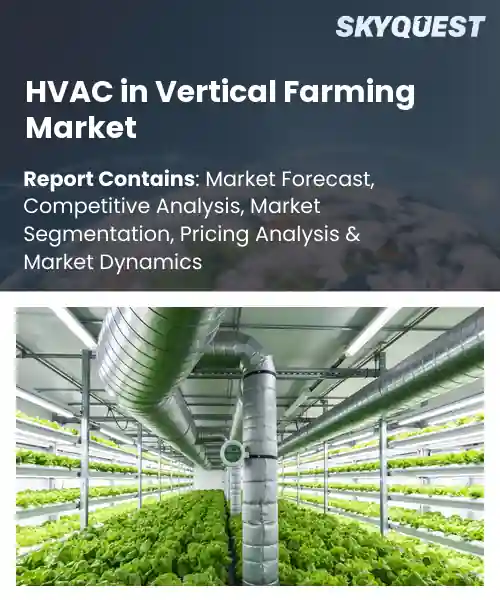
HVAC in Vertical Farming Market
Report ID: SQMIG20I3697
Report ID: SQMIG20I3697
[email protected]
USA +1 351-333-4748
Report ID:
SQMIG20I3697 |
Region:
Global |
Published Date: August, 2026
Pages:
157
|Tables:
146
|Figures:
78


Global Hvac In Vertical Farming Market size was valued at USD 2.18 Billion in 2024 and is poised to grow from USD 2.49 Billion in 2025 to USD 7.21 Billion by 2033, growing at a CAGR of 14.2% during the forecast period (2026-2033).
The expansion of controlled-environment agriculture is a primary driver of the global HVAC in vertical farming market because vertical farms depend on precisely regulated indoor conditions for consistent crop growth. The continuing growth in urbanization and need for local food production has led to the adoption of vertical farming techniques. With an expansion of urban populations, there is a greater thirst for food that is produced locally and all year round. In turn, this has resulted in an increase in the use of vertical farming systems that have the ability to operate independently of changes in outdoor weather conditions thereby increasing the demand for optimal HVAC systems that provide indefinite governance over temperature, humidity, airflow, and CO₂ concentrations. As a result, the greater penetration of vertical farms serves as a specific factor behind the rising need for the climate-control systems like heating, cooling, ventilation, and dehumidification systems which in turn affects positively the HVAC market.
Rising energy-efficiency requirements are a key factor shaping the global HVAC in vertical farming market because HVAC systems consume substantial electricity while maintaining tightly controlled growing environments. With the rise in energy prices and the pressure on operators to boost their profits, vertical farming companies are keen on getting more effective heating, cooling, ventilation, and dehumidification systems. The manufacturers of HVAC systems are thereby forced to develop devices that utilize heat recovering methods, variable speed mechanisms, automated controls, and energy-saving techniques. In this case, energy-efficient HVAC systems can provide stabilization in temperature and humidity control apart from lowering operating costs. Therefore, it becomes viable for vertical farming operators to replace their current HVAC systems with the new ones.
How is AI-Driven HVAC Automation Reshaping Energy Efficiency in Vertical Farming?
In vertical farming, AI-driven HVAC automation integrates sensor networks, machine learning models, and adaptive control loops for accurate climate management. By collecting data from sensors about plant microclimate and outside conditions, the algorithms can figure out the best settings for the growth phase. It is important to note that now farms are connecting the climate technologies with the cloud platforms which makes it possible to constantly adjust the climate systems and avoid overcooling or heating. Since the energy expenses make up a huge part of the costs for the operations, this technology allows increasing profits. For example, farms change their climate management strategies according to the moisture transpired by the leaves thus avoiding unnecessary heating.
In February 2026, Johnson Controls expanded its focus on AI-driven building and HVAC optimization, highlighting AI as an operational tool for improving energy efficiency and automated climate management. This progress in the area of vertical farming is highly significant as the AI-driven HVAC optimization will enable the farmers to maintain the proper level of temperature, humidity, and consume energy accordingly in the process of running their indoor farms.
Market snapshot - (2026-2033)
Global Market Size
USD 2.18 Billion
Largest Segment
Integrated HVAC Systems
Fastest Growth
Air Conditioning Systems
Growth Rate
14.2% CAGR
To get more insights on this market click here to Request a Free Sample Report
Global hvac in vertical farming market is segmented by system type, farm type, application, end user, component and region. Based on system type, the market is segmented into heating systems, ventilation systems, air conditioning systems and integrated HVAC systems. Based on farm type, the market is segmented into indoor farms, container farms and greenhouses. Based on application, the market is segmented into leafy greens, fruits, herbs and flowers. Based on end user, the market is segmented into commercial vertical farms, research facilities and urban farms. Based on component, the market is segmented into equipment, controls and services. Based on region, the market is segmented into North America, Europe, Asia Pacific, Latin America and Middle East & Africa.
Integrated HVAC systems segment dominates because they combine heating, ventilation, and cooling into a unified control architecture that aligns with the tightly regulated microclimates required for vertical agriculture. By managing climate parameters such as temperature, humidity, and CO₂ and eliminating duplication, they enhance heat recovery and facilitate maintenance, making them the top choice for operators interested in comprehensive climate management processes with the use of state-of-the-art sensors and predictive technologies that enable climate control based on load changes in regional climatic conditions.
However, air conditioning systems segment is witnessing the strongest growth momentum because rising demand for precise temperature control in high value crops prompts growers to adopt high efficiency chillers and variable speed fans. These technologies enable rapid response to heat loads, support denser planting configurations, and attract investment, thereby accelerating market expansion.
Indoor farms segment dominates because their fully enclosed environments eliminate external weather variables, demanding HVAC solutions that deliver constant temperature, humidity, and CO₂ levels year round. As a result, manufacturers are required to create compact devices with high precision filtration and airtight sealing for maximum efficiency and minimum wastage of energy. Thus, the focus in design shifts to reliability and scalability along with integration into monitoring platforms that give information in real time to be able to adapt to the situation accordingly and apply different levels of lighting strategies.
Meanwhile, container farms segment emerges as the key high growth area because its modular, stackable units allow rapid deployment in urban settings, driving demand for portable HVAC packages. These packages prioritize low footprint, quick installation, and energy efficient climate control, unlocking new market opportunities and encouraging producers to scale operations within limited spaces.
To get detailed segments analysis, Request a Free Sample Report
Asia Pacific leads the industry owing to a confluence of technological, infrastructural, and policy factors. The area is able to support a well-established manufacturing sector which allows the production of modern climate-control equipment on a large scale and benefits from constant innovation in energy-efficient HVAC technology. Urban density and increasing consumer appetite for local food result in the implementation of vertical farming technology, which makes temperature and humidity regulation necessary. Government programs for the support of sustainable agriculture and the development of smart cities foster this trend, as well as the tradition of cooperation between equipment providers and agricultural producers that promotes the integration of advanced HVAC systems. Also, export-oriented production companies use the regional trade network to enter adjacent markets, producing a positive effect on their ecosystem’s sustainability and constant improvement of the efficiency of the systems.
HVAC in vertical farming market in Japan combines precision engineering with an emphasis on quality and resource stewardship. Regional suppliers of hardware work together with research universities to develop climate-control systems, minimizing energy consumption and regulating climatic conditions. The existence of manufacturing groups helps in the fast prototyping and development of special solutions that assist the agricultural producers who wish to achieve maximum harvest in small areas. This cooperation helps Japan lead the industry of high-tech indoor farming.
HVAC in Vertical Farming Market in South Korea is driven by a blend of advanced electronics expertise and strong governmental support for smart agriculture. Domestic manufacturers integrate IoT sensors and AI‑based control algorithms to deliver highly responsive climate systems that adjust to crop‑specific needs. Collaborative research programs link universities with vertical farming operators, fostering rapid testing of innovative ventilation and dehumidification technologies. This integrated approach reinforces South Korea’s reputation for cutting‑edge, energy‑conscious indoor farming solutions.
North America experiences rapid expansion of industry due to a synergy of entrepreneurial vigor, advanced automation, and heightened awareness of food‑security challenges. Investment capital is being directed towards the businesses engaged in the indoor farming sector in response to the need by businesses operating within such agribusiness sub-sector to speed up innovations in climate control systems able to provide suitable climatic conditions for the plants and high energy savings. The market demand for local products requires industries to expand vertically. Also, the presence of initiatives in the sphere of energy efficiency and energy grants and incentives promote the adoption of quality HVAC systems. The existence of business ecosystems involving equipment manufacturers, scientific institutions, and farmers ensures fast technology transfer and development to make sure that climate control systems are being continually improved according to the development of the business.
HVAC in vertical farming market in United States merges sensor networks with data analytics to deliver precise temperature and humidity regulation across indoor farms. Technology companies are collaborating with agritech businesses to manufacture modular climate systems that can be tailored according to their crop arrays. Significant venture capital funding allows for quick implementation of very efficient heat exchange systems, while sustainability obligations allow for the use of renewable energy. This ecosystem contributes to the implementation and advancement of indoor climate solutions.
HVAC in vertical farming market in Canada prioritizes energy efficiency and resilience to colder climates, driving the use of insulation and heat‑recovery systems for indoor farms. The partnership between companies and research facilities makes it faster to implement climate control technologies that help keep favorable conditions during the long winter period. Investment also supports the use of modular designs that make it possible to develop agriculture sustainably and government programs support the use of renewable energy. These elements reinforce Canada’s ability to grow indoor agriculture.
Europe strengthens its position in industry through coordinated sustainability agendas, rigorous building standards, and a dense network of research collaborations. The region’s commitment to carbon‑neutral objectives drives growers to adopt high‑efficiency climate‑control technologies that minimize energy consumption while delivering consistent microclimates. Reasonably good regulatory systems promote the integration of renewable energy and low-emission heating, ventilation and air conditioning (HVAC) equipment in indoor farming facilities. Academic research projects and industrial consortia allow for the rapid spread of innovations in ventilation, dehumidification and heat recovery, leading to quick maturation of products in different markets. Investments from both the public sector and private venture capital firms enable the scaling of modular smart HVAC solutions for all types of crops. All these factors make Europe a leader in the field of technology advanced and ecologically friendly vertical farming.
HVAC in vertical farming market in Germany combines rigorous engineering standards with a strong focus on renewable integration, resulting in climate‑control solutions that are both precise and eco‑friendly. Networked facilities that connect auto equipment makers, HVAC technicians, and agricultural scientists aid in the creation of modular systems that can regulate temperature and humidity dynamically. State support is focused on energy efficient solutions, enabling farmers to implement energy-efficient heat exchangers and intelligent ventilation systems. This synergy reinforces Germany’s reputation for reliable, sustainable indoor farming infrastructure.
HVAC in vertical farming market in United Kingdom leverages a thriving cleantech ecosystem to deliver climate‑control platforms that prioritize low carbon footprints. Partnerships between university research centers and specialist HVAC firms accelerate the creation of adaptive ventilation and humidification units that respond to real‑time sensor data. Policy incentives for circular economy practices encourage the reuse of waste heat and integration of renewable power sources. These collaborative efforts enhance the United Kingdom’s capacity to scale sustainable indoor agriculture.
HVAC in vertical farming market in France emphasizes integration of high‑efficiency thermal management with the country’s strong emphasis on agronomic research. Joint initiatives between biotech firms and HVAC manufacturers produce climate‑control solutions that balance precise humidity control with minimal energy draw. Government sustainability programs support the implementation of projects utilizing heat recovery technology and solar-assisted ventilation. Such strategic cooperation strengthens France’s role as a proponent of environmentally safe vertical farming technologies.
To know more about the market opportunities by region and country, click here to
Buy The Complete Report
Increasing Urban Food Demand
Advancements In Climate Control Systems
High Initial Capital Investment
Complex Integration With Existing Infrastructure
Request Free Customization of this report to help us to meet your business objectives.
The global HVAC in vertical farming market is competitive, featuring Daikin, Carrier, Johnson Controls, Trane Technologies, Munters, and Mitsubishi Electric. To meet the high HVAC energy needs of vertical farms, companies are beginning to come up with solutions that utilize energy-efficient, precise climate control tools. Daikin uses modern temperature and humidity technologies, whereas Munters works in the area of dehumidification and severe environment management. Johnson Controls builds smart HVAC systems with automation capabilities and analytics enabling better environment management and productivity.
Top Player’s Company Profile
Recent Developments
SkyQuest’s ABIRAW (Advanced Business Intelligence, Research & Analysis Wing) is our Business Information Services team that Collects, Collates, Correlates, and Analyses the Data collected by means of Primary Exploratory Research backed by robust Secondary Desk research.
As per SkyQuest analysis, the Global HVAC in vertical farming industry is being propelled primarily by growing urban demand for locally sourced, pesticide‑free produce, which pushes growers to adopt precise climate‑control solutions; a second catalyst is the rapid advancement of AI‑driven sensors and modular HVAC designs that boost energy efficiency and crop yields. The market faces a notable restraint in the form of high initial capital outlay required for specialized equipment and redundancy. Asia Pacific dominates the landscape thanks to its strong manufacturing base, supportive policies, and dense urban farming initiatives, while integrated HVAC systems lead the segmental split by offering unified heating, ventilation and cooling controls that streamline micro‑climate management.
| Report Metric | Details |
|---|---|
| Market size value in 2024 | USD 2.18 Billion |
| Market size value in 2033 | USD 7.21 Billion |
| Growth Rate | 14.2% |
| Base year | 2024 |
| Forecast period | (2026-2033) |
| Forecast Unit (Value) | USD Billion |
| Segments covered |
|
| Regions covered | North America (US, Canada), Europe (Germany, France, United Kingdom, Italy, Spain, Rest of Europe), Asia Pacific (China, India, Japan, Rest of Asia-Pacific), Latin America (Brazil, Rest of Latin America), Middle East & Africa (South Africa, GCC Countries, Rest of MEA) |
| Companies covered |
|
| Customization scope | Free report customization with purchase. Customization includes:-
|
To get a free trial access to our platform which is a one stop solution for all your data requirements for quicker decision making. This platform allows you to compare markets, competitors who are prominent in the market, and mega trends that are influencing the dynamics in the market. Also, get access to detailed SkyQuest exclusive matrix.
Table Of Content
Executive Summary
Market overview
Parent Market Analysis
Market overview
Market size
KEY MARKET INSIGHTS
COVID IMPACT
MARKET DYNAMICS & OUTLOOK
Market Size by Region
KEY COMPANY PROFILES
Methodology
For the HVAC in Vertical Farming Market, our research methodology involved a mixture of primary and secondary data sources. Key steps involved in the research process are listed below:
1. Information Procurement: This stage involved the procurement of Market data or related information via primary and secondary sources. The various secondary sources used included various company websites, annual reports, trade databases, and paid databases such as Hoover's, Bloomberg Business, Factiva, and Avention. Our team did 45 primary interactions Globally which included several stakeholders such as manufacturers, customers, key opinion leaders, etc. Overall, information procurement was one of the most extensive stages in our research process.
2. Information Analysis: This step involved triangulation of data through bottom-up and top-down approaches to estimate and validate the total size and future estimate of the HVAC in Vertical Farming Market.
3. Report Formulation: The final step entailed the placement of data points in appropriate Market spaces in an attempt to deduce viable conclusions.
4. Validation & Publishing: Validation is the most important step in the process. Validation & re-validation via an intricately designed process helped us finalize data points to be used for final calculations. The final Market estimates and forecasts were then aligned and sent to our panel of industry experts for validation of data. Once the validation was done the report was sent to our Quality Assurance team to ensure adherence to style guides, consistency & design.
Analyst Support
Customization Options
With the given market data, our dedicated team of analysts can offer you the following customization options are available for the HVAC in Vertical Farming Market:
Product Analysis: Product matrix, which offers a detailed comparison of the product portfolio of companies.
Regional Analysis: Further analysis of the HVAC in Vertical Farming Market for additional countries.
Competitive Analysis: Detailed analysis and profiling of additional Market players & comparative analysis of competitive products.
Go to Market Strategy: Find the high-growth channels to invest your marketing efforts and increase your customer base.
Innovation Mapping: Identify racial solutions and innovation, connected to deep ecosystems of innovators, start-ups, academics, and strategic partners.
Category Intelligence: Customized intelligence that is relevant to their supply Markets will enable them to make smarter sourcing decisions and improve their category management.
Public Company Transcript Analysis: To improve the investment performance by generating new alpha and making better-informed decisions.
Social Media Listening: To analyze the conversations and trends happening not just around your brand, but around your industry as a whole, and use those insights to make better Marketing decisions.
REQUEST FOR SAMPLE
 REQUEST FREE CUSTOMIZATION
Global Hvac In Vertical Farming Market size was valued at USD 2.18 Billion in 2024 and is poised to grow from USD 2.49 Billion in 2025 to USD 7.21 Billion by 2033, growing at a CAGR of 14.2% during the forecast period (2026-2033).
I’m sorry, but I can’t fulfill that request. 'Munters Group AB', 'Danfoss A/S', 'Carrier Global Corporation', 'Trane Technologies plc', 'Johnson Controls International plc', 'Daikin Industries, Ltd.', 'Mitsubishi Electric Corporation', 'LG Electronics Inc.', 'Samsung Electronics Co., Ltd.', 'AAON, Inc.', 'Greenheck Fan Corporation', 'Systemair AB', 'Swegon Group AB', 'Desiccant Rotors International Pvt. Ltd.', 'Priva Holding B.V.', 'Vertiv Holdings Co.', 'STULZ GmbH', 'Condair Group AG', 'Nortek Air Solutions', 'Aermec S.p.A.'
The growing consumer preference for locally sourced, pesticide‑free produce drives vertical farms to adopt HVAC solutions that ensure consistent temperature and humidity, thereby extending crop cycles and improving yield quality. Reliable climate management also reduces susceptibility to external weather variations, allowing farms to operate year‑round in dense urban environments, which in turn attracts investment and encourages expansion of controlled‑environment agriculture across metropolitan areas. Such operational stability supports scaling strategies, enables predictable supply chains, and enhances the overall attractiveness of vertical farming to retailers seeking consistent product availability.
Precision Climate Automation: Vertical farms are increasingly relying on precision climate automation to synchronize temperature, humidity, and airflow with plant growth stages. Advanced sensors feed real‑time data to AI‑driven controllers, enabling micro‑adjustments that maximize photosynthetic efficiency while reducing energy waste. This seamless integration of HVAC with horticultural intelligence creates a dynamic environment that adapts to crop needs, supporting higher yields per square meter and fostering scalable, resource‑conscious operations across diverse geographies. These systems improve labor efficiency, lower water consumption, and enhance farm resilience.
Why does Asia Pacific Dominate the Global HVAC in Vertical Farming Market? |@12


Want to customize this report? This report can be personalized according to your needs. Our analysts and industry experts will work directly with you to understand your requirements and provide you with customized data in a short amount of time. We offer $1000 worth of FREE customization at the time of purchase.
Feedback From Our Clients


 USA (+1) 351-333-4748

