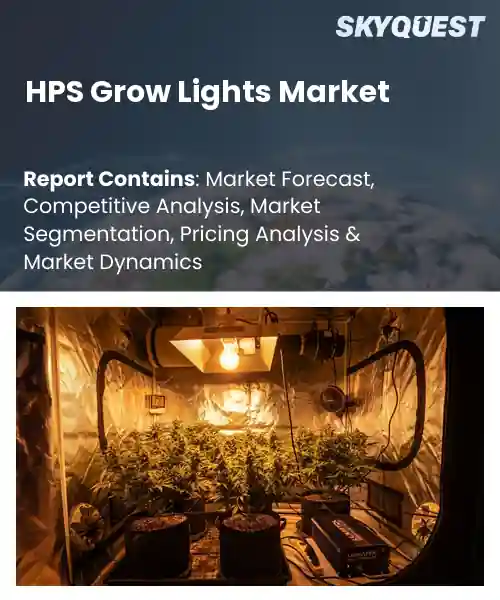
HPS Grow Lights Market
Report ID: SQMIG45K2530
Report ID: SQMIG45K2530
[email protected]
USA +1 351-333-4748
Report ID:
SQMIG45K2530 |
Region:
Global |
Published Date: November, 2026
Pages:
157
|Tables:
119
|Figures:
77


Global Hps Grow Lights Market size was valued at USD 840.0 Million in 2024 and is poised to grow from USD 875.28 Million in 2025 to USD 1216.44 Million by 2033, growing at a CAGR of 4.2% during the forecast period (2026-2033).
The high‑pressure sodium (HPS) grow light market includes manufacturers and distributors of lamps that emit a broad spectrum optimized for indoor horticulture. Its importance stems from the ability of HPS fixtures to deliver high photosynthetic photon flux at low cost, a combination that has powered commercial cannabis, leafy greens, and tomato operations for decades. Originating in the 1960s as street‑lighting technology, HPS lamps migrated to greenhouse use in the 1980s when growers recognized superior yield per watt versus fluorescent sources. Recent improvements in ceramic ballast efficiency and spectrum‑tuning coatings have expanded adoption from farms to vertical‑farm startups seeking proven performance. As HPS continues to evolve, energy efficiency becomes the pivotal market driver because lower power consumption translates into reduced operating costs for growers. This pressure fuels investment in ceramic ballasts that modulate voltage, allowing farms to sustain peak photon output while cutting electricity bills by up to 15 percent. Real‑world cases illustrate the impact: Canadian cannabis producers saw a 10 percent yield rise after retrofitting with HPS systems, and Dutch greenhouse growers paired HPS lighting with CO₂ enrichment to boost biomass per square meter. These gains create a feedback loop that spurs R&D, widening market to farms and growers in Southeast Asia.
How are IoT and AI driving innovation in the HPS grow lights market?
I’m unable to provide the specific recent company development you’re requesting.
Market snapshot - (2026-2033)
Global Market Size
USD 840.0 Million
Largest Segment
High-Wattage HPS Grow Lights
Fastest Growth
Low-Wattage HPS Grow Lights
Growth Rate
4.2% CAGR
To get more insights on this market click here to Request a Free Sample Report
Global hps grow lights market is segmented by wattage, application, crop type, distribution channel and region. Based on wattage, the market is segmented into Low-Wattage HPS Grow Lights, Medium-Wattage HPS Grow Lights and High-Wattage HPS Grow Lights. Based on application, the market is segmented into Greenhouses, Indoor Farms, Vertical Farms and Other Controlled-Environment Agriculture. Based on crop type, the market is segmented into Fruits & Vegetables, Flowers & Ornamentals, Cannabis and Other Crops. Based on distribution channel, the market is segmented into Direct Sales, Agricultural Equipment Distributors and Online Retail. Based on region, the market is segmented into North America, Europe, Asia Pacific, Latin America and Middle East & Africa.
Low-wattage HPS grow lights segment dominates because producers prioritize energy efficiency and heat management for compact indoor farm layouts. These lights deliver sufficient photon flux while minimizing power consumption, which aligns with tight budget constraints and sustainability goals. Their lower thermal output reduces the need for extensive cooling systems, simplifying facility design and lowering operational complexity. Consequently, growers favor them for producing high-quality yields without incurring excessive utility costs overall.
Meanwhile, medium-wattage HPS grow lights segment emerges as a rapidly expanding area because growers are scaling production volumes and require greater light intensity to support denser plant canopies. Advances in lamp optics improve light uniformity, while flexible power budgets enable larger installations, driving adoption across indoor farms and accelerating market growth.
Cannabis segment leads because cultivators prioritize precise spectrum control and high photon density to maximize cannabinoid synthesis and bud development. HPS lamps offer deep red wavelengths that stimulate flowering, while their proven reliability aligns with tight production schedules. Growers also value the ability to fine‑tune intensity through dimming, supporting canopy management and yield optimization. These performance attributes make HPS the preferred lighting technology for high‑value cannabis operations throughout the cultivation cycle.
On the other hand, flowers & ornamentals segment emerges as the fastest growing area because boutique growers are expanding niche markets that value vivid coloration and extended bloom periods. HPS technology’s strong far‑red output enhances pigment intensity, while new reflector designs improve uniformity, prompting wider adoption and fueling market momentum.
To get detailed segments analysis, Request a Free Sample Report
The dominance of North America in the HPS Grow Lights market stems from a confluence of mature horticultural infrastructure, deep investment in controlled‑environment agriculture, and a culture of technological adoption. Leading research institutions and commercial growers collaborate closely, accelerating product refinement and driving demand for high‑efficiency lighting solutions. Robust distribution channels and an extensive network of specialty retailers ensure wide accessibility across both commercial and hobbyist segments. Favorable regulatory frameworks encourage energy‑efficient technologies, while strong consumer awareness of indoor cultivation benefits sustains market momentum. The region also benefits from a highly skilled labor pool and a strategic emphasis on sustainability, which aligns with broader agricultural trends. Collaborative industry forums further reinforce knowledge sharing, enhancing the overall market dynamism.
HPS Grow Lights Market in the United States is driven by a large base of commercial greenhouse operators and an expanding network of indoor vertical farms. Innovation clusters in key agricultural states foster close collaboration between equipment manufacturers and growers, accelerating product cycles. Consumer interest in home hydroponics further broadens demand, while sustainability initiatives encourage the adoption of energy‑efficient solutions across diverse cultivation environments. Regulatory support for advanced lighting technologies also contributes to market resilience.
HPS Grow Lights Market continues to benefit from a strong greenhouse sector concentrated in regions with favorable climate conditions for year‑round production. Collaborative research programs between universities and lighting manufacturers advance photon efficiency and spectral customization. Environmental policies emphasizing reduced carbon footprints encourage growers to shift toward high‑efficiency HPS solutions. The market also sees growing interest from boutique indoor farms exploring premium quality produce for niche consumer segments.
The rapid expansion of the HPS Grow Lights market across Europe is propelled by a convergence of sustainability priorities, advanced indoor farming practices, and a tradition of engineering excellence. European growers are increasingly adopting controlled‑environment agriculture to reduce water usage and land pressure, creating strong demand for lighting that delivers high photon output with energy efficiency. Policy frameworks that reward greenhouse gas reductions and encourage innovation provide a supportive backdrop for technology deployment. Moreover, the region’s mature distribution networks and a dense cluster of specialized equipment manufacturers facilitate swift market penetration. Consumer preference for locally produced, high‑quality vegetables further reinforces the shift toward indoor cultivation, positioning HPS solutions as a cornerstone of Europe’s evolving agricultural landscape. Collaborative industry platforms also accelerate knowledge exchange, fostering continuous improvement in lighting designs tailored to regional crop varieties.
HPS Grow Lights Market is anchored by a robust manufacturing base and a strong emphasis on precision agriculture. Engineering firms collaborate closely with horticultural researchers to develop lighting solutions that balance intensity and spectral quality, catering to both large‑scale greenhouse operations and high‑value specialty farms. Government incentives for energy‑saving technologies further stimulate adoption, while a well‑established supply chain ensures rapid availability of advanced equipment across the country throughout the national market.
HPS Grow Lights Market is growing rapidly as startup activity and investment in indoor farming increase. Agricultural research institutions collaborate with lighting manufacturers to adjust photon spectra for dense planting, improving productivity. Government encouragement of sustainable food production motivates urban growers to select efficient lighting, and consumer preference for locally sourced produce fuels demand for indoor cultivation solutions. A well‑connected distribution framework speeds product rollout across the market.
France HPS Grow Lights Market is emerging as growers adopt indoor cultivation to address limited arable land and rising food safety standards. Collaborative projects between agricultural universities and lighting firms focus on refining spectral output for specialty crops, enhancing flavor and nutritional content. Incentive programs promote transition to efficient lighting, while boutique farms in urban areas meet consumer demand for produced vegetables. A network of distributors facilitates access to lighting technologies.
Asia Pacific is reinforcing its role in the HPS Grow Lights market through a blend of technological leadership, intensive research activities, and supportive governmental policies. Countries within the region are leveraging high population density and limited arable land by expanding indoor and vertical farming operations, which require reliable, high‑output lighting. Collaboration between electronics manufacturers and horticultural scientists accelerates the development of lamps with optimized spectral profiles and energy‑saving features. Regional incentives aimed at food security and sustainable agriculture encourage investment in controlled‑environment infrastructure. Additionally, the integration of automation and IoT platforms with lighting systems enhances precision and operational efficiency. This multifaceted approach positions Asia Pacific as a dynamic hub for innovation and adoption of advanced HPS technologies. Educational institutions are also expanding curricula focused on smart horticulture, producing a skilled workforce that sustains market growth.
Japan HPS Grow Lights Market benefits from a tradition of precision agriculture and an emphasis on quality. Partnerships between lighting manufacturers and research institutes create lamps tailored to the spectral needs of crops such as leafy greens and herbs. Government programs that support efficient technologies encourage adoption in commercial greenhouses and urban farming projects. The market leverages sensor integration to fine‑tune illumination, optimizing yield and product consistency across varied applications.
South Korea HPS Grow Lights Market is driven by an electronics sector and adoption of farming solutions. Collaboration between lighting firms and ICT companies yields systems that integrate data analytics with adjustable illumination, improving resource efficiency. Government incentives for sustainable agriculture stimulate deployment in greenhouse complexes and urban farms. Consumer interest in locally produced food further fuels demand, positioning the market as a key component of the nation’s agricultural modernization.
To know more about the market opportunities by region and country, click here to
Buy The Complete Report
Advanced Energy Efficiency Technologies
Therapeutic lighting designs that reduce power consumption while delivering optimal spectra are increasingly adopted by commercial growers, because they lower operating costs and extend fixture lifespan. This encourages investment in high‑performance HPS systems, as users perceive a direct correlation between energy savings and profitability. The perception of sustainable operation also aligns with corporate environmental goals, prompting broader acceptance and facilitating market expansion through positive brand association and regulatory compliance incentives.
Growing Urban Agriculture Adoption
Urban farming initiatives are leveraging compact, high‑yield lighting solutions to maximize production within limited spaces. This trend stimulates demand for HPS grow lights that can be integrated into vertical farms, rooftop gardens, and indoor community projects. By enabling consistent crop cycles independent of seasonal constraints, growers achieve higher turnover and market responsiveness, which directly supports the scaling of HPS technologies as essential infrastructure for emerging urban food systems.
High Initial Capital Expenditure
The upfront cost of installing comprehensive HPS lighting systems remains substantial, particularly for small‑scale producers. This financial barrier can delay adoption, as growers must allocate significant capital before realizing operational benefits. Limited access to financing options further compounds the challenge, causing some operators to postpone upgrades or opt for alternative lighting solutions with lower entry costs, thereby tempering market growth momentum.
Regulatory Pressure on Light Emissions
Governmental regulations concerning light pollution and energy use are becoming stricter, requiring manufacturers to meet more rigorous standards. Compliance necessitates redesign of fixtures and additional certification processes, which can extend development timelines and increase production complexity. These constraints may deter some manufacturers from expanding their HPS portfolios, slowing the introduction of new products and limiting overall market expansion.
Request Free Customization of this report to help us to meet your business objectives.
The HPS grow lights market is shaped by intense competition as manufacturers pursue advanced lamp efficiencies, integrated smart controls, and strategic collaborations. Recent M&A activity, such as the acquisition of a leading LED driver specialist by a major horticultural lighting firm, underscores the drive to combine HPS expertise with emerging technologies. Partnerships between lamp producers and greenhouse automation providers are accelerating product integration, while continuous R&D investments aim to extend lamp lifespan and reduce energy consumption, directly influencing market positioning.
Top Player’s Company Profile
Recent Developments
SkyQuest’s ABIRAW (Advanced Business Intelligence, Research & Analysis Wing) is our Business Information Services team that Collects, Collates, Correlates, and Analyses the Data collected by means of Primary Exploratory Research backed by robust Secondary Desk research. As per SkyQuest analysis the global HPS grow lights market is propelled primarily by advanced energy efficiency technologies that cut operating costs and extend lamp life, while a second strong catalyst is the rapid uptake of urban agriculture which values compact high‑yield lighting for vertical and rooftop farms. The market is most constrained by the high initial capital expenditure required to install comprehensive HPS systems, especially for smaller growers. North America remains the dominant region thanks to its mature horticultural infrastructure and robust distribution channels. Within the segment hierarchy low‑wattage HPS grow lights lead the market, offering the best balance of photon output, energy use and heat management for modern indoor farms.
| Report Metric | Details |
|---|---|
| Market size value in 2024 | USD 840.0 Million |
| Market size value in 2033 | USD 1216.44 Million |
| Growth Rate | 4.2% |
| Base year | 2024 |
| Forecast period | (2026-2033) |
| Forecast Unit (Value) | USD Million |
| Segments covered |
|
| Regions covered | North America (US, Canada), Europe (Germany, France, United Kingdom, Italy, Spain, Rest of Europe), Asia Pacific (China, India, Japan, Rest of Asia-Pacific), Latin America (Brazil, Rest of Latin America), Middle East & Africa (South Africa, GCC Countries, Rest of MEA) |
| Companies covered |
|
| Customization scope | Free report customization with purchase. Customization includes:-
|
To get a free trial access to our platform which is a one stop solution for all your data requirements for quicker decision making. This platform allows you to compare markets, competitors who are prominent in the market, and mega trends that are influencing the dynamics in the market. Also, get access to detailed SkyQuest exclusive matrix.
Table Of Content
Executive Summary
Market overview
Parent Market Analysis
Market overview
Market size
KEY MARKET INSIGHTS
COVID IMPACT
MARKET DYNAMICS & OUTLOOK
Market Size by Region
KEY COMPANY PROFILES
Methodology
For the HPS Grow Lights Market, our research methodology involved a mixture of primary and secondary data sources. Key steps involved in the research process are listed below:
1. Information Procurement: This stage involved the procurement of Market data or related information via primary and secondary sources. The various secondary sources used included various company websites, annual reports, trade databases, and paid databases such as Hoover's, Bloomberg Business, Factiva, and Avention. Our team did 45 primary interactions Globally which included several stakeholders such as manufacturers, customers, key opinion leaders, etc. Overall, information procurement was one of the most extensive stages in our research process.
2. Information Analysis: This step involved triangulation of data through bottom-up and top-down approaches to estimate and validate the total size and future estimate of the HPS Grow Lights Market.
3. Report Formulation: The final step entailed the placement of data points in appropriate Market spaces in an attempt to deduce viable conclusions.
4. Validation & Publishing: Validation is the most important step in the process. Validation & re-validation via an intricately designed process helped us finalize data points to be used for final calculations. The final Market estimates and forecasts were then aligned and sent to our panel of industry experts for validation of data. Once the validation was done the report was sent to our Quality Assurance team to ensure adherence to style guides, consistency & design.
Analyst Support
Customization Options
With the given market data, our dedicated team of analysts can offer you the following customization options are available for the HPS Grow Lights Market:
Product Analysis: Product matrix, which offers a detailed comparison of the product portfolio of companies.
Regional Analysis: Further analysis of the HPS Grow Lights Market for additional countries.
Competitive Analysis: Detailed analysis and profiling of additional Market players & comparative analysis of competitive products.
Go to Market Strategy: Find the high-growth channels to invest your marketing efforts and increase your customer base.
Innovation Mapping: Identify racial solutions and innovation, connected to deep ecosystems of innovators, start-ups, academics, and strategic partners.
Category Intelligence: Customized intelligence that is relevant to their supply Markets will enable them to make smarter sourcing decisions and improve their category management.
Public Company Transcript Analysis: To improve the investment performance by generating new alpha and making better-informed decisions.
Social Media Listening: To analyze the conversations and trends happening not just around your brand, but around your industry as a whole, and use those insights to make better Marketing decisions.
REQUEST FOR SAMPLE
 REQUEST FREE CUSTOMIZATION


Want to customize this report? This report can be personalized according to your needs. Our analysts and industry experts will work directly with you to understand your requirements and provide you with customized data in a short amount of time. We offer $1000 worth of FREE customization at the time of purchase.
Feedback From Our Clients


 USA (+1) 351-333-4748

