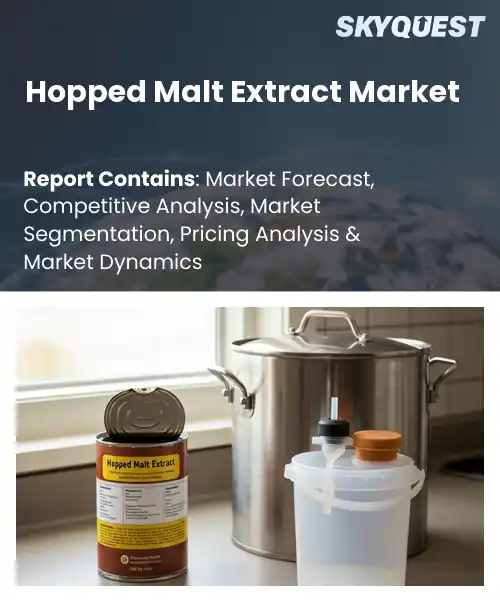
Hopped Malt Extract Market
Report ID: SQMIG30H2429
Report ID: SQMIG30H2429
[email protected]
USA +1 351-333-4748
Report ID:
SQMIG30H2429 |
Region:
Global |
Published Date: June, 2026
Pages:
157
|Tables:
117
|Figures:
77


Global Hopped Malt Extract Market size was valued at USD 9.55 Billion in 2024 and is poised to grow from USD 10.33 Billion in 2025 to USD 19.41 Billion by 2033, growing at a CAGR of 8.2% during the forecast period (2026-2033).
The hopped malt extract market growth for is largely driven by the increasing popularity of craft and convenience brewing as well as food formulation. Hopped malt extract is concentrated liquid made from mashing malted barley then adding hop derivatives to provide brewers and food marketers with easily reproducible and consistent flavors while reducing processing time. This market is significant due to its ability to lower batch variability, reduce production cycle times, and provide both small breweries and large-scale food manufacturers with the ability to produce beers and savory food products with dependable profiles.
Initially, the hopped malt extract market trends grew from being a homebrew additive to developing into a commercial supply chain. With the emergence of contract brewing, the focus of producing finished products from artisanal recipes is now being driven by the need to produce reproducible products for the international hopped malt extract market. The demand for seasonal style beers has prompted manufacturers to invest in concentrated syrups of hops and to implement automated dosing systems which enable brewers to minimize errors and shorten brew setup time.
As a result of the cause and effect relationship between these trends, manufacturers have recognized that they can add value to their products by using hopped malt extract in additional applications such as savory sauces, ready to drink beverages, and non-alcoholic beverages. These products are all enhanced using hops to impart bitterness, aroma, and shelf stability. As a result of this growth, manufacturers are expanding into alternative distribution channels such as private label and export markets thereby creating more consistent volume and profit margin.
How is AI Optimizing Production Efficiency in the Hopped Malt Extract Market?
With the use of artificial intelligence, production is becoming more efficient through the integration of real-time sensors, process models, and quality analytics into a continuous feedback loop. Among other things, this will result in improved predictive control on extraction and concentration steps, machine learning driven flavor profiling to protect delicate hop aromas, predictive maintenance for drying and handling equipment, and computer vision for quality inspection by producers and the brewery.
By using these technologies, producers are able to reduce variability between batches, shorten cycle times, and produce extract products tailored for both hop forward beer styles or alternate food use. The net result is a much higher level of consistency in aroma and bitterness delivery, significantly less waste, and improved energy efficiency, which ultimately allows suppliers to meet craft and commercial demand.
As a follow-up to this trend, Muntons plc in November 2024 announced that they have begun a large expansion of their Stowmarket site by adding new spray drying and extraction capacity and have also added artificial intelligence enabled process optimization of production processes to increase yield and flavor consistency as well as provide a means for quicker and more efficient scale-up of brewers' production.
Market snapshot - (2026-2033)
Global Market Size
USD 9.55 Billion
Largest Segment
Liquid Hopped Malt Extract
Fastest Growth
Dry (Powder) Hopped Malt Extract
Growth Rate
8.2% CAGR
To get more insights on this market click here to Request a Free Sample Report
Global hopped malt extract market is segmented by form, application, distribution channel, end-use and region. Based on form, the market is segmented into liquid hopped malt extract and dry (powder) hopped malt extract. Based on application, the market is segmented into brewing, baking, confectionery, beverages and others. Based on distribution channel, the market is segmented into direct sales and distributors/retail. Based on end-use, the market is segmented into commercial brewers, microbreweries / craft brewers and household. Based on region, the market is segmented into North America, Europe, Asia Pacific, Latin America and Middle East & Africa.
The liquid hopped malt extract segment leads the industry by providing ready-to-use formulations that make dosing easier to execute, simplify the complexities of handling, and are stable enough to preserve the aroma derived from hops throughout the brewing process on a large scale. Liquid is preferred by brewers for its seamless integration into automated dosing systems and continuous processing, which allow for sensory outcomes that are highly reproducible. Additionally, advances made by suppliers in solubility and cold chain logistics help to reduce operational variability and support streamlined production planning, as well as consistent quality control.
Although the liquid hopped malt extract segment is dominant, the dry (powdered) hopped malt extract segment has been growing at the fastest rate. This growth is driven by its ease of storage/transport, as well as its longer shelf life compared to liquid forms. These attributes are allowing dry hopped malt extracts market forecast to be used in more than just core beer brewing activities, as they can now be utilized in baking and confectionery applications. The powdered form also provides better precision when it comes to dosing and allows for greater flexibility in terms of formulation, enabling new flavor applications and facilitating entry into adjacent product categories. This acceleration will lead to numerous commercial opportunities for suppliers, as well as continued supplier innovation.
The commercial brewers segment represents a significantly larger portion of the hopped malt extract market due to the consolidated nature of their production (large batch operations) where the demand for standardized concentrated products to reduce variability and maximize throughput drives purchasing decisions. As such, large brewers typically look for ingredients that work with automated processes, provide a consistent hop flavor profile across multiple SKUs or brands, and meet aggressive quality and traceability standards. Because of the long-term relationships suppliers have with their customers and supplier agreements, commercial brewers create pathways for longer product development cycles focused on predictable performance in industrial brewers' facilities.
On the other hand, microbreweries / craft brewers are experiencing the fastest growth rate in the industry because of their demand for unique flavored products (craft brewing), as well as their willingness to experiment rapidly with recipes. As a result of this trend, craft brewers are increasingly looking for flexible hopped malt extract products that are easy to customize with speed, are distinctive in receiving hops, and that allow them to position themselves in a highly artisan manner (i.e., small-batch). In response to this trend, suppliers have begun to develop specialized formats for their concentrates that can be used to secure high-end sales opportunities.
To get detailed segments analysis, Request a Free Sample Report
With a mature beverage industry and a large cluster of ingredient manufacturers, North America is uniquely positioned for continued demand from consumers for premium and craft products. The region has an advanced production infrastructure, strong links between malting and hopping supply companies, and an established quality assurance system that ensures product consistency. There are also many research facilities focused on innovation in formulation and application, as well as the continued development of ingredients, which has facilitated the growth of many different texture (2D/3D, etc.). In addition to these resources, North America has a very broad range of distribution channels that allow producers to reach markets on a national level (both on-premise and retail). This reinforces the trend toward clean labels, natural ingredients, with consumer preference for each further increasing demand for these types of products; this has been supported by partnerships between producers and brewers, accelerating product adoption into main stream and specialty products.
Hopped malt extract market share in United States reflects a vibrant combination of craft brewing momentum and ingredient innovation that encourages diversified applications beyond beer. Manufacturers focus on clean label, flavor intensity, and process consistency to meet a sophisticated customer base. Established logistics and distribution networks support trial and scale, while partnerships between hop growers and malt extract producers enable tailored solutions for brewers and food formulators seeking distinct flavor profiles and natural alternatives.
Hopped malt extract market regional outlook in Canada is characterized by a dynamic craft scene and a focus on high quality and sustainability that attract specialty ingredient suppliers. Producers emphasize traceability and close collaboration with local hop and barley growers to develop products suited to artisanal and commercial brewers alike. Distribution channels leverage both domestic and cross border trade relationships, and there is growing interest from food manufacturers seeking natural flavor and functional attributes for premium offerings.
There has been great growth of the European craft beer market because of the region's long-standing traditions in brewing, the growing consumer demand for a variety of beer styles, and the popularity of new ingredients used in craft brewing. The presence of established malting and hop production regions facilitates the ability to meet the increasing demand for quality craft beers and develop new product types. The focus on quality and labelling has increased consumer confidence in purchasing craft beers; while culinary trends are driving the demand for greater uses of hopped malt extract in food and beverage applications due to premiumization. Numerous innovation centres and ingredient specialists in Europe collaborate with craft brewers to provide custom solutions to their specific needs, while well-developed distribution and supply chain networks support technology transfer and expanded market reach in different lawsuits.
Hopped malt extract market regional forecast in Germany is anchored by a longstanding brewing culture and a robust malting industry that prioritize purity and process reliability. Domestic producers focus on product consistency and a range of flavor profiles to serve both traditional and innovative brewers. Close relationships with hop growers and emphasis on technical excellence make the market a key source of high quality ingredients for regional and international customers seeking classic and specialty beer profiles.
Hopped malt extract market analysis in United Kingdom is experiencing dynamic growth driven by a lively craft brewing ecosystem and strong consumer appetite for experimental flavors. Producers respond with flexible, flavor-forward extracts and support services that cater to small and medium brewers. The market benefits from a culture of innovation, active home brewing communities, and retailers willing to introduce specialty ingredients, creating a fertile environment for rapid adoption and product diversification.
Hopped malt extract market penetration in France is emerging as artisanal brewing and gourmet food trends elevate demand for premium natural ingredients. Suppliers align extract profiles with culinary preferences and craft beverage experimentation, while collaboration between food technologists and brewers expands applications beyond beer into specialty foods. A growing appreciation for regional sourcing and sensory quality supports gradual uptake among producers focusing on differentiation and gastronomic appeal.
Expansion of manufacturing capabilities, increasing consumer demand for craft or premium products, and improved collaboration between global suppliers of ingredients are improving Asia Pacific's position. Players in the region have invested substantially in source formulation knowledge and technology to provide extracts to the food industry that will match local consumers' tastes and preferences, and will also meet application requirements for both alcoholic and non alcoholic food products. Improvements being made to the region's supply chain, along with better alignment of the regulatory processes will enable greater accessibility to the consumer market for these same products; innovative approaches that are aimed at addressing consumer demand for clean labels and multifunctional products will facilitate this access. Strategic partnership arrangements and developing new products locally will help Asia Pacific manufacturers convert the increased interest they are experiencing from consumers into increased commercial adoption of their products and increased supply capability.
Hopped malt extract industry in Japan benefits from a mature beverage industry that emphasizes precision, quality, and subtle flavor innovation. Suppliers focus on delivering refined extract profiles and technical support for brewers pursuing premium and seasonal offerings. Integration into both traditional and contemporary beverage formats, combined with disciplined manufacturing standards, positions the market as a source of specialized solutions tailored to discerning producers.
Hopped malt extract industry analysis in South Korea is shaped by rapidly evolving consumer tastes and a burgeoning craft brewing sector that encourage experimentation with hop and malt combinations. Ingredient suppliers collaborate with local brewers to create bold and novel flavor profiles, while retail and on premise channels show strong interest in premium and imported ingredient solutions. The market is responsive, with emphasis on innovation, branding, and partnerships to meet dynamic demand.
To know more about the market opportunities by region and country, click here to
Buy The Complete Report
Rising Demand In Food Applications
Expansion Of Craft Brewing Sector
Regulatory And Labeling Challenges
High Cost Of Premium Ingredients
Request Free Customization of this report to help us to meet your business objectives.
The competitive landscape in the global hopped malt extract market is defined by consolidation among large malt and ingredient suppliers and by craft brewing demand for consistent hop character and supply risk mitigation. Companies are pursuing capacity expansions, strategic partnerships, and ingredient technology. Examples include Muntons capacity investments, BSG CraftBrewing collaborations for hop formulations, and hop terpene product launches by specialty ingredient firms.
Top Player’s Company Profile
Recent Developments in the Hopped Malt Extract Market
SkyQuest’s ABIRAW (Advanced Business Intelligence, Research & Analysis Wing) is our Business Information Services team that Collects, Collates, Correlates, and Analyses the Data collected by means of Primary Exploratory Research backed by robust Secondary Desk research. As per SkyQuest analysis, growing preference for craft and convenience in brewing and food formulation is a key driver supporting hopped malt extract adoption, while expansion of the craft brewing sector acts as a second driver by broadening demand for flexible, concentrated ingredients. Regulatory and labeling challenges remain a notable restraint that can slow market entry and complicate formulation and compliance across regions. North America emerges as the dominating region due to mature beverage industries, strong ingredient supply chains and innovation capacity, and the liquid hopped malt extract segment is the dominating segment because it enables ready to use dosing, automation integration and consistent sensory outcomes for commercial brewers and large processors.
| Report Metric | Details |
|---|---|
| Market size value in 2024 | USD 9.55 Billion |
| Market size value in 2033 | USD 19.41 Billion |
| Growth Rate | 8.2% |
| Base year | 2024 |
| Forecast period | (2026-2033) |
| Forecast Unit (Value) | USD Billion |
| Segments covered |
|
| Regions covered | North America (US, Canada), Europe (Germany, France, United Kingdom, Italy, Spain, Rest of Europe), Asia Pacific (China, India, Japan, Rest of Asia-Pacific), Latin America (Brazil, Rest of Latin America), Middle East & Africa (South Africa, GCC Countries, Rest of MEA) |
| Companies covered |
|
| Customization scope | Free report customization with purchase. Customization includes:-
|
To get a free trial access to our platform which is a one stop solution for all your data requirements for quicker decision making. This platform allows you to compare markets, competitors who are prominent in the market, and mega trends that are influencing the dynamics in the market. Also, get access to detailed SkyQuest exclusive matrix.
Table Of Content
Executive Summary
Market overview
Parent Market Analysis
Market overview
Market size
KEY MARKET INSIGHTS
COVID IMPACT
MARKET DYNAMICS & OUTLOOK
Market Size by Region
KEY COMPANY PROFILES
Methodology
For the Hopped Malt Extract Market, our research methodology involved a mixture of primary and secondary data sources. Key steps involved in the research process are listed below:
1. Information Procurement: This stage involved the procurement of Market data or related information via primary and secondary sources. The various secondary sources used included various company websites, annual reports, trade databases, and paid databases such as Hoover's, Bloomberg Business, Factiva, and Avention. Our team did 45 primary interactions Globally which included several stakeholders such as manufacturers, customers, key opinion leaders, etc. Overall, information procurement was one of the most extensive stages in our research process.
2. Information Analysis: This step involved triangulation of data through bottom-up and top-down approaches to estimate and validate the total size and future estimate of the Hopped Malt Extract Market.
3. Report Formulation: The final step entailed the placement of data points in appropriate Market spaces in an attempt to deduce viable conclusions.
4. Validation & Publishing: Validation is the most important step in the process. Validation & re-validation via an intricately designed process helped us finalize data points to be used for final calculations. The final Market estimates and forecasts were then aligned and sent to our panel of industry experts for validation of data. Once the validation was done the report was sent to our Quality Assurance team to ensure adherence to style guides, consistency & design.
Analyst Support
Customization Options
With the given market data, our dedicated team of analysts can offer you the following customization options are available for the Hopped Malt Extract Market:
Product Analysis: Product matrix, which offers a detailed comparison of the product portfolio of companies.
Regional Analysis: Further analysis of the Hopped Malt Extract Market for additional countries.
Competitive Analysis: Detailed analysis and profiling of additional Market players & comparative analysis of competitive products.
Go to Market Strategy: Find the high-growth channels to invest your marketing efforts and increase your customer base.
Innovation Mapping: Identify racial solutions and innovation, connected to deep ecosystems of innovators, start-ups, academics, and strategic partners.
Category Intelligence: Customized intelligence that is relevant to their supply Markets will enable them to make smarter sourcing decisions and improve their category management.
Public Company Transcript Analysis: To improve the investment performance by generating new alpha and making better-informed decisions.
Social Media Listening: To analyze the conversations and trends happening not just around your brand, but around your industry as a whole, and use those insights to make better Marketing decisions.
REQUEST FOR SAMPLE
 REQUEST FREE CUSTOMIZATION
Global Hopped Malt Extract Market size was valued at USD 9.55 Billion in 2024 and is poised to grow from USD 10.33 Billion in 2025 to USD 19.41 Billion by 2033, growing at a CAGR of 8.2% during the forecast period (2026-2033).
The competitive landscape in the global hopped malt extract market is defined by consolidation among large malt and ingredient suppliers and by craft brewing demand for consistent hop character and supply risk mitigation. Companies are pursuing capacity expansions, strategic partnerships, and ingredient technology. Examples include Muntons capacity investments, BSG CraftBrewing collaborations for hop formulations, and hop terpene product launches by specialty ingredient firms. 'Muntons plc', 'Briess Malt & Ingredients Co.', 'Malteurop Group', 'Boortmalt', 'Simpsons Malt Ltd.', 'Rahr Corporation', 'Cargill, Incorporated', 'GrainCorp Limited', 'Soufflet Group', 'Viking Malt', 'Coopers Brewery Limited', 'Brewferm', 'Mangrove Jack's', 'Munich Malt GmbH', 'Bairds Malt Limited', 'Crisp Malting Group', 'Castle Malting', 'Great Western Malting', 'Canada Malting Company', 'Malteries Soufflet'
Rising consumer preference for natural flavor enhancers and clean-label ingredients has encouraged food and beverage manufacturers to incorporate hopped malt extract into formulations. Its ability to impart distinctive malt and hop-derived flavor profiles while simplifying ingredient lists supports product development and faster commercialization. Manufacturers value the extract for consistent sensory characteristics and for improving process efficiency in brewing, snack, and savory applications. Broad acceptance by formulators strengthens supplier relationships and encourages investment in production and distribution, thereby expanding availability and supporting market growth across regions.
Flavor-Driven Product Diversification: Manufacturers and beverage producers are expanding hopped malt extract applications beyond traditional beer, creating novel flavor profiles for spirits, nonalcoholic drinks, snacks, and culinary uses. Demand for differentiated taste experiences and collaborative development with craft producers is driving product line extensions and bespoke formulations. This trend encourages R&D investment in hop varietal selection, sensory-driven extraction techniques, flexible supply arrangements, enabling commercialization of unique offerings and helping brands capture changing consumer preferences for layered, hop-influenced aromas and tastes across consumption occasions.
Why does North America Dominate the Global Hopped Malt Extract Market? |@12


Want to customize this report? This report can be personalized according to your needs. Our analysts and industry experts will work directly with you to understand your requirements and provide you with customized data in a short amount of time. We offer $1000 worth of FREE customization at the time of purchase.
Feedback From Our Clients


 USA (+1) 351-333-4748

