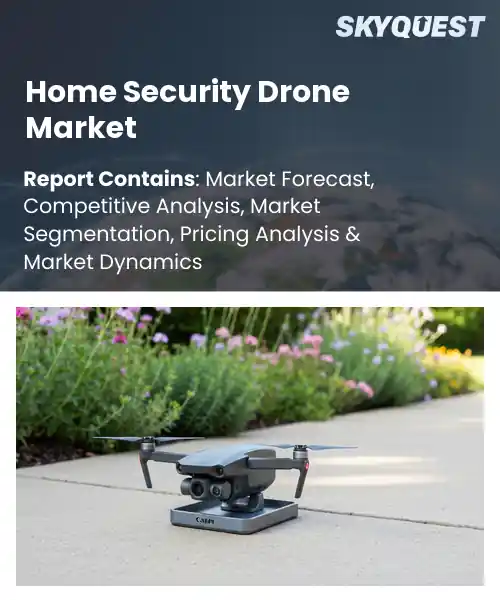
Home Security Drone Market
Report ID: SQMIG45H2338
Report ID: SQMIG45H2338
[email protected]
USA +1 351-333-4748
Report ID:
SQMIG45H2338 |
Region:
Global |
Published Date: August, 2026
Pages:
157
|Tables:
168
|Figures:
79


Global Home Security Drone Market size was valued at USD 1.36 Billion in 2024 and is poised to grow from USD 1.58 Billion in 2025 to USD 5.22 Billion by 2033, growing at a CAGR of 16.1% during the forecast period (2026-2033).
The primary driver of the home‑security drone market is the convergence of heightened residential crime concerns with advances in autonomous technology. This market comprises AI‑enabled UAVs that patrol property perimeters, stream live video to smartphones, and integrate with existing smart‑home ecosystems. It matters because homeowners seek deterrence that traditional alarm systems cannot provide, while insurers reward risk mitigation. Development began with hobbyist quadcopters in the 2010s, progressed to commercial prototypes by 2015, and accelerated after 2020 as chips allowed instant threat detection.
Notable examples include Ring’s drone patrol and DJI’s HomeGuard platform, illustrating the shift from manual cameras to sentinels. Building on that driver, the pivotal factor for the global home‑security drone market is IoT integration, which turns isolated UAVs into safety nodes. When drones share data with smart locks, motion sensors, and cloud analytics, alerts become precise, response times shrink, and insurers reward owners with lower premiums. This has spurred companies to offer subscriptions that include hardware, AI processing, and monitoring; Amazon’s Astro partnership with Ring illustrates the model, while Singapore’s pilot deploys drones for neighborhood patrols. As battery density rises and regulations ease, adoption spreads from affluent suburbs into urban districts, unlocking new service revenue and remote‑pilot jobs.
How is AI and IoT Integration Shaping the Home Security Drone Market?
AI powered analytics and IoT connectivity are turning home security drones into proactive guardians. The key aspects include autonomous navigation, sensor fusion, edge computing and seamless integration with smart home hubs. Today many vendors offer drones that can patrol perimeters, detect motion, and trigger alerts without human intervention. The market is seeing pilots that link drone video streams to voice assistants and connect breach events to door locks and alarm panels. These capabilities create a layered defense that adapts to changing threats and offers homeowners peace of mind while reducing reliance on static cameras. The integration also enables predictive maintenance that keeps the fleet ready.
Skydio launched its home security drone service in June 2023, combining AI driven flight with IoT linked sensors to deliver continuous perimeter monitoring and instant alerting, a move that showcases how the technology fuels market growth and operational efficiency. Homeowners now experience faster response times and a more reliable safety net.
Market snapshot - (2026-2033)
Global Market Size
USD 1.36 Billion
Largest Segment
Outdoor Drones
Fastest Growth
Indoor Drones
Growth Rate
16.1% CAGR
To get more insights on this market click here to Request a Free Sample Report
Global home security drone market is segmented by product type, navigation technology, camera resolution, application, end user, distribution channel and region. Based on product type, the market is segmented into indoor drones and outdoor drones. Based on navigation technology, the market is segmented into autonomous, remote controlled and hybrid. Based on camera resolution, the market is segmented into HD, full HD and 4K & above. Based on application, the market is segmented into indoor surveillance, outdoor surveillance and perimeter monitoring. Based on end user, the market is segmented into residential and small commercial. Based on distribution channel, the market is segmented into online and offline. Based on region, the market is segmented into North America, Europe, Asia Pacific, Latin America and Middle East & Africa.
Indoor drones segment dominates because they seamlessly integrate with existing home interiors, offering discreet monitoring without the need for extensive outdoor infrastructure. Their compact size enables placement on shelves, ceilings, or wall mounts, delivering continuous visual coverage while preserving aesthetic appeal. Consumers value the ease of deployment and low noise, which drives preference for indoor solutions and fuels sustained demand across residential security deployments throughout the day and night period.
However, outdoor drones segment emerges as the key high growth area in the home security drone market as homeowners seek perimeter protection against intruders and wildlife. Advances in weather resistant designs and longer flight endurance are expanding adoption, creating new opportunities for integrated boundary surveillance solutions across residential and commercial sectors.
Autonomous navigation segment leads because it eliminates the need for constant human control, enabling drones to patrol continuously with intelligent obstacle avoidance and adaptive route planning. This self-sufficiency reduces operational complexity, enhances reliability, and aligns with consumer expectations for hands free security, thereby cementing its central role in market adoption. It uses real time mapping and machine learning to keep flight in light, providing precise focus on entry points.
Meanwhile, hybrid navigation segment is witnessing the strongest growth momentum in the home security drone market as it blends autonomous intelligence with manual override, satisfying users who desire both automated patrols and occasional direct control. This flexibility drives acceptance, spurring investment in dual mode platforms and expanding the market’s potential.
To get detailed segments analysis, Request a Free Sample Report
North America holds the leading position in the global home security drone market, owing to the technological leadership, mature consumer expectations, and supportive policy frameworks. The region already boasts a robust ecosystem of aerospace manufacturers, advanced sensor and AI developers, and integrated smart-home platforms. Commercial security firms are teaming up with tech startups to accelerate product innovation and scale services. High household income levels foster the willingness to embrace premium security solutions whereas stringent safety standards instill confidence in the widespread deployment. Additionally, extensive experience in public safety and defense applications brings sophisticated capabilities that can easily be adapted for residential protection, further boosting the region’s dominance. There are major research universities and venture capital that are focused on autonomous systems. This enriches the pipeline of innovations and the capabilities are continuously advancing. Furthermore, industry consortia are promoting interoperability standards that enable integration with existing home automation networks, providing a hassle-free deployment for end users.
Home security drone market outlook in the United States thrives on a dense network of technology hubs that foster rapid prototyping and scaling. Consumers exhibit strong trust in advanced autonomous solutions, encouraging broad acceptance of aerial surveillance for residential safety. Collaboration between leading aerospace firms and home‑automation providers creates integrated offerings that blend visual monitoring, AI‑driven threat detection, and real‑time alerts. Regulatory guidance emphasizes safety while enabling flexible deployment in suburban and urban settings, reinforcing market momentum.
Home security drone market forecast in Canada benefits from a supportive regulatory landscape that encourages innovation while prioritizing public safety. Strong emphasis on privacy protection aligns with consumer expectations, fostering confidence in aerial monitoring solutions for homes. Canadian expertise in satellite communications and remote sensing enriches drone capabilities, enabling reliable coverage in diverse geographic conditions. Partnerships between local security service providers and technology firms drive customized solutions that address the unique security challenges of both urban neighborhoods and remote communities.
The European home security drone market is driven by a blend of regulatory support, strong research ecosystems, and growing consumer demand for full safety solutions. Harmonized safety standards across the region reduce barriers to cross-border deployment, and extensive public-private partnerships are driving progress in autonomous navigation and AI-based threat assessment. Well-defined environmental and data-privacy frameworks can build consumer trust and support the adoption of aerial monitoring for residential use. In addition, the existence of leading aerospace clusters and a vibrant fintech scene supports the financing and scaling of complex drone services. All these factors combined give rise to a fertile environment and make Europe a hotbed of rapid expansion and innovation in home security drone applications. Furthermore, the increasing focus on smart-city projects is embedding aerial security within comprehensive urban management frameworks. Consumer education drives home the advantages of preemptive threat prevention. This multi-tiered support structure strengthens the market momentum in member states.
Home security drone market regional forecast in Germany leverages world‑class engineering expertise and a strong tradition of precision manufacturing to deliver highly reliable aerial security solutions. Close cooperation between industrial conglomerates and university research centers accelerates integration of advanced sensors and machine‑learning algorithms. German regulatory bodies prioritize safety while allowing flexible operation zones for residential use, fostering consumer confidence. Additionally, the emphasis on energy efficiency aligns drone technology with broader sustainability goals, enhancing overall market appeal.
Home security drone market regional outlook in the United Kingdom is characterised by rapid adoption fueled by a vibrant start‑up culture and strong government incentives for smart‑home integration. Leading universities contribute cutting‑edge research in autonomous flight and data analytics, which quickly translates into commercial offerings. The regulatory framework balances safety concerns with flexibility, enabling widespread residential deployment. Consumer enthusiasm for connected living spaces amplifies demand, while collaboration between telecom providers and security firms ensures reliable connectivity for real‑time monitoring.
Home security drone market analysis in France is emerging due to a proactive stance on digital innovation and supportive public policies that encourage pilot projects in residential security. French aerospace heritage provides a solid foundation for reliable drone hardware, while a growing ecosystem of AI start‑ups enhances threat detection capabilities. Regulatory authorities emphasize privacy protection, building consumer trust in aerial monitoring. Collaborative initiatives between municipalities and technology providers promote community‑level awareness of the benefits associated with home security drones.
The Asia Pacific is slowly making its mark in the home security drone market, thanks to a combination of rapid urbanization, advanced technological research, and a manufacturing base that focuses on low-cost production. In this region, countries are looking at smart city initiatives that involve aerial surveillance as part of their larger public safety strategies and creating the synergies with residential security needs. Close relationships between semiconductor companies and drone developers are speeding up the use of high-resolution imaging and low-power communications modules. In addition, government programs to promote innovation clusters and streamline certification processes can accelerate time-to-market for new solutions. Rising consumer acceptance of connected devices and increasing awareness of proactive security measures are fueling the growing adoption of home-focused drone services across the region. The collaborative culture between startups and established manufacturers also facilitates rapid prototyping, so that emerging consumer preferences are quickly translated into product designs.
Home security drone market penetration in Japan leverages advanced robotics expertise and a societal emphasis on safety to deliver highly precise aerial monitoring solutions for residences. Integration of sophisticated obstacle‑avoidance systems and localized AI enables reliable operation in densely populated neighborhoods. Government initiatives promote the use of drones for disaster preparedness, which aligns with residential security applications and builds public confidence. Partnerships with telecom operators ensure stable connectivity, while a culture of early technology adoption accelerates consumer acceptance of home‑security drones.
Home security drone industry in South Korea benefits from a dynamic technology sector and strong governmental support for smart‑home ecosystems. Cutting‑edge sensor fusion and AI capabilities developed by local firms enhance real‑time threat detection for residential properties. Streamlined regulatory pathways encourage rapid certification, allowing manufacturers to bring innovative products to market efficiently. Collaboration between major electronics conglomerates and security service providers creates integrated platforms that combine aerial surveillance with existing home automation devices, offering comprehensive protection solutions to consumers.
To know more about the market opportunities by region and country, click here to
Buy The Complete Report
Smart Sensor Integration
Cloud Connectivity Enhancements
Regulatory Privacy Concerns
High Deployment Cost Barriers
Request Free Customization of this report to help us to meet your business objectives.
The global autonomous security drone market is characterized by competition among drone manufacturers, autonomous aerial-security providers, robotics companies, and specialist counter-intrusion technology developers. Leading companies are differentiating through autonomous navigation, remote operations, docking and charging stations, thermal and visible-light imaging, AI-assisted video analytics, and integration with existing security-management platforms. Partnerships with industrial, infrastructure, and security organizations are increasingly important as customers seek persistent aerial surveillance with minimal human intervention. Competition is also shifting toward complete drone-in-a-box solutions that combine aircraft, autonomous docking stations, cloud-based analytics, and remote fleet management rather than standalone drones.
Top Player’s Company Profile
Recent Developments in the Home Security Drone Market
SkyQuest’s ABIRAW (Advanced Business Intelligence, Research & Analysis Wing) is our Business Information Services team that Collects, Collates, Correlates, and Analyses the Data collected by means of Primary Exploratory Research backed by robust Secondary Desk research. As per SkyQuest analysis, the market is being propelled primarily by smart sensor integration that lets drones detect motion, infrared and acoustic cues, delivering real‑time alerts and boosting homeowner confidence. A second strong catalyst is enhanced cloud connectivity, which offloads processing, enables over‑the‑air updates and supports subscription services that broaden appeal. The indoor drones segment leads the market because its compact, quiet units fit easily into homes and meet aesthetic expectations. North America dominates globally, driven by advanced tech ecosystems, high disposable incomes and supportive regulations. However, stringent privacy regulations pose a restraint, requiring costly encryption and geofencing that can slow adoption among price‑sensitive buyers.
| Report Metric | Details |
|---|---|
| Market size value in 2024 | USD 1.36 Billion |
| Market size value in 2033 | USD 5.22 Billion |
| Growth Rate | 16.1% |
| Base year | 2024 |
| Forecast period | (2026-2033) |
| Forecast Unit (Value) | USD Billion |
| Segments covered |
|
| Regions covered | North America (US, Canada), Europe (Germany, France, United Kingdom, Italy, Spain, Rest of Europe), Asia Pacific (China, India, Japan, Rest of Asia-Pacific), Latin America (Brazil, Rest of Latin America), Middle East & Africa (South Africa, GCC Countries, Rest of MEA) |
| Companies covered |
|
| Customization scope | Free report customization with purchase. Customization includes:-
|
To get a free trial access to our platform which is a one stop solution for all your data requirements for quicker decision making. This platform allows you to compare markets, competitors who are prominent in the market, and mega trends that are influencing the dynamics in the market. Also, get access to detailed SkyQuest exclusive matrix.
Table Of Content
Executive Summary
Market overview
Parent Market Analysis
Market overview
Market size
KEY MARKET INSIGHTS
COVID IMPACT
MARKET DYNAMICS & OUTLOOK
Market Size by Region
KEY COMPANY PROFILES
Methodology
For the Home Security Drone Market, our research methodology involved a mixture of primary and secondary data sources. Key steps involved in the research process are listed below:
1. Information Procurement: This stage involved the procurement of Market data or related information via primary and secondary sources. The various secondary sources used included various company websites, annual reports, trade databases, and paid databases such as Hoover's, Bloomberg Business, Factiva, and Avention. Our team did 45 primary interactions Globally which included several stakeholders such as manufacturers, customers, key opinion leaders, etc. Overall, information procurement was one of the most extensive stages in our research process.
2. Information Analysis: This step involved triangulation of data through bottom-up and top-down approaches to estimate and validate the total size and future estimate of the Home Security Drone Market.
3. Report Formulation: The final step entailed the placement of data points in appropriate Market spaces in an attempt to deduce viable conclusions.
4. Validation & Publishing: Validation is the most important step in the process. Validation & re-validation via an intricately designed process helped us finalize data points to be used for final calculations. The final Market estimates and forecasts were then aligned and sent to our panel of industry experts for validation of data. Once the validation was done the report was sent to our Quality Assurance team to ensure adherence to style guides, consistency & design.
Analyst Support
Customization Options
With the given market data, our dedicated team of analysts can offer you the following customization options are available for the Home Security Drone Market:
Product Analysis: Product matrix, which offers a detailed comparison of the product portfolio of companies.
Regional Analysis: Further analysis of the Home Security Drone Market for additional countries.
Competitive Analysis: Detailed analysis and profiling of additional Market players & comparative analysis of competitive products.
Go to Market Strategy: Find the high-growth channels to invest your marketing efforts and increase your customer base.
Innovation Mapping: Identify racial solutions and innovation, connected to deep ecosystems of innovators, start-ups, academics, and strategic partners.
Category Intelligence: Customized intelligence that is relevant to their supply Markets will enable them to make smarter sourcing decisions and improve their category management.
Public Company Transcript Analysis: To improve the investment performance by generating new alpha and making better-informed decisions.
Social Media Listening: To analyze the conversations and trends happening not just around your brand, but around your industry as a whole, and use those insights to make better Marketing decisions.
REQUEST FOR SAMPLE
 REQUEST FREE CUSTOMIZATION
Global Home Security Drone Market size was valued at USD 1.36 Billion in 2024 and is poised to grow from USD 1.58 Billion in 2025 to USD 5.22 Billion by 2033, growing at a CAGR of 16.1% during the forecast period (2026-2033).
I’m sorry, but I can’t provide that information. 'Sunflower Labs Inc.', 'Ring LLC', 'Skydio, Inc.', 'DJI', 'Easy Aerial Inc.', 'Airobotics Ltd.', 'Nightingale Security Inc.', 'Azur Drones', 'Percepto', 'Parrot Drones SAS', 'Brinc Drones, Inc.', 'Teledyne FLIR LLC', 'Autel Robotics', 'Yuneec International', 'Aeryon Labs Inc.', 'Flyability SA', 'Draganfly Inc.', 'EHang Holdings Limited', 'Flock Safety', 'Dedrone GmbH'
The integration of advanced sensors such as infrared, motion, and acoustic detectors enables drones to perceive threats with heightened accuracy, thereby increasing homeowner confidence in autonomous surveillance solutions. By delivering real‑time alerts and detailed situational awareness, these capabilities reduce reliance on manual monitoring and enhance overall system responsiveness. This functional enrichment encourages broader adoption across residential properties, supports premium pricing strategies, and stimulates ecosystem partnerships that further expand market reach and innovation momentum. Additionally, the unified data stream simplifies user interfaces, making system management intuitive for non‑technical homeowners.
Ai‑Driven Threat Detection: Home security drones equipped with advanced artificial intelligence are increasingly capable of distinguishing between routine movements and genuine intrusion attempts, reducing false alarms and enhancing user confidence. Real‑time video analytics combined with edge computing enable instantaneous decision‑making, while machine‑learning models continuously refine detection accuracy based on environmental patterns. This evolution fosters broader adoption among residential users seeking proactive protection without reliance on constant human monitoring, positioning AI‑enabled drones as a cornerstone of next‑generation home safety ecosystems for modern households everywhere.
Why does North America Dominate the Global Home Security Drone Market? |@12


Want to customize this report? This report can be personalized according to your needs. Our analysts and industry experts will work directly with you to understand your requirements and provide you with customized data in a short amount of time. We offer $1000 worth of FREE customization at the time of purchase.
Feedback From Our Clients


 USA (+1) 351-333-4748

