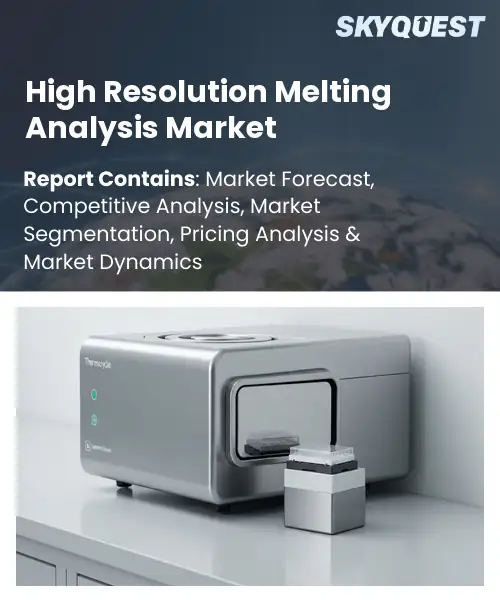
High Resolution Melting Analysis Market
Report ID: SQMIG35J2285
Report ID: SQMIG35J2285
[email protected]
USA +1 351-333-4748
Report ID:
SQMIG35J2285 |
Region:
Global |
Published Date: May, 2026
Pages:
157
|Tables:
119
|Figures:
77


Global High Resolution Melting Analysis Market size was valued at USD 482.50 Million in 2024 and is poised to grow from USD 522.16 Million in 2025 to USD 985.40 Million by 2033, growing at a CAGR of 8.2% during the forecast period (2026-2033).
High Resolution Melting (HRM) analysis has emerged as a key molecular diagnostic and research tool as it facilitates rapid, low-cost identification of DNA sequence variants without the need for sequencing. This primary driver demand for faster, lower-cost genotyping has spurred market growth. It matters because clinicians and researchers rely on HRM applications from oncology mutation screening to infectious disease surveillance. The market consists of instruments, reagents and software for mutation scanning, methylation profiling and pathogen typing. HRM was developed out of research laboratories in the early 2000s, but in wider clinical use as sensitivity of the assay improved, and vendors introduced integrated platforms and validated kits widely.
The global high resolution melting analysis market trends is driven by a key factor of integration into clinical workflows and complementary use with next-generation sequencing. As laboratories seek fast prescreening methods they adopt HRM to triage samples which reduces sequencing costs and turnaround times. This drive encourages vendors to develop user-friendly instruments and validated assays, thereby creating market opportunities for reagent kits, clinical services and software analytics. Real-world applications include prescreening tumor biopsies for hotspot mutations before sequencing, rapid detection of drug-resistant pathogens in hospitals, and high-throughput genotyping in agricultural breeding programs. All of these add up to measurable demand growth around the world.
How is AI Improving Accuracy and Throughput in the High-Resolution Melting Analysis Market?
High resolution melting analysis market growth is improved through automation of curve interpretation and reduction of manual variability, with AI to preserve expert oversight, leading to increased accuracy and throughput. It depends on machine learning models trained on labeled melt curves, automated quality control to flag suboptimal runs and tighter integration with instrument software to speed sample processing. Today instrument vendors and diagnostic labs are adopting AI assisted analysis to accelerate time to result and increase throughput, without compromising analytical rigor. Examples include software for alignment and normalization of melt traces, detection of subtle shifts in peaks, and triaging of samples for confirmatory testing. Reliability for genotyping and research.
Thermo Fisher announced a strategic partnership with NVIDIA to use AI on instrumentation and data pipelines that can speed and standardize HRM curve classification and automate peak detection to allow for higher throughput and more consistent variant calls.
Market snapshot - (2026-2033)
Global Market Size
USD 482.5 Million
Largest Segment
Reagents & Kits
Fastest Growth
Reagents & Kits
Growth Rate
8.22% CAGR
To get more insights on this market click here to Request a Free Sample Report
Global high resolution melting analysis market is segmented by product, application, end-user and region. Based on product, the market is segmented into instruments, reagents & kits and software. Based on application, the market is segmented into mutation scanning, genotyping, methylation analysis and pathogen typing. Based on end-user, the market is segmented into research institutes, pharmaceutical companies, diagnostic labs and forensic labs. Based on region, the market is segmented into North America, Europe, Asia Pacific, Latin America and Middle East & Africa.
The reagents & kits segment is dominant due to these products providing the required chemistry as well as standardized protocols that enable high resolution melting analysis to be performed reliably across laboratories. With consistent dye chemistry, optimized buffers and validated primer kits, variation of assay is minimized and development timelines shortened to foster widespread adoption. Suppliers also concentrate on user-friendly formats and regulatory-grade quality, providing confidence to researchers and diagnostic developers, sustaining recurring demand for reagents and cross-platform compatibility.
However, instruments is the fastest growing area as manufacturers invest in high throughput automated HRM platforms that streamline workflows and improve reproducibility. Greater instrument sensitivity, inbuilt real time PCR capabilities and streamlined software interfaces are driving faster uptake in both research and clinical environments, opening up new applications and creating demand for complementary services and consumables.
The mutation scanning segment is the largest as high resolution melting analysis is the optimal method for fast, cost effective detection of unknown sequence variants during screening workflows. Its sensitivity to small melting temperature shifts enables wide usage in target discovery and clinical pre screening, decreasing dependence on more time consuming methods. Its integration into routine laboratory pipelines and compatibility with existing PCR protocols further highlight its central role in research, diagnostics and assay development activities and validation efforts.
On the other hand methylation analysis is the fastest growing area as epigenetic biomarkers increase in oncology and personalized medicine. Increasing assay sensitivity and streamlined workflows are expanding the scope of HRM into biomarker validation and companion diagnostics, which is driving investment in dedicated kits and partnerships to unlock new clinical and commercial opportunities.
To get detailed segments analysis, Request a Free Sample Report
North America is dominating the global high resolution melting analysis market owing to the developed clinical research environment, presence of significant number of technology vendors and broad diagnostic and academic networks that promote early adoption and incremental innovation. The laboratory infrastructure is well established, regulatory pathways for molecular diagnostics are supportive, and there are abundant private and public funding channels that allow for rapid translation of methodological advances into clinical and research workflows. Instrument manufacturers, reagent suppliers and service providers need to work together to offer integrated solutions that meet the needs of various applications such as mutation screening, genotyping and methylation analysis. Sustained leadership is driven by market consolidation and deep technical expertise among end users. Ongoing demand from precision medicine initiatives and molecular pathology programs drive high utilization and continuous optimization of assay performance across the region.
High resolution melting analysis market regional outlook in United States benefits from a dense network of leading clinical laboratories, strong translational research programs and a vibrant diagnostics industry focusing on assay sensitivity and workflow integration. Reagent and instrument innovation is closely tied to clinician needs and collaborative consortia and contract research organizations expedite method validation. The growing demand for personalized medicine and diagnostics in oncology is driving the demand for advanced assays in hospital and reference laboratories.
High resolution melting analysis market regional forecast in Canada is driven by centralized public health laboratories, the growing use of molecular diagnostics in provincial systems, and collaborations between academic centers and industry. Emphasizing assay robustness and efficient workflows for genetic screening and pathogen surveillance. Targeted procurement and collaborative pilots allow for tailored implementation. Training initiatives build laboratory capacity and allow for wider integration of high resolution melting techniques across clinical and public health service delivery settings.
High resolution melting analysis market in Europe is expected to witness rapid expansion due to dense network of translational research centers, harmonized regulatory frameworks facilitating cross border clinical studies and strong demand from clinical genetics and oncology diagnostics. Public-private research partnerships speed up assay validation and promote protocol standardization, and established reagent and instrument vendors tailor solutions to a range of clinical pathways. The increased emphasis on molecular epidemiology and pathogen surveillance has expanded the range of applications beyond testing for inherited disease. The push to incorporate molecular diagnostics into routine care has led to the modernization of laboratories and purchases of sophisticated analytical platforms throughout the region . HRM assays are validated for different indications by pan regional consortia and clinical networks. Vendor investment in local support and training reduces barriers and facilitates wider adoption across national laboratory models.
High resolution melting analysis market forecast in Germany is expected to be lucrative due to industrial research partnerships, presence of specialized molecular diagnostics laboratories and emphasis on the standardization of the assay for clinical adoption. Developing and validating methods in collaboration with academic centers allows manufacturers to integrate them into hospital pathology and genetic testing services. Oncology and rare disease programs have driven the need for robust HRM workflows and ongoing technical training to support laboratory capability and quality assurance practices.
High resolution melting analysis market outlook in United Kingdom is the accelerated adoption across clinical and research institutions supported by translational networks and investment in diagnostic pathways. Hospitals, biotech companies and laboratories are working together to accelerate assay optimization and validation. Focusing on technical support, workforce training, and integration with genomic medicine initiatives reduces barriers to implementation, leading to more widespread adoption of HRM applications in oncology testing, infectious disease surveillance, and centralized quality programs.
High resolution melting analysis market share in France is driven by the rising interest of research, research infrastructures, and pilot programs exploring clinical applications in testing for infectious and genetic disease. The growing partnership between academia, clinical labs, and biotech vendors is encouraging the customization of assays to meet local requirements. The focus should be on methodological validation, training and reference centres to support gradual scale-up. Innovation initiatives should encourage the integration of HRM approaches into national diagnostic and public health surveillance frameworks.
Asia Pacific is making strides in the high resolution melting analysis market by strategic investments in laboratory infrastructure, increasing domestic manufacturing capabilities and selective collaborations between research institutes and industries. Regional public health priorities and active pathogen surveillance programs have created tangible use cases that speed adoption in clinical laboratories. Workforce development and localized technical support investments improve assay reproducibility and operational readiness . Vendors adapt instruments and reagents to local regulatory and procedural requirements . Cross border research partnerships and pilot projects provide further validation of HRM utility across a range of different clinical and environmental applications, providing markets such as Japan and South Korea with the opportunity to move from early adoption to broader integration into national diagnostic and research frameworks. Government support for diagnostic innovation, harmonized regulatory dialogue across the region and market maturation are aided, while academic industry consortia demonstrate clinical utility that informs broader procurement and operational scale up.
High resolution melting analysis industry in Japan is supported by the country’s advanced laboratory infrastructure, clinical research networks and local vendors offering customized instruments. Precision diagnostics and oncology testing drive assay refinement and adoption in hospital and reference laboratories. Partnerships between universities, hospitals and industry encourage validation and technical training, while regulatory engagement and local support allow laboratories to implement standardized HRM workflows that are broadly aligned with national clinical and public health priorities.
High resolution melting analysis industry trends in South Korea are rising, supported by a biotechnology industry, public health laboratories, and collaborations between academic research centers and commercial developers. The adaptation of HRM methods to routine laboratory workflows is driven by a focus on diagnostic deployment and infectious disease surveillance. Investment in technical training, local sourcing of reagents and validation support scalable implementation. Pilot studies and industry partnerships encourage uptake across clinical and public health testing.
To know more about the market opportunities by region and country, click here to
Buy The Complete Report
Advancements In Diagnostic Applications
Growing Use In Clinical Research
Complexity Of Data Interpretation
Limited Standardization Across Protocols
Request Free Customization of this report to help us to meet your business objectives.
Big instrument and reagent incumbents, competing with niche epigenetics and assay specialists, are pushing differentiation through assay specialization, AI driven curve interpretation and dealmaking. Recent tangible strategies include M&A to add epigenetic capability (e.g., Exact Sciences acquiring an Oxford TAPS developer), distribution partnerships to increase assay reach, and upgrades to HRM analysis software by established vendors to automate interpretation.
Top Player’s Company Profile
Recent Developments in the High Resolution Melting Analysis Market
SkyQuest’s ABIRAW (Advanced Business Intelligence, Research & Analysis Wing) is our Business Information Services team that Collects, Collates, Correlates, and Analyses the Data collected by means of Primary Exploratory Research backed by robust Secondary Desk research.
As per SkyQuest analysis, the global high resolution melting analysis market is driven by integration into clinical workflows for rapid prescreening to reduce sequencing cost and turnaround time. Increasing use in clinical research for biomarker discovery and genotyping is further driving the market. The complexity of data interpretation moderates adoption, increasing training needs and reliance on vendor software and services. North America continues to dominate the market driven by mature research and diagnostic infrastructure. Reagents and kits dominate the market by providing standardized chemistry and validated protocols that drive recurring demand for consumables. In the short term, growth will be driven by vendors with easy-to-use instruments and AI-assisted analytics.
| Report Metric | Details |
|---|---|
| Market size value in 2024 | USD 482.5 Million |
| Market size value in 2033 | USD 985.4 Million |
| Growth Rate | 8.22% |
| Base year | 2024 |
| Forecast period | (2026-2033) |
| Forecast Unit (Value) | USD Million |
| Segments covered |
|
| Regions covered | North America (US, Canada), Europe (Germany, France, United Kingdom, Italy, Spain, Rest of Europe), Asia Pacific (China, India, Japan, Rest of Asia-Pacific), Latin America (Brazil, Rest of Latin America), Middle East & Africa (South Africa, GCC Countries, Rest of MEA) |
| Companies covered |
|
| Customization scope | Free report customization with purchase. Customization includes:-
|
To get a free trial access to our platform which is a one stop solution for all your data requirements for quicker decision making. This platform allows you to compare markets, competitors who are prominent in the market, and mega trends that are influencing the dynamics in the market. Also, get access to detailed SkyQuest exclusive matrix.
Table Of Content
Executive Summary
Market overview
Parent Market Analysis
Market overview
Market size
KEY MARKET INSIGHTS
COVID IMPACT
MARKET DYNAMICS & OUTLOOK
Market Size by Region
KEY COMPANY PROFILES
Methodology
For the High Resolution Melting Analysis Market, our research methodology involved a mixture of primary and secondary data sources. Key steps involved in the research process are listed below:
1. Information Procurement: This stage involved the procurement of Market data or related information via primary and secondary sources. The various secondary sources used included various company websites, annual reports, trade databases, and paid databases such as Hoover's, Bloomberg Business, Factiva, and Avention. Our team did 45 primary interactions Globally which included several stakeholders such as manufacturers, customers, key opinion leaders, etc. Overall, information procurement was one of the most extensive stages in our research process.
2. Information Analysis: This step involved triangulation of data through bottom-up and top-down approaches to estimate and validate the total size and future estimate of the High Resolution Melting Analysis Market.
3. Report Formulation: The final step entailed the placement of data points in appropriate Market spaces in an attempt to deduce viable conclusions.
4. Validation & Publishing: Validation is the most important step in the process. Validation & re-validation via an intricately designed process helped us finalize data points to be used for final calculations. The final Market estimates and forecasts were then aligned and sent to our panel of industry experts for validation of data. Once the validation was done the report was sent to our Quality Assurance team to ensure adherence to style guides, consistency & design.
Analyst Support
Customization Options
With the given market data, our dedicated team of analysts can offer you the following customization options are available for the High Resolution Melting Analysis Market:
Product Analysis: Product matrix, which offers a detailed comparison of the product portfolio of companies.
Regional Analysis: Further analysis of the High Resolution Melting Analysis Market for additional countries.
Competitive Analysis: Detailed analysis and profiling of additional Market players & comparative analysis of competitive products.
Go to Market Strategy: Find the high-growth channels to invest your marketing efforts and increase your customer base.
Innovation Mapping: Identify racial solutions and innovation, connected to deep ecosystems of innovators, start-ups, academics, and strategic partners.
Category Intelligence: Customized intelligence that is relevant to their supply Markets will enable them to make smarter sourcing decisions and improve their category management.
Public Company Transcript Analysis: To improve the investment performance by generating new alpha and making better-informed decisions.
Social Media Listening: To analyze the conversations and trends happening not just around your brand, but around your industry as a whole, and use those insights to make better Marketing decisions.
REQUEST FOR SAMPLE
 REQUEST FREE CUSTOMIZATION
Global High Resolution Melting Analysis Market size was valued at USD 482.5 Million in 2024 and is poised to grow from USD 522.16 Million in 2025 to USD 985.4 Million by 2033, growing at a CAGR of 8.22% during the forecast period (2026-2033).
Competitive landscape is shaped by large instrument and reagent incumbents competing with niche epigenetics and assay specialists, pushing differentiation through assay specialization, AI driven curve interpretation, and dealmaking. Recent tangible strategies include M&A to add epigenetic capability, for example Exact Sciences acquiring an Oxford TAPS developer, distribution partnerships to broaden assay reach, and established vendors updating HRM analysis software to automate interpretation. 'Thermo Fisher Scientific', 'Bio-Rad Laboratories', 'Roche Diagnostics', 'Agilent Technologies', 'QIAGEN NV', 'Idaho Technology (BioFire)', 'Canon BioMedical', 'Analytik Jena', 'Meridian Bioscience', 'Takara Bio', 'Bioer Technology', 'Corbett Research (QIAGEN)', 'LGC Biosearch Technologies', 'Perkin Elmer', 'Illumina Inc.', 'New England Biolabs', 'Kapa Biosystems (Roche)', 'Integrated DNA Technologies', 'Biosyntagma', 'ELITechGroup'
Advancements in diagnostic applications have enhanced assay sensitivity and specificity, enabling more reliable detection of genetic variations and pathogen profiling. As clinicians and laboratories recognize the technique’s ability to support rapid, nonsequencing-based mutation scanning and quality control workflows, demand for high-resolution melting systems grows because they can be integrated into diagnostic pipelines and companion diagnostics development. This acceptance by diagnostic stakeholders and the demonstrated clinical utility foster procurement of platforms, consumables, and service agreements, thereby expanding market uptake and encouraging continued investment in HRM technology.
Integration With Clinical Workflows: High resolution melting analysis is increasingly integrated into clinical diagnostic workflows, enabling laboratories to incorporate rapid, closed loop testing within existing sample processing and reporting systems. Vendors focus on seamless software interoperability, intuitive user interfaces, and workflow automation to reduce manual steps and facilitate result transfer to electronic records. This trend supports adoption by hospital laboratories and specialty clinics, fosters multidisciplinary collaboration, and drives vendor partnerships that emphasize validated protocols, training resources, and continuous instrument support for routine diagnostic use.
Why does North America Dominate the Global High Resolution Melting Analysis Market? |@12


Want to customize this report? This report can be personalized according to your needs. Our analysts and industry experts will work directly with you to understand your requirements and provide you with customized data in a short amount of time. We offer $1000 worth of FREE customization at the time of purchase.
Feedback From Our Clients


 USA (+1) 351-333-4748

