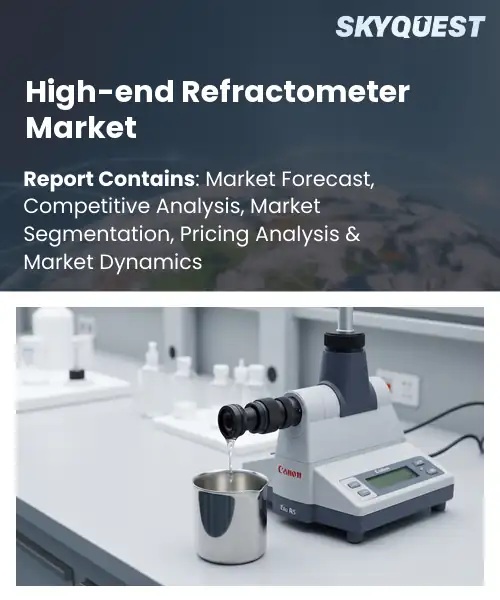
High-end Refractometer Market
Report ID: SQMIG35A3842
Report ID: SQMIG35A3842
[email protected]
USA +1 351-333-4748
Report ID:
SQMIG35A3842 |
Region:
Global |
Published Date: June, 2026
Pages:
157
|Tables:
143
|Figures:
78


Global High-End Refractometer Market size was valued at USD 230.0 Million in 2024 and is poised to grow from USD 246.79 Million in 2025 to USD 433.64 Million by 2033, growing at a CAGR of 7.3% during the forecast period (2026-2033).
The main reason promoting the growth in the high-end refractometer market is the increase in demand for precision in various regulated sectors where precision in refractive index measurement determines the quality of the product. High-end refractometers are measuring instruments used to measure the refractive index and concentrations in solids and liquids, and they are significant because errors in measurements can affect pharmaceutical effectiveness, food safety, or purity of chemicals. This type of refractometer technology started from manual Abbe refractometers to the current bench-top and inline refractometers which have automation capabilities and temperature control features. Pharmaceutical companies invested in inline refractometers due to FDA requirements, while wineries use digital refractometers during fermentation.
Another significant driving factor for the growth in the global high-end refractometer market is technology innovations, which incorporate the latest advances in high-accuracy optics coupled with digitalization and connectivity capabilities for performing process analysis and automation on a real-time basis. With the increased accuracy and reliability of the sensors, it has become possible to implement inline refractometers for process monitoring, which has resulted in decreased variation in batches, minimized waste generation, and increased productivity in the manufacturing facilities of the pharmaceutical and beverages industry. Beer breweries use inline refractometry to optimize their fermentation process through sugar analysis.
How is IoT Enhancing Precision and Connectivity in the High-end Refractometer Market?
There have been developments in high-end refractometers through IoT technology to enhance their accuracy and connectivity by connecting optical devices with networking systems. This can be attributed to the following factors such as real-time data exchange, automatic temperature compensation and remote calibration and monitoring. The present market trend includes refractometer designs that connect to execution software and LIMS systems to generate electronic recordkeeping for quality assurance and compliance purposes. Refractometers' vendors incorporate the use of autosampler features and multi-parameter systems to enable refractive index measurements to fit into overall process control. This is useful in minimizing errors and enhancing decision-making.Anton Paar February 2026, Anton Paar upgraded its AP Connect to offer greater Abbemat connectivity and data networking which enhances automated temperature monitoring and remote monitoring systems.
Market snapshot - (2026-2033)
Global Market Size
USD 230.0 Million
Largest Segment
Digital Laboratory Refractometers
Fastest Growth
Inline Process Refractometers
Growth Rate
7.3% CAGR
To get more insights on this market click here to Request a Free Sample Report
Global high-end refractometer market is segmented by product type, technology, application, measurement type, end user and region. Based on product type, the market is segmented into Abbe Refractometers, Digital Laboratory Refractometers, and Inline Process Refractometers. Based on technology, the market is segmented into Analog (Traditional) and Digital / Automatic. Based on application, the market is segmented into Pharmaceuticals, Food & Beverages, Chemicals & Petrochemicals and Research Laboratories. Based on measurement type, the market is segmented into Refractive Index (RI) and Brix / Concentration. Based on end user, the market is segmented into Industrial Manufacturing, Laboratories and Academic & Research Institutes. Based on region, the market is segmented into North America, Europe, Asia Pacific, Latin America and Middle East & Africa.
Inline Process Refractometers category leads in terms of size since these refractometers facilitate in-situ testing of fluid parameters essential for controlling production and ensuring product uniformity in premium-level manufacturing facilities. The durability of inline devices, compatibility with automated control systems, and provision of analytical data help to cut down variability and minimize downtime and therefore are used by those manufacturers who pay more attention to large-scale production.
Nevertheless, Digital Laboratory Refractometers show the highest increase as laboratories require increasing efficiency through automation and improvement of data accuracy. The user-friendly design, integration with laboratory information systems, and enhanced accuracy help to promote such products faster, and therefore, provide new service opportunities for manufacturers.
The Brix/Concentration range prevails due to the need for concentration analysis since it forms an important part of formulation and quality control of products related to the food industry and beverages. In addition, there is an increasing need to have precise measurements of concentration as it forms an important part of the quality of the final product. The instruments used are usually tailored to Brix measurements and provide ease of workflow and simple quality control procedures that ensure quick adoption by production and quality personnel.
Nonetheless, the Refractive Index is currently growing at the fastest rate among the different types of measurements due to the need for advanced capabilities in high-level applications that require flexible and non-destructive analysis.
To get detailed segments analysis, Request a Free Sample Report
The market dominance of North America in the top-tier segment of refractometers is attributable to its superior technological competence, demand concentration, and well-established QA infrastructure, which gives the edge to highly precise instruments. The synergy created between research organizations and manufacturers leads to a constant stream of new products and applications. The presence of highly developed branches of science, petrochemical industry, and food analysis provides for a stable demand for sophisticated equipment with wide distribution and after-sales networks. Easy availability of financial resources coupled with procurement practices focused on the highest level of accuracy makes purchasing top-of-the-line refractometers a necessity.
Market of High-End Refractometers in the USA is known to feature highly focused demands for such products coming from highly developed research organizations, pharmaceutical companies, and analytical laboratories. Cooperation between producers and customers is very close which results in high levels of sophistication and tailor-made solutions. Comprehensive services and calibrations help to maintain high performance of these instruments. The process of purchasing favors the use of top-quality equipment on the market.
Market for High-end Refractometer in Canada consists of innovation in the academic sector and its practical applications, with demands from the food and beverages testing sector, environmental analysis, and biological science research. The availability of local support and calibration services ensures the proper functioning of the device. Manufacturers and sellers focus on adapting advanced devices to the local conditions along with technical assistance. Preference is given to equipment that has a history of accurate measurement and good after-sales services.
The fast growth of the high-end refractometer market in Europe can be attributed to the interplay of factors such as growing industrial demand, improvements in design, and regulatory frameworks focused on the measurement precision of instruments. Industries in the fields of chemistry, pharmacology, and food quality require advanced tools for conducting precise measurements. High-end manufacturers in Europe develop instruments featuring compact designs, high levels of digitization, and robustness required for working under various conditions. A favorable environment involving service infrastructure and compatibility with standards helps to create confidence in the performance of instruments, whereascollaboration in international research helps to develop more practical applications. Partnerships between vendors and consumers of instruments result in customizations for local applications.
Germany High-End Refractometer Market relies on industrial customers belonging to chemical and manufacturing industries, who use equipment that should be both robust and highly accurate for process and quality control. A good technical infrastructure and service network ensure reliable equipment operation. The engineering know-how helps establish close cooperation between developers and end-users, which allows for highly customized solutions. Established technologies and services are preferred during procurement, enhancing the position of vendors in the German market.
The high-end refractometer market in the UK is marked by an adoption that is highly dynamic, due to innovative centers, rising demands for analytical services, and university-industry collaboration. The focus on connectivity and portability of high-performance refractometers allows room for new features. Deployment and calibration services are provided by the service providers. The procurement of flexible systems with good connectivity and responsive vendors is preferred in the market environment.
The High End Refractometer Market in France is being developed by virtue of strategic research tie-ups, growth in niche food testing applications, and through laboratory modernization. Local manufacturers and application laboratories customize the technology offered in refractometers to suit their needs of national quality and certification requirements. Calibration and maintenance technical support services are being built. Users look for devices which combine accuracy of analysis with seamless incorporation into lab procedures.
Asia Pacific is becoming an influential player in the advanced refractometer market through strategic investments in instrument R&D, advancements in industrial expertise and infrastructures that call for improved accuracy of measurements. In technology-based countries, research institutes and commercial labs set the need for improved optics and interface. Manufacturers within the region are incorporating intelligent elements into their products according to the requirements of their local applications. Strategic collaborations between suppliers and foreign players contribute to knowledge sharing and after-market capabilities. In addition, the focus of countries in the region towards quality control in their pharmaceuticals, food industries and chemical processing plants is promoting the use of premium instruments, while regional service offerings help end-users gain better trust in these systems.
Market for High-End Refractometers in Japan benefits from the country's heritage of precision optics and instrumentation development. Applications are widespread in electronics, pharmaceuticals, and laboratory environments. Domestic companies emphasize compact designs with high precision and automated functions for use in lab and manufacturing facilities. Technical support and calibrations ensure proper operation of the equipment. Cooperation between the industry and research establishments fosters improvements over time. Purchases of instrumentation involve acquiring systems that provide accurate measurements and connectivity.
Development in the Premium Refractometers Market in South Korea is enabled through the association between innovation-driven firms and research facilities, leading to the generation of demand for high-quality, small-sized devices that meet the needs of labs operating in semiconductor industries, biotechnology, and quality control. Manufacturers in South Korea emphasize on providing good user experiences and interfaces and focus on calibration procedures. Increasing capacity for services improves instrument functionality and reliability.
To know more about the market opportunities by region and country, click here to
Buy The Complete Report
Rising Demand from Pharmaceutical Laboratories
The increasing significance placed on accuracy, efficacy, and stability in pharmaceutical lab settings is driving up the need for precision refractometers as such devices can make reliable, high-resolution measurements necessary in quality assurance as well as research and development work. Companies and their quality departments seek to buy instruments that have minimum variability in their measurements and help maintain traceability, thus driving the purchase of refractometers that are more advanced. Furthermore, strict documentation and validation requirements further drive the purchase of high-quality equipment that integrates into laboratory management software.
Advancements in Digital Refractometry
Advancements in optical technology, digital sensor technology, and software interfaces have contributed to making refractometers at the high end of the market offer advantages in terms of faster analysis time, higher accuracy, and better user experience, thus encouraging their use among laboratories and companies that seek to improve efficiency. Greater connectivity and automation make the integration into existing lab operations easier, minimizing the possibility of errors in this regard. With greater emphasis placed on miniaturization, stable calibration, and easy-to-use software by suppliers, the advantages of high end products become more noticeable, prompting buyers to upgrade to them.
High Acquisition and Maintenance Costs
High purchasing cost coupled with the recurrent expenditure involved in calibrating, maintaining, and repairing the instruments acts as a substantial financial constraint for small laboratories and other financially restrained establishments, hindering them from acquiring premium-quality refractometers. Despite the benefits that might accrue from using such machines, an entity may choose not to invest in them for fear of alternative uses for capital and uncertain short-term gains. Certified service agreements and frequent replacements of specialized parts are some of the elements that increase the costs of acquisition and use of the instruments.
Limited Skilled Technical Support
A limitation on the availability of qualified personnel who can use, calibrate, and maintain expensive refractometers can hinder market entry especially in areas with few training programs available for these professionals. Purchase orders will take long because clients are likely to encounter challenges finding suitable personnel to install, validate, or fix problems that arise from their operation. It means that manufacturers as well as end-users have to allocate more time and effort into training and even outsourcing services.
Request Free Customization of this report to help us to meet your business objectives.
Market dynamics within the high-end refractometer industry are characterized by the dominant firms' use of mergers and acquisitions along with innovations to sustain their market positions, while the entrant firms are focusing on developing their unique products by entering niches with low-cost digital technologies. Some of the recent developments include the acquisition of Wyatt Technology by Waters, the introduction of Refractix by AMETEK Reichert, and K-Patents being integrated into Vaisala.
Digital Workflow Integration: Connectivity of premium refractometers to a lab environment is becoming an integral part of both manufacturers' and clients' priorities. Connectivity via laboratory information management systems, automatic data capturing technologies, and cloud platforms ensures consistent process control, remote monitoring, and efficient management of data flows. The mentioned tendency leads to improved decision-making processes, fewer mistakes associated with the manual recording of data, and increased traceability of supply chains. Companies actively invest in communication standards and software packages that allow for easier validation of instruments and ensure their compatibility with other devices.
Sustainable Instrument Design: Modern buyers are becoming more aware of the need for high-end refractometers to be consistent with their companies' sustainability objectives, making manufacturers focus on producing equipment that is highly efficient in terms of energy consumption, minimal use of harmful materials, and components which are readily recyclable. The modular construction and upgradable software ensure an extended lifespan and facilitate circular economic models, whereas the minimized power requirement and optimized sample processing reduce environmental impact.
SkyQuest’s ABIRAW (Advanced Business Intelligence, Research & Analysis Wing) is our Business Information Services team that Collects, Collates, Correlates, and Analyses the Data collected by means of Primary Exploratory Research backed by robust Secondary Desk research.
As per SkyQuest analysis, the world market for high-end refractometers is driven mainly by increased needs for exact measurement in controlled industries and further aided by digital advances that allow for online process control. Growth is constrained by the high cost of equipment and maintenance that restricts usage from small-scale laboratories and businesses with limited budgets. The North American region continues to dominate due to the presence of prominent life sciences, petrochemical, and food testing services in the region. Inline process refractometers continue to be the most popular segment owing to continuous measurement capability offered by them. Companies developing IoT-based solutions and automated workflow will have ample opportunities.
| Report Metric | Details |
|---|---|
| Market size value in 2024 | USD 230.0 Million |
| Market size value in 2033 | USD 433.64 Million |
| Growth Rate | 7.3% |
| Base year | 2024 |
| Forecast period | (2026-2033) |
| Forecast Unit (Value) | USD Million |
| Segments covered |
|
| Regions covered | North America (US, Canada), Europe (Germany, France, United Kingdom, Italy, Spain, Rest of Europe), Asia Pacific (China, India, Japan, Rest of Asia-Pacific), Latin America (Brazil, Rest of Latin America), Middle East & Africa (South Africa, GCC Countries, Rest of MEA) |
| Companies covered |
|
| Customization scope | Free report customization with purchase. Customization includes:-
|
To get a free trial access to our platform which is a one stop solution for all your data requirements for quicker decision making. This platform allows you to compare markets, competitors who are prominent in the market, and mega trends that are influencing the dynamics in the market. Also, get access to detailed SkyQuest exclusive matrix.
Table Of Content
Executive Summary
Market overview
Parent Market Analysis
Market overview
Market size
KEY MARKET INSIGHTS
COVID IMPACT
MARKET DYNAMICS & OUTLOOK
Market Size by Region
KEY COMPANY PROFILES
Methodology
For the High-end Refractometer Market, our research methodology involved a mixture of primary and secondary data sources. Key steps involved in the research process are listed below:
1. Information Procurement: This stage involved the procurement of Market data or related information via primary and secondary sources. The various secondary sources used included various company websites, annual reports, trade databases, and paid databases such as Hoover's, Bloomberg Business, Factiva, and Avention. Our team did 45 primary interactions Globally which included several stakeholders such as manufacturers, customers, key opinion leaders, etc. Overall, information procurement was one of the most extensive stages in our research process.
2. Information Analysis: This step involved triangulation of data through bottom-up and top-down approaches to estimate and validate the total size and future estimate of the High-end Refractometer Market.
3. Report Formulation: The final step entailed the placement of data points in appropriate Market spaces in an attempt to deduce viable conclusions.
4. Validation & Publishing: Validation is the most important step in the process. Validation & re-validation via an intricately designed process helped us finalize data points to be used for final calculations. The final Market estimates and forecasts were then aligned and sent to our panel of industry experts for validation of data. Once the validation was done the report was sent to our Quality Assurance team to ensure adherence to style guides, consistency & design.
Analyst Support
Customization Options
With the given market data, our dedicated team of analysts can offer you the following customization options are available for the High-end Refractometer Market:
Product Analysis: Product matrix, which offers a detailed comparison of the product portfolio of companies.
Regional Analysis: Further analysis of the High-end Refractometer Market for additional countries.
Competitive Analysis: Detailed analysis and profiling of additional Market players & comparative analysis of competitive products.
Go to Market Strategy: Find the high-growth channels to invest your marketing efforts and increase your customer base.
Innovation Mapping: Identify racial solutions and innovation, connected to deep ecosystems of innovators, start-ups, academics, and strategic partners.
Category Intelligence: Customized intelligence that is relevant to their supply Markets will enable them to make smarter sourcing decisions and improve their category management.
Public Company Transcript Analysis: To improve the investment performance by generating new alpha and making better-informed decisions.
Social Media Listening: To analyze the conversations and trends happening not just around your brand, but around your industry as a whole, and use those insights to make better Marketing decisions.
REQUEST FOR SAMPLE
 REQUEST FREE CUSTOMIZATION
Global High-End Refractometer Market size was valued at USD 230.0 Million in 2024 and is poised to grow from USD 246.79 Million in 2025 to USD 433.64 Million by 2033, growing at a CAGR of 7.3% during the forecast period (2026-2033).
Competitive dynamics in the global high-end refractometer market are shaped by incumbents using M&A and product innovation to defend share while new entrants pursue niche, lower-cost digital solutions for specialty applications. Recent examples include Waters' acquisition of Wyatt Technology, AMETEK Reichert's Refractix product launch, and Vaisala’s integration of K-Patents, which together illustrate consolidation, targeted acquisitions, and feature-led differentiation by major suppliers. 'Anton Paar GmbH', 'Mettler-Toledo International Inc.', 'Atago Co., Ltd.', 'Vaisala Oyj', 'Reichert Technologies', 'Rudolph Research Analytical', 'Bellingham + Stanley (Xylem Inc.)', 'A. KRÜSS Optronic GmbH', 'Hanna Instruments Inc.', 'SCHMIDT + HAENSCH GmbH & Co.', 'Thermo Fisher Scientific Inc.', 'Shimadzu Corporation', 'Horiba Ltd.', 'JASCO Inc.', 'KEM Electronics Co., Ltd.', 'Sper Scientific', 'Milwaukee Instruments Inc.', 'VEE GEE Scientific Inc.', 'Index Instruments Ltd.', 'Optika Srl'
The growing emphasis on precise formulation, potency, and stability testing in pharmaceutical laboratories increases demand for high end refractometers because they deliver the repeatable, high resolution measurements required for quality control and research and development. Manufacturers and quality teams prioritize instruments that minimize measurement variability and support traceability, which promotes procurement of advanced refractometers. In addition, stringent regulatory expectations for documentation and method validation encourage investment in premium equipment that can integrate with laboratory information systems and support standardized workflows, reinforcing market uptake among pharmaceutical users.
Digital Workflow Integration: Manufacturers and end users increasingly prioritize seamless connectivity between high-end refractometers and digital laboratory ecosystems. Integration with laboratory information management systems, automated data capture, and cloud platforms enables consistent process control, remote monitoring, and consolidated data governance. This trend supports faster decision cycles, reduces manual transcription errors, and strengthens traceability across supply chains. Vendors are responding with standardized communication protocols and software suites that facilitate validation and interoperability, driving adoption in regulated industries that demand reproducible measurements and audit trails.
Why does North America Dominate the Global High-end Refractometer Market? |@12


Want to customize this report? This report can be personalized according to your needs. Our analysts and industry experts will work directly with you to understand your requirements and provide you with customized data in a short amount of time. We offer $1000 worth of FREE customization at the time of purchase.
Feedback From Our Clients


 USA (+1) 351-333-4748

